High reach demolition is a controlled, top-down method that dismantles tall structures from ground level using excavators fitted with extended booms. The machine works from a fixed position on the ground, progressively removing structure floor-by-floor from the roof downward, without any worker needing to stand on the partially demolished building. Before a single attachment touches the structure, a licensed structural engineer must complete a load-path analysis and sign off on an engineered demolition plan, also called a method statement. Missiondemolition publishes this guide as a practical reference for property owners, developers and project managers across Australia who need to understand whether this method suits their project.
The most common applications in Australia are multi-storey residential and commercial buildings in constrained urban streets, industrial chimneys, concrete stacks and reinforced concrete frames where neighbouring properties sit close enough to rule out explosives or conventional top-down manual work.
Table of Contents
- What is high reach demolition and how does it differ from standard excavation?
- What equipment does high reach demolition use?
- How does the high reach demolition process work, step by step?
- When should you choose high reach over other demolition methods?
- What are the safety obligations and approvals for high reach demolition in Australia?
- What are the benefits and limitations of high reach demolition?
- What drives the cost and timeline of a high reach demolition project?
- Where is high reach demolition commonly used in Australia?
- How do you choose the right contractor for a high reach demolition project?
- How Missiondemolition approaches high reach demolition in Australia
- Key takeaways
- The case for getting the engineering right before anything else
- Ready to assess your site for a high reach project?
- Useful sources and further reading
What is high reach demolition and how does it differ from standard excavation?
The industry term used by the European Demolition Association is “high or ultra-high reach demolition,” defined as demolition carried out at height while operating from ground level with specialised machinery. The distinction from a standard excavator is structural: the boom and stick assembly is purpose-built for vertical reach and lateral precision, not horizontal digging. A conventional excavator digs down and out; a high reach machine works upward, peeling a building apart from the top.
Long reach excavators are a related but different category. A long reach machine has an extended arm optimised for horizontal reach, typically used for dredging, canal work or demolition of low structures across water. It cannot exert the same breaking force at height and lacks the reinforced undercarriage and cab protection that high reach work demands. The two machines are not interchangeable, and confusing them when specifying plant is a common procurement mistake.
What equipment does high reach demolition use?
High reach excavators typically operate at heights suitable for multi-storey buildings and can reach very tall structures with the largest ultra-high reach rigs. Operating weights vary widely depending on machine size, from relatively lightweight models to very heavy purpose-built units. These are not cranes. They must never be used for lifting duties, and pushing structures to force a collapse or trying to free lodged material by levering with the boom are recognised safety failures that have caused fatalities.
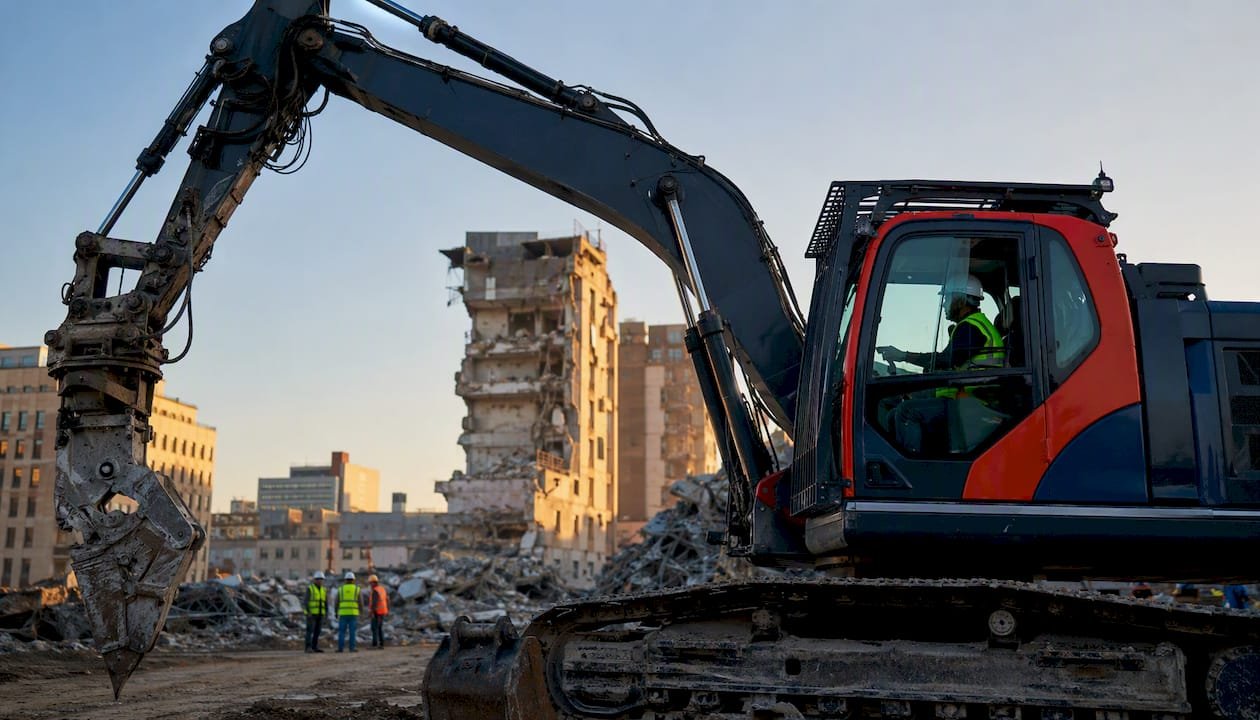
Attachments and what they do
The attachment is what actually breaks the structure, and the right choice depends on the material being demolished:
- Concrete pulverisers crush reinforced concrete and separate rebar from aggregate, making material segregation at ground level far easier.
- Hydraulic shears cut structural steel sections, beams and columns cleanly.
- Grapples grab and reposition large debris sections, useful for controlled placement of material into a processing zone.
- Hydraulic hammers (breakers) are used for hard, thick concrete elements where a pulveriser would be inefficient.
Quick-change hydraulic couplings cut attachment changeover time from more than 10 minutes manually to roughly one minute, which matters enormously on a project where the machine might switch between a pulveriser and a shear a dozen times in a single shift.
Pro Tip: Plan your attachment sequence before mobilisation. Knowing which attachments you need for each floor level, and in what order, lets the operator work through the top-down sequence without unnecessary stops. One poorly planned changeover can cost more time than the attachment swap itself.
Reach bands and typical machine characteristics
| Reach band | Typical use | Approximate operating weight | Common attachments |
|---|---|---|---|
| 20–30 m | 5–8 storey buildings, industrial structures | 23 tonnes | Pulveriser, hammer, grapple |
| 30 metres | 10–15 storey buildings, chimneys, stacks | 60 tonnes | Pulveriser, shear, grapple |
| — | Ultra-high structures, tall towers | 120–200 tonnes | Purpose-built attachments, shear |
Ancillary systems
Water misting rigs for dust suppression are standard on compliant Australian sites, particularly in urban areas where the EPA and local councils impose strict air quality conditions. Stability monitoring systems and tiltable cabs are factory-fitted on modern purpose-built rigs, giving the operator real-time feedback on machine lean and improving sightlines to the work face. Temporary works, including engineered compacted pads or shoring, are often needed before the machine even arrives, because a 200-tonne rig on soft or uneven ground is a serious tipping risk.
How does the high reach demolition process work, step by step?
Preparatory stage
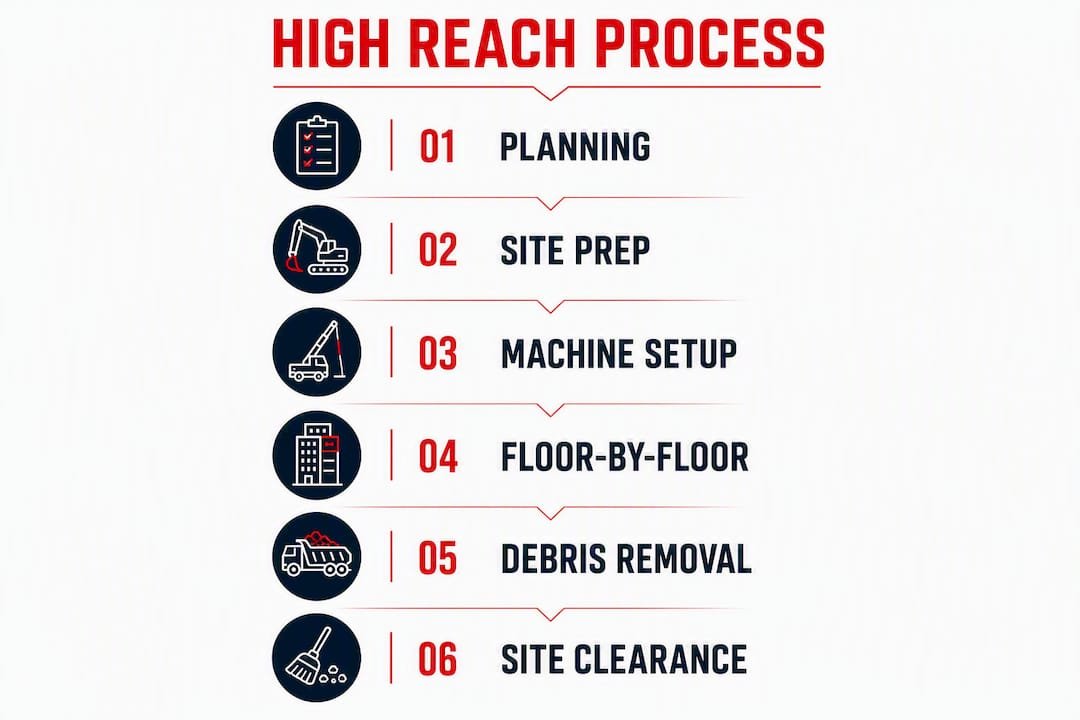
Nothing moves on site until the paperwork is right. A licensed structural engineer surveys the building, analyses the load path, and produces an engineered demolition plan. That plan, per industry guidance, must specify ramp and embankment sizing, the time sequence of demolition, machine characteristics, exclusion zones and debris fall zones. Asbestos surveys happen at this stage too, and any licensed asbestos removal is completed before structural demolition begins.
On-site sequence
- Site setup and exclusion zones. Hoarding, fencing and signage are erected. Exclusion zones are established and communicated to all workers and any neighbouring occupants.
- Machine positioning and ground preparation. The high reach excavator is positioned on its engineered pad. Ground-bearing capacity is confirmed against the rig’s operating weight.
- Roof and top-floor removal. The operator begins at the highest point, using the appropriate attachment to break and remove roof structure and the top floor systematically.
- Floor-by-floor dismantling. Each floor is removed in sequence, working downward. The machine repositions as needed, always maintaining a stable working platform and clear debris fall zone.
- Material segregation at ground level. Concrete, steel, timber and other materials are sorted into separate stockpiles as they reach the ground. This is where recycling rates are won or lost.
- Secondary processing. A crusher or secondary excavator processes concrete rubble on site, reducing haulage volume and increasing the proportion of material that can be recycled.
- Demobilisation and site clearance. Once the structure is down to ground level, the high reach rig is removed and conventional plant completes the slab removal and site clean.
Pro Tip: Modern purpose-built rigs include tiltable cabs and camera systems that let the operator see the work face clearly at full reach. If a contractor is running a high reach machine without a camera system or stability monitor on a complex urban site, that is worth questioning before you sign a contract.
Typical phasing timeline
A small urban project (5–8 storeys) might run from mobilisation to demobilisation in four to eight weeks. A mid-size project (10–15 storeys) commonly takes three to five months, depending on asbestos removal, permit lead times and secondary processing volume. Large or complex structures can extend well beyond that. These are indicative ranges; actual schedules depend heavily on site access, ground conditions and the scope of preparatory works.
Safety checkpoints run throughout: exclusion zones are verified at the start of each shift, spotters are positioned to monitor debris fall, debris netting is maintained, and plant stability is checked whenever the machine repositions.
When should you choose high reach over other demolition methods?
Height alone does not determine method choice. A feasibility study must consider ground conditions, neighbouring property risks and the working space available to the machine before any method is selected.

Method comparison
| Dimension | High reach | Long reach | Implosion (explosive) | Manual / deconstruction |
|---|---|---|---|---|
| Height reach | 20 metres | Typically under 20 m horizontal | Unlimited (structure-dependent) | Any height (slow) |
| Typical attachments / breaking force | Pulveriser, shear, grapple, hammer | Bucket, grapple, cutter | Explosive charges | Hand tools, small plant |
| Best for | Multi-storey buildings, chimneys, constrained urban sites | Low structures, waterside work, trenching | Large isolated structures with clearance | Heritage, selective, high-value material recovery |
| Site footprint and access | Moderate; needs engineered ground pad | Moderate; needs horizontal clearance | Large exclusion zone required | Minimal footprint |
| Speed / efficiency | Fast for height; attachment changes add time | Fast for horizontal work | Very fast demolition phase; long prep | Slow |
| Safety / temporary works | Workers off structure; engineered pad required | Workers off structure | Complex blast design; evacuation required | Workers on structure; highest exposure |
| Environmental controls | Integrated dust suppression; good segregation | Limited dust control | Dust and vibration spike at blast | Best material recovery; low dust |
Decision checklist
- Is the structure above 20 metres? High reach is likely the most practical ground-based option.
- Are neighbouring buildings within close proximity? High reach gives precision that explosives cannot.
- Is the ground stable enough to support a rig of 23–200 tonnes? If not, temporary works are needed before any method is viable.
- Does the project have material recycling or waste diversion targets? High reach with staged segregation outperforms most alternatives.
- Is there enough working space for the machine footprint and debris fall zone? If not, a feasibility study may point to partial manual deconstruction first.
What are the safety obligations and approvals for high reach demolition in Australia?
A licensed structural engineer assessment and written engineered demolition plan are mandatory before any high reach work begins. The plan must include load-path analysis, exclusion zone specifications, machine characteristics and a sequenced time schedule. No reputable contractor starts without it, and no council or WHS regulator will accept a demolition notification without one.
Documents and approvals typically required in Australia
- Council demolition permit: required in most local government areas before structural demolition begins; lead times vary from two to six weeks depending on the council and project complexity. Missiondemolition’s guide to demolition permits in Sydney covers the documentation requirements in detail.
- WHS demolition notification: under the Work Health and Safety Regulations, demolition work above a threshold height must be notified to the relevant state regulator (SafeWork NSW, WorkSafe Victoria, and equivalents in other states) before work starts.
- Asbestos survey and licensed removal: any structure built before 1990 in Australia must be surveyed for asbestos-containing materials before demolition. Where asbestos is found, licensed asbestos removal by a Class A or Class B licensed contractor is required before structural work proceeds.
- Traffic management and road opening permits: urban sites often require a traffic management plan and, where plant or haulage crosses a road reserve, a road opening permit. For Victorian projects, the road opening permit process involves specific compliance steps worth understanding early.
- Environmental controls documentation: dust, noise and vibration management plans are required by most councils and by EPA guidelines in urban areas. Water misting, hoarding and vibration monitoring are standard controls.
Allow at least four to eight weeks for the full permit and approval cycle on a straightforward urban project. Complex sites, heritage overlays or sites near sensitive receivers can take considerably longer. Starting the permit process before finalising the contractor appointment is one of the most effective ways to avoid schedule blow-outs.
What are the benefits and limitations of high reach demolition?
Primary benefits
The single biggest safety advantage is that workers stay off the partially demolished structure throughout the process. Historically, working on unstable, partially demolished buildings has been a leading cause of demolition fatalities and serious injuries in Australia. High reach eliminates that exposure entirely.
Precision is the second major advantage. In a tight Sydney street where the neighbouring terrace sits two metres from the party wall, a high reach machine can remove structure selectively without transmitting the kind of shock loading that manual breaking or explosives would generate. The operator controls the attachment force and placement directly.
Material segregation and recycling improve substantially when the top-down sequence is planned with material streams in mind. Concrete rubble, structural steel and other materials are separated as they come down, rather than being mixed in a pile and sorted later. Integrated dust suppression keeps the site compliant and reduces the health risk to workers and neighbours.
Limitations and constraints
Ground stability is the constraint that catches projects off guard most often. Rigs weighing up to 200 tonnes require engineered, compacted support pads or temporary shoring, and that preparation adds cost and time before the first attachment swing. Transport logistics for large rigs are also significant: a 120-tonne machine requires a multi-axle low-loader and often requires a traffic management plan just for delivery.
Noise and vibration are real constraints on sites near sensitive receivers, particularly hospitals, schools or heritage structures. Vibration monitoring and limits on working hours are common conditions attached to urban demolition permits.
Pro Tip: Maximise recycling rates by planning secondary crushing on site rather than carting mixed rubble to a waste facility. Crushed concrete can often be reused as fill or road base on the same project, cutting both disposal costs and haulage movements.
What drives the cost and timeline of a high reach demolition project?
Cost in high reach demolition is driven by a handful of factors, and understanding them before you go to tender lets you ask the right questions and compare quotes on equal terms.
Core cost drivers
- Machine size and hourly rate: a 30-metre rig costs significantly less per hour than a 50-metre ultra-high reach machine. Matching machine size to actual reach requirements avoids paying for capacity you do not need.
- Site preparation and temporary works: engineered ground pads, shoring and access ramps can be a substantial pre-mobilisation cost, particularly on soft or sloped sites.
- Transport and mobilisation: moving a large rig across Sydney or interstate involves permit fees, low-loader hire and traffic management. For regional projects, mobilisation costs can rival the demolition cost itself.
- Attachments and secondary processing: on-site crushing and material processing add plant cost but typically reduce net waste disposal costs.
- Asbestos removal and permits: licensed asbestos removal is priced separately from structural demolition and must be completed first. Permit fees vary by council and project type.
Quote-request checklist
When approaching contractors, provide and request the following to get comparable estimates:
- Site address, structure type, number of storeys and approximate gross floor area
- Any known asbestos survey results or reports
- Site access constraints (street width, overhead services, neighbouring buildings)
- Desired programme (start date and completion target)
- Scope of works: does the quote include permits, asbestos removal, secondary processing and site clearance, or are these separate?
- Exclusions and provisional allowances for unforeseen ground conditions or hazardous materials
Where is high reach demolition commonly used in Australia?
Multi-storey residential flat buildings are the most common application in Australian cities, particularly in inner-Sydney, inner-Melbourne and Brisbane suburbs where older walk-up blocks are being replaced by new residential towers. The method suits these sites because the buildings are tall enough to require extended reach, the streets are too narrow for large exclusion zones, and the neighbouring properties are too close for explosives.
Commercial towers in tight CBD streets are a natural fit for the same reasons. A 12-storey office building on a 15-metre-wide city block in Sydney’s inner west is exactly the scenario high reach was developed for.
Industrial chimneys and concrete stacks present a different challenge: they are tall, narrow and often located on sites with overhead power lines or adjacent structures. High reach machines handle these well because the operator can work around the circumference of the stack progressively, controlling the fall direction of material.
Partial façade removal and selective dismantling for redevelopment are growing applications. Where a developer retains a heritage façade but demolishes the structure behind it, a high reach machine can remove internal floors and structure without touching the retained element, provided the engineered plan accounts for temporary propping of the façade.
High reach is frequently combined with other methods. A project might use high reach for the upper floors, then switch to a conventional excavator for the lower levels and slab, with a secondary crusher processing concrete rubble throughout. Missiondemolition’s commercial demolition services in Sydney cover this kind of multi-method project management.
How do you choose the right contractor for a high reach demolition project?
Questions to ask every contractor
- Can you provide a copy of your demolition licence and public liability insurance certificate?
- Will you engage a licensed structural engineer to produce an engineered demolition plan and load-path analysis before mobilisation?
- What are your operators’ qualifications and how current are their certifications?
- Can you provide plant maintenance records for the specific high reach machine proposed for this project?
- Do you have previous case studies or references for comparable projects in Australia?
- What is your recycling and material diversion target for this project, and how do you achieve it?
- Who is responsible for obtaining council permits, WHS notifications and asbestos removal, and are these included in the quoted scope?
Missiondemolition’s contractor vetting guide covers these questions in more detail for readers who want a deeper checklist.
Red flags to watch for
- No engineered demolition plan offered, or a contractor who dismisses the need for one.
- Vague scope with no clear exclusions or provisional allowances.
- Pressure to sign quickly before a site inspection or asbestos survey has been completed.
- Unwillingness to obtain permits or to segregate materials for recycling.
- Unclear or evasive answers about asbestos handling and licensed removal.
- No written method statement covering adjacent property protection.
A contractor who cannot answer questions 1 through 4 above with documentary evidence is not ready to run a compliant high reach project in Australia.
How Missiondemolition approaches high reach demolition in Australia
Missiondemolition delivers high reach and specialised demolition services across Australia, with a particular focus on Sydney and surrounding regions. Every project begins with a licensed structural engineer assessment and a written engineered demolition plan before any plant is mobilised. Asbestos management is handled in-house through Missiondemolition’s licensed asbestos removal team, which means the survey, removal and clearance inspection are coordinated as part of the overall project programme rather than managed as a separate contract.
Missiondemolition holds the licences, insurances and WHS compliance documentation that a compliant high reach project requires. The team manages council permit applications, WHS notifications, traffic management and environmental controls as part of full-service project delivery, so clients are not left coordinating multiple contractors across a complex approval pathway.
To request a site assessment, provide site photos, a copy of any existing asbestos survey or building plans, and a brief description of access constraints. The team will confirm scope, indicative programme and next steps.
Key takeaways
High reach demolition is the safest and most precise ground-based method for dismantling tall structures in constrained Australian urban sites, provided the site is properly engineered and the contractor holds the right licences.
| Point | Details |
|---|---|
| Definition and method | High reach demolition uses ground-operated excavators with extended booms to dismantle structures top-down, floor by floor. |
| Machine reach and weight | High reach excavators typically operate above 20 metres and can reach beyond 60 metres; operating weights range from roughly 23 to 200 tonnes. |
| Mandatory engineering input | A licensed structural engineer assessment and written engineered demolition plan are required before any work begins in Australia. |
| Key limitations | Ground stability and machine weight demand engineered pads; transport logistics and permit lead times add to schedule and cost. |
| Missiondemolition | Missiondemolition delivers licensed, fully managed high reach and demolition services across Australia, including asbestos removal and permit coordination. |
The case for getting the engineering right before anything else
Most of the problems I see in high reach demolition projects in Australia come from the same source: the engineering is treated as a formality rather than the foundation of the whole operation. A method statement that gets signed off without a genuine load-path analysis, or a ground assessment that underestimates bearing capacity, creates risks that no amount of operator skill can fully compensate for.
The industry has made real progress on machine technology. Stability monitoring, tiltable cabs and quick-change hydraulics have genuinely improved both safety and productivity. But the machine is only as safe as the plan it is operating within. The trend toward better recycling outcomes is also real and worth taking seriously: staged material segregation and on-site secondary crushing are no longer optional extras on a well-run project. They reduce disposal costs, cut truck movements through residential streets, and increasingly form part of the environmental conditions attached to urban demolition permits.
The practical advice is simple: insist on the engineered plan before you agree to a start date, and verify that the contractor’s structural engineer is actually licensed and independent, not a subcontractor who signs whatever the demolition company puts in front of them.
Ready to assess your site for a high reach project?
Missiondemolition is the direct alternative to managing a high reach demolition through multiple separate contractors. The team handles the full scope: licensed structural engineer coordination, engineered demolition plan, asbestos removal in Sydney, council permits, WHS notifications, plant mobilisation and site clearance, all under one contract and one point of accountability.
The concrete advantage for clients is straightforward: no gap between the asbestos contractor finishing and the demolition contractor starting, no permit delays caused by miscommunication between separate parties, and a fixed-price quote that covers the full scope rather than a base rate with a long list of provisional sums. Missiondemolition’s team is available 24/7, fully licensed and insured, and operates across Sydney and Australia.
To get a quote for your demolition project, send through site photos, any existing asbestos survey reports, building plans if available, and a brief note on access constraints. The team will come back with a scoped assessment and indicative programme.
Useful sources and further reading
| Source | What it covers |
|---|---|
| What is high reach demolition? — EDA | Industry definition, machine types and operational principles |
| High reach demolition guidelines — EDA | Best practice techniques and equipment standards for contractors |
| What machines are used for high reach demolition? — EDA | Machine characteristics, operating weights, reach ranges and safety rules |
| How to determine the necessity of high reach methods — EDA | Feasibility study criteria and method selection guidance |
| How to plan a high reach demolition project — BM Magazine | Step-by-step planning guide including engineering plan requirements |
| Hydraulics and demolition efficiency — Stucchi USA | Quick-change hydraulic couplings and attachment efficiency |
| Demolition permits Sydney — Missiondemolition | Australian permit documentation and council approval process |
| Safe demolition Sydney — Missiondemolition | WHS compliance and safe demolition practices in NSW |
| Road opening permit Victoria — Pressure Works | Road opening permit process for Victorian demolition and civil projects |
