A compliant commercial site handover after demolition delivers one thing above all else: a cleared, documented site that the incoming party can accept without legal exposure. That means the licensed contractor hands over a physical site free of visible asbestos contamination, disconnected services, and cleared waste, along with a specific set of compliance documents that prove each of those conditions has been met.
The mandatory handover documents are:
- Asbestos clearance certificate issued by an independent licensed asbestos assessor (class A removals) or a competent person (class B removals)
- Air monitoring results and lab reports where air testing was performed
- Waste transfer dockets and EPA receipts confirming lawful disposal of all demolition waste
- Utility disconnection and capping certificates for electricity, gas, water, and telecommunications
- Safe Work Method Statement (SWMS) completion sign-offs
- Final inspection report countersigned by the contractor and site supervisor
- Photographic record and annotated site plan showing slab status, service cap locations, retained structures, and boundary conditions
- Insurance certificates covering public liability and workers’ compensation
Responsibility splits across three parties. The commissioning PCBU (the property owner or developer) holds the legal duty to arrange a clearance inspection after licensed asbestos removal. The licensed demolition and asbestos removal contractor supplies waste dockets, SWMS sign-offs, and site evidence. An independent licensed asbestos assessor issues the clearance certificate for class A work. Regulators including SafeWork NSW, WorkSafe QLD, and the NSW Environment Protection Authority (NSW EPA) set and enforce these requirements. Missiondemolition operates as the licensed delivering contractor across commercial sites in Sydney and throughout Australia.
Table of Contents
- What does a compliant handover checklist actually include?
- Who is responsible for each handover item?
- How do you verify licences, assessor independence, and the documents you receive?
- How long does the process take, and what drives the cost?
- What goes wrong at handover, and how do you prevent it?
- What should a complete handover pack contain?
- How Missiondemolition delivers a compliant handover
- Key takeaways
- The handover problem nobody talks about
- Ready to engage Missiondemolition for your commercial site?
- Primary sources and regulator guidance
What does a compliant handover checklist actually include?
The checklist breaks into two categories: documents you must receive and site conditions you must physically verify.
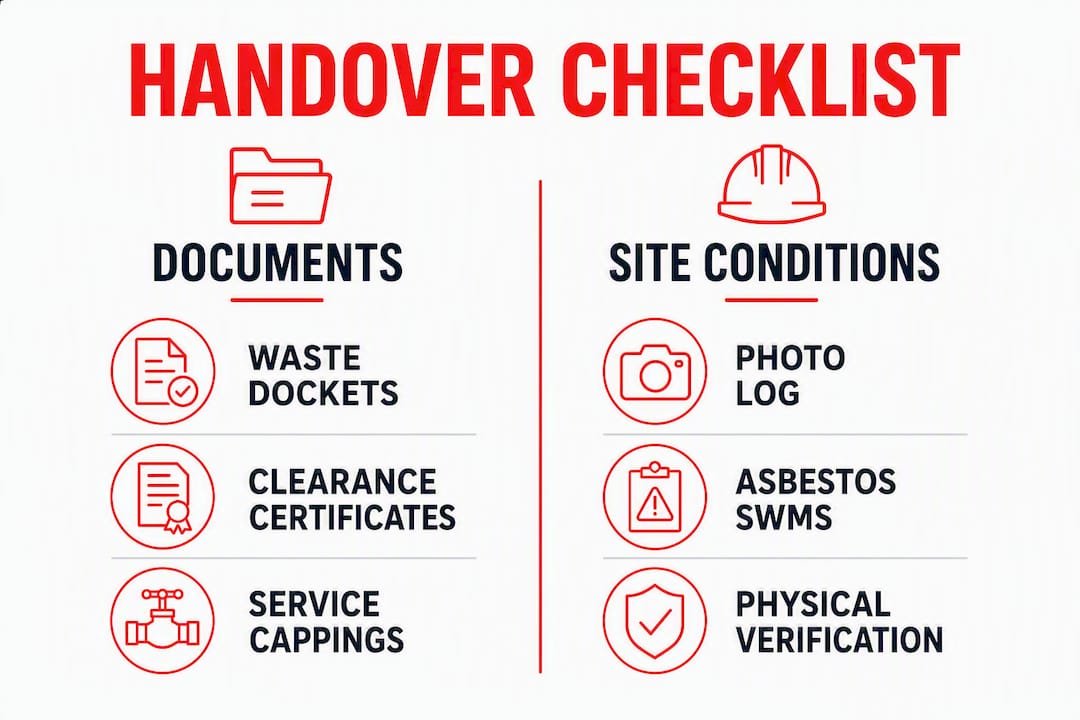
Documents to receive
| Document | Issued by | When supplied | What to check |
|---|---|---|---|
| Asbestos clearance certificate | Independent licensed asbestos assessor (class A) or competent person (class B) | After clearance inspection, before site acceptance | Assessor licence number, area description, signed declaration, lab results if air monitoring performed |
| Air monitoring report | Licensed asbestos assessor or NATA-accredited lab | Concurrent with or after class A removal | Fibre concentration results, lab accreditation number, chain of custody |
| Waste transfer dockets | Licensed waste carrier | On each load departure | Carrier licence, waste stream description, receiving facility name |
| EPA disposal receipts | Licensed waste facility | Within days of disposal | Facility EPA licence, waste classification, tonnage |
| Utility capping certificates | Licensed service authority or plumber/electrician | On isolation completion | Service type, capping location, certifier licence number |
| SWMS completion sign-off | Site supervisor or principal contractor | On work completion | Signatures, date, scope description |
| Final inspection report | Contractor and/or independent inspector | At practical completion | Scope coverage, outstanding items, signatures |
| Photographic record | Contractor | Throughout and at completion | Timestamps, GPS tags, coverage of slabs, caps, boundaries |
| Insurance certificates | Contractor’s insurer | Before work commences, updated at handover | Policy number, coverage amounts, expiry date |
Site condition items to verify physically
- Residual hazards flagged with location markers and noted in the inspection report
- Retained structural elements (slabs, footings, party walls) clearly identified on the annotated plan
- Temporary fencing and hoarding left in place or removed per the agreed scope
- Service cap markers visible and consistent with the capping certificates
- No visible asbestos debris, dust, or contaminated soil on the cleared area
Pro Tip: Insist on a sequential, timestamped photo log rather than a single end-of-job album. High-resolution, geotagged images taken progressively through the work, including shots of each service cap, slab edge, and waste load, give you a defensible baseline if a latent condition dispute arises later.
The Safe Work Australia demolition code requires asbestos identification and a SWMS for any demolition work likely to disturb asbestos, so both documents must appear in every commercial handover pack where asbestos was present or suspected.
Who is responsible for each handover item?
Legal responsibility is not evenly shared, and confusing it is one of the most common reasons handovers stall.

The commissioning PCBU (the property owner, developer, or principal contractor who engaged the demolition firm) carries the primary duty to arrange a clearance inspection after licensed asbestos removal work. That duty cannot be delegated away by contract. The PCBU must also notify the relevant regulator before demolition begins and confirm that only licensed contractors perform licensed work.
The licensed demolition and asbestos removal contractor must perform the physical work, supply waste transfer dockets and EPA receipts, provide SWMS sign-offs, and cooperate fully with any independent assessor appointed to conduct the clearance inspection. The contractor cannot issue their own asbestos clearance certificate for class A work.
The independent licensed asbestos assessor conducts the clearance inspection and issues the certificate. For class A removals, SafeWork NSW’s code of practice is explicit: the assessor must hold an asbestos assessor licence, must be independent of the removalist, and must conduct both the visual inspection and any required air monitoring. For class B removals, a competent person (who may be employed by the contractor) can issue the certificate, but independence is still strongly recommended.
The incoming builder or next contractor takes on site risk from the moment they sign the handover form. That acceptance implies they have reviewed the documentation and are satisfied with the site condition.
Accepting a handover without sighting the asbestos clearance certificate and waste dockets transfers liability for any residual contamination to the incoming party. Regulators can issue improvement or prohibition notices against a competent person who issues a clearance certificate improperly, and can direct the removalist to remediate. Do not accept handover on a verbal assurance that paperwork is “on the way.”
How do you verify licences, assessor independence, and the documents you receive?
Run this four-step check on handover day, not after you’ve signed.
-
Step 1 — Contractor licences: Ask for the demolition contractor licence class and the asbestos removal licence (class A or B as applicable). Cross-reference the licence number against the relevant state regulator’s public register. Confirm the ABN/ACN matches the entity named on the contract. Check that public liability and workers’ compensation insurance certificates are current and cover the project value. The demolition contractor vetting guide outlines exactly what licence classes to look for by state.
-
Step 2 — Assessor independence: The asbestos assessor must hold a current asbestos assessor licence (for class A work). Confirm the assessor’s name and licence number do not match any director, employee, or subcontractor of the removalist. Recognised qualifications include CPCCDE5001 and occupational hygiene credentials from bodies such as the Australian Institute of Occupational Hygienists (AIOH). Ask the assessor directly who engaged them and who pays their invoice.
-
Step 3 — Clearance certificates and air monitoring: Check the certificate against the WorkSafe QLD clearance inspection requirements: it must describe the area inspected, confirm no visible asbestos contamination, and carry the assessor’s licence number and signature. Where air monitoring was performed, the report must show fibre concentration results and the NATA-accredited laboratory’s accreditation number.
-
Step 4 — Waste dockets and EPA receipts: Each docket must name the licensed waste carrier, describe the waste stream (general demolition waste, asbestos-containing material, etc.), and identify the receiving facility. The EPA receipt from the facility confirms lawful disposal. Cross-check that the waste streams on the dockets match what was removed from site. For demolition waste tracking, the carrier’s EPA licence number should appear on every docket.
Compliance documentation mistakes are one of the leading causes of site delays. The partner resource on documentation mistakes that delay handovers is worth reviewing before your handover meeting.
How long does the process take, and what drives the cost?
Typical sequencing
- Asbestos removal and clearance inspection — (1–5 days for removal; clearance inspection same day or next day; lab results 24–72 hours for air monitoring).
Where the programme allows, scheduling asbestos removal concurrent with soft strip in unaffected areas can save meaningful time without compromising safety.
Primary cost drivers
- Asbestos scope and class: class A (friable) removal costs significantly more than class B (non-friable) due to containment, PPE, and independent assessor requirements.
- Air monitoring and lab testing: required for all class A work; adds cost proportional to the number of samples and turnaround time required.
- Waste volumes and disposal distance: heavier or more contaminated loads, and sites further from licensed facilities, increase haulage and tipping fees.
- Slab and footing retention or removal: leaving a slab in place is cheaper short-term but may require a structural engineer’s report for the incoming builder.
- Unexpected finds protocol: if suspected asbestos is encountered during demolition, work must stop, the area must be sealed, and an occupational hygienist engaged for sampling and identification before work resumes. Budget a contingency for this.
- Independent assessor fees: non-negotiable for class A work; typically charged per inspection visit plus travel.
What goes wrong at handover, and how do you prevent it?
The most common failures on commercial sites are predictable and avoidable.
- Incomplete asbestos clearance: the removalist issues a certificate without an independent assessor, or the certificate covers only part of the affected area. Prevention: specify in the contract that class A clearance must be issued by an independently engaged licensed asbestos assessor, named before work begins.
- Incomplete service isolation: power or water is turned off at the meter but not capped at the building line. Prevention: require capping certificates that identify the physical capping point, not just a disconnection notice. Builders commonly reject handover when this document is missing.
- Missing waste dockets: the contractor cannot produce dockets for all loads. Prevention: require progressive submission of dockets as loads leave site, not a bundle at the end.
- Inadequate photographic records: a handful of wide-angle shots taken on a phone. Prevention: specify in the contract that photos must be timestamped, geotagged, and cover each service cap, slab edge, retained structure, and boundary condition.
- Ambiguous end-condition: the contract says “demolish to ground level” but does not specify whether the slab is to be removed. Prevention: define the end-condition precisely in the scope of works.
- Assessor conflicts of interest: the person issuing the clearance certificate is employed by or financially connected to the removalist. Prevention: appoint the assessor directly, or require the contractor to name the assessor for your approval before work starts.
Pro Tip: Include a clause along these lines in your demolition contract (seek legal review before use): “The contractor must supply, prior to practical completion, a handover pack comprising [list each document]. The asbestos clearance certificate for any class A removal must be issued by a licensed asbestos assessor engaged independently of the removalist and approved in writing by the principal prior to commencement of removal works.”
Red flags when vetting contractors: no licence numbers on quotes, vague or missing disposal records, refusal to name the independent assessor, and pressure to accept handover before documentation is complete. A licensed demolition company will never resist providing these details.
What should a complete handover pack contain?
A well-structured handover pack removes ambiguity for the incoming builder and protects the owner if a dispute arises later. Here is the full list of items to demand:
- Asbestos clearance certificate(s) with assessor licence number and signed declaration
- Air monitoring report and NATA-accredited lab results (where applicable)
- Waste transfer dockets for all loads, including asbestos-containing material
- EPA disposal receipts from the receiving facility
- Utility capping certificates for each service (electricity, gas, water, telecommunications)
- SWMS completion sign-off signed by the site supervisor
- Final inspection report covering the full demolition scope
- Sequential, timestamped photographic record with GPS tags
- Annotated site plan showing slab status, retained structures, service cap locations, and boundary conditions
- Insurance certificates (public liability, workers’ compensation) current at handover date
- Unexpected finds documentation (if applicable) including hygienist reports and amended removal plans
- Project Area Handover Form for each progressively handed-back area, where staged handover applies
For staged handovers, each area should be documented separately with its own clearance certificate and photo set before the next stage begins. This approach, used in formal demolition work plans, prevents disputes about which area was accepted and when.
Sample contract clause prompt: Require the contractor to submit the handover pack at least 48 hours before the proposed handover date so you have time to review documents before signing the acceptance form.
Industry practice confirms that builders who receive waste records, service capping certificates, and a sequential photo log at handover proceed without delay. Those who do not typically conduct their own validation, which adds time and cost to the programme.
How Missiondemolition delivers a compliant handover
Missiondemolition manages every element of the handover process for commercial clients across Sydney and throughout Australia, so owners and developers receive a complete, compliant pack without chasing individual contractors for missing documents.
The services that map directly to the handover checklist include:
- Licensed class A and class B asbestos removal with independent assessor coordination arranged before work begins
- Waste management with progressive docket submission and EPA receipts for all loads
- Utility disconnection and service capping with certificates
- SWMS preparation, sign-off, and retention
- Sequential, geotagged photographic records throughout the project
- Final site clean and demobilisation
- Assembly of the complete handover pack in a single document set
For class A asbestos work, Missiondemolition arranges the independent licensed asbestos assessor directly, confirms their independence from the removal team, and coordinates the clearance inspection and lab testing so results are available before handover is proposed. The team operates with full public liability and workers’ compensation insurance, and 24/7 project management support means site managers can reach someone when a documentation question arises at short notice.
To get a quote or discuss your commercial site’s specific requirements, contact Missiondemolition through the professional demolition services page or call directly. Have the site address, known asbestos history, required end-condition, and planned next works ready when you call.
Key takeaways
A compliant commercial site handover requires the commissioning PCBU to hold a complete document pack, including an independently issued asbestos clearance certificate, waste dockets, capping certificates, and a timestamped photographic record, before signing any acceptance form.
| Point | Details |
|---|---|
| Asbestos clearance independence | Class A clearance certificates must come from a licensed assessor who is independent of the removalist — this is a legal requirement, not a preference. |
| PCBU holds the duty | The commissioning party, not the contractor, is legally responsible for arranging the clearance inspection after licensed asbestos removal. |
| Waste dockets are non-negotiable | EPA receipts and waste transfer dockets must cover every load; missing dockets are the most common reason builders reject handover. |
| Define the end-condition in writing | Specify slab removal, service capping points, and retained structures in the contract scope before work begins to avoid disputes at handover. |
| Missiondemolition | Manages licensed asbestos removal, independent assessor coordination, waste receipts, and the full handover pack for commercial sites across Sydney and Australia. |
The handover problem nobody talks about
Most handover failures on commercial sites are not caused by bad contractors. They are caused by owners and developers who accept verbal assurances instead of documents, and by contracts that describe the work without defining the end-condition.
The pattern repeats: a demolition contractor completes the physical work competently, but the clearance certificate is issued by someone on their own payroll, the waste dockets cover only two of the five loads, and the “photos” are twelve wide-angle shots taken from the street. The incoming builder arrives, flags the gaps, and the programme stalls while everyone argues about who is responsible for the missing paperwork.
The fix is not complicated. Appoint the independent asbestos assessor yourself, or require written approval of the assessor before removal begins. Require progressive docket submission. Specify geotagged photos in the contract. Define the physical end-condition precisely. These four steps resolve the vast majority of handover disputes before they start.
What I see less often, but matters just as much, is the unexpected finds clause. Commercial sites regularly turn up asbestos that was not on the original register. Without a contractual protocol that stops work, seals the area, and engages a hygienist, the contractor has no clear path forward and the owner has no protection. Build it into the scope from day one.
Ready to engage Missiondemolition for your commercial site?
Missiondemolition gives commercial property owners and developers in Sydney a single point of contact for the entire post-demolition handover process: licensed asbestos removal, independent assessor coordination, waste management with EPA receipts, service capping, and a complete handover pack delivered before you sign anything.
Before you call or submit an enquiry, have these details ready: site address, any known asbestos history or existing asbestos register, the required end-condition (slab in or out, retained structures), and the planned next works and programme dates.
Visit the commercial demolition services page or the licensed demolition contractors page to review credentials and submit an enquiry. The team responds within one business day and can mobilise quickly for time-sensitive commercial programmes.
Primary sources and regulator guidance
Keep the original certificates and disposal dockets as part of the permanent project record. These documents are the primary sources that support each checklist item above:
- Clearance inspections — Asbestos Queensland (WorkSafe QLD): mandates independent assessor for class A clearance, defines certificate content requirements, and sets out enforcement powers for improper certificates.
- How to safely remove asbestos — Code of Practice 2021 (WorkSafe QLD): includes a sample clearance certificate template (Appendix D) and air monitoring requirements.
- How to safely remove asbestos — Code of Practice (SafeWork NSW): confirms PCBU duty to commission independent assessor for class A work and assessor licence requirements.
- Model Code of Practice: Demolition work (Safe Work Australia): covers SWMS requirements, asbestos identification before demolition, and utility isolation documentation.
- Work Health and Safety Regulations 2011 — Regulation 474 (AustLII): the legislative basis for clearance certificate requirements under the national WHS framework.
- Non-friable asbestos clearance certificate template (SafeWork NSW): shows the required fields for a class B clearance certificate, useful for checking that a received certificate is complete.
Recommended
- Professional Site Clearance Sydney: Preparing Your Land with MissionDemolition – My Blog
- Commercial Demolition in Sydney: Planning Permits and Expert Contractors Guide – My Blog
- Demolition contractor vetting criteria: 2026 guide
- Demolition Permits Sydney | Complete Guide by MissionDemolition – My Blog
