Targeted wet suppression at source, combined with near-source extraction and operator isolation, is the fastest effective route to controlling demolition dust on Australian sites. Before the first hammer swings, confirm your asbestos survey is complete, operators are in enclosed filtered cabs or fitted with appropriate respiratory protective equipment (RPE), and targeted wetting is running at every cutting and breaking point. Respirable crystalline silica (RCS) is the primary health hazard, and Safe Work Australia sets a workplace exposure standard (WES) of 0.05 mg/m³ as an 8-hour time-weighted average for RCS. That limit is not a target to approach — it is a ceiling you must stay well below.
Immediate priorities for any demolition start:
- Confirm asbestos survey and clearance before breaking any material
- Isolate equipment operators in enclosed, filtered cabs or supply fit-tested RPE
- Start targeted wetting at all cutting, coring, and breaking points before work begins
- Set up local extraction at any enclosed or semi-enclosed work area
- Notify neighbours and relevant authorities per EPA Victoria requirements
Statistic callout: The WES for RCS in Australia is 0.05 mg/m³ (8-hour TWA) — half the previous standard, reflecting updated evidence on silicosis risk at lower exposure levels.
Key takeaways
Effective demolition dust control on Australian sites requires source reduction, wet suppression, extraction, and documented monitoring working together — no single method is sufficient on its own.
| Point | Details |
|---|---|
| RCS is the primary hazard | The WES for respirable crystalline silica is 0.05 mg/m³ (8-hour TWA); controls must keep exposures below this limit. |
| Source control first | Hydraulic low-vibration tools and pre-wetting reduce dust generation before suppression is needed. |
| Combine wet suppression and extraction | Misting with surfactant dosing plus local exhaust ventilation captures what wetting alone misses. |
| Monitor and document | Personal air sampling by a NATA-accredited lab, with records retained for at least 30 years, is required for compliance. |
| Missiondemolition | Provides end-to-end demolition and licensed asbestos removal with dust management plans, monitoring, and compliance documentation built in. |
Table of Contents
- Why demolition dust is a serious health and legal issue in Australia
- The control hierarchy for demolition dust: choosing the right method
- Wet suppression options and when each one works best
- How containment and local extraction stop dust spreading off-site
- Demolition practices that cut dust generation at the source
- Respirators and PPE: the last line of defence for workers
- Air monitoring for RCS: when to test and how to interpret results
- Budgeting for dust control: the main cost drivers
- Site-ready checklist: deploying dust control on a demolition job
- How Missiondemolition implements dust control on real projects
- The trade-offs site managers actually face in the field
- Missiondemolition: end-to-end dust control and demolition compliance
- Sources
Why demolition dust is a serious health and legal issue in Australia
RCS exposure causes silicosis, an irreversible and potentially fatal lung disease, and the risk is highest during demolition because breaking, cutting, and crushing concrete, brick, and sandstone generates fine particles that stay airborne long after the visible dust cloud settles. Australian regulators have tightened enforcement significantly in recent years, and the duty to control RCS exposure now sits firmly with the person conducting a business or undertaking (PCBU).
Safe Work Australia and state WorkSafe bodies require employers to apply the hierarchy of controls to manage dust exposure, keeping RCS below the WES. WorkSafe Victoria’s task-based guidance gives specific control examples for demolition and construction activities, and non-compliance can result in prohibition notices, fines, or prosecution. EPA Victoria adds a separate layer: businesses must control dust that affects the surrounding community, respond to complaints, and in some cases notify neighbours before starting high-dust activities.
Beyond silica, demolition dust can carry asbestos fibres, lead paint particles, and other contaminants from older structures. A pre-demolition asbestos survey is not optional — it is a legal requirement before any structural work begins, and the presence of asbestos changes both the control methods and the licencing requirements. HSE research (RR1202) found that water suppression reduced RCS exposures during demolition but was only partially effective without consistent water supply and complementary controls, which underlines why a single-method approach is rarely sufficient.
The key Australian authorities to know:
- Safe Work Australia — national policy and model WHS laws, including the WES for RCS
- WorkSafe Victoria / state WorkSafe bodies — enforcement, task-level guidance, and licensing
- EPA Victoria / state EPAs — community dust obligations, stormwater, and permit requirements
The control hierarchy for demolition dust: choosing the right method
The most effective approach matches controls to the specific task and material, rather than applying one technology across the whole site. The hierarchy of controls, adapted for demolition, runs from most to least effective:
- Elimination/substitution: remove the dusty material before work starts (pre-demolition strip-out, wet-down stockpiles), or substitute a high-dust method for a lower-dust one (hydraulic splitting instead of percussive breaking)
- Engineering controls: local exhaust ventilation (LEV), on-tool water suppression, misting cannons, enclosed cabs, negative-pressure enclosures
- Administrative controls: task rotation to limit individual exposure duration, scheduling dusty work away from other trades, community notification, monitoring programmes
- PPE: fit-tested respirators, coveralls, and eye protection as the last line of defence
In practice, demolition sites almost always need a combination. Concrete breaking with a hydraulic pulveriser still generates RCS; add targeted wetting and you reduce the plume significantly. Add local extraction at the point of impact and you capture what wetting misses. Isolate the operator in a filtered cab and you protect the person closest to the source. Each layer addresses a gap the previous one leaves.
Short use-case guide:
- Concrete breaking/demolition: hydraulic tools + targeted wetting + enclosed cab
- Soft strip (plasterboard, insulation): LEV with HEPA filtration + RPE + containment sheeting
- Concrete cutting/coring: on-tool water delivery or shroud-and-vacuum dust collection system (VDCS) + RPE
- Material relocation: wet material before moving, minimise drop heights, cover loads
Wet suppression options and when each one works best
Finely dosed wetting — mist rather than coarse spray, with surfactant added for hydrophobic fine particles — is highly effective at knocking down RCS-sized particles when applied correctly and consistently. The key word is consistently: HSE RR1202 found that intermittent or insufficient water supply undermined suppression performance on demolition sites.
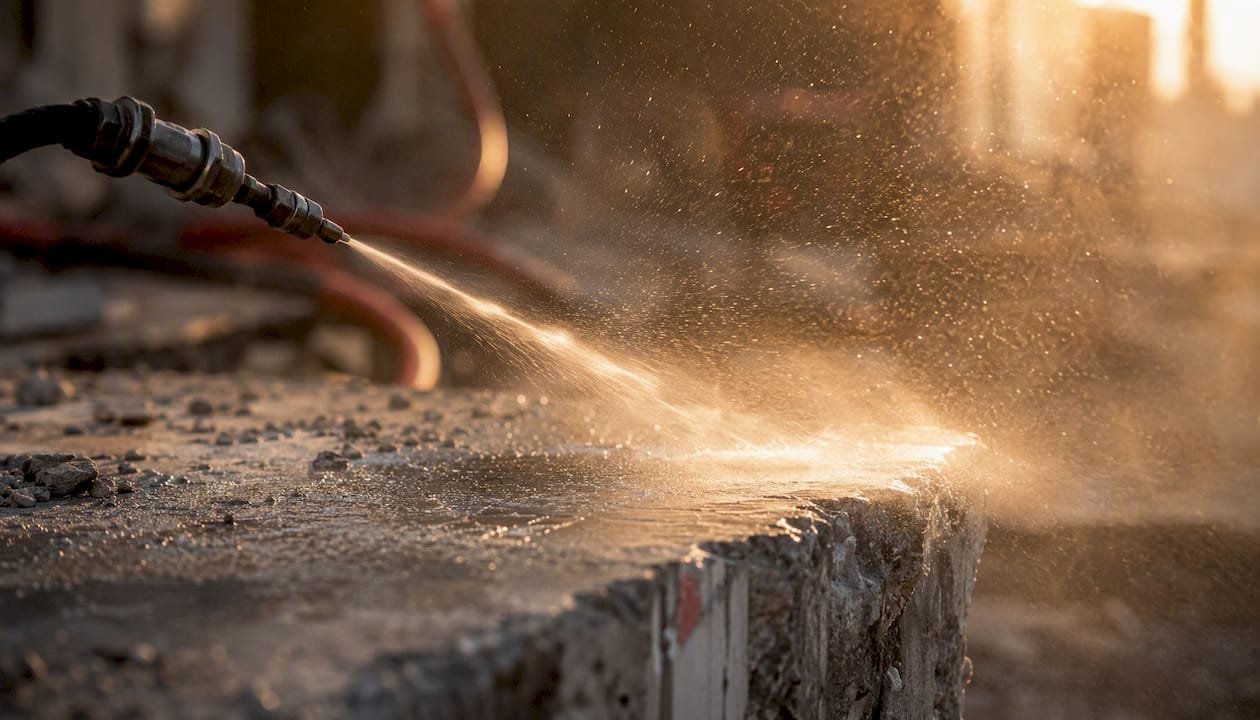
| Equipment type | Best use case | Effectiveness for fine RCS particles | Water usage | Key limitations |
|---|---|---|---|---|
| Fixed misters/ring misters | Enclosed work areas, chutes, conveyors | High (fine droplets) | Low–moderate | Wind-sensitive; needs pressurised supply |
| Mobile misting cannons (e.g. DustBoss by BossTek) | Open demolition areas, large footprints | High at close range | Moderate–high | Reduced at >20 m in wind; visibility impact |
| High-pressure foggers | Tight spaces, indoor strip-outs | Moderate–high | Low | Requires power; nozzle maintenance critical |
| Water carts/sprinklers | Haul roads, stockpiles, open areas | Low for fine RCS | High | Coarse droplets miss finest particles |
| On-tool water delivery (jackhammers, saws) | Cutting, coring, chipping at source | Very high (point of generation) | Very low | Requires tool compatibility; slurry management |
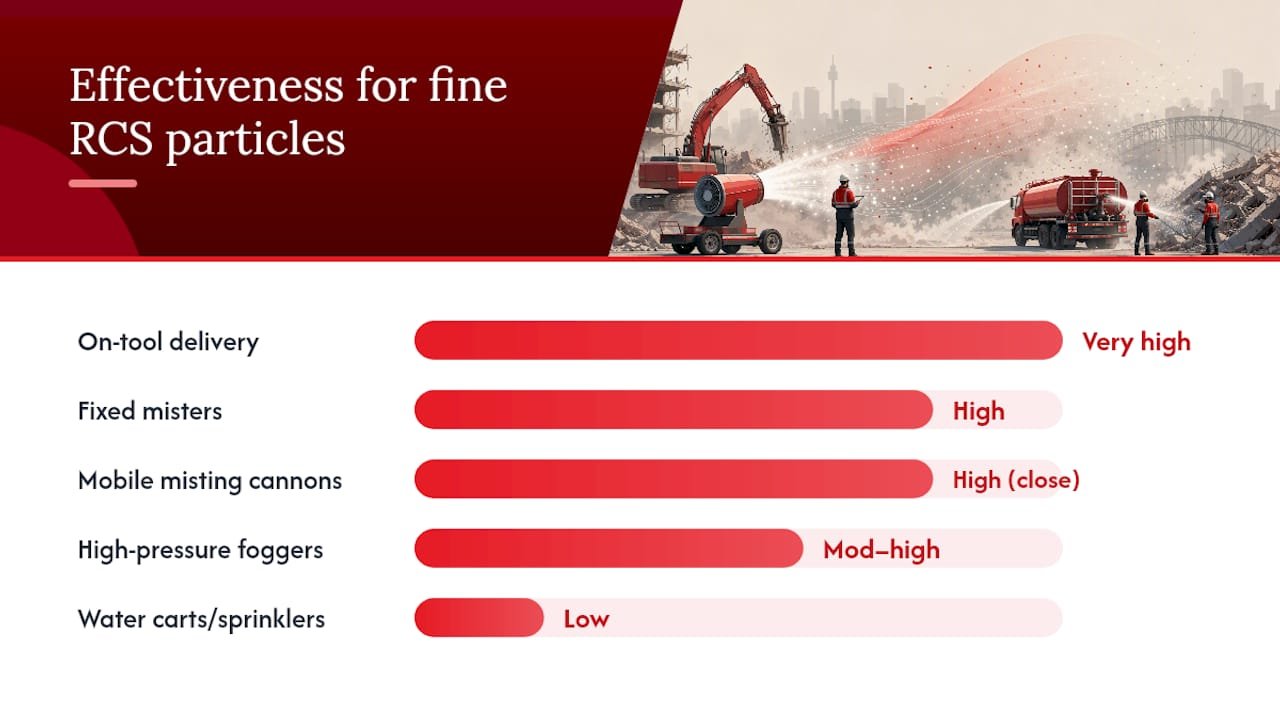
Droplet size matters. Coarse water sprays from a hose or cart produce droplets too large to capture RCS-sized particles efficiently. Mist systems generating droplets in the 10–100 micron range are far more effective for fine dust. In windy conditions, even fine mist disperses before it reaches the plume — that is when on-tool water delivery or physical containment becomes the better primary control.
Frontiers research (2022) found that adding surfactants to misting systems materially improves droplet wettability and increases fine-particle knock-down compared with plain water alone. Fine demolition dust, particularly from concrete and sandstone, is often hydrophobic — plain water beads off rather than binding the particle. A dosing pump adding a small concentration of surfactant to the misting supply changes that interaction significantly. On sites where water alone is not achieving visible plume suppression, surfactant dosing is worth trialling before scaling up water volume.
Environmental note: wetting generates slurry and runoff. Under Australian requirements, stormwater from demolition sites must be managed to prevent discharge of sediment and contaminants. Plan for bunded work areas, sediment traps, and appropriate disposal of slurry. US EPA guidance on demolition stormwater provides useful technical background on best-management practices, though Australian state EPA requirements govern locally. Dustquip supplies a range of dust suppression equipment suited to Australian demolition sites, including misting systems and water carts configured for local conditions.
How containment and local extraction stop dust spreading off-site
Containment combined with local extraction prevents dust from reaching non-involved workers and neighbouring properties — two of the most common enforcement triggers for Australian demolition sites. The goal is to create a zone where dust is generated, captured, and removed before it can migrate.
Containment options by situation:
- Full enclosures with negative pressure: most effective for high-risk indoor strip-outs or asbestos-adjacent work; air is drawn through HEPA-filtered units and exhausted away from occupied areas
- Curtain hoardings and scaffold sheeting: standard for street-facing demolition; reduces wind-driven dust migration and provides a physical barrier for neighbours
- Temporary cabins and shrouds: used around specific cutting or coring points to capture dust at the source before it disperses
- Local capture hoods and on-tool shrouds: fitted directly to angle grinders, core drills, and chasing tools; most effective when the capture gap is small and airflow matches particle load
Pro Tip: When running negative pressure enclosures, always route exhaust through a HEPA-filtered unit and discharge away from any occupied area or air intake. Verify the pressure differential with a simple manometer check at the start of each shift — a positive reading means the enclosure is not working as intended.
OSHA guidance for heavy equipment during demolition recommends enclosed, positively pressurised filtered cabs and water sprays or atomised mist for areas where other workers are present. That principle applies equally on Australian sites: machine operators in excavators, skid steers, and demolition rigs should be in enclosed cabs with filtered air supply wherever practicable.
Material handling is a frequently overlooked dust source. Dropping demolished material from height generates significant dust plumes even when the primary breaking work is well-controlled. Keep drop heights to a minimum, wet material before relocation, and cover skip bins and truck loads before moving them off-site. For guidance on compliant demolition waste removal, including slurry and contaminated material handling, site managers should confirm disposal routes before work starts.
Demolition practices that cut dust generation at the source
Selecting low-impact tools and sequencing work carefully reduces dust generation more effectively than trying to suppress large plumes after they form. This is the substitution step in the control hierarchy, and it is often underused on Australian demolition sites.
Darda’s industry guidance recommends a multi-stage approach: near-source wetting, capture extraction, shielding, and adapted working methods, with hydraulic low-vibration tools producing significantly less airborne RCS than percussive alternatives. Hydraulic pulverisers, concrete splitters, and shears fracture material with controlled force rather than impact energy, which means fewer fine particles become airborne in the first place.
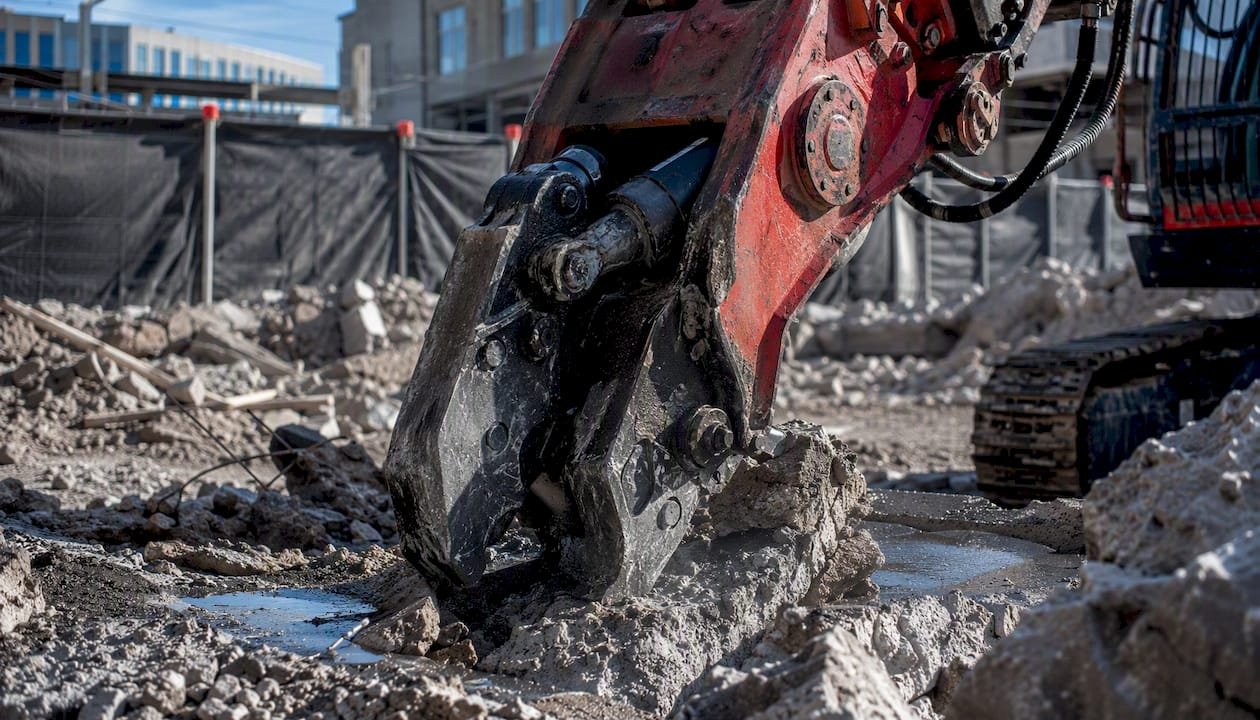
Practical sequencing steps:
Pre-wet before breaking. Saturating concrete or masonry before demolition reduces the dust generated at fracture. This is most practical for smaller elements — columns, beams, walls — where water can penetrate before work starts.
Cut before breaking. Defining break lines with a diamond saw (with on-tool water) before using a pulveriser or hydraulic breaker reduces uncontrolled fracture and the associated dust plume. OSHA’s fact sheet on jackhammers and powered chipping tools recommends continuous water at the point of impact or a shroud with vacuum dust collection as the primary controls for powered hand tools.
Stage demolition to limit exposed surfaces. Breaking an entire floor slab at once exposes a large surface area of disturbed material to wind. Working in sections, wetting as you go, and removing broken material promptly keeps the active dust surface small.
Wet material before relocation. Dry broken concrete and masonry generates significant dust when loaded, transported, or tipped. A brief wetting before loading reduces this substantially.
Always confirm the presence or absence of asbestos before selecting a demolition method. Hydraulic tools are generally preferred for asbestos-containing materials because they minimise fibre release, but the method must be confirmed with your licensed asbestos removal contractor before work begins.
Respirators and PPE: the last line of defence for workers
PPE is required wherever engineering controls cannot reduce RCS exposure below the WES — and on demolition sites, that means most cutting, coring, and breaking tasks will require RPE at some point, even with good wetting and extraction in place.
RPE and PPE checklist for demolition dust:
- Respirator selection: minimum P2 (half-face) for general demolition dust; P3 full-face or powered air-purifying respirator (PAPR) for high-exposure tasks or enclosed spaces
- Fit testing: documented quantitative or qualitative fit testing for every worker wearing a tight-fitting facepiece — a respirator that does not seal provides almost no protection
- Maintenance and storage: inspect before each use, replace filters per manufacturer schedule, store in a clean sealed bag away from dust and UV
- Eye protection: safety glasses or goggles for all cutting and breaking tasks
- Coveralls: disposable coveralls for high-dust or asbestos-adjacent work; decontaminate or dispose of before leaving the work area
- Retraining schedule: fit testing and RPE training should be repeated annually or when a worker’s face shape changes (weight loss, dental work, facial hair)
Hilti Australia’s dust control guidance emphasises combining local extraction, wet methods, and correct tooling for diamond cutting and coring — RPE alone is not a substitute for engineering controls, and regulators will expect to see both.
Respirators are mandatory for enclosed work, prolonged high-exposure tasks, and any work involving asbestos or suspected asbestos-containing materials. The fit-testing requirement is non-negotiable: WorkSafe Victoria expects documented fit testing as part of a compliant respiratory protection programme.
Air monitoring for RCS: when to test and how to interpret results
Monitoring verifies that controls are working. Visual checks and dust meters give real-time feedback, but personal air sampling analysed for RCS content is what confirms compliance with the WES.
Practical monitoring steps:
- Identify high-risk tasks and locations — concrete cutting, breaking, and grinding are the priority; identify where workers spend the most time near dust sources
- Choose sampling method — personal sampling (worker wears the sampler) is the most relevant for WES compliance; area sampling identifies hotspots and informs control placement
- Set sampling frequency — sample at the start of a new task type, after any change in controls, and periodically throughout the project; do not sample once and assume conditions are static
- Use accredited laboratories — RCS analysis requires gravimetric and X-ray diffraction (XRD) methods; use a NATA-accredited laboratory for results that will stand up to regulatory scrutiny
- Interpret results against the WES — results above 0.05 mg/m³ (8-hour TWA) require immediate control review; results approaching the WES warrant tighter controls before the next sampling round
- Keep records — retain sampling results, chain-of-custody documentation, and control logs for the duration of the project and for at least 30 years (RCS-related diseases have long latency periods)
Settling and re-entrainment: RCS particles in the 1–4 micron range can remain airborne for hours after dust generation stops, particularly in still indoor air. Site clearance decisions should account for this — do not declare an area clear immediately after work stops. Allow adequate settling time, conduct a visual check, and confirm with area sampling before removing containment or allowing unprotected workers to re-enter.
WorkSafe Victoria’s crystalline silica guidance and EPA Victoria’s business dust guidance both expect documented monitoring as part of a compliant dust management plan.
Budgeting for dust control: the main cost drivers
Dust-control cost depends on method choice, project duration, water and power availability, containment requirements, and monitoring frequency. Plan for it at tender stage — ad-hoc hire and reactive monitoring are consistently more expensive than controls built into the project programme from the start.
Main cost factors:
- Equipment hire or purchase: misting cannons, LEV units, HEPA air filtration units, and water carts vary widely; mobile misting cannon hire typically runs from a few hundred to over a thousand dollars per week depending on capacity and supplier
- Water supply and drainage: connection to mains, water carting, or on-site storage tanks; bunded areas and sediment traps for runoff management
- Labour: dedicated operators for misting systems and extraction units, plus time for daily checks and maintenance
- Consumables: HEPA filters (replace on schedule, not when blocked), surfactant, PPE consumables (disposable coveralls, filter cartridges)
- Monitoring: personal air sampling and NATA-accredited laboratory analysis; budget for multiple sampling rounds on longer projects
- Permitting and notifications: EPA Victoria and local council requirements may involve application fees and community notification costs
Ballpark ranges vary significantly by project scale and location — these figures are illustrative only, and accurate budgeting requires supplier quotes and a site-specific dust management plan. Early planning also reduces the risk of programme delays caused by dust complaints or enforcement action, which can cost far more than the controls themselves.
For low-dust approaches in sensitive environments, the low-dust replacement workflow used in residential renovation contexts illustrates how containment and sequencing can minimise disruption. The same principles apply to demolition strip-outs near occupied spaces.
Site-ready checklist: deploying dust control on a demolition job
A concise sequence from pre-start to handover keeps controls in place and auditable. The checklist below can be adapted as a printed task sheet for site supervisors.
Pre-start:
- Complete risk assessment and identify all dust-generating tasks
- Obtain and review asbestos survey; confirm licensed removal if required
- Prepare written dust management plan including monitoring programme
- Check water supply, power for extraction units, and drainage/runoff controls
- Issue fit-tested RPE and brief all workers on dust hazards and controls
- Notify neighbours and relevant authorities per EPA Victoria requirements
- Confirm demolition permits and approvals are in place
During work:
| Checkpoint | Action | Frequency |
|---|---|---|
| Wetting systems | Confirm misting/on-tool water is running before work starts | Start of each shift |
| Extraction units | Check airflow, filter condition, and capture hood placement | Start of each shift |
| Enclosure integrity | Inspect sheeting, seals, and negative pressure differential | Daily |
| Runoff management | Check bunds, sediment traps, and slurry disposal | Daily |
| RPE compliance | Confirm workers are wearing correct, fitted RPE | Ongoing |
| Incident documentation | Record any dust escape, complaint, or control failure | As occurs |
Close-out:
- Wet-sweep all surfaces before final clean; never dry-sweep or use compressed air
- Conduct area air sampling and allow adequate settling time before clearance
- Archive all monitoring results, equipment maintenance records, and incident logs
- Confirm waste removal and site cleanup meets regulatory requirements
How Missiondemolition implements dust control on real projects
On a recent commercial strip-out in Sydney, Missiondemolition combined source-control tool selection, targeted misting, and full hoarding enclosure to meet compliance requirements while keeping the programme on schedule. The approach followed the active demolition methods the company uses across residential, commercial, and industrial projects.
Credentials and practices checklist:
- Licensed asbestos removal contractor with trained, certified staff
- Pre-demolition asbestos surveys completed before every structural project
- Written dust management plans prepared for each site
- Personal air sampling conducted by accredited providers and results retained
- Operators in enclosed filtered cabs for all heavy equipment work
- Misting systems and on-tool water delivery deployed at all cutting and breaking points
- Community notifications issued per EPA Victoria requirements
- Post-demolition clearance checks and monitoring records archived
Coordination with regulators is built into the project timeline, not treated as an afterthought. Maintenance routines for misting equipment, HEPA filters, and extraction units are scheduled weekly on longer projects, with records kept as part of the compliance file. For site managers looking for a licensed demolition company with documented dust-control processes, verifying these credentials before signing a contract is the single most effective risk-reduction step available.
The trade-offs site managers actually face in the field
Dust control guidance reads cleanly on paper. On site, the constraints are real: water supply is limited, wind changes direction, adjacent properties are closer than the plan assumed, and the programme is always tighter than anyone wants.
The practical priority is to protect the source first. Get wetting running at the point of generation before worrying about area-wide misting. A misting cannon covering a large footprint looks impressive, but if the on-tool water supply to the jackhammer operator is inconsistent, that worker is getting the highest exposure on site. Fix the source first, then layer area controls on top.
Weather matters more than most plans acknowledge. Fine mist in a 20-knot wind is largely wasted water. On windy days, shift to on-tool water delivery, tighten containment, and consider delaying the highest-dust tasks until conditions improve. That decision is easier to make when it is written into the dust management plan as a trigger — “if wind exceeds X km/h, switch to on-tool water and enclosed work only” — rather than left to a supervisor’s judgement under programme pressure.
Cost is always a factor, but the calculation is straightforward: a dust complaint to the EPA, a prohibition notice from WorkSafe, or a silicosis claim from a worker costs orders of magnitude more than the misting system hire. Plan the controls early, budget them properly, and treat them as a fixed project cost rather than a contingency.
Missiondemolition: end-to-end dust control and demolition compliance
Dust control compliance on Australian demolition sites requires more than equipment — it requires a contractor who has the licences, the trained staff, and the documented processes to back every decision made on site.
Missiondemolition delivers professional demolition services across Sydney and Australia with dust management built into every project from the planning stage. That means written dust management plans, pre-demolition asbestos surveys, personal air sampling, and community notifications handled as standard, not as extras. For projects involving asbestos-containing materials, the company’s licensed asbestos removal team manages the full scope from survey through to clearance certificate. To get a site-specific quote or request a pre-start assessment, contact Missiondemolition directly through the demolition services page with your site address, project scope, and any known hazardous material concerns.
Sources
Safe Work Australia, WorkSafe state bodies, and EPA Victoria are the primary compliance references for Australian demolition sites. The sources below are the most useful for site managers and safety officers building or auditing a dust management programme.
- Control dust from your business
- Preventing exposure to crystalline silica dust (WorkSafe Victoria)
- Frontiers — surfactant dosing improves wettability and dust suppression
- Respirable crystalline silica exposure during demolition activity (HSE RR1202)
- Control of silica dust in construction: heavy equipment and utility vehicles used during demolition activities (OSHA)

Cảm ơn thông tin bổ ích. Nếu bạn quan tâm du học Hàn Quốc, Letco chuyên tư vấn lộ trình, chọn trường và xin visa với tỷ lệ đậu cao. Xem chi tiết tại letco.vn.