Professional suspended ceiling removal is a licensed asbestos remediation and demolition service, not a simple renovation task. If your ceiling system was installed before 1990, contains low-density fibreboard (LDB) panels, acoustic spray coatings, or has an unknown material history, you must treat it as a potential asbestos hazard until sampling proves otherwise. The legal trigger is clear: any friable asbestos requires a Class A licence, and removal of non-friable asbestos-containing material (ACM) above a certain area requires either a Class A or Class B licence under the WHS Regulations. Hire a licensed removalist when:
- The workplace asbestos register lists ACM in the ceiling system
- Visible LDB panels, degraded tiles, or acoustic spray coatings are present
- The ceiling area exceeds 10 m² and asbestos status is unconfirmed
- Any friable asbestos is suspected anywhere in the plenum space
- Safe Work Australia guidance or your state WHS code applies to the work
Missiondemolition holds the relevant licences and carries out the full process, from inspection and asbestos removal control plan (ARC plan) through to independent clearance certificate.
Key takeaways
Licensed suspended ceiling removal requires a Class A or Class B asbestos licence for any friable ACM or non-friable ACM over 10 m², and the project is not legally complete until an independent assessor issues a written clearance certificate.
| Point | Details |
|---|---|
| Licence triggers | Friable ACM (any amount) = Class A; non-friable ACM over 10 m² = Class A or Class B minimum. |
| ARC plan is mandatory | A written asbestos removal control plan must be in place before licensed removal work starts. |
| Clearance certificate is the endpoint | Re-occupation is not permitted until an independent licensed assessor issues a written clearance certificate. |
| Retain all disposal paperwork | Waste consignment notes and disposal receipts are your legal proof of compliant handling. |
| Missiondemolition | Provides Class A/B licensed removal, ARC plan preparation, independent assessor coordination, and full disposal documentation. |
Table of Contents
- When does suspended ceiling removal become licensed asbestos work?
- What hazards are actually hiding inside a suspended ceiling?
- What does a licensed suspended ceiling removal project actually look like?
- What drives the timeline and cost of ceiling removal?
- Who is legally responsible, and what happens if duties are ignored?
- How do you choose a licensed suspended ceiling removal contractor?
- What paperwork must you receive after asbestos removal?
- Why DIY suspended ceiling removal is unsafe and often unlawful
- The part of this job most clients underestimate
- Missiondemolition: licensed suspended ceiling removal done right
- Sources
When does suspended ceiling removal become licensed asbestos work?
The threshold is set by the WHS Regulations and is straightforward in practice. A person conducting a business or undertaking (PCBU) without an asbestos removal licence may only remove a small amount of non-friable ACM. Go beyond that area, or touch any friable asbestos at all, and a licence is legally required.
- Class B licence: covers non-friable ACM removal above 10 m² (bonded materials such as fibre cement sheeting and most ceiling tiles)
- Class A licence: required for all friable asbestos, including LDB panels, acoustic spray coatings, and any material that can be crumbled by hand pressure
The SafeWork NSW Code of Practice sets out these licence thresholds, the requirement for an ARC plan, mandatory notifications to the regulator before licensed work begins, and the independent clearance inspection that must follow.
Licence threshold: Non-friable ACM over 10 m² = Class B minimum. Any friable ACM = Class A, no exceptions.
The PCBU’s duty does not stop at hiring someone. Before any disturbance, the PCBU must check the asbestos register, commission laboratory sampling where the register is absent or unreliable, and confirm the contractor’s licence class matches the material type. Assuming asbestos is absent without evidence is not a defence.
What hazards are actually hiding inside a suspended ceiling?
Suspended ceiling systems are more complex than they look from below. Asbestos NSW identifies several distinct asbestos-containing items that can be present simultaneously in a single ceiling system:
- LDB panels: soft, low-density fibreboard that releases fibres more readily than cement sheeting; identifiable by a fingernail test but must be confirmed by laboratory analysis
- Acoustic spray coatings: applied directly to structural soffits above the grid, often friable and disturbed when tiles are lifted
- Fire dampers and seals: asbestos-containing gaskets and wraps around ductwork penetrations in the plenum
- Ceiling tiles: some older mineral fibre tiles contain asbestos binders
- Plenum dust and debris: legacy asbestos fibres from decades of tile movement, pest activity, and HVAC airflow settle in the plenum and become airborne when the space is opened
Non-asbestos hazards compound the risk. Live electrical services, insulation batts, pest nesting material, and structural fixings all require management before and during removal.
Pro Tip: Before any ceiling disturbance, request a copy of the workplace asbestos register and, where it is absent or outdated, commission bulk sampling from a NATA-accredited laboratory. Sampling costs a fraction of the remediation bill if an unexpected friable material is found mid-job.
What does a licensed suspended ceiling removal project actually look like?
A compliant project follows a fixed sequence. Skipping any step creates legal exposure and leaves the site unsafe for re-occupation.
- Initial inspection and sampling. A licensed assessor or competent person inspects the ceiling system, reviews the asbestos register, and takes bulk samples for laboratory analysis where materials are unconfirmed.
- ARC plan preparation. The licensed removalist prepares a written asbestos removal control plan covering scope, methods, PPE, emergency procedures, and waste handling before work starts.
- Regulator notification. Licensed asbestos removal work requires advance notification to the relevant state WHS regulator. The notification period varies by jurisdiction.
- Site setup. Exclusion zones are established, signage posted, HVAC vents and ducts sealed, and electrical services de-energised. For large or friable removals, a full enclosure with negative-pressure air units is erected to prevent fibre migration into adjacent spaces.
- Removal. The preferred technique is wet spray: a fine mist of water, often with a surfactant or PVA emulsion, keeps ACM saturated throughout removal. Water alone is sometimes insufficient for LDB, which is why PVA is specified in the Safe Work Australia LDB guide. HEPA H-class vacuums and damp wipes handle residual contamination.
- Worker controls. Minimum PPE is a P3 full-face respirator, disposable coveralls with hood and boot covers, and gloves. A decontamination unit with a single entry and exit point is mandatory on licensed sites.
- Waste packaging. Removed material is double-wrapped in 200 µm polyethylene sheeting, labelled in accordance with GHS requirements, and transported promptly to an authorised asbestos waste facility.
- Independent clearance inspection. An independent licensed asbestos assessor, separate from the removalist, conducts a visual inspection and air monitoring. Re-occupation is not permitted until the assessor issues a written clearance certificate confirming airborne fibre concentrations are below the required limit. Learn more about what a clearance inspection involves.
What drives the timeline and cost of ceiling removal?
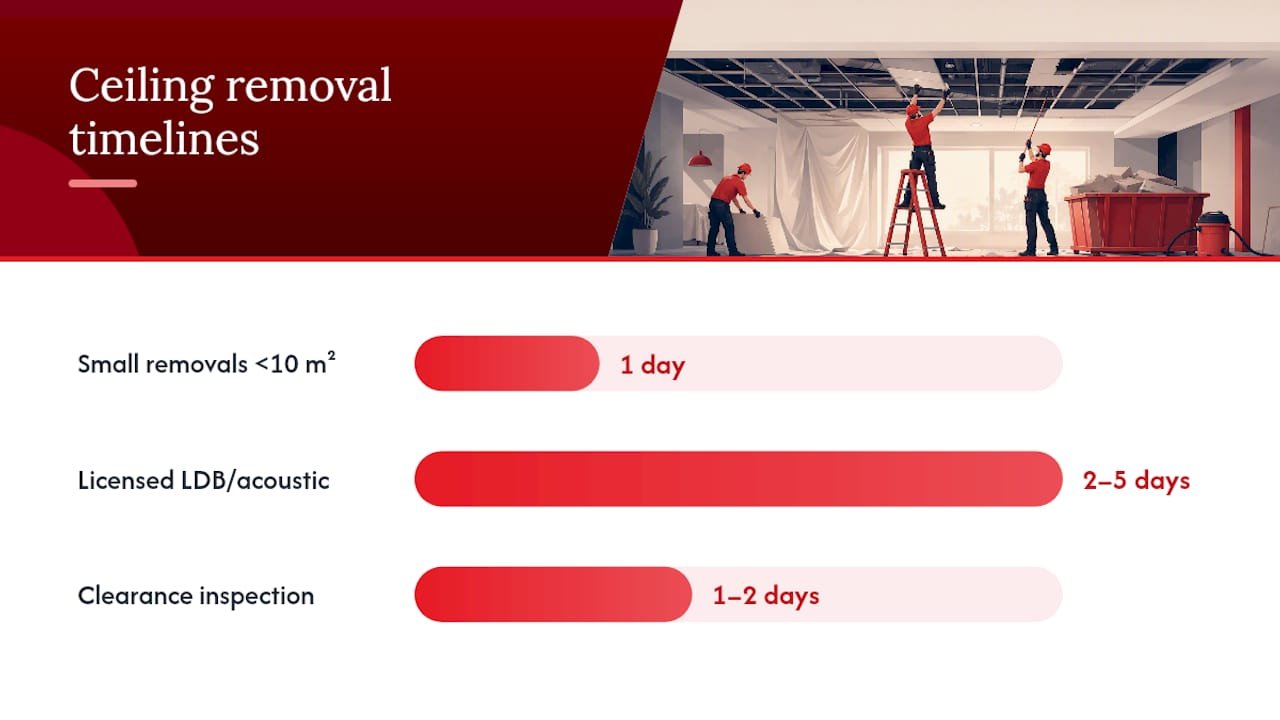
Small non-friable removals under 10 m² can be completed in a day. Licensed projects involving LDB or acoustic spray typically run two to five days for removal alone, with the independent clearance inspection adding one to two days depending on air monitoring results and laboratory turnaround.
Cost drivers include:
- Material type and condition: friable LDB costs more to remove than bonded fibre cement tiles because it demands enclosures, higher-grade PPE, and more intensive wet suppression
- Area and access: high ceilings, confined plant rooms, and occupied adjacent spaces all increase setup time and cost
- Services in the plenum: HVAC, lighting, and data cabling must be managed or temporarily disconnected before removal
- Independent testing fees: air monitoring during and after removal, plus laboratory analysis, are separate line items
- Disposal fees: authorised asbestos landfills charge by weight and volume; large ceiling systems generate significant waste
Hidden costs catch many property owners off guard. Re-instating ceilings after removal, temporary relocation of occupants, extended site cleaning, and multiple clearance tests where initial results are borderline all add to the final figure. For asbestos clearance timelines, the independent assessor’s schedule is often the critical path item.
Pro Tip: Ask every contractor to provide a line-item quote separating inspection, removal labour, air monitoring, disposal fees, and clearance. A single lump-sum quote makes it impossible to verify that compliant steps were actually completed.
Who is legally responsible, and what happens if duties are ignored?
The PCBU commissioning the work carries primary legal responsibility under the WHS Act. That means checking the asbestos register before work starts, verifying the contractor’s licence, and confirming that a clearance certificate is issued before re-occupation. Regulators place the onus squarely on the PCBU, not the removalist alone.
Licensed removalists carry their own obligations: supervision of all removal work by a competent person, maintaining training records, notifying the regulator, operating decontamination units, and delivering a clearance certificate. The WorkSafe Victoria compliance code specifies that enclosures must not be dismantled until the independent assessor permits it.
Enforcement reality: Breaches of asbestos removal regulations attract significant fines for both PCBUs and individual workers. More critically, improper disturbance creates long-term mesothelioma and asbestosis liability that cannot be undone after the fact.
Construction safety data consistently shows asbestos-related disease as one of the leading occupational health burdens in the construction sector. The regulatory framework exists because the health consequences of exposure are irreversible.
How do you choose a licensed suspended ceiling removal contractor?
Licence and insurance verification is the starting point, not the finish line. Before signing any contract, request:
- A copy of the Class A or Class B asbestos removal licence (check it against the state regulator’s public register)
- The written ARC plan specific to your site
- The name and licence number of the independent licensed asbestos assessor who will conduct clearance
- Public liability and professional indemnity insurance certificates
- The contractor’s waste consignment process and confirmation of the authorised disposal facility they use
- Evidence of worker training and competency records
Ask directly about methods: wet removal, negative-pressure enclosures, HEPA vacuum use, and decontamination unit setup. Vague answers on any of these are a red flag. So is pressure to skip air monitoring to reduce cost.
The asbestos removal compliance checklist from Missiondemolition covers the regulatory steps and paperwork to verify after a removal project. For a compliance-focused site inspection and quote, Missiondemolition’s asbestos removal team can confirm licence class, assessor arrangements, and disposal chain before work begins.
What paperwork must you receive after asbestos removal?
Disposal and documentation are where many projects fall short. Under WHS Regulation r484, asbestos waste must be contained, labelled according to GHS, and disposed of as soon as practicable at an authorised facility. Contaminated PPE must be sealed, labelled, and either disposed of or laundered at an authorised facility.
The document set you must retain includes:
- Updated workplace asbestos register reflecting the removal
- Written ARC plan used during the project
- Independent licensed asbestos assessor’s clearance certificate
- Waste consignment notes and disposal receipts from the authorised landfill
- Contractor’s invoice itemising each stage of work
These documents are your legal proof of compliant handling. Without them, you cannot demonstrate to a regulator, insurer, or future purchaser that the removal was lawful. For guidance on asbestos waste manifests and what each document must contain, Missiondemolition’s site provides a plain-language breakdown.
Why DIY suspended ceiling removal is unsafe and often unlawful
The 10 m² non-friable exception exists, but it is narrower than most property owners assume. It applies only to non-friable ACM, only where the PCBU has confirmed the material is non-friable through sampling, and only where all WHS controls are still applied. The Asbestos Safety and Eradication Agency is explicit: when asbestos may be disturbed in demolition or refurbishment, it must be removed before other work starts, and high-speed power tools and dry sweeping are prohibited.
Common DIY mistakes that create serious legal and health liability:
- Skipping sampling and assuming tiles are safe
- Using angle grinders, drills, or power saws on ACM
- Inadequate or absent PPE (a dust mask is not a P3 respirator)
- Single-layer wrapping or disposal in general waste bins
- No clearance testing before re-occupation
Warning: Disturbing asbestos without the required controls is a notifiable incident under WHS legislation. Property owners who proceed without a licensed contractor face enforcement action, remediation orders, and personal liability for any health consequences to workers or occupants.
Regulators treat unlicensed removal of friable asbestos as a serious breach. The workplace safety management obligations that apply to PCBUs make cost-cutting on licensed removal a false economy.
The part of this job most clients underestimate
The physical removal of ceiling tiles is the visible part of the project. What actually determines compliance is the independent clearance certificate, and that document does not exist until an assessor separate from the removalist has inspected the site, reviewed air monitoring results, and confirmed fibre concentrations are below the required limit. That is the legal endpoint for re-occupation, not the moment the last tile comes down.
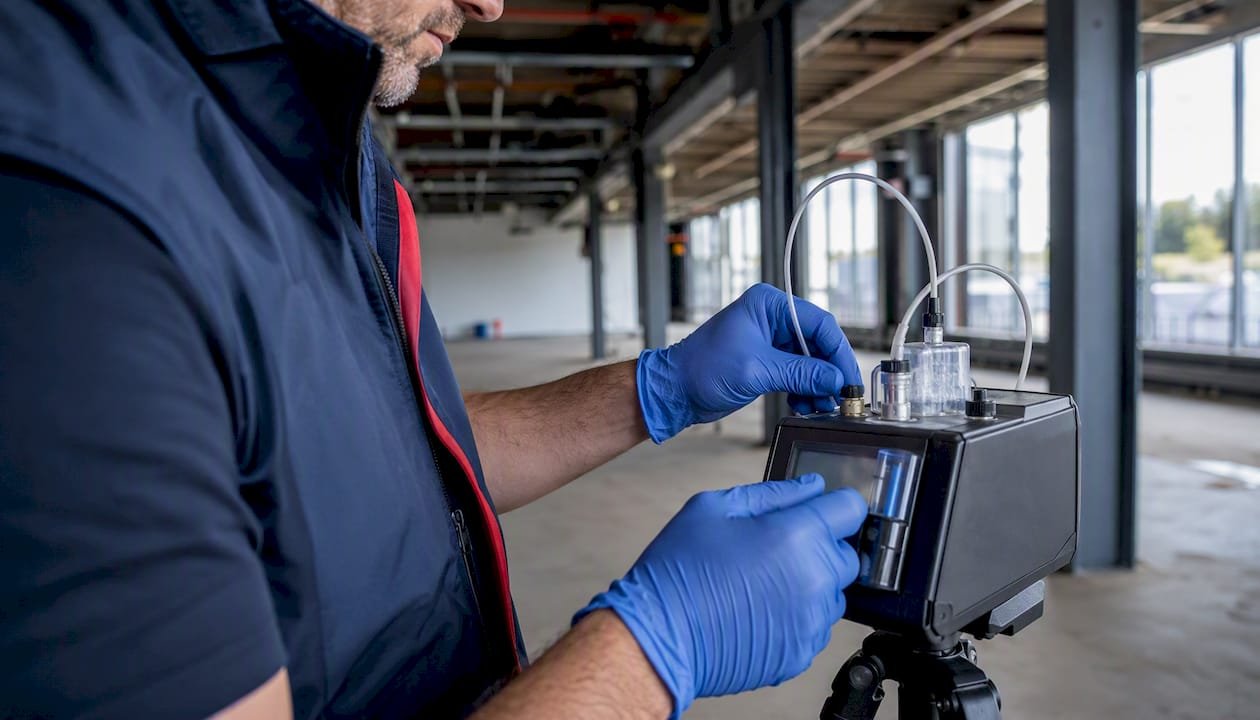
Scheduling matters more than most clients expect. Independent assessors have their own availability, and air monitoring results require laboratory turnaround time. On a complex project with borderline initial results, a second round of monitoring adds days. Factor that into your programme before committing to a handover date for subsequent trades.
Missiondemolition: licensed suspended ceiling removal done right
Missiondemolition’s licensed asbestos removal service covers the full scope that suspended ceiling projects demand: Class A and Class B removal capability, ARC plan preparation, coordination of an independent licensed assessor, and complete waste consignment and disposal handling. The difference from a general demolition contractor is the compliance infrastructure: every project comes with documented air monitoring, disposal receipts, and a clearance certificate you can show a regulator or future tenant.
Trust signals to confirm on your quote: licence class and number, named independent assessor, insurance certificates, and the authorised disposal facility. Missiondemolition provides all of these as standard. For residential, commercial, and industrial ceiling removals across Australia, request a compliance-focused inspection and quote to confirm scope, licence requirements, and timeline before any work begins.
Sources
The following official sources underpin the regulatory guidance in this article:
- Guide to identifying and handling low density asbestos fibreboard (Safe Work Australia, December 2024)
- How to safely remove asbestos – Code of Practice (SafeWork NSW PDF)
- How to safely remove asbestos — Code of Practice 2021 (WorkSafe QLD)
- WORK HEALTH AND SAFETY REGULATIONS 2011 – REG 484 (AustLII)
For site-specific advice, consult an independent licensed asbestos assessor before any ceiling disturbance. Regulatory requirements vary by state and territory; always confirm current obligations with your relevant WHS regulator.
This article is general information, not a substitute for advice from a qualified doctor. Consult a qualified healthcare professional about your own circumstances before acting on anything here.
