
For most concrete inspection jobs on an active construction site, ground penetrating radar (GPR) is the better default. It works from one side of a slab or wall, needs no evacuation, and gives you a marked-up result the same day. Reserve X-ray for the smaller set of cases where GPR returns are ambiguous and you need photograph-level certainty on a congested or high-stakes spot.
Three things decide which method you actually need:
- Access: can you get to both sides of the element, or only one? X-ray needs a source on one face and a detector on the other. GPR doesn’t.
- Occupancy: is the site live, with people working nearby? X-ray radiation demands an exclusion zone; GPR doesn’t emit anything and can run around occupied areas.
- Complexity: is the reinforcement dense, stacked, or unusually deep? That’s where X-ray’s sharper imaging earns its higher cost.
Most experienced scanning contractors run a staged approach: GPR to map the whole area fast, then X-ray on the handful of spots where the radar image doesn’t give a confident answer. That combination, rather than picking one technology and sticking with it, is what actually reduces risk on a real job.
Key Takeaways
GPR is the practical default for most concrete inspection jobs because it works from one side, needs no evacuation, and delivers same-day results at a fraction of X-ray’s cost.
| Point | Details |
|---|---|
| GPR is the default | Use it for broad mapping, slab scanning, and pre-cutting checks on most jobs. |
| X-ray suits narrow cases | Reserve it for congested reinforcement or high-consequence spots needing photograph-level certainty. |
| Safety burden differs sharply | X-ray needs a licensed radiation officer and exclusion zone; GPR uses no ionising radiation. |
| Stage the two methods | Map with GPR first, confirm only the ambiguous spots with X-ray. |
| Demand proper documentation | Request an engineer-stamped report with depth data and grid references, and Missiondemolition can coordinate scanning with the demolition scope itself. |
Table of Contents
- GPR scanning vs X-ray: a side-by-side comparison
- How GPR and concrete X-ray actually create an image
- What can each method reliably detect?
- Radiation, exclusion zones, and who’s allowed to operate the equipment
- Cost, scheduling, and what actually happens on site
- Building a decision checklist for your next scope
- Fitting scanning into a demolition or strip-out workflow
- Coordinating scanning and demolition under one supplier
- Sources
GPR scanning vs X-ray: a side-by-side comparison
Here’s how the two methods stack up across the factors that actually change a project manager’s decision, not just the marketing pitch.
| Factor | GPR | X-ray (radiography) |
|---|---|---|
| Recommended use | Broad mapping, slab scanning, locating rebar/conduit before cutting | Confirming congested or ambiguous spots, forensic-quality documentation |
| Resolution vs depth | Centimetre-scale near surface with high-frequency antennas, coarser at depth | Photograph-quality image regardless of depth, but limited by element thickness |
| Safety/regulatory burden | No ionising radiation, minimal controls | Licensed radiation officer, exclusion zone, permits |
| Access requirements | Single face only | Source and detector on opposite faces |
| Cost & throughput | Lower cost, hundreds of square metres per day per crew | Higher cost, exposure-by-exposure, slower per point |
| Operator skill required | Trained technician who can interpret reflection profiles | Radiation-licensed operator plus image interpretation |
Three quick reads from that table. Full-floor or full-wall mapping jobs almost always go to GPR because it needs only one operator and no evacuation. Jobs with dense, overlapping steel or a single high-consequence penetration point (say, a core hole near a post-tension tendon) often justify the cost of X-ray. And anything on an occupied floor, a tenanted building, or a site where you can’t clear people out for an hour, effectively rules X-ray out before cost even enters the conversation.
Confidence levels differ too. A GPR scan gives you a location and a depth reading, but the interpretation is not always unique. An X-ray image is a direct transmission picture, which is why it’s often preferred for legal or forensic documentation where a non-specialist needs to read the result without training.
How GPR and concrete X-ray actually create an image
Both technologies solve the same problem, “what’s hidden inside this concrete”, but they get there in completely different ways.
GPR works by radar reflection:
- A GPR unit sends high-frequency electromagnetic pulses into the concrete and times how long the reflected signal takes to return.
- Antenna frequency dictates the trade-off between resolution and depth. Commercial antennas range from roughly 10 MHz to over 1,000 MHz; higher frequencies give sharper images but don’t reach as deep.
- The output is a real-time profile the operator reads on-screen, often built up into a depth-sliced map across the scanned area as the antenna is dragged along a grid.
X-ray (radiography) works by transmission imaging:
- A radioactive source or X-ray generator sits on one face of the concrete; a detector or film sits on the opposite face.
- Denser materials, like steel reinforcement, block more of the radiation, which shows up as contrast on the resulting image.
- The result reads like a photograph of what’s inside the slab, but it requires two-sided access and, often, off-site film processing before anyone can read it properly.
If you’re briefing a client or a site team unfamiliar with either method, a simple side-by-side diagram, a GPR transect line next to an X-ray plate setup, does more to explain the difference than paragraphs of text ever will.
What can each method reliably detect?
Both methods find hidden objects in concrete, but they’re not interchangeable on every target.
Typical detectable targets include:
- Steel reinforcing bar (rebar) and mesh
- Post-tension cables and anchor plates
- Electrical conduit and plastic pipe
- Voids, honeycombing, and slab thickness anomalies
- Embedded services like data cabling or in-slab heating
| Method | Typical resolution | Typical usable depth in concrete | Notes |
|---|---|---|---|
| GPR, high-frequency antenna (over 1,000 MHz) | Centimetre-scale | Shallow, generally within the top 200 mm | Best for closely spaced rebar and cover checks |
| GPR, low-frequency antenna (roughly 10 MHz) | Decimetre to metre scale | Deeper, into the 300–600 mm range common in slabs | Loses fine detail as depth increases |
| X-ray | Fine, photograph-quality | Limited mainly by element thickness rather than antenna choice | Better for stacked or overlapping targets |
GPR can tell you something is there and roughly how deep, but the interpretation isn’t always unique. A single reflection could be rebar, a conduit, or a void, and distinguishing between them takes operator judgement and, ideally, corroborating data.
Pro Tip: Cut down false positives by running overlapping transects on a tighter grid spacing rather than trusting a single pass. Depth-slicing the same area at two antenna frequencies (one for resolution, one for depth) resolves most of the ambiguous returns before you’d ever need to call in an X-ray crew.
Radiation, exclusion zones, and who’s allowed to operate the equipment
X-ray imaging works because it uses ionising radiation, and that comes with a regulatory load GPR simply doesn’t carry.
Before any radiography exposure on site, expect this checklist:
- A licensed radiation safety officer present or supervising the work
- An established exclusion zone around the source, with the radius set by exposure strength
- Radiation warning signage and controlled access points
- Permits or notifications lodged with the relevant state or territory radiation authority, depending on jurisdiction
None of that applies to GPR. It uses no ionising radiation at all, which means it can run on a live site, around occupied offices, or during trading hours without clearing anyone out. That single fact changes scheduling more than almost anything else in this comparison: a GPR scan can often be slotted into a normal work shift, while an X-ray exposure cycle has to be planned around an exclusion window.
If you’re specifying X-ray work, verify the operator’s radiation licence and check current rules with your state or territory radiation authority before signing off on a scope. Regulations and permit requirements differ between jurisdictions, so don’t assume the process from your last project applies to this one.
Cost, scheduling, and what actually happens on site
Quotes for concrete scanning vary more on method than on contractor, so it pays to know what’s driving the number before you compare bids.
Main cost drivers to expect:
- Crew size (X-ray typically needs more hands for safety controls)
- Area coverage achievable per day
- Equipment mobilisation and, for X-ray, licensing overheads
- Report turnaround, including any off-site film processing
- Number of individual exposures required for X-ray, versus continuous coverage for GPR
A rough timeline comparison makes the gap concrete. A single GPR technician can scan and mark up hundreds of square metres in a day, with findings chalked or flagged on the surface before they pack up. An equivalent X-ray job covering the same footprint, done exposure by exposure with exclusion cycles between each shot, can stretch across several days with a larger crew. That difference in labour and time is a major reason GPR runs significantly cheaper than X-ray for equivalent coverage, often by a majority percentage.
When comparing quotes from scanning vendors, ask:
- What’s the rate per square metre, and does it include markup and a written report?
- For X-ray, how many individual exposures are included, and what’s the cost per additional exposure?
- Is the final report engineer-stamped, and does it include depth measurements and grid references?
Building a decision checklist for your next scope
Before you write a scanning scope into a tender or brief a contractor, run through this:
- Confirm access. Can you reach both sides of the element? If not, X-ray is off the table regardless of budget.
- Check occupancy. Is the area occupied or trading? If clearing it isn’t practical, GPR is the only realistic option.
- Estimate area size. Large floors and walls favour GPR on cost and time alone.
- Assess target complexity. Dense or stacked reinforcement, or a single high-consequence penetration, may justify targeted X-ray.
- Weigh the consequence of error. Cutting into a live post-tension cable is expensive and dangerous enough to warrant the extra certainty.
Sample lines worth pasting into a scanning brief:
- “Scope: full-slab GPR mapping at [X] mm grid spacing, with depth-sliced reporting for all detected anomalies.”
- “Deliverables: engineer-stamped report including planview markup, cross-sections, and depth measurements referenced to a fixed grid.”
- “Tolerance: any GPR-flagged location with ambiguous return to be confirmed by targeted X-ray prior to coring.”
The staged approach, GPR for mapping, X-ray reserved for the ambiguous or high-risk spots, keeps most jobs fast and affordable while still giving you certainty where it actually matters.
Fitting scanning into a demolition or strip-out workflow
Scanning isn’t a stand-alone activity, it’s a step that has to slot into the sequence of coring, cutting, and demolition without holding the whole job up.
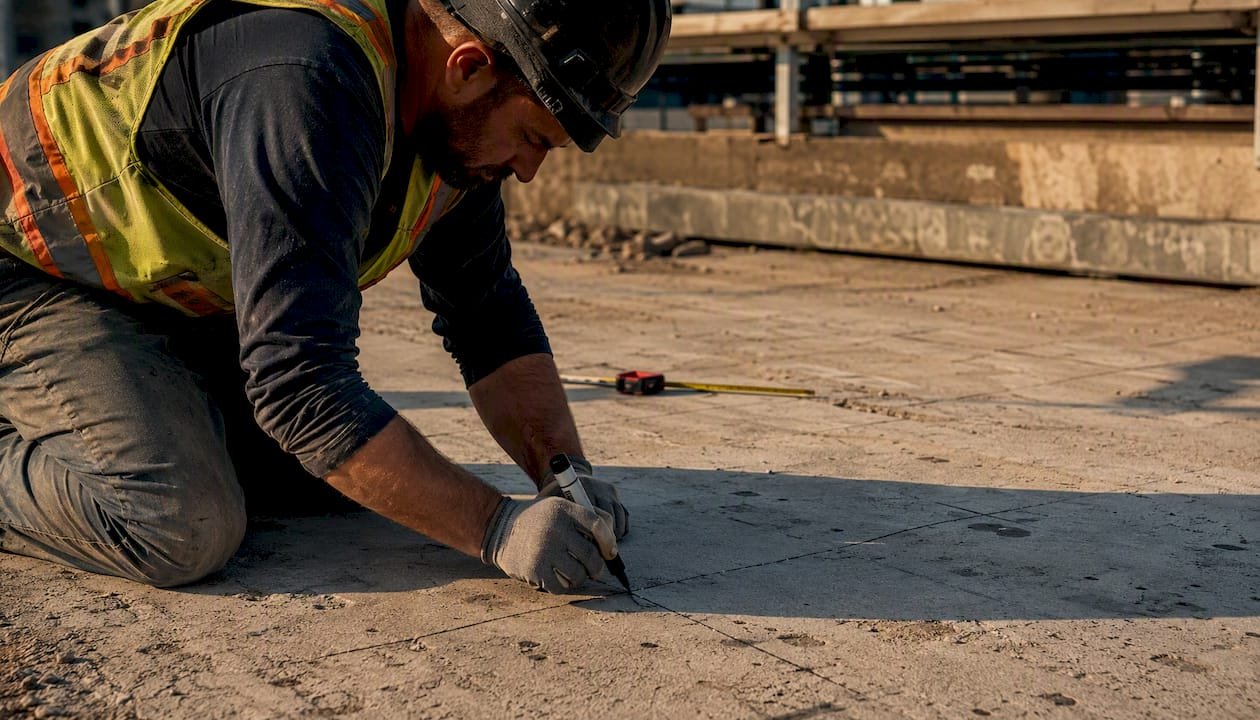
Order scanning before any coring or cutting begins, not after the crew has already mobilised saws to the slab. Mark findings clearly and photograph them before any surface prep or dust suppression work might obscure the marks. Keep the scan report, photos of the marked-up surface, and the grid reference sheet together in the project handover pack, so anyone referring back to the job later isn’t guessing at what was checked.
What you should demand from any scanning deliverable:
- An engineer-stamped report, not just raw scan images
- Depth measurements tied to a fixed grid reference
- An interpreted planview and, where relevant, cross-sections through key areas
Pro Tip: On sites where scanning and asbestos removal both need to happen, sequence them so scan marks survive the asbestos permit window. Wetting down materials or erecting containment can wipe temporary chalk marks, so photograph and log grid references before any wet works start.
Combining GPR mapping with a proper site audit after clearing gives you a documented trail from scan to cut to demolition, which matters if a dispute ever comes up later. Teams handling concrete slab removal routinely use this scan-then-cut sequence to avoid hitting live services buried in the slab.
A pragmatic take on the staged approach
The staged approach isn’t a compromise, it’s the sensible default because most concrete inspection jobs simply don’t have the congestion or consequence profile that justifies X-ray’s cost and downtime. Where GPR earns its reputation as the workhorse is in exactly the situations project managers face daily: mapping a floor before a strip-out, checking cover before an anchor is drilled, confirming a wall is clear before a doorway gets cut. X-ray still has its place, and dismissing it entirely on a genuinely congested or high-consequence spot is false economy.
The procurement mistake I see most often is treating scanning as a commodity line item and picking whoever quotes lowest per square metre. Specify the operator’s qualifications and the report format in the contract itself, not as a verbal assumption. An engineer-stamped report with depth data and grid references is worth more than a cheaper scan with a text summary and no traceable measurements.
Coordinating scanning and demolition under one supplier
There are standalone scanning specialists and separate demolition crews, and running two contracts across a project is a common way schedules slip when one hands off badly to the other. Missiondemolition coordinates GPR-informed cutting, coring, and full demolition scope under one team, so scan findings feed straight into the cutting plan without a handover gap between contractors.

Whether you’re clearing a slab that’s already been scanned or need the scanning and demolition sequenced together from the start, verify the operator’s qualifications, ask for an engineer-stamped report, and confirm any X-ray work has scheduled exclusion controls before signing off. For projects involving concrete slab removal in Sydney, Missiondemolition builds the scan-to-cut sequence into the project plan from day one, so reinforcement and services are mapped before a saw ever touches the surface. If you’re planning demolition work and want scanning coordinated as part of the scope, get in touch through the demolition services page to discuss your site and timeline.
Sources
- Concrete Scanning vs X-Ray: Which Technology Is Right for Your Project? | SiteOps Blog | SiteOps
- GPR vs. X-Ray for Concrete Scanning: How to Choose – Materials Lab
- Ground-penetrating radar (Wikipedia)
