
A strip‑out is the physical removal of everything your business installed in a leased space. A make good is the contractual obligation in your lease to return that space to an agreed condition. The strip‑out is demolition, and the make good is reinstatement, and confusing the two is where most lease‑end budgets blow out.
The single next step: pull out your lease, find the make‑good clause, and book a joint inspection with your landlord or their agent before you touch a single wall.
- Read the make‑good clause word for word, not the summary your broker gave you three years ago.
- Book a pre‑exit inspection with the landlord or managing agent while there’s still time to negotiate scope.
- Get quotes for strip‑out and make‑good as two separate line items, not one bundled number.
Pro Tip: Budget separately for strip‑out and for “revealed conditions”. Make‑good scope is often provisional until the strip‑out exposes what’s actually behind the plasterboard.
Key Takeaways
Meeting your make‑good obligation requires reading the lease clause first, separating strip‑out from reinstatement costs, and confirming asbestos status before any demolition begins.
| Point | Details |
|---|---|
| Strip‑out and make‑good differ | Strip‑out is physical demolition; make‑good is the lease obligation to reinstate the space afterwards. |
| Check the lease clause first | Terms like “return to base building” or “broom clean” determine your exact scope of work. |
| Asbestos testing comes before demolition | Older fitouts need a licensed survey and clearance certificate before strip‑out starts. |
| Budget for revealed conditions separately | Make‑good scope often changes once strip‑out exposes hidden damage behind walls or ceilings. |
| Missiondemolition manages both scopes | Strip‑out and licensed asbestos removal are handled together, with itemised quotes and provisional sums for revealed conditions. |
Table of Contents
- What is the difference between strip out and make good?
- How does the lease‑end strip‑out and make‑good process work?
- What approvals and safety obligations apply to strip out work?
- What does your lease actually require you to remove?
- How much does strip out and make good typically cost?
- What should you require in a strip out and make good quote?
- What should be on your pre‑inspection checklist?
- What sequencing actually saves time and money?
- What do handovers most often get wrong?
- Getting strip out and make good done without the guesswork
- Where to find more on strip‑out and make‑good obligations
- Frequently asked questions
- Sources
What is the difference between strip out and make good?
Strip‑out means removing everything you or a previous tenant installed: partitions, joinery, raised flooring, signage, and any secondary services cut back to their base connection points. It’s demolition work, plain and simple.
Make good is the lease standard you’re contracted to meet once that stuff is gone. It usually covers patching, repainting, ceiling and floor repairs, and reinstating services to whatever condition the lease specifies. Some leases call for a full return to base building. Others only require selective removal, and a common misconception is treating every make‑good clause as a demand for a bare shell when many actually allow you to leave agreed improvements in place.
Defit is an industry term you’ll hear used interchangeably with lease‑end strip‑out, particularly among fitout contractors and project managers.
What usually goes:
- Non‑structural partitions and internal doors
- Tenant‑installed joinery, kitchenettes, and reception desks
- Carpet tiles, signage, and branded finishes
What commonly stays:
- Base building ceiling grid and mechanical services
- Structural elements and fire services
- Landlord‑approved permanent improvements, if documented in writing
How does the lease‑end strip‑out and make‑good process work?
Getting from occupied tenancy to signed‑off handover follows a fairly predictable sequence, and skipping steps is where most disputes start.
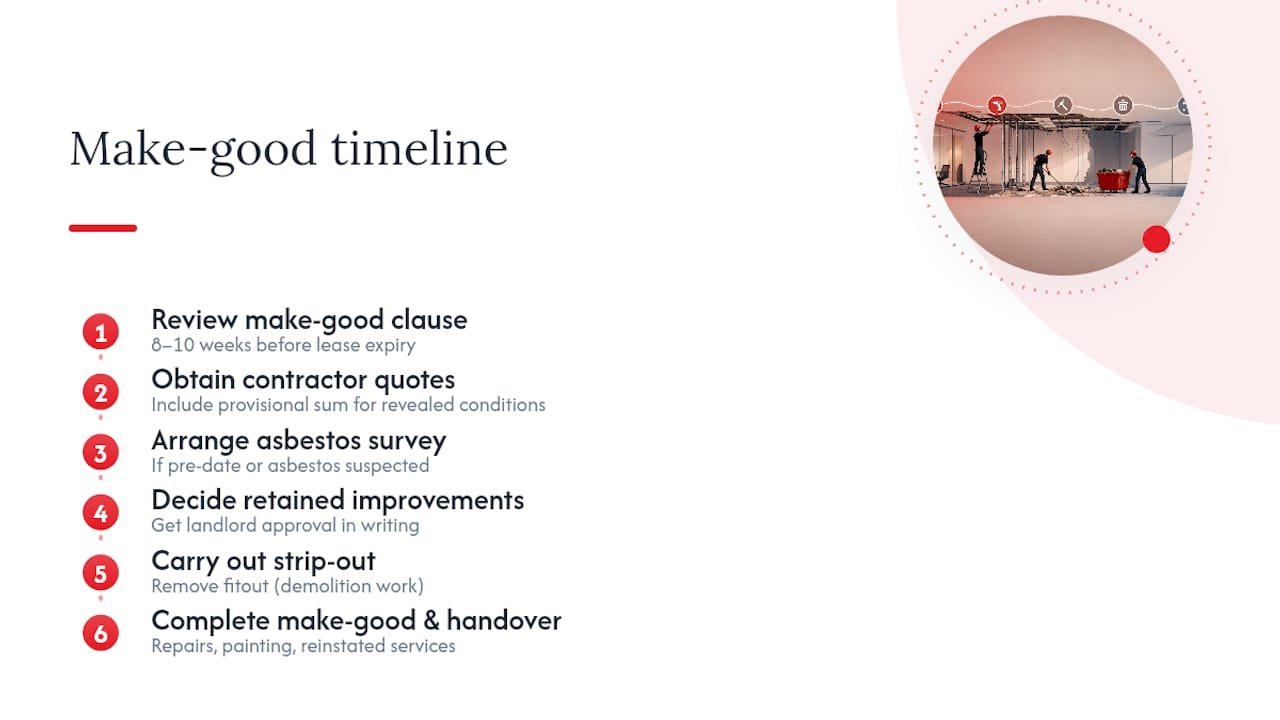
- Review the lease for the exact make‑good wording, notice periods, and any schedule of condition attached at the start of the tenancy.
- Arrange a joint pre‑exit inspection with the landlord or agent to agree baseline expectations before work begins.
- Commission approvals and an asbestos assessment, especially in older buildings or ones fitted out before certain dates.
- Get itemised quotes from contractors, splitting strip‑out and make‑good as separate scopes.
- Disconnect services — electrical, HVAC, data — safely and in the correct order.
- Carry out strip‑out works, removing partitions, joinery, and finishes.
- Assess revealed conditions once the space is stripped back to base build.
- Complete make‑good and reinstatement, including repairs uncovered during strip‑out.
- Clean and hold the final joint inspection for landlord sign‑off.
On timing, reviewing the make‑good clause 8 to 10 weeks before lease expiry gives you enough runway to procure contractors, complete works, and still have a buffer for anything unexpected.
Watch for three risk points along the way:
- Suspected asbestos in ceiling tiles, floor adhesives, or wall sheeting
- Damaged service penetrations behind removed partitions
- Ceiling void or slab damage only visible once fitout is stripped
What approvals and safety obligations apply to strip out work?
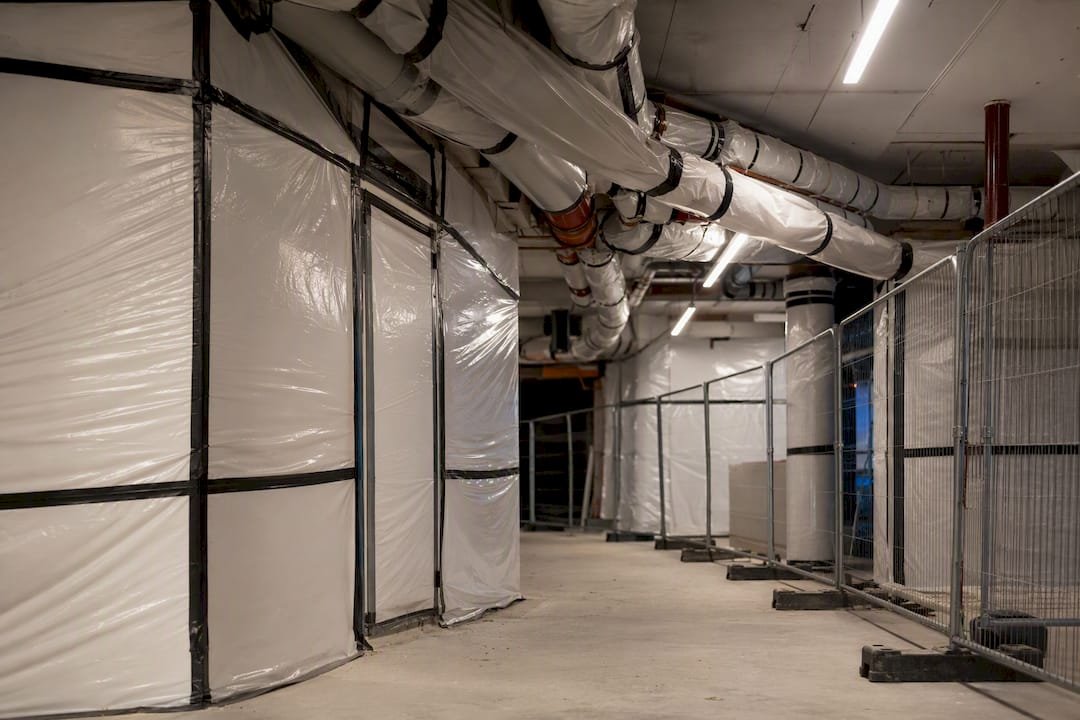
Asbestos is the obligation tenants most often overlook, and it’s the one with the sharpest legal teeth. If your premises were fitted out before certain dates, or asbestos is suspected in ceiling tiles, vinyl flooring, or wall linings, you need a proper survey before any demolition starts. Asbestos must be identified and managed by licensed specialists, with appropriate controls in place and a clearance certificate issued before anyone re‑occupies the space.
Building managers typically expect a specific documentation pack before they’ll let contractors on site:
- Method statements outlining how the work will be carried out
- Current public liability insurance certificates
- Waste transfer manifests showing lawful disposal
- Asbestos clearance certificates, where applicable
Sequence testing before strip‑out, not during it. A commercial asbestos removal guide can help you understand what a proper survey should cover, and licensed contractors will only remove hazardous material once that survey is complete.
Pro Tip: Never let a contractor start demolition “while we wait on the asbestos report.” If the report comes back positive after walls are already down, you’ve likely contaminated adjoining areas and doubled your remediation cost.
What does your lease actually require you to remove?
Your lease clause will use specific language that determines exactly how far your obligation extends, and reading it carelessly is expensive. Look for phrases like “make good,” “return to base building,” “broom clean condition,” and any reference to a schedule of condition taken at lease commencement.
A compact checklist to confirm before you scope any work:
- Are partitions required to come out, or can some stay with landlord approval?
- Do floor coverings need to be removed, or just cleaned?
- Are ceiling tiles and grid part of your obligation or the base building’s?
- Have any services alterations (extra power, data cabling) been called out separately?
- Is signage removal and facade patching explicitly included?
If any clause is ambiguous, ask the landlord or managing agent directly, in writing, and keep the reply. RICS guidance recommends a clear schedule of make good precisely because vague clauses generate disputes at the exact moment neither party wants one. If you negotiated to keep an improvement, get that agreement in writing before handover, not as a verbal aside during the final walkthrough.
How much does strip out and make good typically cost?
Cost swings on a handful of factors: tenancy area, how much joinery and partitioning needs removing, whether concealed repairs turn up, asbestos presence, site access constraints, waste volumes, and the finishing standard your lease demands.
Timeframes scale with size. A small office suite might wrap strip‑out and make‑good in one to two weeks. A mid‑sized floor typically needs three to five weeks. Larger, multi‑level tenancies can run six weeks or more, particularly once revealed conditions extend the reinstatement scope. Build your programme with a buffer between “strip‑out complete” and “make‑good finished” specifically for that assessment window.
- Get at least three itemised quotes, not verbal estimates
- Hold a separate contingency line for revealed conditions
- Ask each contractor to price strip‑out and make‑good separately
Pro Tip: Never accept a single lump‑sum figure covering both strip‑out and make‑good. If the two scopes are blended, you have no way to challenge a variation once hidden damage turns up.
RICS notes that greening make‑good reduces waste at lease churn by planning ahead for reuse or take‑back of carpet tiles and joinery rather than sending it all to landfill.
What should you require in a strip out and make good quote?
A comparable quote needs a few non‑negotiable line items: a clear split between strip‑out and make‑good pricing, a distinct asbestos removal cost if relevant, waste disposal fees, and a provisional sum specifically for revealed conditions.
Before signing anyone, check their insurance and credentials: current public liability cover, workers’ compensation, asbestos licences where the job requires them, and evidence they issue proper waste transfer documentation.
- Ask how they sequence work around live building services
- Ask how they protect lift lobbies and shared corridors during demolition
- Ask what happens, contractually, if they find damage behind a wall they didn’t quote for
Getting this right up front is far cheaper than negotiating an open‑ended variation halfway through the job.
What should be on your pre‑inspection checklist?
Before the landlord walks through, tick off the basics: dated photos of every room, final meter readings, signage fully removed, patching and paint touch‑ups complete, carpet lifted where the lease requires it, and evidence power and data have been properly reconnected or disconnected.
On the day itself, document the final joint inspection in writing and request signed confirmation on the spot. Keep your waste manifests and asbestos clearance certificates together with that paperwork.
- Photograph every room, dated, before the inspection begins
- Get written sign‑off, not a verbal “looks fine”
- File manifests and clearance certificates with the final report
Pro Tip: Take the photos on the morning of the inspection, not the week before. A landlord disputing a bond deduction will always ask when the photo was taken.
What sequencing actually saves time and money?
The safest order is strip‑out first, then assess what’s revealed, then finalise the make‑good scope. Trying to price make‑good before demolition starts means guessing at damage nobody’s seen yet. Protecting base building services and shared areas during the works matters just as much. Isolating circuits and shielding lift lobbies from dust and vibration keeps building management on side and speeds up sign‑off.
Keep every asbestos report, method statement, waste transfer note, and photo, and hand the full set to the landlord at inspection to maintain proper building services for commercial offices and site protection. Where the lease allows it, reusing or recycling tenant joinery rather than skipping it cuts disposal cost, and pushing for provisional sums in your quotes beats open‑ended variations every time.
What do handovers most often get wrong?
The most common failure I see isn’t bad workmanship. It’s missing paperwork: no asbestos report on file, tenant alterations nobody documented, and no joint inspection booked until the last possible day, by which point there’s no time left to fix a disagreement.
The fix is simple and cheap. Organise a joint pre‑exit walk with the landlord, take photos of everything, and get written notes signed by both parties before a single tradesperson arrives.
Getting strip out and make good done without the guesswork
Missiondemolition handles both halves of this job under one roof, strip‑out and licensed asbestos removal, so you’re not coordinating two separate contractors and hoping their paperwork lines up at handover.
Our team manages the approvals, the waste removal, and the full project sequencing described above, including asbestos surveys before demolition starts and clearance certificates before you hand the keys back. When you request a quote, ask for strip‑out and make‑good priced as separate line items, asbestos handling scoped explicitly, and a provisional sum for revealed conditions rather than an open‑ended variation clause. That structure is what keeps your budget honest once the walls come down. Our demolition service page outlines what’s included in a typical project, and our asbestos removal team can assess your site before you commit to a strip‑out date. Book a site visit and get an itemised quote before your notice period runs out.
Where to find more on strip‑out and make‑good obligations
- RICS make good guidance for schedule‑of‑make‑good practice and sustainable reinstatement
- Asbestos safety booklet for trades and construction for licensed removal obligations
- Office strip‑out process explainer for a practical breakdown of typical scope
Commercial lease churn keeps demand for strip‑out and make‑good work steady across office markets, which is exactly why RICS built a dedicated make‑good standard rather than leaving it to generic construction guidance.
Frequently asked questions
Is make good the same as strip out?
No. Strip‑out is the demolition work of removing fitout. Make good is the contractual standard you must meet once that fitout is gone, covering repairs, painting, and reinstated services.
Do I need an asbestos survey before every strip‑out?
Not always, but any building fitted out before certain dates, or where asbestos is suspected in ceiling tiles, flooring adhesive, or wall linings, needs a licensed survey before demolition starts.
Can I leave improvements in place instead of removing them?
Sometimes. Many leases allow retained improvements with landlord approval. Get that agreement in writing before handover, never as a verbal assurance during the final walkthrough.
Who pays if damage is found once the strip‑out is complete?
That depends on your lease and quote structure. A provisional sum for revealed conditions, agreed upfront in your contractor’s quote, is the standard way to handle this without an open‑ended dispute.
How early should I start the make‑good process?
Review your make‑good clause 8 to 10 weeks before lease expiry, which leaves enough time for quotes, asbestos assessment, strip‑out, and reinstatement before your handover date.
Sources
- Make good Australia (3rd edition) | RICS
- Asbestos safety for trades and construction workers (booklet)
- Office stripout process explained | NMGS
- Office strip‑out and make good before lease expiry | Tau Constructions
