
For demolition, erect continuous perimeter fencing before work begins. Baseline panels sit at 1.8–2.0 metres, stepping up to solid hoarding or gantries wherever the site borders a public footpath or thoroughfare. The barrier stays in place until an authorised inspection clears removal, not until the crew feels finished.
Three things sit underneath that one rule:
- The person with management or control of the site carries legal responsibility for the fencing, not the subcontractor who installed it.
- Height and material choice scale with public exposure. Chainmesh works for a quiet suburban block; a busy footpath demands plywood hoarding or a gantry.
- Inspection records (dated photos, checklist sign-offs) are what separates a defensible compliance position from a stop-work notice when an inspector turns up unannounced.
Key Takeaways
Compliant demolition fencing means continuous perimeter barriers meeting AS 4687 heights, upgraded to hoarding near public areas, installed before work starts and retained until an authorised inspection clears removal.
| Point | Details |
|---|---|
| Minimum height | Panels need at least 1.8 metres, with many sites running 2.0 metres or taller hoarding near public areas. |
| Legal responsibility | The person with management or control of the site holds the legal duty to secure the perimeter. |
| Material choice | Linkmesh mesh openings should stay around 50 mm x 50 mm; hoarding needs solid plywood cladding near footpaths. |
| Daily inspections | Check gates, bracing, mesh integrity, and post stability daily, and photograph the results. |
| Removal timing | Fencing stays up until debris, hazardous waste, and grading are cleared and sign-off is documented. |
| Specialist support | Mission Demolition manages fencing, hoarding, and permit liaison as part of full demolition project delivery. |
Table of Contents
- What are the demolition site fencing requirements under WHS law?
- How tall does demolition fencing need to be?
- When do you need hoarding or a gantry instead of mesh?
- How should you install and maintain demolition site fencing?
- Which demolition works need council or state permits?
- When can demolition site fencing be removed?
- What happens if your demolition fencing fails inspection?
- How Mission Demolition manages fencing and permits on site
- Where the standard advice on fencing gets it wrong
- Get compliant fencing and permits handled as part of your demolition project
- Where to check the primary regulator guidance
- Sources
What are the demolition site fencing requirements under WHS law?
Under work health and safety frameworks, the “person with management or control” of a demolition site carries the legal duty to secure the perimeter, and that duty doesn’t transfer just because a fencing subcontractor did the physical install. WorkSafe Victoria’s guidance is explicit that construction and demolition sites must provide site security measures such as temporary fencing, and points operators to the demolition compliance code for higher risk jobs where controls need to go further than standard perimeter mesh.
SafeWork NSW takes a similar line in its own site security checklist, which sets out acceptable fencing materials and treats mesh size and gate security as inspection items, not afterthoughts. Western Australia’s demolition code of practice reinforces the same principle: fencing standards get checked, and inspectors have specific items they’re trained to look for.
Sitting across all three is AS 4687, the Australian Standard covering temporary fencing and hoarding. It’s not a standalone law. It’s the technical reference regulators expect you to meet, and most council permit conditions cite it directly.
A few things to lock in before you order a single panel:
- Confirm who on your project holds “management or control” in writing. Ambiguity here is where enforcement notices land.
- Check your state’s specific demolition compliance code, not just the general construction guidance.
- Treat AS 4687 as the floor, and your local council’s conditions as the ceiling. Councils routinely ask for more than the standard’s minimum.
A quick fact that catches people out: the standard fencing rules that apply to a build site don’t automatically satisfy a demolition permit. Demolition sits in a higher risk category in most jurisdictions, which is why the demolition-specific codes exist separately from general construction site fencing standards.
How tall does demolition fencing need to be?
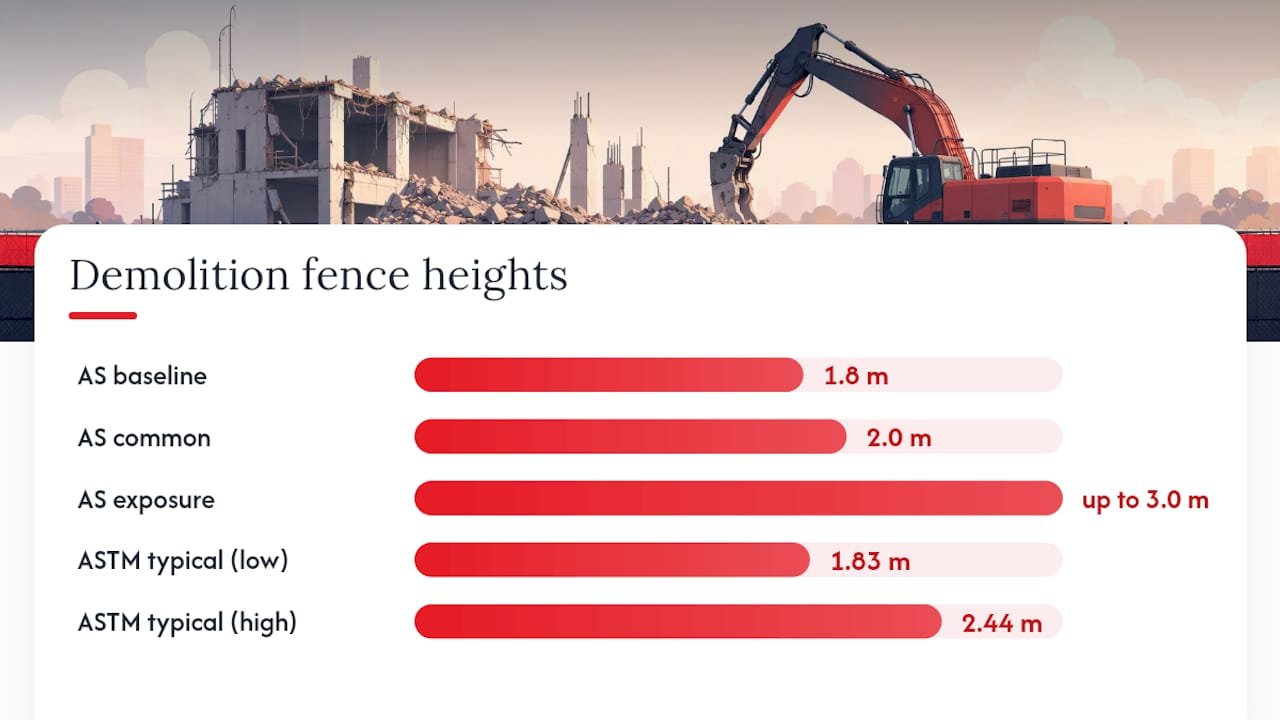
Panels need to be at least 1.8 metres tall as a baseline, drawn from AS 4687. Plenty of demolition sites run 2.0 metres as standard practice, and taller solid hoarding becomes mandatory once work happens near a public footpath or road.
International guidance under ASTM F3342 lands in the same range, specifying typical temporary fence heights of 1.83 metres or 2.44 metres depending on exposure, which tells you Australia’s baseline isn’t an outlier. It’s the industry norm.
Materials matter as much as height. SafeWork NSW’s checklist caps acceptable linkmesh mesh sizes at roughly 50 mm x 50 mm, tight enough to stop a foot finding purchase for climbing. Where hoarding is specified instead of mesh, expect plywood sheeting over braced timber or steel framing, thick enough to resist a deliberate push and to contain dust and small debris.
One number worth remembering: demolition sites near public areas may need hoarding well beyond that 1.8 metre floor, sometimes up to 3 metres where exposure is high, a threshold echoed in overseas technical guidance for demolition and construction hoarding.
- Baseline: 1.8–2.0 m panels for standard perimeter security.
- Step-up: solid hoarding, often 2.4–3.0 m, where public exposure is significant.
- Mesh limit: roughly 50 mm x 50 mm for linkmesh sections.
- Wind loading: any screening or shade cloth added to mesh increases wind load and may require engineered bracing, not just extra star pickets.
Treat chainmesh as a perimeter security barrier, not a debris containment system. If anything being demolished could realistically drop, roll, or crumble toward a footpath, mesh isn’t the right call. That’s a hoarding or gantry decision, engineered properly rather than bolted on as an afterthought.
When do you need hoarding or a gantry instead of mesh?
Distance to the public is the deciding factor, not preference or budget. Fencing type must scale with the hazard: the closer you sit to a footpath or thoroughfare, move from linkmesh to hoarding or a gantry that controls falling objects and dust rather than just blocking sightlines.
Run through this sequence when scoping a job:
- Measure the setback. If there’s meaningful clear distance between the demolition zone and any public path, standard mesh fencing at 1.8–2.0 m is usually adequate.
- Assess drop risk. Where material could fall, roll, or blow toward pedestrians, specify solid hoarding with continuous cladding, plywood sheeting on braced framing, rather than mesh with a shade cloth bolted on.
- Consider overhead protection. Where the building overhangs a footpath that can’t be closed, a gantry (a covered walkway structure) becomes the only compliant option, and it needs its own engineering sign-off.
- Check encroachment. Any hoarding or gantry extending onto public footpath or road reserve typically needs a separate council licence, on top of your demolition permit.
- Add debris control. Netting or sheathing across gaps in the structure stops dust and small debris escaping, a requirement inspectors check specifically on sites bordering occupied properties.
Skipping straight to hoarding because it feels “safer” than working through this sequence usually costs more and delays the program for no compliance benefit.
How should you install and maintain demolition site fencing?

Fencing goes up before a single piece of equipment touches the structure, and it stays continuous around the entire perimeter. Gaps are the single most common failure point inspectors flag, and a five-metre gap “just for truck access” is exactly the kind of shortcut that turns into a stop-work notice.
Get the sequencing and physical detail right from day one:
- Install the full perimeter first, confirm no gaps exist at ground level, then start any demolition activity.
- Brace every panel with a stable base, weighted feet or ground anchors depending on ground conditions and expected wind exposure.
- Design vehicle and pedestrian gates to swing inward, not outward onto a footpath, and secure them to the same standard as the fence line itself.
- Lock gates outside working hours, every time, with a documented process for who holds keys.
- Inspect daily: panel fixings, post verticality, base stability, mesh or hoarding integrity, and gate lock status.
Pro Tip: Photograph your fence line at the start and end of every shift, keyed to a simple checklist. It takes ninety seconds and it’s the single easiest way to prove compliance if an inspector shows up when you’re not on site.
Unsecured gates and gaps under fencing are the two issues WorkSafe Victoria flags most often as triggers for enforcement action, and both are entirely preventable with a five minute daily walk-around.
Which demolition works need council or state permits?
Not every fence needs a permit, but plenty of demolition-specific fencing situations do, and the trigger points are predictable once you know what to look for.
- Encroachment onto public land. Any hoarding or gantry extending over a footpath or road reserve almost always needs a separate council licence, distinct from your demolition permit itself.
- Duration. Longer projects sometimes attract different conditions than short ones, particularly where a hoarding will sit in a public space for months.
- Height above the standard. Councils frequently set their own maximum heights or design conditions for hoarding, above and beyond what AS 4687 specifies as a baseline.
- Traffic or pedestrian management. Where a gantry or hoarding narrows a footpath, expect councils to request a traffic and pedestrian management plan alongside your site plan and risk assessment.
Submit early. Councils commonly need weeks, not days, to process hoarding licences, and inspection windows for approval can add further delay if your paperwork arrives incomplete. A demolition permit application that bundles fencing and hoarding detail from the outset avoids a second round trip through council.
When can demolition site fencing be removed?
Fencing comes down only once specific conditions are met, not simply once demolition activity stops. Local council guidance is consistent on this: barriers must remain until debris and hazardous waste are cleared and the site is genuinely safe for public access.
Before anyone reaches for the fence panels:
- All demolition debris must be removed or made safe, including graded ground and functioning drainage.
- Any asbestos or hazardous material clearance documentation, including a completed waste manifest, needs to be on file.
- The authorising inspector or certifier signs off removal, and that sign-off is what you keep on record, not a verbal all clear.
- Watch for the usual pitfalls: residual asbestos fragments, unstable backfill, or plant equipment still parked on site all delay handback well past when the crew assumes they’re done.
Professional site clearance that closes out debris and grading properly is what actually lets fencing come down on schedule, rather than sitting up for weeks past the last demolition day.
What happens if your demolition fencing fails inspection?
Inspectors gravitate to the same handful of faults every time, which means they’re entirely avoidable with basic diligence. Gaps under fencing, gates that swing outward or sit unlocked, poor bracing that lets panels lean or fall, and screening added without checking wind load are the recurring culprits behind stop-work notices.
The response to a failed inspection matters as much as the original install:
- Fix the specific defect immediately and photograph the correction, not just the problem.
- Keep a running photo log tied to your daily checklist. It’s the fastest way to demonstrate a pattern of maintenance rather than a one-off scramble.
- Escalate quickly to whoever holds management or control if a defect needs engineering input, don’t wait for the next scheduled inspection to raise it.
A stop-work notice on fencing rarely stays isolated. It tends to invite closer scrutiny of the rest of your site controls, which is the real cost. Daily photographic records keyed to a simple checklist, panel fixings, post verticality, base stability, gate lock status, materially reduce that risk during random inspections.
How Mission Demolition manages fencing and permits on site
Mission Demolition runs licensed asbestos removal alongside structural demolition, which matters when fencing can’t legally come down until hazardous material clearance is documented. Every job carries hoarding and traffic management experience built from thousands of completed projects across residential, commercial, and industrial sites.
A typical contractor checklist on our jobs covers:
- Perimeter fencing installed and photographed before any demolition activity starts.
- Daily inspection of panels, gates, bracing, and mesh integrity.
- Hoarding and gantry design reviewed against council conditions before installation, not after a rejection notice.
- Full documentation retained through to handback sign-off.
If your site borders a public footpath, involves asbestos, or needs a council hoarding licence, that’s usually the point to bring in a specialist rather than manage it internally.
Where the standard advice on fencing gets it wrong
Most guidance on this topic treats fencing as a box-ticking exercise: get the height right, get the mesh size right, done. That misses the part that actually determines whether a site stays compliant for the full duration of a demolition project, which is maintenance discipline, not initial spec.
A fence that meets AS 4687 on day one and gets no attention for the next six weeks is a liability waiting for a windstorm or a bored teenager with a crowbar. The sites that avoid stop-work notices aren’t the ones with the most expensive hoarding. They’re the ones with someone walking the perimeter every single day and photographing what they see.

The other gap in conventional advice: treating fencing height as the primary decision, when distance to the public is what should drive the spec. A site with generous setback rarely needs anything beyond standard mesh, while a tight urban block with foot traffic metres away needs hoarding regardless of what the “typical” demolition project uses. Match the barrier to the actual exposure, not to what worked on your last job.
If you’re managing a demolition site yourself, prioritise the daily walk-around over any other single control. It’s the cheapest, fastest way to catch the failures inspectors actually cite.
— Tarek
Get compliant fencing and permits handled as part of your demolition project
Mission Demolition manages fencing, hoarding, and permit liaison as one part of a full-service demolition project, so you’re not coordinating a fencing contractor, a permit application, and a demolition crew as three separate headaches. That matters most on urban sites, jobs with complex hoarding or council licence requirements, or anywhere asbestos is present and clearance documentation has to line up before fencing comes down.

We handle the site plan, the permit paperwork, and the day-to-day fence inspections as part of the project, backed by licensed asbestos removal capability where it’s needed. If you’re scoping a demolition project and want the fencing and compliance side sorted from the outset, get in touch through our demolition services page for a project assessment.
Where to check the primary regulator guidance
- WorkSafe Victoria and SafeWork NSW guidance pages.
- AS 4687 for temporary fencing standards.
- Your local council’s hoarding licence technical notes.
This article is general information, not a substitute for advice from a qualified lawyer. Consult a qualified legal professional about your own circumstances before acting on anything here.
Sources
- Construction site security fencing
- Site security checklist
- Temporary Fencing Legal Requirements | AS 4687
- Hoarding (Maroondah council guidance)

2 Responses