Encapsulation works for intact, non-friable asbestos-containing material (ACM) you won’t disturb; removal is mandatory once that material is damaged, crumbling, or in the path of renovation or demolition. Either way, a licensed asbestos assessment comes first, not last. Get that wrong and you’re guessing with a carcinogen. Some companies carry out both the assessment and the follow-up work, so the decision is based on what’s actually in your building, not what’s cheaper this week.
TL;DR:
- Encapsulation is suitable only for intact, non-friable asbestos materials that are unlikely to be disturbed or in high-traffic areas, and it requires ongoing inspections.
- Removal is mandatory for friable, damaged, or deteriorating asbestos, especially if renovation, demolition, or frequent access is planned, ensuring permanent safety.
- The cost of removal is higher upfront due to required containment, negative air systems, and proper disposal, but it eliminates ongoing monitoring obligations; encapsulation may become more expensive over time due to re-inspections and re-coating.
- Proper assessment by a licensed professional, including sampling, condition evaluation, and clearance testing, is essential to determine whether encapsulation or removal is appropriate.
- Quotes should include a detailed method statement, independent clearance testing, and clear documentation; avoiding shortcuts like skipping testing or disposal proof is critical for safety and compliance.
Table of Contents
- Asbestos encapsulation vs removal: what encapsulation actually does
- Asbestos removal: licensing, process, and when it’s non-negotiable
- When encapsulation is the right call
- When removal is the right call
- What drives the cost difference
- What actually happens on site
- Ongoing obligations you can’t skip
- Your decision checklist and contractor questions
- Materials that need a different approach altogether
- Why the assessment should drive the decision, not the quote
- Get a proper asbestos assessment before you commit to either path
- Sources
Asbestos encapsulation vs removal: what encapsulation actually does
Encapsulation coats or embeds asbestos fibres so they stay locked in place, rather than pulling the material out of the building. The goal is containment, not elimination. Sealing treats the material so fibres aren’t released into the air, but the asbestos itself stays exactly where it was, according to EPA guidance for homeowners.
There are two main types:
- Penetrating encapsulants soak into porous material like pipe lagging, binding fibres from the inside out.
- Bridging encapsulants form a tough film across the surface, sealing it like a skin.
Application usually means two to three thin coats with cure time between each, and EPA technical guidance notes coverage varies roughly between ten and forty square feet per gallon depending on the product and substrate. Encapsulation suits accessible, intact surfaces that won’t be knocked, drilled, or torn out. It’s a management tool, not a substitute for removal.
Asbestos removal: licensing, process, and when it’s non-negotiable
Removal, properly called abatement, gets asbestos out of the building for good. It’s the only permanent answer, which is why it’s the default when material is compromised.
- Containment goes up first, sealing off the work zone with plastic sheeting and negative-air units.
- Negative-air extraction keeps pressure inside the zone lower than outside, so fibres can’t drift into occupied space.
- Wet removal methods dampen the material to stop dust becoming airborne during handling.
- HEPA vacuuming and decontamination clean every surface once the material is out.
- Manifested disposal at a licensed facility, followed by independent clearance testing before the area is handed back.
Removal becomes necessary once ACM is friable or damaged, or when a renovation or demolition will physically disturb it. There’s no halfway version of this process; licensed contractors, negative air, and clearance certificates aren’t optional extras.
When encapsulation is the right call
Encapsulation earns its place when two conditions line up: the material is intact and non-friable, and nobody’s about to touch it. Think ceiling tiles in a rarely used plant room, or asbestos cement sheeting on an external wall that’s structurally sound and out of reach.
- Material passes a friability check and shows no cracking, flaking, or water damage.
- The area sees low foot traffic and isn’t scheduled for renovation.
- Budget and timeline favour a faster, less disruptive job now.
- A management plan and inspection schedule are already in place.
The upside is real: lower disruption, a smaller upfront bill, and a job that can often be finished in a day rather than a fortnight. The catch is that encapsulation doesn’t switch off your obligations. Encapsulated material still holds the asbestos, so any future disturbance still triggers full abatement procedures.
Pro Tip: Photograph and date encapsulated surfaces at every inspection. If the coating shows cracking, bubbling, or discolouration between visits, that’s your signal to escalate to removal, not to add another coat and hope.
When removal is the right call
Some situations don’t leave room for a coating-based fix. Friable material that’s already deteriorating, anything in the way of planned renovation or demolition, and asbestos in high-traffic or high-risk locations, such as childcare centres or busy corridors, should go straight to removal.
- Material is friable, crumbling, or shows visible damage.
- Structural work, renovation, or demolition will disturb the ACM.
- The location involves frequent public or staff access.
- You want the liability closed out permanently, not managed indefinitely.
Removal’s biggest advantage is finality. Once material is out, tested, and certified clear, that item drops off your ongoing monitoring list and your compliance paperwork gets simpler, not more complicated. That’s only true, though, if the job was done by a licensed contractor with proper clearance testing. Skip that step and you’ve just swapped a known hazard for an undocumented one.
What drives the cost difference
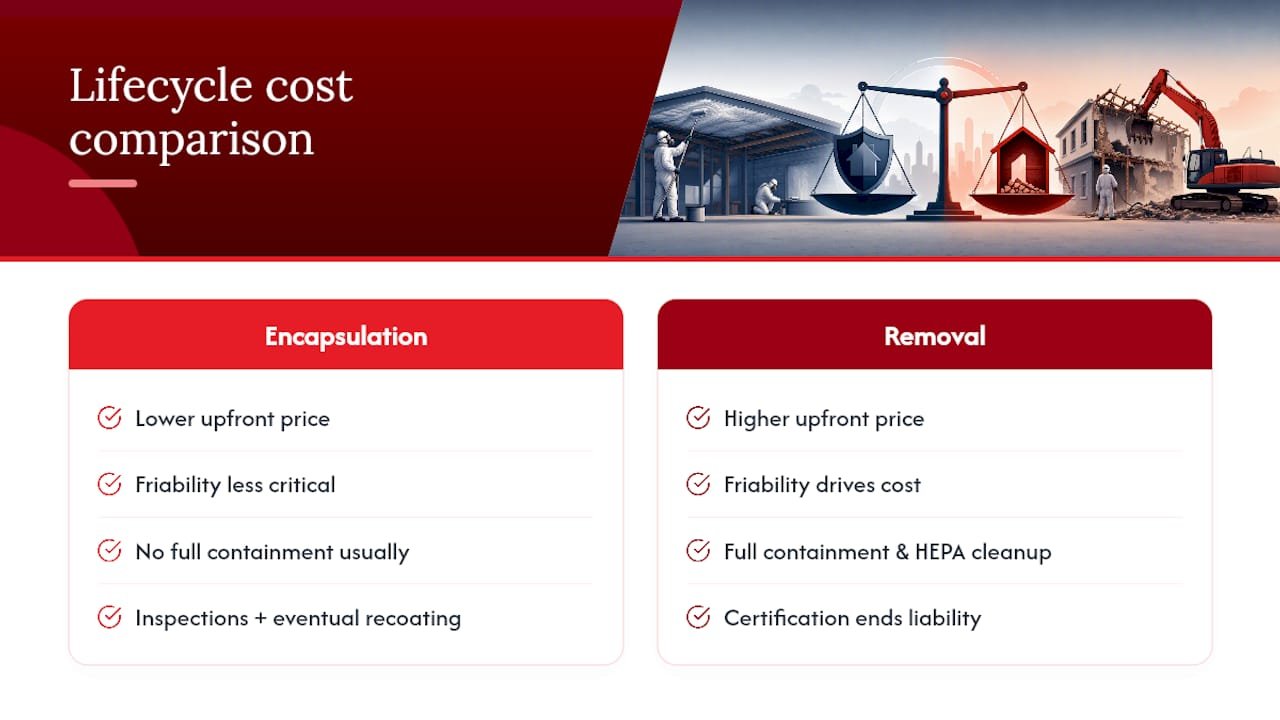
Encapsulation is almost always cheaper on day one. Removal costs more because friable material demands full containment, negative-air setups, wet removal, HEPA cleaning, and manifested disposal, and friability is the main cost driver, not square metre age.
A small patch of damaged pipe lagging can cost more to remove than a large sheet of intact non-friable cement board, simply because the lagging is friable and demands the full regulated process, while the cement sheet might not need containment at all if it’s stable and undisturbed.
Lifecycle cost is where the comparison gets interesting. Encapsulation’s lower upfront price comes with ongoing inspections and, eventually, re-coating, so the total cost over ten or fifteen years can creep up on you. Removal has no such tail. Once it’s certified clear, that line item disappears from your maintenance budget for good. Weigh both numbers, not just the quote in front of you.
What actually happens on site
Every job starts the same way, regardless of which method you land on.
- Survey and sampling. A licensed assessor identifies ACM, tests samples, and records findings in your asbestos register.
- Risk assessment. The assessor rates condition and disturbance likelihood, which decides encapsulation versus removal.
- Encapsulation path: surface preparation, then multiple coats with cure time between each, followed by inspection and clear labelling of the treated area.
- Removal path: containment goes up, negative air runs continuously, wet removal proceeds coat by coat, then HEPA cleaning, clearance testing, and disposal manifest sign-off.
Encapsulation jobs often wrap in hours to a couple of days. Removal, especially with containment and clearance testing, typically runs from several days to a few weeks depending on scope and how much of the building has to be sealed off.
Ongoing obligations you can’t skip
Whichever path you take, the paperwork doesn’t end when the trades person leaves. Every dutyholder needs an accurate asbestos register, clear labelling on treated or remaining material, and a documented management plan with scheduled inspections.
- Encapsulated areas need periodic re-inspection, with clear triggers for re-coating or upgrading to removal if the coating fails.
- Removed material needs a retained clearance certificate and disposal manifest as proof the job was done and closed out properly.
- Selling or leasing the property means disclosing asbestos status, and insurers increasingly ask for documentation before they’ll cover a claim.
None of this is optional admin. It’s the difference between a defensible position and a liability you didn’t know you were carrying.
Your decision checklist and contractor questions
Before committing to either path, work through this in order.
- Commission a licensed survey. Don’t guess based on the building’s age.
- Confirm friability and condition, not just presence of ACM.
- Check whether renovation, demolition, or high-traffic use is planned within the next few years.
- Estimate lifecycle costs for both options, not just the quote for the immediate job.
- Update your asbestos register regardless of which method you choose.
When you’re comparing quotes, ask directly: What’s your licence number? Can I see a written method statement? Who conducts clearance testing, and is it independent of your crew? What disposal evidence will I receive?
Pro Tip: Walk away from any quote that skips clearance testing or won’t name the disposal facility. A price that low usually means a step got cut, and that step is usually the one protecting you.
Materials that need a different approach altogether
Not every asbestos situation fits neatly into “coat it” or “remove it.” Some materials and conditions call for something else first, or rule both options out until conditions change.
Severely deteriorated friable material in a location you can’t fully contain, an occupied hospital ward, a live production floor, sometimes needs interim measures like temporary enclosure or restricted access before any permanent work starts. Rushing removal in a space you can’t seal properly risks spreading contamination further than leaving it alone would have.
Asbestos buried in inaccessible structural elements, inside a slab, behind a load-bearing wall you can’t open without compromising the structure, may be genuinely undisturbable in the short term. In these cases, the responsible move is documentation and a strict “do not disturb” management plan rather than forcing either encapsulation or removal onto material you can’t safely reach.
Weathered asbestos cement roofing that’s begun to friate from decades of sun exposure sometimes fails a basic friability test outright. When that happens, encapsulants won’t bond reliably, and the material won’t hold a coating. That’s the assessor’s call to make, not a guess, since a failed friability test typically points straight to removal.
And some jurisdictions and insurers simply won’t accept encapsulation for certain asbestos types, regardless of condition, particularly in childcare centres, schools, or aged care facilities. Local regulatory guidance overrides personal preference here every time.
Why the assessment should drive the decision, not the quote
The industry’s biggest blind spot is treating this as a cost question first. It isn’t. Removal isn’t automatically safer than encapsulation if it’s poorly planned, and encapsulation isn’t automatically cheaper once you count a decade of re-inspections and re-coating.
What actually works is starting with a proper survey, recording findings in a register, then choosing the method the material’s condition demands. A professional company runs that exact sequence: assess, document, then act, whether that means a licensed removal crew or a properly specified encapsulation job. In practice, that ordering tends to surface a straightforward result. Intact material in a stable, low-access area rarely needs the expense of full removal. Damaged material anywhere near planned works almost never survives a second inspection without needing to come out. The material tells you what to do; the job is listening properly before you quote.
— Tarek
Get a proper asbestos assessment before you commit to either path
Licensed professionals survey the material, provide honest advice on whether it’s a genuine candidate for encapsulation or needs licensed removal, and handle either job with clearance testing built in.
You’ll get more than a number on a page. A proper quote includes a written method statement, a realistic timeline, and independent clearance testing before the site is handed back, so you’re not left guessing whether the job actually met the standard. That matters whether you’re managing a single garage, a commercial fit-out, or a portfolio of ageing properties where asbestos might be lurking in more places than one register currently shows.
If you’re weighing encapsulation against removal right now, don’t start with a coating supplier or a demolition crew. Start with the survey. Book an asbestos removal assessment with Mission Demolition and get a decision based on what’s actually in your walls, not what sounded easiest on the phone.
Sources
- Protect your family from exposures to asbestos — EPA
- Guidelines for the use of encapsulants on asbestos-containing materials — EPA NEPIS
- What Asbestos Removal Costs, Job by Job (2026) – InspectandTest
- Asbestos encapsulation vs removal: making the right decision — HumanFocus
