Most standard residential site clearance jobs in Australia land somewhere between $15,000 and $45,000, though the final figure swings hard depending on one thing above all else: asbestos. Access constraints, waste volume and disposal fees matter too, but nothing moves a quote faster than whether the site tests clean or contaminated. Before you commit to anything, get a licensed asbestos inspection and collect at least three itemised quotes.
TL;DR:
- Asbestos type and quantity are the main factors influencing demolition and removal costs, with friable asbestos being significantly more expensive to remove.
- Site access, waste handling, and compliance requirements, such as permits and air monitoring, can add several thousand dollars to the total project cost.
- Accurate, comparable quotes must specify asbestos testing, license class, waste disposal, and clearance certificates to avoid hidden expenses during the job.
- Having a licensed, experienced contractor who plans properly reduces the risk of unexpected costs caused by missed issues or poor pre-job assessments.
Table of Contents
- Typical cost ranges at a glance: demolition, asbestos removal and common line items
- What drives the price: specific cost drivers contractors will charge for
- Asbestos, licences and legal duties (Australia): what must be done and who pays
- How to get accurate, comparable quotes and what to check on each estimate
- Timeline and typical extra fees to budget for
- Why hiring a licensed, experienced demolition contractor reduces cost risk
- Get a scoped, itemised quote from Mission Demolition
- Sources
Typical cost ranges at a glance: demolition, asbestos removal and common line items
A standard three‑bedroom house demolition with site clearance typically falls between $15,000 and $45,000, depending on scope, location and what’s underneath the roofline. That’s the headline figure. What actually lands you at the low end versus the high end comes down to the line items stacked on top of the base demolition price.
Asbestos removal is usually quoted separately and varies enormously by type:
- Bonded (non‑friable) asbestos sheeting: roughly $20 to $50 per square metre for straightforward jobs.
- Class B removals, such as fibro sheeting or garage cladding: typically $1,500 to $5,000.
- Class A (friable) removals: $5,000 to $20,000 or more, driven by containment, decontamination units and air monitoring.
- Garage or shed demolition with asbestos present often incurs several thousand dollars in total costs.
Pro Tip: Ask every contractor to separate the demolition fee from the asbestos removal fee on the quote. Bundled pricing hides which part of the job is actually expensive, and makes it impossible to compare quotes properly.
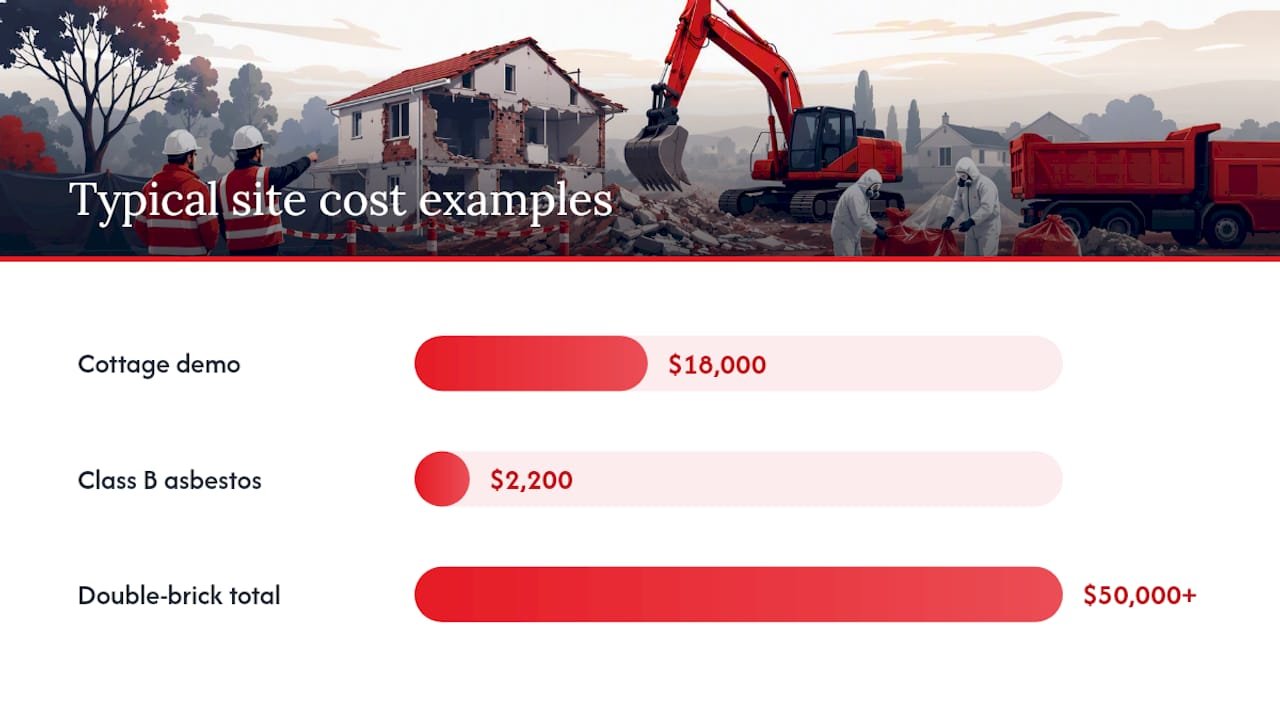
Add skip bins, tip fees, council permits, air monitoring and clearance certificates, and a “simple” demolition can climb by several thousand dollars before a single wall comes down. A weatherboard cottage with a fibro laundry, for example, might run $18,000 for demolition plus $2,200 for Class B removal and clearance testing. A double‑brick home with friable asbestos in the ceiling could tip past $50,000 once containment and monitoring are factored in.
What drives the price: specific cost drivers contractors will charge for
Quotes for what looks like the same job can differ by tens of thousands of dollars, and it’s rarely random; detailed demolition planning and plant requirements are key, as shown by Cornelius Wrecking’s typical workflows. Here’s what actually moves the number:
- Asbestos type and quantity. Friable material costs far more to remove than bonded sheeting, and sampling, lab testing and air monitoring all add separate fees.
- Building fabric and construction type. Double‑storey brick homes take longer to bring down and generate more waste than a single‑storey weatherboard.
- Site access and plant requirements. A tight inner‑city block with no truck access costs more than a wide suburban block a excavator can drive straight onto.
- Waste handling. Licensed asbestos transport, contaminated soil remediation, and standard demolition waste disposal are billed differently, and recycling or salvage can sometimes offset part of the bill.
- Timing and compliance overheads. Council permits, traffic management, hoarding, and any work at height or in confined spaces all add line items.
Pro Tip: If your site sits on a narrow lot or shares a boundary wall, ask upfront how the contractor plans to manage access. Machinery that has to be walked in piece by piece, rather than driven onto site, can add days and dollars you won’t see coming until it’s too late.
Asbestos, licences and legal duties (Australia): what must be done and who pays
Before any demolition work starts, the law requires that asbestos likely to be disturbed is identified and, so far as reasonably practicable, removed. This isn’t optional paperwork. It’s a statutory duty under the Work Health and Safety Regulations, and skipping it exposes property owners and contractors to serious penalties.
The Model Code of Practice for demolition work sets out that a demolition or refurbishment survey must happen first, feeding into an asbestos register before any structural work begins. This survey is where most of the “surprise” cost in a project originates. What looks like clean fibro sheeting on the surface can turn out to be friable once disturbed, and that changes everything about how the job is priced and executed.
Licensing splits into two tiers that matter enormously for cost:
- Class B licence: covers non‑friable (bonded) asbestos removal of any quantity, and is the more common licence for residential jobs.
- Class A licence: required for friable asbestos, which is far more hazardous to handle and drives the containment, decontamination and monitoring costs that push quotes into five figures.
Once removal work finishes, clearance inspections and certificates must be issued by an independent licensed assessor for Class A work, or an independent competent person for other licensed removals. Where air monitoring is used, fibre levels need to sit below 0.01 fibres per millilitre before the site is cleared for re‑occupation or further work. These inspections and certificates are a real cost line, not a formality, and they’re non‑negotiable under WHS law. A contractor who skips this step, or offers to, is not someone you want on your site.
How to get accurate, comparable quotes and what to check on each estimate
The single biggest reason homeowners get burned on site clearance is comparing quotes that aren’t actually comparable. A fair, itemised quote should include:
- Pre‑demolition asbestos inspection and survey results
- Licence class required for the job (and confirmation the contractor holds it)
- Safe Work Method Statement (SWMS) for the specific site
- Demolition method and estimated timeline
- Waste transport, disposal and tip fees, itemised separately from labour
- Clearance certificate and any air monitoring costs
- Explicit exclusions (what’s not covered)
Before signing anything, ask directly for licence numbers, insurance Certificates of Currency and recent project references. A legitimate operator will hand these over without hesitation. Our guide to how site clearing costs are calculated breaks down exactly how contractors build these figures line by line.
Watch for red flags: a suspiciously low quote with no asbestos line item at all, no mention of a SWMS, or vague answers about insurance. Pro Tip: Cross-check any licence number against your state’s WHS regulator register before paying a deposit. It takes five minutes and rules out unlicensed operators completely. Get at least three written quotes, and treat any contractor who won’t put pricing in writing as an immediate no.
Timeline and typical extra fees to budget for
Site clearance rarely runs on a single track. The usual sequence is inspection, then asbestos removal if required, then demolition, then air monitoring and clearance, then final site levelling. A straightforward residential job with no asbestos might take one to two weeks start to finish; add friable asbestos and containment, and it can stretch to four or five weeks once lab results and clearance scheduling are factored in.
Budget for extras beyond the headline quote:
- Council development approval or private certifier fees
- Utility disconnection charges (power, gas, water)
- Tip and landfill fees, which vary by council and waste type
- Contaminated soil testing and remediation, particularly relevant where asbestos has leached into the ground
Weather delays and council processing times are the two most common reasons a “two week job” runs into month three, so build a buffer into both your schedule and your budget.
Why hiring a licensed, experienced demolition contractor reduces cost risk
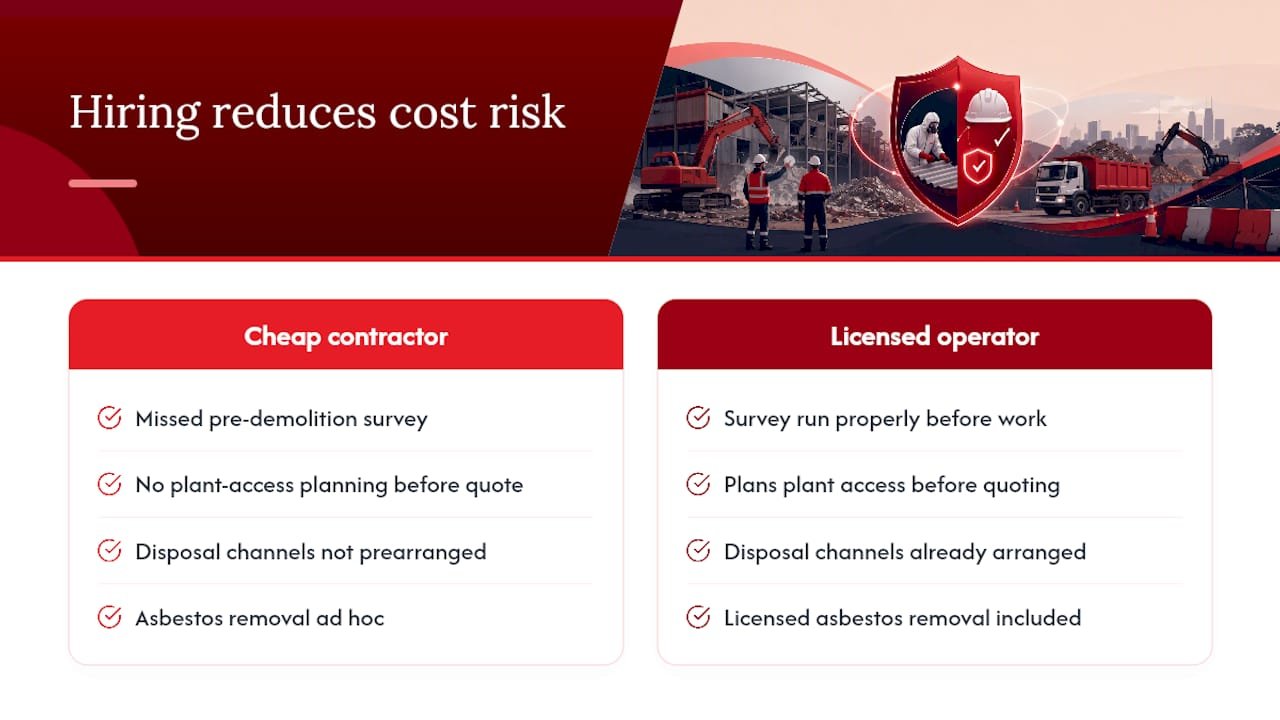
The biggest cost blowouts I see aren’t caused by expensive contractors. They’re caused by cheap ones who missed something in the survey stage and discovered it mid‑job, when change orders cost triple. An experienced operator runs the pre‑demolition survey properly, plans plant access before quoting, and already has disposal channels sorted for whatever waste category turns up.
Some demolition companies build their reputation on safe, fast and affordable demolition and licensed asbestos removal, with compliance paperwork handled as standard rather than as an afterthought. That’s the difference between a quote that holds and one that grows.
— Tarek
Get a scoped, itemised quote from Mission Demolition
There are licensed operators who handle the survey, the removal, the clearance certificate and the waste disposal, so clients are not chasing three separate contractors and hoping their timelines line up. Such teams may handle structure removal, licensed Class A and Class B asbestos remediation, and full site clearance with clearance certificates issued on completion.
An itemised quote from Mission Demolition typically breaks down the inspection findings, licence class required, demolition method, waste and disposal fees, and clearance certification, so you know exactly what you’re paying for before work starts. If your project involves any suspected asbestos, the asbestos removal Sydney service covers inspection through to clearance certificate. For a straightforward demolition scope, the professional demolition services Sydney page outlines what’s included. Request a site inspection to get pricing specific to your property, and always confirm licence and insurance details before signing.
Sources
- Demolition work: Model Code of Practice (Safe Work Australia)
- Asbestos removal cost Australia 2026 (What’s The Damage?)
- How to hire a licensed demolition contractor in Australia (TradieVerify)
- Work Health and Safety Regulations 2011 — Reg 452
