
If asbestos or asbestos-containing material is identified, assumed, or reasonably likely to be present at a workplace, the person with management or control must have a written asbestos management plan in place. That obligation comes straight from the Model Code of Practice and the WHS Regulations, and it applies whether you own a 1970s office block or manage a single rental property with fibro cladding.
TL;DR:
- An asbestos management plan must be created and maintained by the person in control whenever asbestos or ACM is identified, assumed, or likely based on building age and condition.
- The plan should reference the asbestos register, outline management decisions, control procedures, emergency actions, and specify roles and training, with review cycles shortened after any disturbance or significant change.
- Risk prioritization depends on material type, condition, accessibility, disturbance potential, and occupancy, with high-priority items needing action within weeks.
- Site workers, contractors, and health and safety reps must access the plan beforehand, and licensed assessors are required for complex tasks like demolition or soil contamination.
- Records including registers, survey reports, clearance certificates, and AMP versions should be retained for the building’s lifetime to ensure traceability and compliance.
Table of Contents
- What triggers the asbestos management plan requirement?
- What must the asbestos management plan actually contain?
- How often should an asbestos management plan be reviewed?
- How do you prioritise asbestos risks across a site?
- Who needs access to the asbestos management plan on site?
- When do you need a licensed asbestos assessor?
- What does a basic AMP checklist look like?
- What compliance gaps trip up most property managers?
- What penalties apply for AMP non-compliance?
- Who holds specific responsibilities under the plan?
- How does the AMP fit into a broader WHS policy?
- How long do you need to keep asbestos records?
- A practitioner’s view on treating the AMP as a live document
- Get help with surveys, AMP updates, and licensed removal
- Sources
- FAQ
What triggers the asbestos management plan requirement?
The obligation sits with the person conducting a business or undertaking (PCBU) who has management or control of a workplace. Under the Model Code, a written asbestos management plan (AMP) is required once asbestos or asbestos-containing material (ACM) is identified, assumed to be present, or is likely to be present given the age and construction of the building. Roughly one in three Australian homes built before 1990 contains some form of asbestos, so most older buildings fall into “assumed present” until a survey proves otherwise, according to the National Guide for Asbestos Surveys.
A few things worth knowing before you assume this doesn’t apply to you:
- The duty follows management or control, not necessarily ownership. A managing agent, head lessee, or facilities contractor can hold the duty even if someone else owns the building.
- Every state and territory enforces the same national model, but SafeWork NSW, WorkSafe WA, and other regulators publish their own templates, forms, and licensing rules, so check your local regulator for exact paperwork.
- Demolition and excavation sites carry extra obligations where soil disturbance is likely, as explained in this diagnostics avant démolition overview. Our guide on asbestos in soil removal covers the risk thresholds that trigger additional controls.
What must the asbestos management plan actually contain?
An AMP isn’t a formality document you file and forget. SafeWork NSW sets out the minimum contents, and the Model Code expands on how each element should work in practice.
- Link to the asbestos register. The AMP must reference the register that records the location, type, and condition of every identified or assumed ACM, including any survey report that informed those entries.
- Decisions and reasons. For each item of asbestos, the plan needs to state what you’ve decided to do (leave in place, encapsulate, remove) and why, based on condition and risk.
- Safe work procedures. Document the control measures for any work that might disturb ACM, including permit systems and exclusion zones.
- Incident and emergency procedures. Cover what happens if asbestos is accidentally disturbed or damaged, including who to notify and how the area gets isolated.
- Consultation, information, and training. Record how workers, health and safety representatives (HSRs), and contractors are told about ACM locations and trained in the relevant procedures.
- Recommended extras. A timetable for planned actions, named roles and responsibilities, and air monitoring arrangements where friable material is involved all strengthen the plan beyond the bare legal minimum.
How often should an asbestos management plan be reviewed?
The legal floor is once every five years, but several triggers should bring that forward. SafeWork NSW lists the specific circumstances that require an earlier review.
- Asbestos is removed, disturbed, or damaged anywhere on site.
- There’s a significant change to the premises, such as a refurbishment or change of tenancy.
- Management responsibilities change, for example a new managing agent takes over.
- A health and safety representative formally requests a review.
Keep a simple version-control log with the date of each review, who conducted it, and what changed. It sounds basic, but it’s the first thing an inspector or auditor will ask to see, and it’s the easiest record to lose track of when a property changes hands.
How do you prioritise asbestos risks across a site?
A register full of ACM entries is only useful once you know which items need attention first. National guidance recommends scoring each item against a handful of factors, an approach backed by risk assessment frameworks like the one published by the Australian National University.
- Material type: friable asbestos (crumbles easily, releases fibres readily) scores far higher than bonded, non-friable material.
- Condition: cracked, water-damaged, or deteriorating material outranks intact material in good condition.
- Accessibility: ACM within reach of workers or the public scores higher than material sealed behind a wall or above a ceiling.
- Disturbance potential: anything near planned maintenance, cabling runs, or foot traffic needs closer attention.
- Occupancy: high-traffic areas, especially where children, the elderly, or vulnerable groups are present, push priority up regardless of condition.
Most practitioners group results into three bands. High priority means damaged or friable material in accessible areas, and it typically demands action within weeks, not months. Medium priority covers intact but ageing material in moderate-traffic zones, reviewed on a six to twelve month cycle. Low priority is stable, non-friable material in low-access zones, monitored annually as part of routine inspection.
Pro Tip: Attach your priority scores directly to the register, not a separate spreadsheet. When the AMP and the register live in sync, budget approvals move faster because decision-makers can see the risk ranking and the dollar figure on the same page.
Who needs access to the asbestos management plan on site?
An AMP that sits in a filing cabinet protects nobody. Workers, HSRs, contractors, and any other PCBU conducting work at the site are all entitled to see it, and in most cases they need to see it before work starts, not after.
- Keep a hard copy on site in an accessible, clearly signed location, plus a controlled digital copy that’s version-locked so old ACM locations don’t circulate by mistake.
- Run a toolbox talk before any works that could disturb ACM, and get a signature or digital sign-off from every contractor involved.
- File training records and induction sign-offs alongside the plan itself, so you can prove communication happened if a regulator ever asks.
When do you need a licensed asbestos assessor?
Some situations call for specialist input rather than an in-house judgment call. Friable ACM, full or partial demolition, soil contamination, and any survey covering inaccessible areas typically require a licensed assessor or removalist, and several states mandate that identification itself be carried out by a licensed professional.
- Confirm which licence class covers your job (Class A covers friable material, Class B covers non-friable) before you engage anyone.
- Specify deliverables clearly: a written report, sample locations, lab results, and a clearance certificate where removal is involved.
- Ask for the report to reference the existing asbestos register so it slots straight into your AMP rather than sitting as a standalone PDF. Our asbestos survey guide breaks down what a proper survey report should contain.
What does a basic AMP checklist look like?
A workable checklist maps directly onto the Model Code’s minimum contents, with space for the extras that make the plan genuinely useful day to day.
- Register reference: confirm the AMP links to a current, dated asbestos register.
- Decision log: one line per ACM item stating the management decision and the reason.
- Safe work procedures: attach or reference SWMS documents for any work near ACM.
- Emergency contacts: name the person to call if asbestos is disturbed, plus the regulator’s incident line.
- Roles and responsibilities: list who owns each action item by name or position title.
- Attachments: survey reports, lab results, clearance certificates, and any demolition or removal permits.
Keep it to a handful of pages. A 40-page AMP nobody reads is worse than a tight one everyone actually uses, and our compliance checklist for removal projects is a useful companion once removal work is underway.
What compliance gaps trip up most property managers?
The single most common failure is a plan that never gets updated after removal or maintenance work. A contractor removes a section of eaves, clears the site, and nobody goes back to strike that item off the register or the AMP. Six months later, the plan says asbestos is present in a location where it no longer exists, and the next contractor treats it as a live hazard, or worse, assumes the whole document is unreliable and stops trusting it.
The fix is procedural, not technical. Attach a contractor sign-off register directly to the AMP, so every removal or disturbance job closes with a dated update before the crew leaves site. Run a short pre-work briefing for any trade working near known or assumed ACM, and keep that briefing on file. Version-control the digital copy so a superseded register can’t be mistaken for the live one. None of this requires new software or extra budget; it requires someone being named responsible for the update, and that person actually doing it within days, not weeks.
What penalties apply for AMP non-compliance?
Failing to maintain a required asbestos management plan is a breach of the WHS Regulations, and regulators treat it seriously because the consequences of getting it wrong are health consequences, not just paperwork ones. Penalties scale with the severity of the breach and whether it’s an individual or a body corporate facing the notice.
Regulators can issue improvement notices requiring specific fixes within a set timeframe, and non-compliance with that notice escalates the matter further. Where a failure to manage asbestos leads to a worker being exposed, or where a PCBU has ignored known risks, prosecutions under the WHS Act can result in substantial fines, and in the most serious cases, custodial sentences for individuals found to have shown reckless disregard for health and safety duties. Category 1 offences, involving reckless conduct that exposes someone to a risk of death or serious injury, carry the highest penalties under the model laws.
Beyond the formal penalties, there’s a practical cost that’s easy to underestimate: a stop-work order on an active demolition or refurbishment site. Every day a project sits idle because the AMP wasn’t current, or because asbestos wasn’t properly identified before works began, is a day of holding costs, contractor idle time, and delayed handover. For most property owners, that commercial exposure hurts more than the fine itself.
Who holds specific responsibilities under the plan?
An AMP only works if every named role actually understands what they’re accountable for, because a document that assigns responsibility to “management” in the abstract tends to fall through the cracks the first time someone changes jobs.
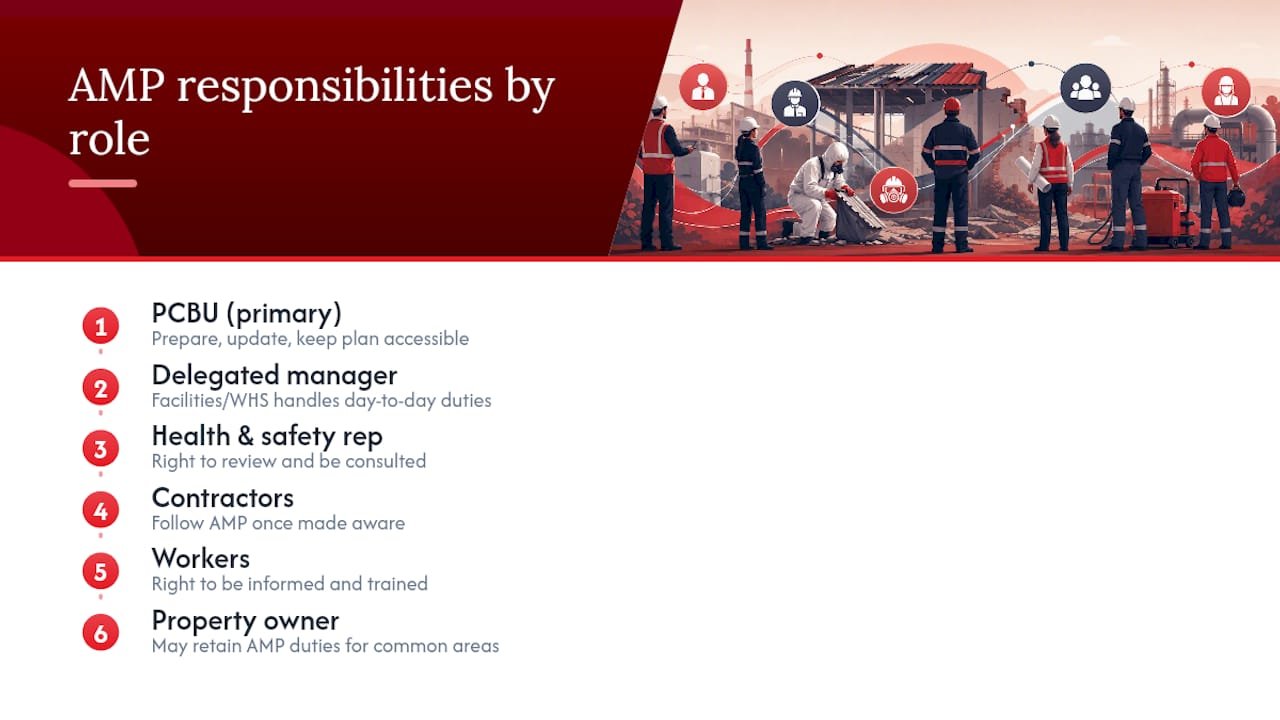
The PCBU with management or control holds the primary duty: preparing the plan, keeping it current, and making sure it’s accessible. Within larger organisations, that duty is usually delegated to a facilities manager or WHS officer, but delegation doesn’t remove the PCBU’s underlying legal obligation if the plan is neglected. Health and safety representatives have a formal right to request a review and to be consulted on decisions affecting worker safety, which means shutting them out of the process isn’t just poor practice, it’s a compliance gap in itself.
Contractors and other PCBUs working on site carry their own duty to follow the AMP’s procedures once they’re made aware of them, which is exactly why sign-off registers matter: they prove the information was actually communicated, not just filed. Workers have the right to be informed and trained, and that training obligation sits with whoever engages them, whether that’s the head contractor or the site PCBU. Property owners who lease to a business, but retain management control of common areas or building fabric, often retain AMP obligations for those shared spaces even after handing day-to-day operations to a tenant, a distinction that gets missed surprisingly often in commercial leases.
How does the AMP fit into a broader WHS policy?
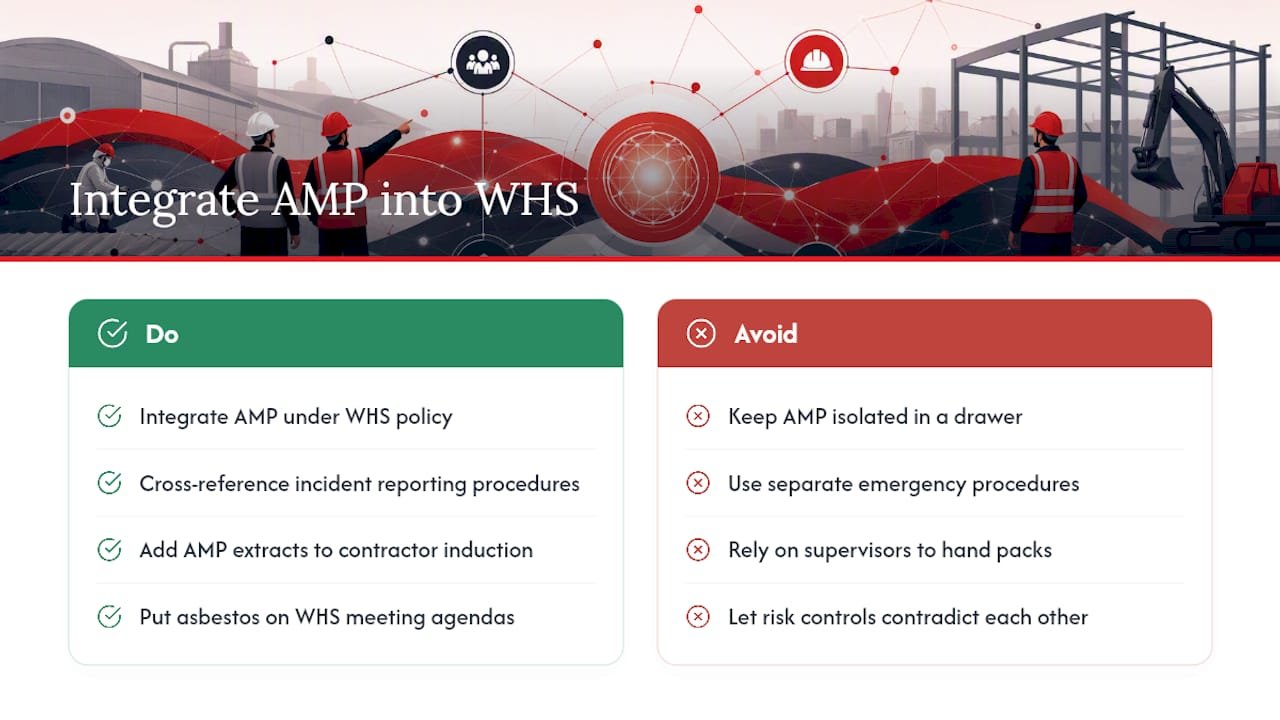
An asbestos management plan that exists in isolation from the rest of a workplace’s health and safety system tends to get forgotten the moment attention shifts elsewhere. The strongest approach treats the AMP as one operational document sitting under the umbrella of the organisation’s overall WHS policy, cross-referenced with incident reporting procedures, contractor induction processes, and risk registers covering other hazards.
Practically, that means the AMP’s emergency procedures should align with the site’s broader emergency response plan, not sit as a separate protocol nobody remembers during an actual incident. Contractor induction packs should include the relevant AMP extracts as standard, rather than leaving it to individual site supervisors to remember to hand them over. Risk assessments conducted for other hazards, like working at heights or confined spaces, often overlap physically with areas containing ACM, so cross-checking the asbestos register against other hazard maps avoids a scenario where two different risk controls contradict each other on the same job.
Consultation arrangements matter here too. If your organisation already runs regular WHS committee meetings, asbestos status updates belong on that agenda rather than in a separate, easily skipped review cycle. The goal is one coherent safety system where the AMP is a chapter, not a standalone binder gathering dust in a drawer while the rest of the WHS program moves on without it.
How long do you need to keep asbestos records?
Asbestos records carry longer retention expectations than most other WHS documentation, largely because asbestos-related disease can take decades to appear after exposure. Registers, AMPs, survey reports, and clearance certificates should be retained for the life of the building, not just for a standard seven-year business records period.
Practically, that means keeping every version of the AMP, not just the current one, so there’s a clear history of what was known and decided at each point in time. Survey reports and lab results should be stored alongside the register entries they informed, with clear dates, so a future duty-holder, or a former worker seeking to establish exposure history, can trace exactly when and where asbestos was identified. Clearance certificates from any removal work should be kept indefinitely as proof that specific areas were remediated and independently verified.
Digital storage makes this far more manageable than the paper-based systems many older organisations still rely on, but only if it’s backed up and accessible beyond any single staff member’s laptop or inbox. If a business changes hands, these records should transfer with the property, since the next PCBU inherits both the asbestos and the legal duty to manage it.
A practitioner’s view on treating the AMP as a live document
An accurate AMP has stopped more than one demolition from stalling on a start date, simply because the register already answered the questions an inspector would otherwise ask on site. Treat it as active project paperwork, not a compliance afterthought.
— Tarek
Get help with surveys, AMP updates, and licensed removal
Specialist companies work with property owners and managers who need their asbestos paperwork to hold up under scrutiny, not just look complete on paper. That means proper surveys that feed straight into a usable register, AMP updates after removal or maintenance work, and licensed removal handled by crews who close the loop on documentation, waste manifests, and clearance certificates, rather than leaving you to chase paperwork after the job’s done.
If your current AMP hasn’t been touched since the last tenant moved out, or you’re not sure whether your register matches what’s actually in the building, that’s the gap worth closing before a regulator or a buyer’s due diligence finds it first. Missiondemolition’s licensed asbestos removal team can run a site survey, flag priority items, and hand you a plan that’s actually usable, not just filed. Book a site assessment and get a straight answer on what needs doing and what it’ll cost before you commit to anything.
Sources
- How to manage and control asbestos in the workplace — Model Code of Practice (Safe Work Australia)
- Asbestos registers and management plans – SafeWork NSW
- National Guide for Asbestos Surveys
FAQ
What are the current Australian standards for asbestos safety?
Australia follows the Model WHS laws, with the Safe Work Australia Model Code of Practice setting the national technical standard, supplemented by state-specific regulator guidance and licensing rules.
How often should an asbestos management plan be reviewed?
At least once every five years, but sooner if asbestos is removed or disturbed, the premises or management responsibilities change significantly, or a health and safety representative requests a review, per SafeWork NSW.
Can you provide an example of an asbestos management plan?
A basic AMP includes a link to the asbestos register, a decision log with reasons for each management choice, safe work procedures, emergency contact details, named roles, and attached survey or clearance reports, structured around the checklist outlined earlier in this guide.
Who is legally required to have an asbestos management plan?
Any PCBU with management or control of a workplace where asbestos is identified, assumed, or likely present must have a written AMP, regardless of whether they own the building or manage it on someone else’s behalf.
What happens if a workplace doesn’t have an AMP?
Regulators can issue improvement notices, and continued non-compliance can lead to prosecution under the WHS Act, with penalties scaling up to serious fines and, in cases of reckless disregard, custodial sentences for individuals.
