
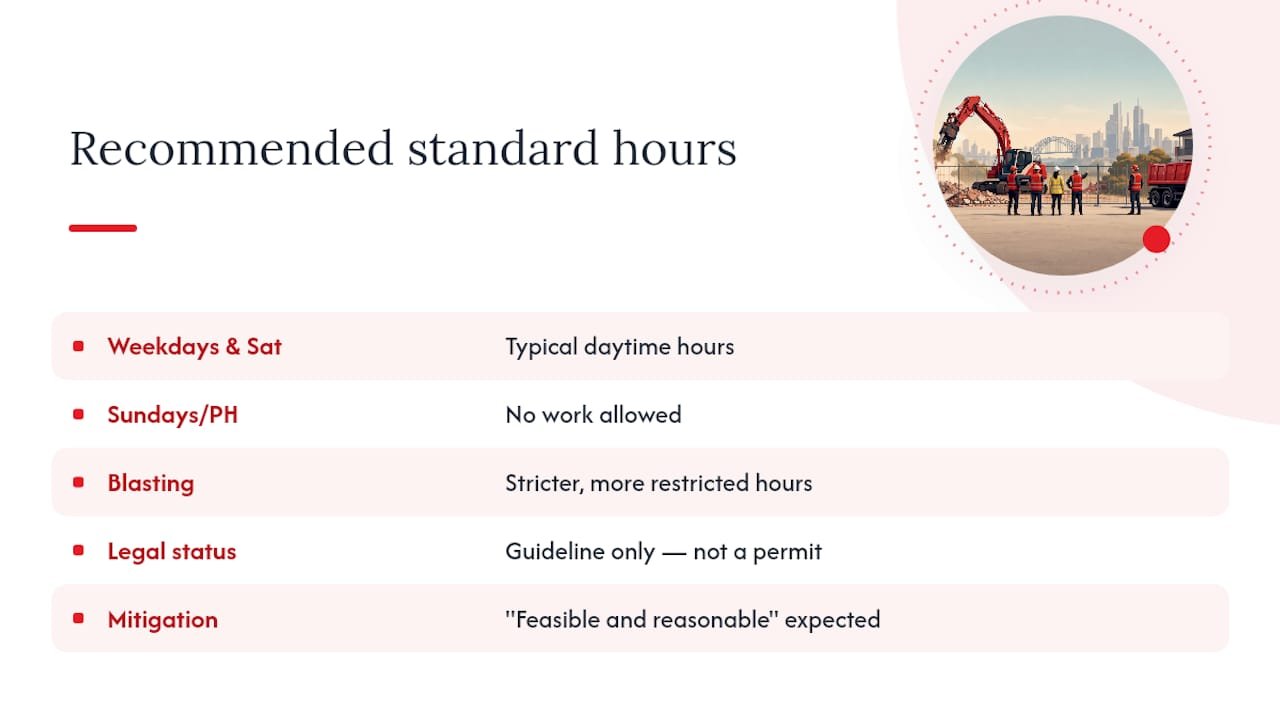
Standard demolition working hours in NSW generally run during typical daytime hours on weekdays and Saturdays, with no work permitted on Sundays or public holidays. That’s the NSW Environment Protection Authority’s recommended benchmark, not an automatic legal right. Your actual permitted hours come from your development consent or complying development certificate, or your local council’s construction policy, and any of these can set tighter limits, especially for rock breaking, piling, or other high-noise demolition activities.
TL;DR:
- The NSW Environment Protection Authority’s recommended demolition hours are daytime on weekdays and Saturdays, with stricter limits on blasting activities, but actual permitted hours depend on site-specific consent or council policies.
- Development consent, complying development certificates, and local council plans can impose tighter or different hours, especially for high-noise activities like rock breaking or pile driving.
- Out-of-hours work may be approved only for emergencies, infrastructure maintenance, or projects with community support, requiring detailed plans, reports, and early application submission.
- Stricter hours often apply to activities like rock breaking, jackhammering, and heavy demolition to reduce noise and vibration impact on nearby residents.
- Enforcement actions from councils or the EPA, such as notices or fines, can occur even if work stays within permitted hours, emphasizing the importance of thorough planning and mitigation.
Table of Contents
- What the NSW recommended standard hours actually say
- Why hours can differ: council policies, development consent and CDCs
- Activities that commonly face stricter demolition hours
- Out-of-hours work: when it may be approved
- How to check permitted hours and prepare an application
- Complaints and enforcement: what happens next
- How licensed demolition contractors plan compliant, low-impact demolition
- Need help staying compliant? Here’s what Missiondemolition offers
- Contractor perspective on getting this right
- Sources
- FAQ
What the NSW recommended standard hours actually say
The Interim Construction Noise Guideline (NSW EPA) sets out recommended standard hours for construction and demolition work across the state. These aren’t a permit or a licence. They’re a reference point the EPA expects councils, consent authorities, and contractors to work from when setting site-specific conditions.
For ordinary demolition and construction, recommended hours typically cover standard daytime hours on weekdays and Saturdays, with no work allowed on Sundays and public holidays. Blasting activities usually observe stricter time limits during weekdays and Saturdays due to their higher disturbance potential.
Pro Tip: Don’t assume the EPA’s recommended hours are your legal ceiling. Always cross-check them against your own development consent or CDC conditions, because a council can (and often does) impose different hours for your specific site.
The guideline’s underlying logic matters more than the numbers themselves. The EPA frames construction noise as an unavoidable but manageable side effect of a growing city, and it asks proponents to apply “feasible and reasonable” noise mitigation rather than simply working within the time limits. That phrase, feasible and reasonable, shows up throughout NSW planning and environmental law, and it’s a judgement call, not a checklist. A contractor with quieter plant, staged works, and a clear community notification plan has a stronger claim to reasonableness than one who just points at the recommended hours table.
Recommended standard hours at a glance
Standard construction and demolition work is generally expected to occur during typical daytime hours on weekdays and Saturdays, with no work on Sundays or public holidays. Blasting activities are subject to more restricted hours during these days due to noise and safety concerns.
This table is the EPA’s default. Your council’s development control plan or your specific consent conditions can narrow it further, and in some cases widen it for particular zones. The insights on the EPA’s own framing make clear that developers carry the burden of showing why any deviation from these hours is necessary, not the other way around.
Why hours can differ: council policies, development consent and CDCs
Three separate documents can govern your permitted hours, and they don’t always say the same thing. Your development consent is the legally binding approval issued for your specific project, and if it specifies working hours, those hours override the EPA’s general guidance for your site. A complying development certificate (CDC) works the same way for projects that don’t need full development consent, often carrying its own set of conditions. Local council policies, usually embedded in a Development Control Plan (DCP), fill the gaps when your consent or CDC is silent on hours.
Council examples show how much this varies across NSW. City of Sydney’s construction noise policy sets different allowable hours depending on location, with more generous windows in the city centre than in residential pockets, and it restricts particularly noisy activities in sensitive areas regardless of the general hours. North Sydney’s DCP goes further, specifying primary construction hours by zone and allowing internal fit-out work outside those hours under certain conditions, while still requiring an out-of-hours permit for anything genuinely disruptive.
Randwick Council, like most residential-heavy LGAs, tends to hold closer to the EPA’s standard hours with limited appetite for extensions, reflecting the density of homes near typical demolition sites.
Here’s where to check before you assume anything:
- Read your development consent or CDC conditions first. Search for the words “hours,” “noise,” or “construction times.”
- Check for an Environment Protection Licence if your project involves large-scale demolition. It may carry its own noise conditions.
- Pull your council’s DCP, usually available on the council website, and look for the construction management or noise chapter.
- If your project sits near a zone boundary (commercial fringe next to residential, for instance), check whether different hours apply to each side of that line.
Albury City’s guidance is a useful reminder for regional NSW readers too: councils summarise standard hours but expect residents to check their own LGA policy, because the detail sits at the local level, not in a single statewide rulebook.
Activities that commonly face stricter demolition hours
Not all demolition noise is treated equally. Councils routinely single out specific high-impact activities for tighter time windows than the general site hours, because these tasks produce short bursts of very high noise and vibration that standard mitigation struggles to fully absorb.
Activities that typically attract extra restrictions:
- Rock breaking and rock sawing
- Pile driving and other deep foundation work
- Jackhammering and concrete breaking
- Heavy demolition of masonry or reinforced structures near residential boundaries
The reasoning is practical rather than bureaucratic. A jackhammer running for eight hours straight is a different proposition to eight hours of general site clean-up noise, and vibration from rock breaking can affect nearby structures, not just eardrums. Councils often respond by shortening the daily window for these specific tasks, requiring them to occur mid-week only, or demanding they’re clustered into the least disruptive part of the day.
Mitigation options exist, and a contractor who uses them has a genuinely stronger case for any hours flexibility they later request. Alternative demolition methods, like hydraulic crushing instead of impact breaking, cut peak noise significantly. Quieter plant selection, acoustic screening, and scheduling the loudest tasks for late morning rather than opening hour all reduce complaint risk.
Pro Tip: Stage your noisiest tasks together and knock them out within a tighter block, rather than spreading rock breaking or jackhammering across several days. Neighbours tolerate one bad day far better than five mediocre ones.
Out-of-hours work: when it may be approved
Out-of-hours approval isn’t handed out for convenience. The EPA and most councils assess applications against a narrow set of justifications, and the EPA’s own guidance outlines the categories that typically qualify:
- Emergency work needed to protect life, property, or the environment
- Maintenance of public infrastructure where standard hours aren’t practical
- Public infrastructure projects that have secured genuine community support for extended hours
- Delivery of oversized plant or materials that can’t reasonably move during standard traffic hours
- A demonstrated need that goes beyond simple scheduling convenience or cost saving
Councils expect a real paper trail behind any application. Standard supporting documents include a Construction Management Plan (CMP), a noise or traffic impact report, and evidence of community consultation, such as letters sent to neighbours or a record of a doorknock. North Sydney Council’s DCP spells out the kind of detail expected, and most other councils follow a similar template.
A checklist for your application:
- Confirm the specific category your work falls under (don’t apply on “we’re behind schedule” alone)
- Draft a CMP with a staged schedule showing exact dates, times, and equipment for the noisy tasks
- Commission a noise or traffic report if your council requires one for the activity type
- Notify affected neighbours in writing before lodging, and keep a record of that notification
- Lodge with enough lead time. Late applications are a common refusal trigger
- Be ready to accept conditions, such as a cap of three consecutive nights or restricted equipment types
Applications get refused for predictable reasons: insufficient justification, a site history of complaints, proximity to sensitive land uses like hospitals or schools, or a permit already granted nearby for the same period. Councils are far more receptive to a concrete, measurable plan than a general request for flexibility.
How to check permitted hours and prepare an application
Confirming your actual permitted hours takes four steps, and skipping any of them is how sites end up with a stop-work order on day one.
- Locate and read your development consent or CDC in full. Search specifically for construction hours, noise conditions, and any reference to an Environment Protection Licence. Don’t rely on a summary from your builder or a real estate agent.
- Cross-check against your council’s construction hours policy and the EPA’s Interim Construction Noise Guideline. Where your consent is silent, the council DCP usually fills the gap, and the EPA guideline sits underneath both as the general benchmark.
- Compile your evidence pack before you need it, not after a complaint lands. This means:
- A noise or vibration assessment if your works include rock breaking, piling, or heavy machinery
- A Construction Management Plan detailing mitigation measures
- A community consultation record, even something as simple as a letterbox drop with dates and contact details
- Follow up in writing and keep every record. If a council requests changes to your application or denies an out-of-hours request, document the response and be prepared to adjust your work methods, staging, or equipment rather than pushing ahead regardless.
Building this evidence early, ideally before your demolition contractor mobilises on site, gives you room to negotiate rather than react. If you’re still working through your approvals, a guide to demolition permits in Sydney walks through the documentation most sites need before work can legally start.
Complaints and enforcement: what happens next
Noise complaints against a demolition site typically go to either the local council or the EPA, and both have real enforcement teeth. Councils can issue noise control notices requiring specific mitigation within a set timeframe. The EPA can issue prevention notices, impose fines, or in serious or repeated cases, order a stop-work. Operating within your permitted hours doesn’t fully protect you either. A site producing unreasonable noise, even inside the approved window, can still face action.
If a complaint lands on your site, the practical response matters more than the paperwork:
- Pause the specific noisy activity if reasonably possible, even briefly, while you assess the complaint
- Document what was happening at the time, including equipment in use and the exact hours
- Contact the complainant or the council directly rather than letting it sit
- Apply additional mitigation immediately if there’s an obvious fix, like relocating plant or adding a screen
Pro Tip: Keep a running noise and complaints log for every site, even when things are going smoothly. Councils and the EPA respond far more favourably to a contractor who can show a documented history of mitigation than one who only produces evidence after a formal notice arrives.
How licensed demolition contractors plan compliant, low-impact demolition
Contractors who work NSW demolition regularly build compliance into the plan before the first excavator arrives. That usually means a pre-consent site assessment to flag noise-sensitive neighbours, a Construction Management Plan drafted specifically for that site rather than a generic template, and noisy tasks staged into tight blocks rather than spread across the project.
Quieter plant selection plays a bigger role than most property owners expect. Choosing hydraulic crushing over impact breaking, or scheduling rock work for a single concentrated period, reduces both complaint risk and the odds an out-of-hours request gets refused later.
The strongest applications come from contractors who can point to a documented history: previous noise monitoring, past complaint responses, and evidence they’ve applied feasible and reasonable mitigation consistently, not just when asked.
Need help staying compliant? Here’s what Missiondemolition offers
Getting the hours right is only half the job. The other half is making sure the demolition itself is done safely, lawfully, and without triggering the kind of complaint that stalls a project. Professional demolition contractors often manage these tasks: checking consent conditions before mobilising, drafting Construction Management Plans that hold up under council scrutiny, and running licensed asbestos removal alongside structural demolition where a site needs both.
If your project involves noisy demolition activities like rock breaking or heavy structural work, getting the staging and mitigation plan right upfront is the difference between a smooth job and a stop-work notice. A demolition team can review your development consent, flag any hours or noise conditions you might have missed, and build a demolition schedule around them rather than against them. Check your site’s requirements and request a professional demolition assessment before locking in a start date, or explore residential demolition services if you’re planning a house or structure removal in the near future.
Contractor perspective on getting this right
Most disputes over demolition hours don’t come from contractors deliberately flouting the rules. They come from a genuine gap between what the EPA’s recommended hours say and what a specific site’s consent actually requires, and nobody checked closely enough before work started.
The EPA guideline gets treated by too many people as the law, when it’s actually a floor that councils build on, not a ceiling that protects you. I’d argue the real skill in compliant demolition isn’t knowing the standard hours table. It’s knowing which document on your specific site overrides it, and building a mitigation plan solid enough that you rarely need an out-of-hours exception in the first place.
The contractors who avoid stop-work notices aren’t the ones who work fastest. They’re the ones who treat a noise complaint as a planning failure worth preventing, not a cost of doing business. That distinction shapes every decision from plant selection to scheduling, and it’s the difference between a project that finishes on time and one that spends its second week fielding calls from an angry council officer.
— Tarek
Sources
- Interim Construction Noise Guideline (NSW EPA)
- Construction site noise – City of Sydney
- NSDCP 2013 – Part B – Section 11 – Construction Management
- Construction noise | NSW Environment Protection Authority
- Construction noise and working hours – Albury City
FAQ
What time does construction noise have to stop in NSW?
The EPA’s recommended standard hours generally require demolition and construction work to occur during typical daytime hours on weekdays and Saturdays, with no work on Sundays or public holidays. Your specific development consent or council policy can set different, often tighter, limits.
What is the demolition code in NSW?
There’s no single “demolition code” as such. NSW demolition is governed by a combination of the EPA’s Interim Construction Noise Guideline, your development consent or CDC conditions, and your local council’s construction management policy, all of which need checking together.
Is it illegal to vacuum after 10pm?
Household noise like vacuuming falls under general environmental noise rules rather than construction hour restrictions, and enforcement typically depends on whether the noise is deemed offensive under state noise regulations rather than a fixed time cutoff. This sits outside the demolition-specific hours covered by the EPA construction guideline.
What are the Australian standards for demolition?
Demolition work in NSW is subject to safety and process requirements set by Australian Standards, which works alongside, not instead of, the noise and hours conditions set by your council and consent documents.
How do I get approval to work outside standard demolition hours?
You need to apply for an out-of-hours permit through your council, supported by a Construction Management Plan, a noise or traffic report, and evidence your request fits one of the EPA’s recognised categories, such as emergency work or oversized deliveries. Councils generally require this lodged well ahead of the planned work, not as an afterthought.
