
Slab sawing, wall sawing, wire sawing, core drilling, and handheld or ring sawing cover almost every job you’ll face, and picking between them comes down to one question: what do the thickness, reinforcement, access, and finish demand? Get that match wrong and you’ll burn through blades, blow your budget, or worse, hit a service line. Every method below also needs proper dust control and a written safety plan before the saw starts.
TL;DR:
- Proper job sequencing, including GPR scans and structural checks, is essential for avoiding costly mistakes such as hitting hidden services or overloading structures.
- Larger, reinforced, or deeper cuts typically require wall sawing or wire sawing, especially when vertical or heavily reinforced sections are involved.
- Wet cutting with water suppression remains the standard for dust control, and slurry management plans must be established before starting to prevent environmental hazards.
- For complex or heavily reinforced jobs, professional contractors always perform site surveys, provide written safety plans, and verify proper waste disposal measures.
- DIY concrete cutting is unsuitable for high-precision, load-bearing, or asbestos-related projects due to safety, compliance, and cost considerations.
Table of Contents
- What concrete cutting methods actually cover
- Slab sawing: cutting floors, roads and driveways
- Wall sawing: precise vertical and angled openings
- Wire sawing: massive or heavily reinforced sections
- Core drilling: clean holes for pipes, anchors and testing
- Handheld, ring and stitch drilling for tight spots
- Managing dust, silica and site risk on every job
- How to choose the right concrete cutting method
- What Mission Demolition has learned from complex cutting jobs
- When DIY concrete cutting stops making sense
- How Mission Demolition handles precision cutting and slab removal
- Sources
- FAQ
What concrete cutting methods actually cover
Concrete cutting isn’t one job. It’s a family of techniques for making openings, trenches, slab removals, and test samples in a material that’s often reinforced with steel and sitting on top of pipes, cables, or conduits nobody documented properly.
Choosing the right approach comes down to four practical questions:
- Thickness: how deep does the cut need to go, and does the equipment reach that depth?
- Reinforcement: is there steel mesh or rebar, and how much?
- Access: can a track saw or road saw physically get positioned, or are you working in a tight room?
- Finish and constraints: does the job need a clean edge, low vibration, or minimal dust in an occupied building?
The rest of this guide runs through slab sawing, wall sawing, wire sawing, core drilling, and the handheld techniques that fill the gaps those bigger machines can’t reach.
Slab sawing: cutting floors, roads and driveways
Slab sawing, sometimes called flat sawing, is the workhorse for horizontal surfaces. A diamond blade mounted on a wheeled frame rolls across the floor, road, or driveway, cutting straight lines at a controlled depth. Walk-behind saws suit smaller jobs and confined yards; self-propelled road saws with bigger blades handle longer runs and thicker pavement. Both come in petrol, electric, or hydraulic versions depending on ventilation and power access on site.
Depth is the main limitation. Slab sawing typically reaches up to about 24 inches, which covers the vast majority of residential and light commercial slabs, but anything thicker or heavily reinforced usually needs a different method or a combined approach.
Wet cutting is standard practice here, not an optional extra. Water suppresses dust and cools the blade, though it creates slurry that has to be contained and disposed of properly rather than washed into stormwater drains.
- Common uses: expansion joints, utility trenches, partial slab removal, control joints in new pavement
- Vibration is generally lower than percussive breaking, useful near existing structures
Pro Tip: Mark your cut lines and check for embedded conduit with a scanner before you start. A five-minute scan costs far less than replacing a severed cable.
Wall sawing: precise vertical and angled openings
Wall sawing is the method when you need a clean vertical or angled cut, typically for door openings, window enlargements, or façade alterations. The saw runs on a track that’s anchored to the wall, and the blade is fed through the concrete on a guided arm, often controlled remotely so the operator stands clear of the cutting zone.
Penetration depth commonly varies depending on the equipment, which covers most load-bearing walls and structural panels. The track system is what makes wall sawing so accurate. Because the blade follows a fixed rail rather than a freehand pass, overbreak (the ragged extra material around a cut edge) stays minimal, and the opening comes out square.
- Precision cuts with minimal overbreak compared to handheld methods
- Remote operation improves operator safety on vertical and overhead work
- Requires enough clear space to mount and anchor the track, which rules it out in very tight rooms
The trade off is setup. Mounting a track rig takes time and floor or wall space that a handheld saw doesn’t need, so wall sawing earns its keep on jobs where accuracy matters more than speed.
Wire sawing: massive or heavily reinforced sections
When a section of concrete is too thick, too irregular, or too heavily reinforced for any circular blade to reach through, wire sawing takes over. A continuous loop embedded with diamond segments runs around pulleys positioned on either side of the cut, driven by a motorised unit that tensions and pulls the wire through the material. There’s effectively no depth ceiling, because the wire simply wraps around whatever cross-section it needs to reach.
This makes it the method of choice for bridge piers, pile caps, thick foundation blocks, and even underwater cutting where circular saws can’t operate at all.
- Suited to cross-sections too large or too irregular for track or road saws
- Handles heavy reinforcement without stalling or overheating a blade
- Setup involves pulley placement, wire tensioning, and often a cooling water supply
Technical guidance from Darda’s overview of concrete cutting methods notes that experienced crews often follow a wire cut with hydraulic splitters to detach the isolated block, which limits vibration and secondary cracking compared to breaking the whole section loose at once. The trade off is time and crew skill. Wire sawing takes longer to rig than a walk-behind saw, and it’s not a job for an inexperienced operator.
Pro Tip: If you’re quoting a job with heavy reinforcement and no clear cut line, ask whether the contractor plans to combine wire sawing with splitting. That sequencing detail tells you a lot about how carefully they’ve thought the job through.
Core drilling: clean holes for pipes, anchors and testing
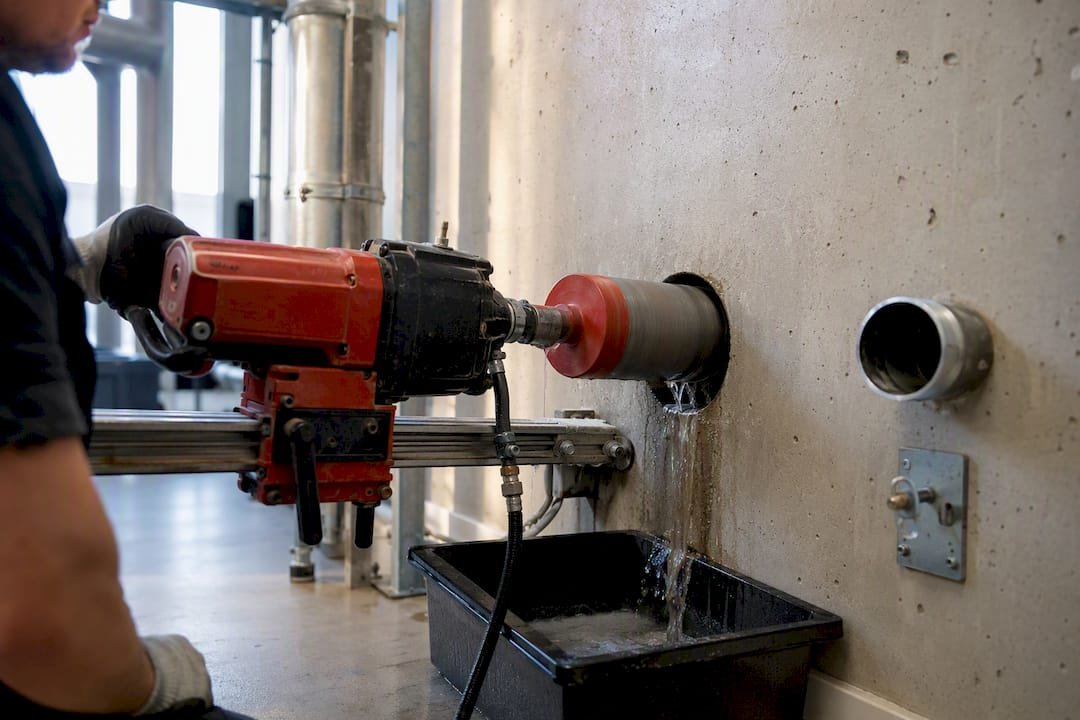
Core drilling produces round holes rather than straight lines, and it’s the go to method whenever a job calls for a pipe penetration, an anchor bolt hole, an electrical conduit run, or a concrete sample for lab testing. A diamond-tipped, hollow bit rotates into the surface and removes a cylindrical plug rather than grinding the material to dust.
Handheld coring works for small diameters and quick jobs; rig-mounted coring, secured with a vacuum base or mechanical anchors, handles larger diameters and keeps the bit perfectly perpendicular for structural accuracy. Common hole sizes run from around 20mm for anchor points up to several hundred millimetres for large service penetrations.
- Low vibration and minimal disturbance to surrounding concrete
- Water cooling is standard, and rebar encountered mid core generally requires a slower feed rather than a different tool
- Ideal for utility penetrations, structural sampling, and anchor installation where a straight cut would waste material
Because coring is so targeted, it’s often the cheapest and fastest option when the job genuinely only needs a hole rather than a full section removed.
Handheld, ring and stitch drilling for tight spots
Not every job has room for a track rig or a road saw. Handheld saws and ring saws fill that gap, cutting into corners, tight rooms, and awkward angles that bigger equipment simply can’t access. Ring saws in particular can complete a full depth cut from one side using a circular blade guided around a roller, useful where you can’t get to both faces of a wall.
Stitch drilling takes a different approach entirely. Instead of a continuous cut, a series of overlapping holes is drilled along the intended line, and the remaining webs are broken out by hand. It’s slower than sawing, but it produces almost no vibration, which makes it the preferred technique where overcutting into an adjoining structure is unacceptable, according to Darda’s technical notes on cutting method selection.
- Handheld saws suit shallow to moderate depths and detail work around obstructions
- Never perform inverted (overhead) cutting with a handheld saw. It’s a specific prohibition in Australian safety guidance because of blade kickback risk
- Combining stitch drilling with a follow up saw cut often speeds up an otherwise slow, detail heavy job
Operators need proper training here, not just because of the equipment, but because judgement about blade condition and cutting angle matters more on freehand work than on track guided cuts.
Managing dust, silica and site risk on every job
Every method above shares the same non-negotiable hazard: respirable crystalline silica, or RCS, released when concrete is cut dry. It’s a serious, well-documented occupational health risk, and it’s why official guidance on cutting, drilling and grinding concrete treats wet cutting as the default control measure. Continuous water flow suppresses dust at the point of cutting and cools the blade at the same time. Where wet cutting genuinely isn’t feasible, the fallback is HEPA-filtered vacuum extraction paired with a properly fitted P2 or P100 respirator, not a standard dust mask.
Water use also creates slurry, and containing that slurry so it doesn’t run into drains or neighbouring properties is part of the job, not an afterthought. A dust control and slurry management resource covers the practical side of that in more detail, and pairing it with proper post-job cleanup, the kind covered in HEPA cleaning guidance for construction dust, closes the loop on airborne residue that lingers after the saw stops.
Before any blade touches concrete, the Safe Concrete Cutting and Drilling Industry Standard calls for a documented Safe Work Method Statement and a scan of the cutting area using ground penetrating radar to identify buried services and reinforcement before anyone commits to a cut line.
- Exclusion zones keep bystanders clear of blade fragments, spray, and slurry runoff
- GPR scanning before cutting prevents the single most expensive mistake on any job: hitting a live service
- PPE requirements extend beyond respirators to hearing protection and eye protection given blade noise and spray
Skipping the scan to save an hour is how a routine trench job turns into an emergency call to the electricity network.
How to choose the right concrete cutting method
Work through this checklist roughly in order, because each step narrows the field before you get to equipment choice.
- Scan first. Get a GPR sweep and service locate done before marking any cut line, no exceptions.
- Confirm thickness and reinforcement. Thin, lightly reinforced slabs suit flat sawing; thick or heavily reinforced sections push you toward wall sawing or wire sawing.
- Check access. If there’s no room for a track rig on both faces, ring sawing or stitch drilling may be the only realistic option.
- Set the finish tolerance. A structural opening with strict overbreak limits favours track mounted saws over handheld ones.
- Weigh vibration and dust limits. Occupied buildings or sensitive equipment nearby often rule out percussive methods entirely in favour of diamond cutting.
- Plan disposal and logistics last. Slurry containment and waste removal routes should be locked in before the first cut, not worked out afterward.
When you’re briefing a contractor, ask directly whether they’ve done a GPR scan, whether they’ll provide a written SWMS, what their wet cutting plan looks like, and how they’re handling waste disposal. Large or structurally sensitive cuts, particularly anything load bearing, warrant sign off from a structural engineer before work starts, and complex jobs frequently combine two or three methods rather than relying on one.
Pro Tip: If a quote doesn’t mention scanning or a written SWMS unprompted, that’s a gap worth asking about directly before you sign anything.
What Mission Demolition has learned from complex cutting jobs
Sequencing matters as much as equipment choice. A GPR scan and service locate happen before cut lines are marked, structural checks confirm what’s load bearing, and cuts are staged to avoid unexpected load redistribution partway through a job. Slurry containment and waste segregation get planned before the first cut, and where a structure has any history that suggests asbestos containing material, that risk gets ruled out before cutting begins, not discovered halfway through. A documented SWMS and operators who’ve handled comparable precision slab removal work are the baseline, not an add on.
When DIY concrete cutting stops making sense
Structural openings, heavy reinforcement, confined spaces, and anything with a hint of pre-1990s asbestos sheeting nearby are where I’d stop a DIY attempt and call a specialist. The hidden costs aren’t just a cracked slab or a ruined blade. They’re compliance exposure if there’s no SWMS on file and no scan record if a service gets hit. Ask for a site survey and a written SWMS before anyone starts cutting. It costs you nothing to ask and tells you everything about who you’re hiring.
— Tarek
How Mission Demolition handles precision cutting and slab removal
A professional concrete cutting job should start with a GPR scan and a written SWMS before a blade goes near the slab, not after something goes wrong.

Professional teams handle precision concrete cutting, slab removal, core drilling, dust-controlled wet cutting, and the slurry and waste handling that goes with it, across residential, commercial, and industrial sites. Where a structure raises any asbestos concern, that should be flagged and managed properly rather than treated as someone else’s problem later. If you’ve got a cutting or slab removal job coming up, the practical next step is a site survey. You’ll get a written SWMS and a fixed quote before work starts, so there’s no guessing what the job actually involves. Get in touch through our demolition services page to book one in.
Sources
- Working safely when cutting, drilling and grinding concrete and masonry products – Code of practice
- Safe concrete cutting and drilling industry standard (WorkSafe Victoria)
- Darda knowledge base: concrete cutting
FAQ
What are the different methods for cutting concrete?
The main methods are slab (flat) sawing for floors and roads, wall or track sawing for vertical and angled openings, wire sawing for very large or heavily reinforced sections, core drilling for circular penetrations, and handheld, ring, or stitch drilling for tight access and detail work.
What is the most effective tool for cutting concrete?
There’s no single best tool. A diamond-bladed walk-behind saw suits most flat slab work, while a track-mounted wall saw or diamond wire system handles thicker or heavily reinforced structures with far less vibration than percussive breaking.
What is the cheapest way to cut concrete?
For small jobs, a handheld saw or core drill is usually the lowest-cost option because it needs minimal setup, though thicker or reinforced concrete often makes a professional slab saw cheaper overall once you factor in blade wear and rework.
How do you cut through concrete by hand?
Handheld cutting uses a petrol or electric saw with a diamond blade, or a series of overlapping holes drilled along a line (stitch drilling) with the remaining material broken out. Water suppression or a HEPA vacuum should run throughout to control silica dust, and inverted overhead cutting with a handheld saw should never be attempted.
Does Mission Demolition offer concrete cutting services?
Yes. Mission Demolition provides precision concrete cutting and slab removal alongside its demolition and asbestos removal work, backed by GPR scanning and a written SWMS on every project.
