If your house has been through a fire, don’t disturb the ash or rubble. Assume damaged asbestos may be present, especially in anything built or renovated before 1990, and leave debris exactly where it lies. Contact your insurer and local council, then arrange a licensed asbestos assessor before anyone starts cleaning up or planning demolition.
TL;DR:
- Fire-damaged asbestos becomes loose and scattered after a fire, especially if it was in building materials constructed or renovated before 1990.
- Airborne fibre levels are generally low during the fire but increase sharply once debris is disturbed, such as during cleaning or demolition.
- Always wait for professional assessment and clearance certification before removing debris or reoccupying the property to ensure safety.
- Licensed asbestos assessors and removalists must hold the correct licences, with assessors providing inspection and air monitoring, and removalists conducting controlled cleanup.
- Proper containment measures, including dampening debris and using approved waste disposal methods, significantly reduce health risks during cleanup.
Table of Contents
- What happens to asbestos during and after a house fire
- Immediate safety steps for homeowners and property managers
- Who to call: licensed assessors and inspection requirements
- Containment, removal and disposal: how the cleanup actually works
- Health risks and what long-term monitoring looks like
- Neighbouring properties and debris on public land
- When it’s safe to re-enter and what a clearance inspection covers
- How a licensed contractor coordinates the response
- If you need licensed asbestos removal now, call a licensed asbestos removal contractor
- Key government and state guidance to consult
- Provider perspective: what professional coordination actually delivers
- Sources
- FAQ
What happens to asbestos during and after a house fire
Heat cracks, spells and delaminates asbestos cement sheeting, turning solid wall and roof material into loose fragments scattered through ash and rubble. That’s the physical reality of fire-damaged asbestos, and it’s why every burnt-out property built before the 1990s deserves caution rather than a shovel.
During the fire itself, airborne fibre levels are generally low. The real danger shows up afterwards, once someone starts moving things around.
- Fibres release when debris is disturbed, not usually while it’s sitting still.
- Sweeping, raking or vacuuming ash is the fastest way to send fibres airborne.
- Wind and foot traffic can shift settled ash even without deliberate cleaning.
That gap between “low risk while undisturbed” and “high risk once touched” is the entire logic behind waiting for professionals.
Immediate safety steps for homeowners and property managers
Your first job is restraint, not cleanup. Follow this sequence:
- Stay out of the property until emergency services or your local authority say it’s safe to approach.
- Keep children, pets and neighbours away from the site and any ash that’s drifted onto footpaths or gardens.
- If you must check on the property briefly, wear a P2 respirator, gloves and disposable coveralls, and dampen debris lightly rather than sweeping or vacuuming it.
- Call your insurer and your local council or environmental health team the same day, and photograph the damage from a safe distance.
- Write down who you spoke to, when, and what they advised. Insurers and councils will ask for this later.
Pro Tip: Keep a simple written log from day one, calls made, names given, advice received. It speeds up insurance claims and gives your licensed assessor a clear starting point.
Who to call: licensed assessors and inspection requirements
Two different licensed professionals come into play, and homeowners often mix them up.
A licensed asbestos assessor inspects the site, scopes the extent of contamination and carries out air monitoring where needed. They’re independent of the removal work and their sign off is what eventually produces your clearance certificate. A licensed asbestos removalist does the physical work, and Australia splits this into two licence classes: Class A covers all types of asbestos including friable material, while Class B is limited to non-friable, bonded material like most fibro sheeting.
After a fire, EPA Victoria recommends checking that any contractor you engage holds the correct licence for the job in front of them, not just any asbestos licence.
- Ask for the licence number and check it against your state’s WorkSafe or environmental regulator register.
- Confirm whether you need a Class A or Class B removalist based on the assessor’s report.
- Request the clearance certificate in writing before you plan any reoccupation or demolition.
A licensed asbestos inspection before any strip-out or rebuild work protects you legally as much as physically.
Containment, removal and disposal: how the cleanup actually works
Licensed removalists control fibre release by keeping debris damp, applying low-pressure PVA encapsulants to bind loose material, and erecting physical barriers around the work zone, as detailed in fire and smoke restoration on industrial equipment. High-pressure hoses are avoided deliberately, because blasting water into cracked asbestos cement can do more to spread fibres than contain them.
- Debris is kept wet or lightly encapsulated, never dry-swept.
- Contaminated waste is double-wrapped in 200 micron polythene before it leaves site.
- Waste goes only to an approved landfill, and you should keep every disposal docket.
- Large-scale events like bushfires are usually coordinated by state or local government. However, a single house fire is the homeowner’s responsibility to arrange.
In monitoring done during controlled demolitions of fire-damaged houses, fibre concentrations measured below 0.01 fibres per millilitre once dust controls and barriers were in place. That’s the difference proper containment makes when it’s actually followed.
Health risks and what long-term monitoring looks like
There’s no known safe level of asbestos exposure, according to the World Health Organization, and the diseases linked to it, mesothelioma and asbestos-related lung cancer among them, can take decades to appear. That long latency is exactly why prevention matters more than reassurance after a single event.
Acute symptoms from a brief exposure are uncommon. You’re unlikely to feel unwell immediately, which is precisely the trap: nothing hurts on the day, so people assume nothing happened.
- See your GP if you’re concerned about a specific exposure incident, even without symptoms.
- Keep a written record of the fire, the exposure, and any advice you received. It matters for future monitoring and for any compensation claim years down the track.
- Don’t wait for symptoms before documenting what happened.
Neighbouring properties and debris on public land
Ash and fragments don’t stay put. Wind, water runoff and foot traffic carry contaminated debris well beyond the original fire footprint, creating what practitioners sometimes call a secondary debris zone, an area neighbours disturb without realising it’s contaminated.
- Avoid walking on or mowing near ash that’s settled on your own lawn if it’s come from a neighbouring fire.
- Keep children and pets off affected ground until it’s checked.
- Report debris on footpaths, roads or nature strips to your local council rather than clearing it yourself.
Local government generally takes responsibility for removing contaminated material from public land, while cleanup on private property remains the owner’s job to arrange.
When it’s safe to re-enter and what a clearance inspection covers
Wait for two sign offs before you go back in: one from emergency services or your local authority, and, if asbestos was confirmed, a formal clearance certificate from a licensed assessor. Skipping either one is a legal and health risk you don’t want attached to your name.
A clearance inspection typically involves a visual check for any remaining fragments or dust, followed by final air monitoring to confirm fibre levels are acceptable. Only once both pass does the assessor issue the certificate that allows reoccupation or demolition to proceed.
- Timeframes vary with the size of the job, insurer processes, and how quickly a licensed assessor or removalist is available.
- Smaller residential jobs can clear in days; larger or more contaminated sites take longer.
- Don’t schedule rebuilding trades until you have the certificate in hand.
How a licensed contractor coordinates the response
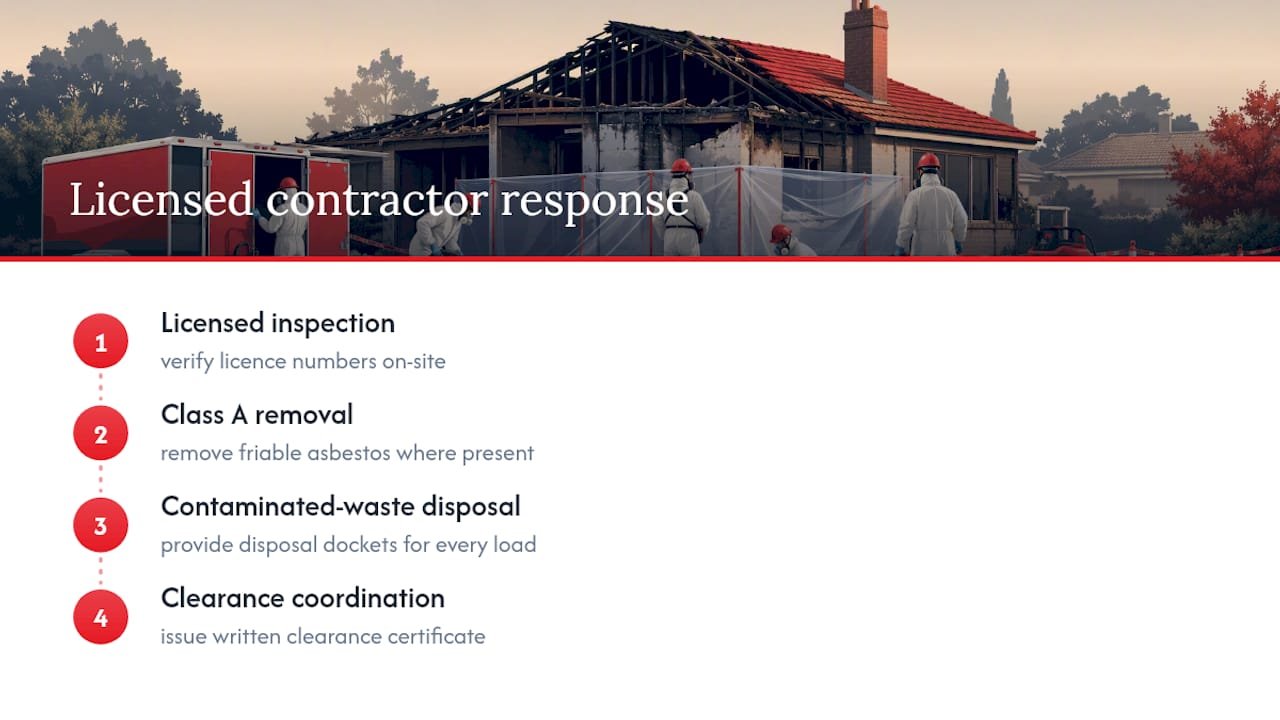
A licensed contractor manages this process end to end, from licensed inspection through Class A removal where friable material is involved, to disposal and clearance coordination. Homeowners should expect to see licence numbers, a written clearance certificate, and disposal dockets for every load of contaminated waste, not just a verbal assurance that the job’s done.
If you need licensed asbestos removal now, call a licensed asbestos removal contractor
There’s no upside in waiting on this one. Licensed contractors provide asbestos inspection and testing, Class A and Class B removal, emergency demolition and full site clearance for homeowners and property managers across Sydney and Australia. When a fire’s just happened, having one licensed contractor manage inspection through to disposal saves you from chasing separate assessors, removalists and waste carriers on your own.
Have your fire report, insurer details and any photos of the damage ready before you call, along with confirmation the site’s safe to access. Contractors arrange the licensed inspection, coordinate the clearance process with a qualified assessor, and provide disposal receipts and the clearance certificate once the job’s finished. For urgent jobs, check the asbestos inspection and testing page or call directly for a quote on emergency removal.
Key government and state guidance to consult
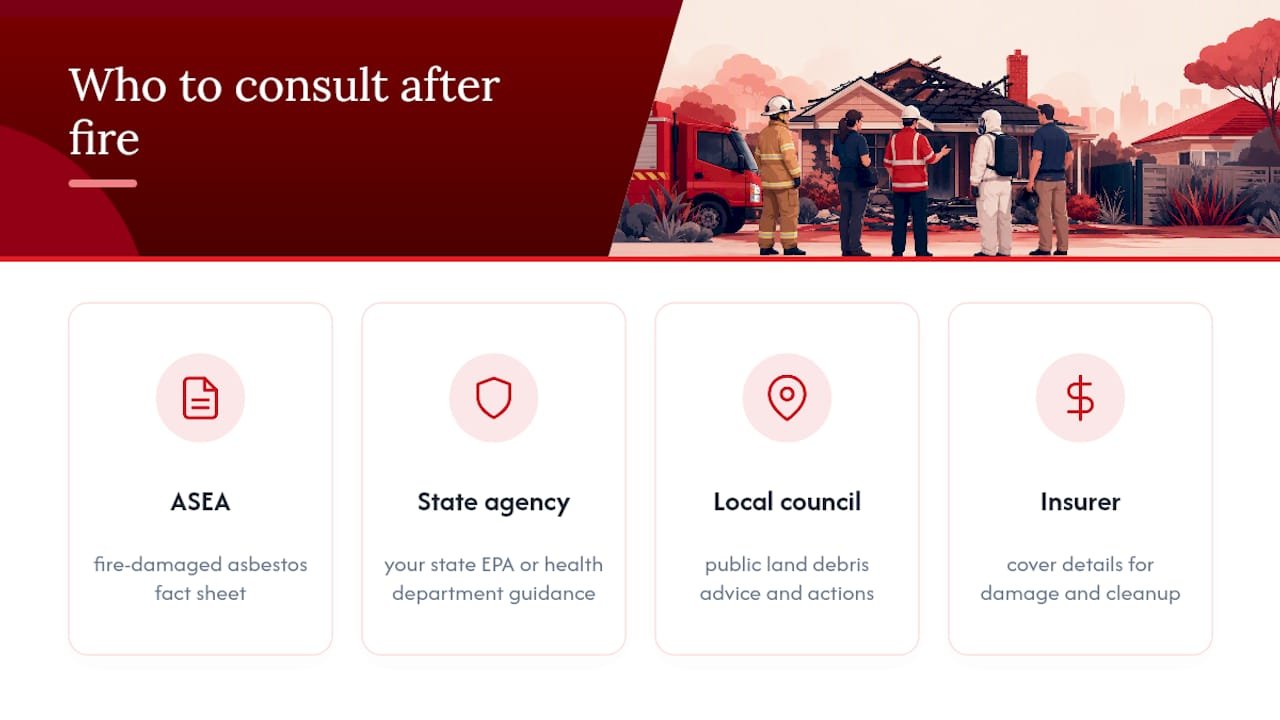
Check the ASEA fire-damaged asbestos fact sheet, your state EPA or health department guidance, and contact your local council for public land debris and your insurer for cover details.
Provider perspective: what professional coordination actually delivers
Most of the stress after a house fire comes from not knowing who’s responsible for what. A licensed contractor who handles inspection, removal and clearance under one roof removes that guesswork, homeowners get a single point of contact instead of three separate quotes and three separate timelines to reconcile. The paperwork, licence numbers, clearance certificates, disposal dockets, isn’t bureaucratic padding. It’s the only proof you’ll have that the site was actually safe to reoccupy, and it’s what your insurer and any future buyer will ask for.
— Tarek
This article is general information, not a substitute for advice from a qualified doctor. Consult a qualified healthcare professional about your own circumstances before acting on anything here.
Sources
- Fact sheet – Fire-damaged asbestos (ASEA) — December 2024
- Containment and disposal of asbestos contaminated dust and debris arising from fire damaged buildings (Queensland guidance)
- After a fire: asbestos hazards (EPA Victoria)
- Asbestos fact sheet (WHO) — 2024-09-27
FAQ
Can you sell a house with asbestos in Australia?
Yes, you can sell a property with known asbestos, but most states require disclosure to buyers, and many contracts hinge on a current asbestos report. A clearance certificate from a licensed assessor makes the sale far smoother if remediation has already happened.
Can I get compensation for mesothelioma in Australia?
Compensation claims are possible through workers’ compensation schemes, common law claims, or state-based asbestos injury funds, depending on how and where exposure occurred. Speak to a specialist asbestos compensation lawyer, and keep detailed records of any exposure event, including dates, locations and witnesses.
Is asbestos toxic when burned?
Burning doesn’t destroy asbestos fibres, it makes the surrounding cement or bonding material crack and crumble, which frees fibres that were previously locked in place. The fire itself produces relatively low airborne fibre levels, but the debris left behind becomes hazardous the moment someone disturbs it.
Will 30 minutes of asbestos exposure hurt you?
A brief exposure is unlikely to cause immediate symptoms, and there’s no reliable way to predict individual risk from a single short event. Because there’s no known safe threshold, the sensible response is to avoid further exposure, tell your GP what happened, and keep a written record in case it matters for future health monitoring.
