
Do not start demolition until utilities are permanently disconnected. Begin by asking your electricity retailer to raise an abolishment and your gas distributor for a permanent disconnection, and do not attempt any work on meters or supply cables yourself. Keep every job number, and insist on physical, on-site verification (meter gone, warning sticker fitted) before machinery moves onto the site.
TL;DR:
- Electricity and gas disconnections must involve physical removal of meters and cables by licensed or authorized personnel, not just switching off supplies.
- Property owners are responsible for requesting disconnection, ensuring proper documentation and physical verification before demolition begins.
- Complex access or special circumstances can cause delays, so early planning and verification are crucial to avoid project halts.
- Final safety checks include confirming the absence of meters, warning stickers, and on-site isolation of solar and backup systems.
- Coordinating utility disconnection is easiest when managed as part of the overall demolition project, rather than through separate, late requests.
Table of Contents
- Which utilities must be disconnected before demolition
- Who is responsible for arranging disconnection
- How to arrange electricity abolishment: a step-by-step checklist
- Arranging permanent gas disconnection for demolition
- Water, sewer, telecommunications and other services
- Timelines, fees and the evidence pack for site
- On-site safety checks before demolition starts
- Decommissioning solar, battery and backup systems
- Why a licensed demolition specialist manages this better
- What project managers should prioritise
- Get a managed demolition and utility coordination quote
- Regulators and guidance worth checking
- Sources
- FAQ
Which utilities must be disconnected before demolition
Demolition planning treats service isolation as a core safety step, not a formality. The Model Code of Practice: Demolition Work from Safe Work Australia lists locating and disconnecting essential services as a required part of pre-demolition planning, alongside a Safe Work Method Statement for the job.
Each service has its own definition of “disconnected,” and getting this wrong is where most delays and near-misses happen.
- Electricity: abolishment, meaning physical removal of the meter and supply cable, not just switching the power off at the main.
- Gas: a permanent disconnection service from the distributor at the meter and boundary, plus separate removal of internal pipework by a licensed gas fitter.
- Water and sewer: isolation and capping at the meter or main, with council notification where the connection affects shared infrastructure.
- Telecommunications and NBN: provider-arranged decommissioning and removal of lead-ins before structural work begins.
- Other hazards: LPG cylinders, on-site diesel tanks, chemical lines and refrigerant circuits, each needing its own isolation or removal method.
Who is responsible for arranging disconnection
The property owner carries the duty to instruct or authorise these requests. Retailers and distributors will generally only act on instructions from the owner or an authorised agent, such as a demolition contractor or project manager acting under written authority.
- For electricity, the retailer lodges the abolishment request, but the distributor physically carries out the meter removal and cable isolation.
- For gas, the distributor runs the permanent disconnection service at the meter and boundary, while a licensed gas fitter handles everything downstream.
- For water, sewer and telecommunications, contact the local provider directly, and expect council involvement where shared infrastructure or road reserves are affected.
- Keep every email, job number, permit and confirmation note in the demolition file, since this paperwork becomes part of the evidence pack a site supervisor needs before machinery starts.
How to arrange electricity abolishment: a step-by-step checklist
Abolishment is a formal process, and skipping steps only slows it down.
- Identify the retailer on the account and confirm the account is active and in the right name.
- Ask the retailer to submit an abolishment request to the network operator, who is the party that actually removes the meter and cable.
- Provide supporting documents: a site plan and proof of ownership, or written authorisation if you are acting as an agent for the owner.
- Expect a scheduled crew visit, which may involve excavation work depending on how the supply enters the property.
- Wait for physical verification: the meter must be gone, and a warning sticker should be fitted inside the meter box confirming the supply has been abolished.
Energy Safe Victoria is explicit that demolition must not start until the meter is physically removed and this sticker is in place, and SafeWork SA gives the same guidance for its own jurisdiction. If the meter is still present, or if you see a “danger” sticker rather than an abolishment confirmation, stop and call the distributor before proceeding.
Pro Tip: Lodge the abolishment request as soon as demolition is confirmed, since network crews often book weeks ahead and this step tends to set the pace for the rest of the schedule.
Arranging permanent gas disconnection for demolition
Gas disconnection follows a similar two-part structure to electricity, but the split between distributor and licensed trade work matters more here because the risks of getting it wrong are higher.
- The distributor’s permanent disconnection service typically removes the meter and clamps and cuts the line at the property boundary, then purges the remaining gas.
- It does not include removing downstream pipework inside the building. That work falls to the owner, arranged through a licensed gas fitter, according to the AEMC’s permanent disconnection contract guidance.
- Owners or their authorised agents can apply for the service, and distributors such as Evoenergy offer tiered options (basic, urgent, complex) with different lead times and costs depending on access difficulty.
- Unauthorised gas work carries real legal risk. Energy Safe Victoria has fined companies for reckless damage to gas infrastructure, which is a reminder that only the distributor or a licensed gas fitter should touch these lines.
Water, sewer, telecommunications and other services
The remaining services rarely make headlines, but leaving one live is enough to hold up a demolition permit or cause a site incident.
- Water: isolate at the meter or main, arrange removal of commercial meters where fitted, and manage backflow prevention devices if the site has them.
- Sewer and drainage: cap the connection and obtain council or plumber sign-off where the local authority requires it.
- Telecommunications and NBN: request decommissioning and removal of lead-ins from the provider, and get written confirmation once it is done.
- Other services: LPG cylinders, on-site fuel tanks, chemical lines and refrigeration circuits each need licensed removal or isolation before demolition starts.
Pro Tip: Request written completion confirmation from every provider, not just a phone call, so the demolition file has a paper trail for each service.
Timelines, fees and the evidence pack for site
Lead times vary by service and distributor, and complex access can push a job well beyond a standard schedule. Evoenergy’s disconnection service tiers show that urgent or complex jobs, such as those needing concrete cutting or trench reinstatement, attract user-pays charges and longer waits than a routine disconnection.
Before machinery arrives, the site supervisor should be holding a physical evidence pack, not just a verbal assurance from the office.
- Confirmation that the meter has been removed, plus the distributor’s warning sticker or work order.
- A clearance certificate, where the distributor or gas fitter issues one.
- These confirmations recorded in the SWMS and the demolition permit file, ready to show a regulator on request.
On-site safety checks before demolition starts
The final check happens on site, immediately before demolition begins, and it should never be skipped even when paperwork looks complete.
- Visually confirm the meter box is empty and the distributor’s abolishment sticker is fitted. Stop work immediately if a “danger” sticker is present instead.
- Confirm a licensed electrician has isolated any solar or battery system and issued a written isolation notice or certificate.
- Positively locate underground services using electronic detection and potholing, and maintain No Go Zones around them, as set out in the underground services guidebook from Energy Safe Victoria and WorkSafe Victoria.
- Check that the SWMS, permits and signed isolation certificates are physically on site, and that every licensed trade has signed off its part.
Pro Tip: Treat the site supervisor as the last line of defence: no visual confirmation of meter removal means no demolition that day, regardless of what the schedule says.
Decommissioning solar, battery and backup systems
Abolishing the main electricity supply does not automatically make a building safe. Solar panels, battery systems and standby generators can keep producing or storing live current on their own, independent of the grid connection.
- A licensed electrician needs to isolate and, where required, remove inverters and batteries before demolition, and issue a certificate confirming the work.
- Coordinate this step with the timing of the main abolishment, since a site with an abolished grid supply but a live PV array is still an electrocution risk for demolition crews.
Why a licensed demolition specialist manages this better
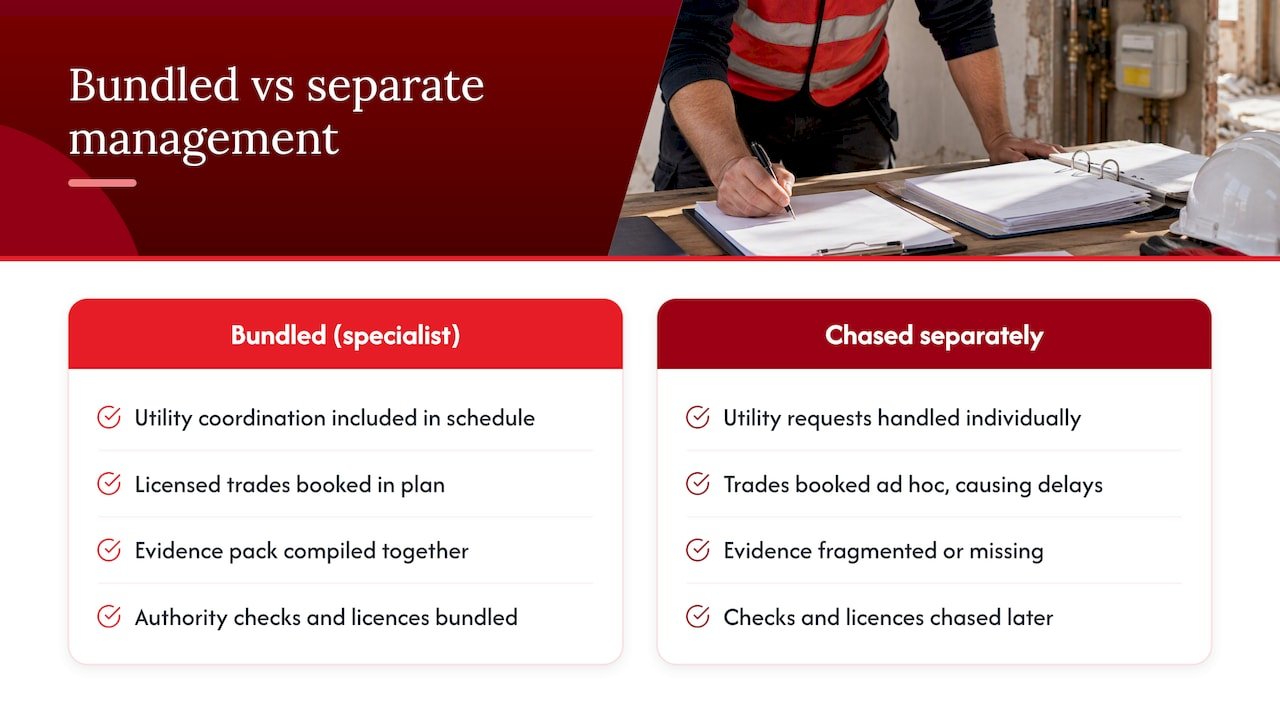
Coordinating retailer and distributor requests, booking licensed trades and compiling the evidence pack takes real project management, and most delays trace back to one of these steps being missed or left too late. Utility coordination is best managed as part of the overall project management service, alongside licensed asbestos removal and site clearance, so the authority checks, licences and on-site verification are bundled into one schedule rather than chased separately.
What project managers should prioritise
Treat abolishment and permanent disconnection confirmations as gating items in procurement and in the SWMS, not paperwork to chase once demolition is already booked. The most common mistake I see is lodging these requests too late, then compressing the schedule and skipping the visual check on site. Lodge early, verify in person, and the rest of the project tends to move on time.
— Tarek
Get a managed demolition and utility coordination quote
Chasing retailers, distributors and licensed trades separately eats time most property owners and builders do not have. Mission Demolition handles demolition and utility coordination as one package, including the evidence pack a site supervisor needs before machinery starts, across residential, commercial and industrial projects.

If you want a managed outcome rather than a checklist to work through yourself, request a site assessment and quote through Mission Demolition.
Regulators and guidance worth checking
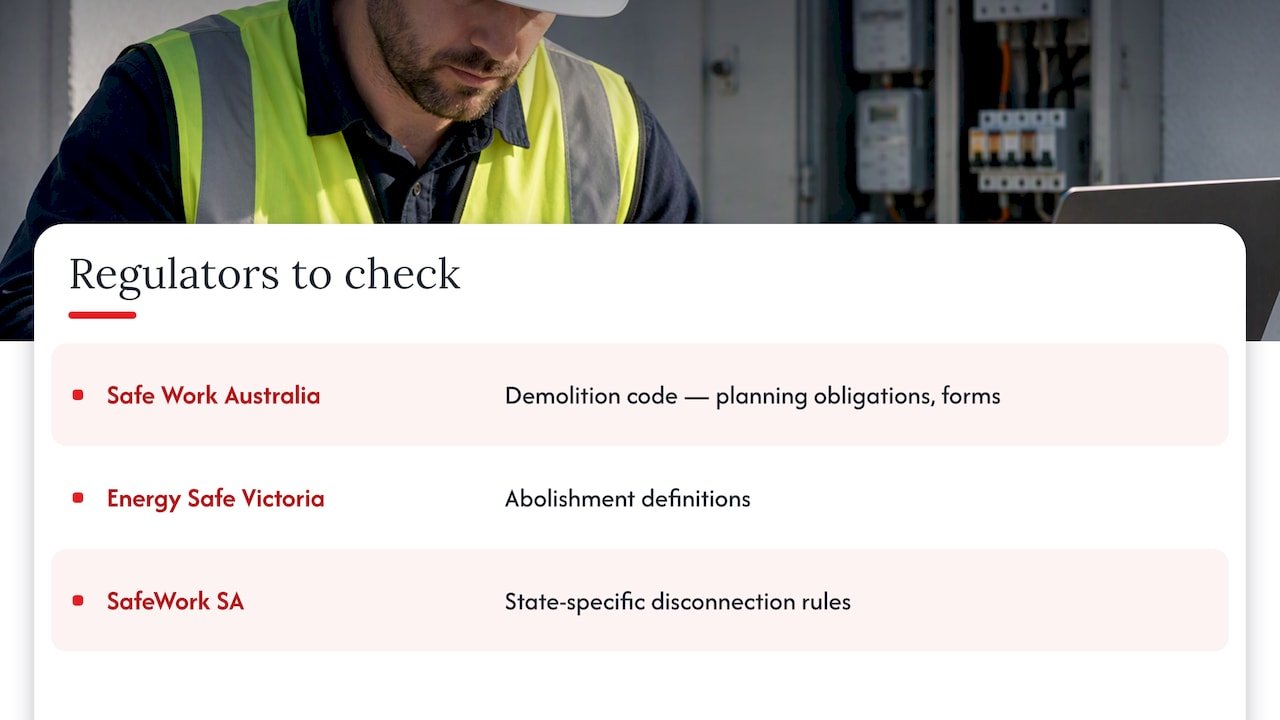
For verification and forms, check Safe Work Australia’s demolition code for planning obligations, Energy Safe Victoria for abolishment definitions, and SafeWork SA for state-specific disconnection rules.
Sources
- Disconnection and abolishment of electricity supply — Energy Safe Victoria
- Abolishment of electricity supply — SafeWork SA
- Model Code of Practice: Demolition work — Safe Work Australia
- Permanent Disconnection Contract — AEMC / distributor contract example
- Evoenergy permanent disconnection services — AER appendix (example of tiered services)
FAQ
Is it illegal to turn off someone’s electricity without authorisation?
Only the property owner or an authorised agent can request disconnection or abolishment services, and distributors will not act on requests from anyone else. Attempting to interfere with a meter or supply cable yourself is unsafe and outside the rules that govern who may request or perform this work.
What are the rules for permanently disconnecting power before demolition in Victoria?
Victoria requires permanent removal of the electricity meter and supply cable, known as abolishment, before demolition can proceed. Energy Safe Victoria states that demolition must not start until the meter is physically removed and a warning sticker confirming abolishment is fitted in the meter box.
What do disconnection rules generally require before demolition?
Most state regulators, including SafeWork SA, require permanent removal of the electricity supply rather than a simple switch-off before demolition work begins. The owner or an authorised agent lodges the request with the retailer, and the distributor carries out the physical removal and issues visual confirmation.
Can a property owner request to be permanently disconnected from electricity?
Yes, a property owner or their authorised agent can request a permanent disconnection, known as abolishment, ahead of demolition. The request goes to the electricity retailer, who lodges it with the network operator responsible for physically removing the meter and supply cable.
What is the difference between disconnection and abolishment?
Disconnection usually means the supply is temporarily switched off, while the meter and cable remain in place. Abolishment is permanent: the meter and supply cable are physically removed, which is the standard required before demolition can safely proceed.

Здесь ресурсе вы сможете получить ценную информацию.
https://kart1na.ru/entry/360-10-yarkikh-obrazov-anuk-eme-ot-fellini-do-lelusha/