
Roof tiles and older cement roofing often contain asbestos if installed before the late 1980s to early 1990s, so the material itself is not an emergency unless it is broken, crumbling or disturbed. If you suspect asbestos, stop any work immediately, keep people and pets off the roof, and arrange testing or book a licensed removalist before touching anything further.
TL;DR:
- Most asbestos cement roofing from before the late 1980s poses minimal risk if undisturbed, but damage can release dangerous fibers.
- Visual inspection helps identify potential asbestos, yet professional testing and sampling are essential for certainty and safe handling.
- Weathering degrades asbestos bonds over time, increasing environmental emissions and health risks, even without physical disturbance.
- DIY cleaning or gutter clearing can cause fiber release; immediate action includes restricting access and carefully bagging loose fragments with protective gear.
- Licensed removal involves a strict process with risk assessment, proper PPE, wetting, sealed transport, and certified disposal, emphasizing the importance of professional help.
Table of Contents
- How to spot asbestos-containing roof tiles and related roof parts
- Why asbestos in roof tiles matters: exposure routes and health risk
- When to presume asbestos, how testing works and what the rules say
- Immediate dos and don’ts while you arrange testing or a contractor
- Deciding whether to manage, repair or remove asbestos roofing
- How licensed removalists handle the job and what to ask for
- Why the standard advice on asbestos roofs misses the point
- FAQ
- Sources
How to spot asbestos-containing roof tiles and related roof parts
Asbestos cement roofing typically shows up as flat or corrugated sheeting, or as moulded slate-style shingles, in grey, off-white or a bluish tone that fades to a chalky pale grey as it weathers. The surface often feels gritty rather than smooth, and corrugated sheets tend to be thinner and lighter than modern fibre cement or metal roofing. Many houses built before 1990 may contain these materials, since asbestos was widely used in building products until the mid-1980s in Australia.
It is not only the tiles themselves. Several other roof components were commonly made from asbestos cement, including ridge capping and hip tiles, flashings around chimneys, vents and valleys, guttering and downpipes that can trap fibres, and eaves linings and underlay sheeting beneath tiles or corrugated roofing.
Brand stamps or moulding marks on the underside of a sheet can sometimes help date the product, but these clues are not reliable on their own. When a visual check leaves any doubt, the sensible step is a professional inspection with a sample sent to a NATA-accredited laboratory rather than guessing from the ground.
Why asbestos in roof tiles matters: exposure routes and health risk
There is no identified safe level of asbestos exposure, which is why even a small amount of disturbed material deserves caution. Intact asbestos cement roofing poses a lower immediate risk because the fibres are bonded into the cement matrix, but damage changes that picture quickly: drilling, cutting, breaking or blasting the surface with a high-pressure washer releases fibres into the air around the work area and into gutters below it.
There is no known safe exposure threshold for asbestos, according to the World Health Organization, which means cumulative, low-level exposure over years still carries risk. Weathering alone, through wind, rain and biological growth on the roof surface, gradually degrades the cement bond and increases the chance that fibres migrate into gutters and downpipes, even without anyone touching the roof. Epidemiological reviews link ongoing weathering of asbestos roofing to measurable environmental emissions and recommend a precautionary approach, including eventual substitution with asbestos-free materials where practical.
The most common real-world exposure scenario for homeowners is not professional removal, it is DIY cleaning: sweeping roof debris, pressure-washing tiles, or clearing gutters by hand without knowing what they contain.
When to presume asbestos, how testing works and what the rules say
If your roof was installed before about 1990, the safest working assumption is that it contains asbestos until proven otherwise, since asbestos cement products were in wide use in Australian construction until the mid-1980s. From there, the path to certainty runs through a few steps:
- A competent person collects a small sample, following safe sampling technique to avoid releasing fibres.
- The sample goes to a NATA-accredited laboratory, which identifies the asbestos type, if present, and returns a written report.
- That report becomes part of your property’s asbestos register, documenting what was found and where.
Some jurisdictions allow homeowners to remove small quantities, often cited as under 10 square metres of non-friable material, without a licence. Even where that allowance exists, SafeWork NSW and equivalent regulators strongly recommend engaging a licensed removalist, because correct disposal, decontamination and paperwork are easy to get wrong. Removal work should end with a clearance certificate and disposal at an authorised facility, not a general waste bin.
Immediate dos and don’ts while you arrange testing or a contractor
What you do in the hours after you suspect asbestos matters more than any long-term plan. Follow these steps:
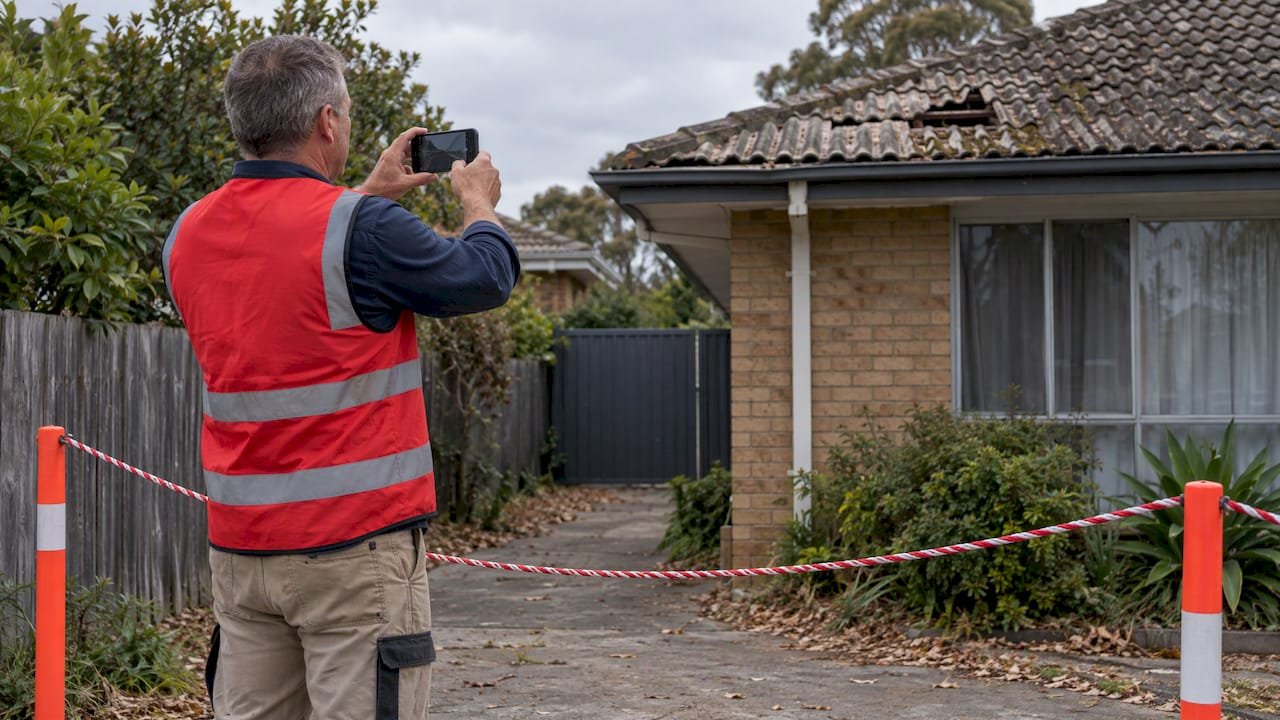
- Rope off or otherwise restrict access to the affected area, including underneath the roof.
- Keep everyone off the roof surface, especially if tiles feel brittle or soft underfoot.
- If light cleaning is unavoidable, mist the area gently with a hand sprayer rather than sweeping or pressure-washing.
- Bag any loose fragments by hand while wearing disposable gloves, and avoid generating dust.
- Treat gutter debris as contaminated rather than clearing it as routine maintenance.
Avoid cutting, drilling or breaking any suspected asbestos sheeting, and never put fragments in household rubbish. Basic protective gear, a well-fitted P2 respirator and disposable coveralls, reduces incidental exposure during these short-term steps, but it is not a substitute for the engineering controls a licensed removalist uses on an actual job. If the roof is visibly deteriorated, avoid using collected rainwater for drinking, gardening or filling pools until the roof has been assessed.
Pro Tip: Photograph any damaged sections before you rope off the area. It gives an inspector or removalist a clear starting point without anyone needing to go back up for a closer look.
Deciding whether to manage, repair or remove asbestos roofing
Condition is the deciding factor. A roof that is intact, undisturbed and not shedding material into gutters can often be managed in place, with periodic inspection rather than immediate removal. A roof that is cracking, lifting, repeatedly worked on, or visibly contaminating rainwater is a stronger case for removal.
- Sealing or coating can temporarily stabilise a weathered surface, but it does not fix underlying cracks and needs reapplication over time.
- Replacement with metal, terracotta-style composite or modern fibre cement roofing removes the long-term risk entirely, though cost and the existing roof structure’s load capacity both factor into the decision.
- A sensible sequence is inspection, risk assessment, quote, then a licensed removal plan ending in a clearance certificate.
If reroofing is on the table, it is also worth thinking ahead to what goes on the new surface, including whether solar panels suit the replacement material.
How licensed removalists handle the job and what to ask for
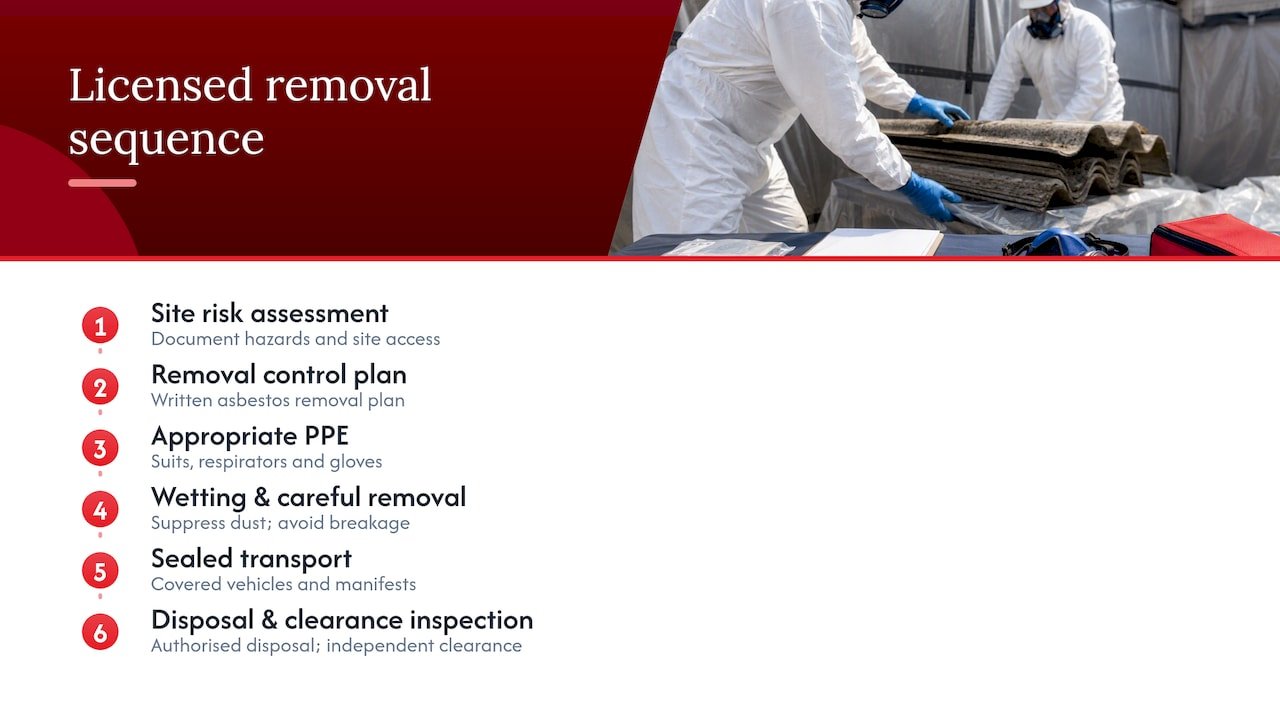
A licensed removalist typically works through a documented sequence: a site risk assessment, a written asbestos removal control plan, PPE appropriate to the job, wetting the material to suppress dust, careful removal to limit breakage, sealed and covered transport, and disposal at an authorised site, followed by an independent clearance inspection. Codes of practice for asbestos-cement products call for different handling than friable asbestos work, including a ban on high-pressure jets during wetting.
Before work starts, ask for evidence of licensing, the removal plan itself, a waste transport manifest and, once finished, the clearance certificate. We handle licensed asbestos roof removal, inspection and testing, and disposal as part of our project management, and we always recommend getting more than one quote before committing.
Why the standard advice on asbestos roofs misses the point
Most guidance on asbestos roofing focuses on the material itself: what it looks like, how old it is, whether it is friable. That is useful, but it skips the part that actually determines outcomes, which is what happens in the days before anyone calls a professional. Homeowners who spot a cracked tile often do nothing dangerous to the roof itself, then undo that caution by clearing the gutter below it with bare hands the same afternoon.
The conventional checklist culture (colour, texture, age) is worth knowing, but it creates a false sense of resolution once you have “identified” the material. Identification is the easy half. The harder, more consequential half is restraint: not touching it, not improvising a clean-up, and not treating a small DIY allowance as a green light just because it exists on paper. If I had to pick one priority for readers to act on first, it would be this: assume contamination, restrict access, and let a sample or a licensed assessment make the removal decision, not your own eye from the ground.
— Tarek
FAQ
What if I accidentally removed asbestos tiles myself?
Stop immediately, avoid further breakage, and do not put the material in household rubbish. Bag any loose fragments carefully, decontaminate the work area by misting rather than sweeping, and contact your local council or a licensed asbestos removalist for guidance on safe disposal at an authorised site.
How long do asbestos roof tiles last?
Asbestos cement roofing can remain structurally serviceable for decades when undisturbed and well maintained, but age and weathering gradually weaken the cement bond around the fibres. Condition, not a fixed age, determines whether a roof should be managed in place or replaced.
Can you still live in a house with asbestos roofing?
Yes, intact and undisturbed asbestos cement roofing is considered lower immediate risk, which is why many homes with these roofs remain occupied safely. The key is avoiding disturbance, monitoring the roof’s condition, and acting promptly if it becomes damaged or weathered.
Can asbestos roofs be repaired?
Minor stabilisation, such as sealing hairline cracks, can extend the life of an otherwise sound asbestos cement roof, but it will not reverse significant weathering or damage. For roofs that are cracked, lifting or shedding material, replacement by a licensed contractor is the more durable solution.
Sources
These links cover identification, testing standards, safe removal practice and disposal rules in more depth than this guide can, and are worth reading directly before any removal decision.
- Asbestos Victoria — What is asbestos
- SafeWork NSW — Unlicensed removal of less than 10 m² non-friable asbestos
- Code: Safe removal of asbestos (archived guidance) — Safe Work Australia
- Epidemiological and policy review on asbestos roofing and public health risks
