
A hazardous landfill is a licensed final disposal site, while a transfer station is a short-term consolidation point where waste is held and reloaded. For hazardous waste, including asbestos and many contaminated soils, you must use a facility licensed to accept that specific waste. Phone ahead to confirm acceptance and booking rules, and sort out tracking requirements before anything is transported.
TL;DR:
- A facility’s licence covers specific waste types, and some sites reject outside business loads, so confirm your exact material and eligibility by phone before booking.
- In New South Wales, trackable waste needs a consignment authorization before transport; arrange required registration and provide driver, vehicle, and load details before pickup.
- Household asbestos usually goes directly to a licensed landfill that accepts it, while contaminated soil may need treatment or a licensed transfer station.
- Wrap and label asbestos as the receiving site requires, keep incompatible materials separate, and retain handover records until the licensed site accepts the load.
Table of Contents
- What is the difference between a hazardous landfill and a transfer station?
- How do licences and acceptance rules differ, and what should you check before you go?
- Should you choose a landfill or a transfer station?
- How do you prepare, document and transport hazardous waste in Australia?
- What health and environmental safety rules apply to these facilities?
- How do their operations and infrastructure compare?
- What role do transfer stations play before final disposal?
- What does hazardous waste disposal cost?
- Where are Australia’s hazardous waste facilities, and who runs them?
- How much hazardous waste does Australia dispose of?
- Why do licensed professionals matter for hazardous waste?
- How can we help with asbestos and hazardous waste disposal?
- FAQ
- Sources
What is the difference between a hazardous landfill and a transfer station?
A hazardous landfill is a permitted site for the final burial or long-term containment of hazardous materials. Disposal there is permanent, so these sites rely on engineered controls and licence conditions that cap what they can receive. Many people call any waste facility “the dump”, which blurs a real difference in purpose.
A transfer station works as a logistics hub. Waste arrives, is briefly held, then is reloaded into larger vehicles and sent to a final disposal or treatment site. That consolidation cuts long-haul trips and the environmental cost of moving many small loads. It is not normally the final resting place for high-hazard waste.
The differences that affect whether your waste is accepted include:
- Purpose: a landfill buries or contains waste permanently, while a transfer station sorts, consolidates and forwards it.
- Segregation: hazardous streams must stay separated, and incompatible wastes cannot be mixed in a tipping area.
- Stockpiling: a transfer station cannot hold waste indefinitely, and storage beyond lawful limits can attract penalties.
- Site controls: a landfill that takes hazardous material needs tighter containment and monitoring than a general consolidation point.
How do licences and acceptance rules differ, and what should you check before you go?
Receiving facilities are regulated under state law, such as the Protection of the Environment Operations Act in NSW. Each site may need an Environment Protection Licence that sets out which waste types it can receive. A licence for one waste type does not cover others, so a site that takes green waste may be forbidden from accepting asbestos or contaminated soil.
In NSW, facilities that receive hazardous and trackable waste must track it under Part 4 of the POEO Regulation, and they may need an environment protection licence to receive hazardous wastes at all. Transporters generally register on the Integrated Waste Tracking Solution and supply driver, vehicle and load details before moving certain loads, as the Asbestos and Waste Tyres Guidelines explain.
The rule that catches people out: the NSW hazardous waste public register notes that transporting trackable waste without a consignment authorisation is an offence, and that some licensees have extra restrictions or refuse waste from outside businesses.
Before you load the vehicle, work through this checklist:
- Phone the facility and confirm it accepts your exact waste type.
- Ask whether it accepts material from external sources or only its own customers.
- Confirm booking requirements, opening times and any limits on quantity.
- Ask about packaging and wrapping rules.
- Check whether your waste is trackable and who must generate the consignment authorisation.
Should you choose a landfill or a transfer station?
Start with the facts about your waste: its classification, hazard level, quantity, available documentation, transport logistics, and whether a given facility is licensed to take it. Those factors decide the answer far more reliably than distance or price.
- Household asbestos: this usually goes straight to a licensed landfill that accepts household asbestos. The NSW EPA keeps a list of facilities that accept household asbestos and advises phoning first to confirm acceptance, bookings and conditions.
- Small commercial contaminated soil: the right destination depends on the contamination. Some soil needs treatment, some needs a hazardous landfill. A transfer station can consolidate loads only if its licence permits that waste.
- Industrial liquid waste: this is often routed through specialist storage, treatment or transfer facilities rather than general landfills. The EPA’s guidance for the liquid waste industry covers segregation, labelling, secondary containment and staff training for sites handling these streams.
Pro Tip: If a facility’s first answer is “we might take it”, treat that as a no until you have the acceptance confirmed against your waste code.
How do you prepare, document and transport hazardous waste in Australia?
Start by confirming the waste type and whether it is trackable. Check your state EPA facility lists, then phone the receiver. Most facilities want notice before you arrive, and many want a booking 24 hours in advance so they can confirm capacity and licensing.
Packaging matters as much as paperwork. Asbestos safety authorities report that many sites accept asbestos only at set times and expect wrapping and documentary proof. Our own guidance on how to dispose of asbestos waste legally in Australia walks through the sequence, and our asbestos disposal safety tips cover the handling side.
- Identify the waste and check whether it is trackable before you book transport.
- Wrap and label asbestos as the receiving site requires, and use suitable sealed containers for liquids.
- Keep incompatible wastes apart, in separate containers and separate parts of the vehicle.
- Arrange the consignment authorisation and any transport certificate, with driver, vehicle and load details ready.
- Keep records of every handover until the load is accepted at a licensed site.
NSW asbestos authorities state that it is illegal to place hazardous waste in kerbside bins or unapproved skips, and that a licensed removalist is strongly recommended because they already work within the disposal rules for asbestos waste. A removalist typically handles packaging, transport and tracking registration in one job.
Pro Tip: Photograph the wrapped load and keep the receipt from the receiving site. That paperwork is your proof that the waste reached a licensed facility.
What health and environmental safety rules apply to these facilities?
Both facility types operate under state environmental law, and the licence is the main control. It sets which wastes can be received, how they are tracked, and what monitoring and containment must be in place. Breaching a licence condition can lead to enforcement action against the operator, and unlawful transport or dumping can lead to action against you.
Health and safety rules also cover the people on site. Workers handling asbestos and other hazardous materials need appropriate training, protective equipment and procedures that limit exposure. For liquid wastes, the EPA’s guidance describes secondary containment, labelling, segregation and plant maintenance, all aimed at stopping spills reaching soil and waterways.
At a landfill, the safety question is long-term: liners, leachate management and gas control are there because buried hazardous waste stays put for generations. At a transfer station, the question is short-term: preventing spills, fires, mixing of incompatible loads and unauthorised stockpiling during the holding period.
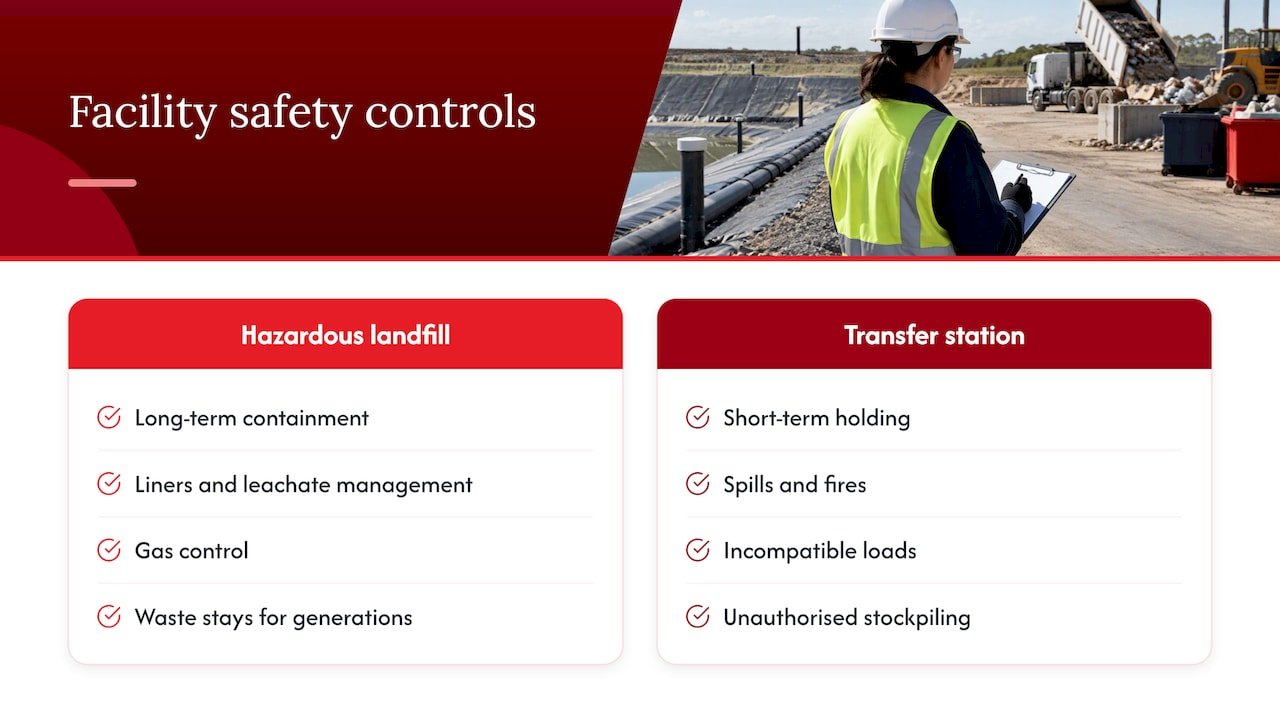
Tracking is the safety net around both. The cradle-to-grave approach means a hazardous load can be followed from pickup to final licensed disposal, so a missing load becomes a regulatory problem rather than a roadside mystery. For you as a generator, the practical message is simple: the rules assume the waste goes only to a site licensed for it, with paperwork that proves it did.
How do their operations and infrastructure compare?
The two facilities are built for different jobs, and the infrastructure shows it. A hazardous landfill is engineered for permanence. A transfer station is engineered for throughput.
| Feature | Hazardous landfill | Transfer station |
|---|---|---|
| Role | Final burial or containment | Receive, hold briefly, reload |
| Typical infrastructure | Engineered cells, liners, leachate and gas management | Tipping floors or bays, bunded storage, loading areas |
| Waste handling | Placed in designated cells and covered | Sorted, consolidated and forwarded |
| Time waste stays | Indefinitely | Short term, within lawful limits |
| Main operational risk | Long-term leakage and emissions | Spills, mixing, fire and excess stockpiling |
A landfill’s daily work is placing and covering waste in designated areas, then monitoring what the site releases over time. A transfer station’s daily work is checking loads in, sorting them, and getting them out again before they build up.
Hazardous waste stockpiles and approved long-term storage are separate ideas. The federal hazardous waste stockpiles and storages paper explains that long-term storage needs pre-approval, while stockpiles are subject to clearance and levy rules if held beyond lawful limits. That is why a transfer station cannot simply become a warehouse for waste nobody wants to deal with.
What role do transfer stations play before final disposal?
Transfer stations reduce the amount of waste that reaches landfill by acting as a checkpoint. Loads are inspected, and material that can be recovered is separated from material that cannot. Metals, clean concrete and other recoverable streams can be pulled out and sent for recycling before the remainder moves on.
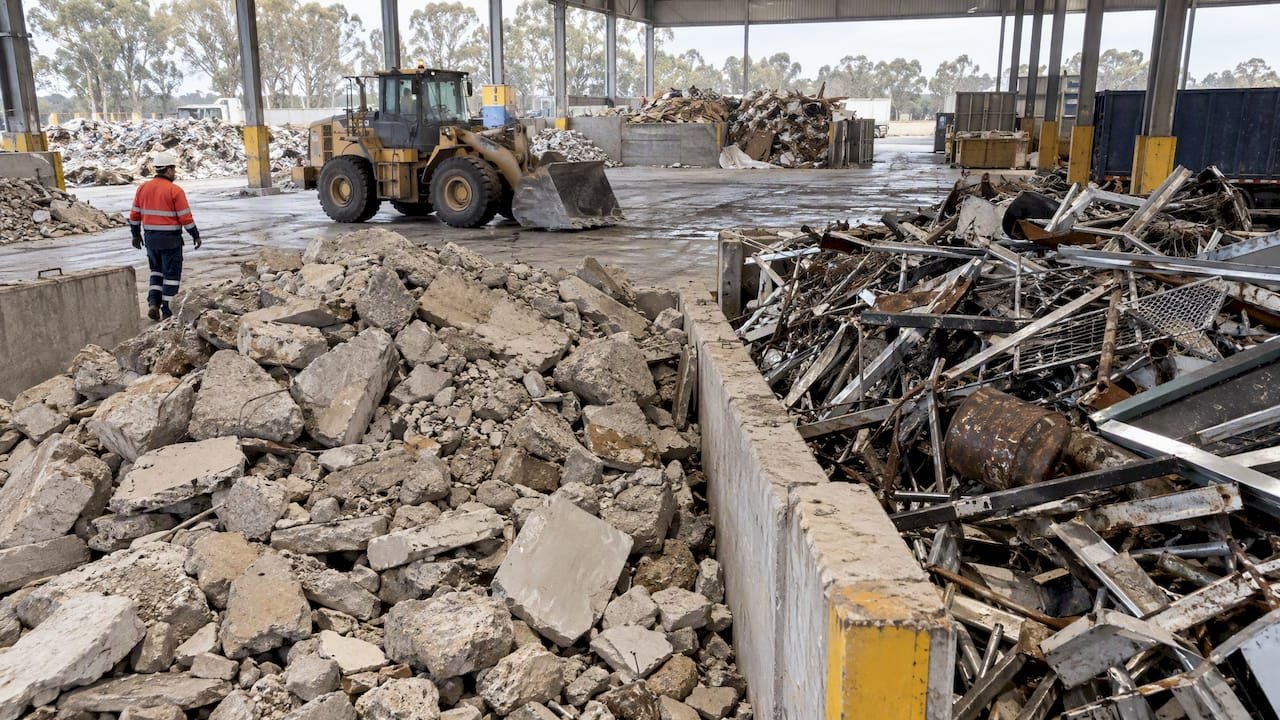
For hazardous waste the minimisation role is narrower but real. Consolidating many small loads into fewer large ones cuts truck movements and the emissions that come with them. Segregating streams at the transfer point also means waste reaches the right treatment facility instead of defaulting to burial.
Transfer stations were developed to reduce long-haul transport costs and environmental impact. That logic applies strongly to regional areas, where sending a half-empty truck a long distance to a hazardous landfill makes little sense. Pooling loads makes the trip worthwhile.
The limit is licensing. A transfer station can only forward hazardous waste it is licensed to hold, and it cannot treat or recycle streams outside its licence. If you generate a one-off load of contaminated soil from a small commercial job, ask the site whether it can consolidate that waste or whether it must go directly to a licensed treatment or disposal facility. Our guide to asbestos in soil removal and Class A and B thresholds covers the soil side in more detail.
What does hazardous waste disposal cost?
Costs vary by facility, waste type, volume and packaging, and we do not quote a single figure for hazardous waste disposal here because published fees differ from site to site and change often. The Asbestos Safety and Eradication Agency’s local disposal facility finder notes that disposal costs and acceptance conditions vary, and that facilities often require prior notification or bookings.
What drives the cost is fairly predictable:
- Waste classification: more hazardous or more tightly controlled waste costs more to receive.
- Quantity: loads are usually charged by weight or volume, so accurate measurement matters.
- Packaging and preparation: poorly wrapped or unlabelled loads can be refused, and a refused load means a second trip.
- Handling route: a landfill charges a disposal fee, while a transfer station charges for receiving and consolidating, and the onward trip adds a cost on top.
- Compliance: tracking registration, consignment documents and licensed transport all carry their own costs.
A cheap tip fee is not a saving if the load is turned away. Phone the facility, describe the waste precisely, and ask for the full charge including any booking or documentation fees. Comparing a landfill quote with a transfer station quote only works when both cover the same waste, packaging and journey.
Where are Australia’s hazardous waste facilities, and who runs them?
Major hazardous waste facilities include Lyndhurst in Victoria and Kemps Creek in NSW. The federal market analysis, Hazardous Waste in Australia 2021, reports that SUEZ operates the Kemps Creek landfill, and that Lyndhurst is a major Victorian facility.
The same analysis shows that national operators including Cleanaway, Veolia and SUEZ provide many of the facilities that receive hazardous wastes across Australia, often running a mix of transfer, treatment and landfill infrastructure. That mix is useful to know: one operator may run a transfer station that feeds its own landfill, and the route your waste takes depends on the licences each site holds.
Being large does not mean a facility will take your waste. Each site’s licence defines what it can receive, and some licensees decline loads from outside businesses. In NSW, the hazardous waste public register lets you search for licensed receiving facilities and transporters by waste code, which is the quickest way to build a shortlist before you start phoning.
For asbestos, remember that facility lists differ from the hazardous waste register. Use the state EPA list of facilities accepting household asbestos for domestic loads, and confirm everything by phone.
How much hazardous waste does Australia dispose of?
The National Waste and Resource Recovery Report 2026 from DCCEEW shows that Australia disposes of roughly one-third of the waste it generates, and that the resource recovery rate is about two-thirds. A portion of the landfilled material is classified as hazardous waste, mainly contaminated soil and similar substances.
That tells you where the pressure sits. Hazardous waste in landfill is dominated by soil and bulk material from construction, remediation and industrial sites, not by the small household items people usually picture. It also explains why transfer stations and treatment facilities matter: every load that can be treated or recovered is a load that does not need permanent burial.
The recovery picture is uneven. Recovery rates are high for streams such as metals and masonry, and lower for contaminated and hazardous material, which is often only suitable for controlled disposal. The national report is the reference point if you want the full breakdown by material and jurisdiction.
For a generator, the national context supports one practical habit: ask whether treatment or reuse is available before defaulting to landfill. The answer is often no, but asking costs a phone call.
Why do licensed professionals matter for hazardous waste?
We handle licensed asbestos removal and hazardous waste on real projects, and the pattern is consistent: the disposal paperwork and the facility choice cause more trouble than the removal itself. People underestimate how strict packaging, consignment and acceptance rules are until a load is refused at the gate.
Our view is that this is not a job to improvise. We comply with the licensing and safety standards the work demands, we dispose of waste responsibly at licensed facilities, and we use modern equipment to keep jobs controlled and efficient. Managing the project end to end means one party is accountable for the waste from the moment it leaves the structure to the moment it reaches a licensed site.
DIY disposal carries real exposure. Asbestos safety authorities advise against it because identification, packaging and documentation requirements are strict, and mistakes can create safety problems and legal consequences. If you are unsure what your material is or where it can go, stop and get it assessed before you move it.
— Tarek
How can we help with asbestos and hazardous waste disposal?
If you have asbestos or hazardous material to remove, we can take the whole job off your hands, so you are not left chasing facilities and paperwork. Our services cover asbestos removal, asbestos disposal, demolition and site clearance. We handle hazardous waste as part of the project, helping address the compliance risks described above.
Browse our asbestos disposal and site clearance services, then phone us for advice or request a quote for your property.
This article is general information, not a substitute for advice from a qualified lawyer. Consult a qualified legal professional about your own circumstances before acting on anything here.
FAQ
Why is the dump called a transfer station?
It is called a transfer station because waste is transferred there from small collection vehicles into larger ones for onward transport. It is a consolidation and reloading point rather than a final disposal site. The term separates it from a landfill, where waste is buried permanently.
What is the best disposal method for hazardous waste?
There is no single best method. The right approach is to use a facility strictly licensed to receive that specific waste, confirmed by phone before you travel. Asbestos safety authorities also advise using a licensed removalist, since identification, packaging and documentation rules are strict.
How many landfills are there in Australia?
Australia has a large number of landfills of many types, and we do not give a single count because the figure depends on how sites are defined and counted. For hazardous waste specifically, major facilities include Lyndhurst in Victoria and Kemps Creek in NSW.
Can I take hazardous waste to any transfer station?
No. A transfer station can only accept the wastes listed on its Environment Protection Licence, and some refuse waste from outside businesses. Phone ahead, confirm your waste type and ask about booking and packaging rules before you load the vehicle.
Sources
- Disposal of asbestos waste | Asbestos
- Receiving facilities’ tracking responsibilities | EPA
- Hazardous waste public register
- Facilities that accept household asbestos | EPA
