
In Australia, the cost of a shared boundary fence is usually split equally between neighbours, and an asbestos fence is no exception. But paying for the fence and being allowed to remove it are two separate questions. Dividing fences law decides who pays. Asbestos rules decide who may touch the sheets, how they come down and where they go. This guide covers both, with the rules that apply in NSW, Western Australia, South Australia and Queensland, and the steps to take when a neighbour does not agree.
TL;DR
- Neighbours generally share the cost of a sufficient dividing fence equally, unless an exception applies, such as damage caused by one owner or one owner choosing a higher standard.
- Cost sharing does not change the asbestos rules. Rules on who may remove fibro fencing depend on your state or territory and on how much material is involved.
- Most people cannot identify asbestos by sight. Cement-sheet fencing installed before 1990 should be treated as asbestos until a NATA-accredited laboratory says otherwise.
- Leave damaged panels intact, avoid power tools and never put the waste in a skip or household bin.
- If your neighbour disagrees, talk first, then use the formal notice and mediation process in your state. Health officers can step in if the fence is a public hazard.
Table of Contents
- Who is responsible for an asbestos fence on the boundary?
- Paying for the fence is not the same as being allowed to remove it
- How to tell whether your fence contains asbestos
- What not to do with a fibro fence
- If your neighbour disagrees
- Renting? Who is responsible then
- Where the waste goes
- Getting it done: what we offer
- Our perspective
- FAQ
- Sources
Who is responsible for an asbestos fence on the boundary?
The short answer: both owners, in equal shares, in most cases. Asbestos fences are treated as dividing fences under state law, so the same cost-sharing rules apply as for a timber or Colorbond fence.
In New South Wales, Legal Aid NSW explains that adjoining owners generally share the cost of building, repairing or replacing a sufficient dividing fence under the Dividing Fences Act 1991 (NSW), unless an exception applies. In Western Australia, the state government’s dividing fences guide says owners on each side generally contribute equal proportions to repair, realignment or re-erection.
The practical result is that if the old fibro fence between you and next door has to come out, you would normally expect to split the cost of a sufficient replacement 50/50. That cost includes the licensed removal and disposal of the asbestos, because removal is part of replacing the fence.
When the split is not 50/50
Legal Aid NSW lists the usual exceptions to equal sharing:
- a pool-barrier fence
- damage caused by one of the owners
- a fence built to a higher standard than is sufficient, at one owner’s request
- a public authority as one of the owners
- one owner agreeing to pay the full cost
Western Australia has a similar rule. An owner who chooses a higher-than-sufficient standard without the neighbour’s agreement may claim only half the cost of a sufficient fence.
For asbestos fences, “sufficient” is the point to watch. Because new asbestos sheeting cannot be installed, the replacement will be a modern material. Agreeing on that material in writing before work starts avoids most arguments about who asked for what.
How the rules differ by state
| State | Law | What the official sources say |
|---|---|---|
| NSW | Dividing Fences Act 1991 | Cost generally shared. Discuss first, then serve a fencing notice. After one month without agreement, a fencing order can be sought. |
| WA | Dividing Fences Act 1961 | Equal contribution generally expected. Local government requirements may also apply. |
| SA | Fences Act 1975 | No automatic duty to contribute unless the neighbour agrees, the Act’s procedure is followed or repairs are urgent. Equal contribution is the usual assumption. |
| QLD | Neighbourhood Disputes (Dividing Fences and Trees) Act 2011 | Disputes are decided by QCAT. Mediation is available for unresolved disputes. |
Sources for the table: Legal Aid NSW, WA Department of Health, South Australian Law Handbook and Logan City Council. Other states and territories have their own legislation, so check your state’s fencing law before you serve any notice.
Paying for the fence is not the same as being allowed to remove it
This is where homeowners get caught. Agreeing to split the bill does not give either of you a licence. Asbestos work is regulated by state and territory workplace safety authorities, and the thresholds differ.
In NSW, the official asbestos guidance says a homeowner can remove less than 10 m² of non-friable asbestos themselves. More than 10 m², or any amount of friable asbestos, needs a licensed removalist. A typical boundary fence runs well past that. A 20 metre run of 1.8 metre high fibro sheeting is about 36 m² on one face alone.
The national picture is not uniform. The national household guidance records that in the ACT homeowners and tradespeople cannot remove any asbestos themselves. In Queensland, homeowners need training to remove more than 10 m² of non-friable asbestos, and friable asbestos must be removed by a Class A licensee. The same guidance says a tradesperson may remove less than 10 m² of non-friable asbestos only if trained, equipped and compliant with safe removal, decontamination and disposal methods. Otherwise a licence is required.
Not every fencing company is licensed for asbestos either. If a fencing contractor quotes to “take the old fence away”, ask for their asbestos removal licence number and who will transport and dispose of the waste. If they are not licensed, the removal needs to be done by a licensed asbestos removalist first.
The national asbestos authority also notes that professional removal is often safer and cheaper than doing it yourself once equipment, protective gear and disposal are counted.
How to tell whether your fence contains asbestos
You cannot reliably tell by looking. The City of South Perth advises that cement-sheet fencing installed before 1990 is highly likely to contain asbestos and should be managed as such, and that only testing by an accredited NATA laboratory can confirm it.
What to do before anyone arranges removal:
- Check the age. Council records, the seller’s disclosure or the age of the house give a rough date. Flat or corrugated cement sheets from before 1990 are the main concern.
- Do not sample it yourself. Breaking off a corner to send to a lab disturbs the material. Have a licensed assessor or inspector take the sample.
- Keep panels intact. The national authority says to avoid disturbing or damaging asbestos until a licensed professional can remove it.
- Tell your neighbour early. A lab result on paper changes the conversation from opinion to fact.
If you want to know what testing involves, our guide to asbestos testing methods explains how samples are taken and analysed, and our asbestos inspection and testing service covers the sampling for you.
What not to do with a fibro fence
The national home guidance is blunt on this. Never use power tools, high-pressure water, compressed air, dry sweeping or household vacuum cleaners on asbestos. Where vacuuming is appropriate, a specialised Class H HEPA-filtered vacuum is used.
That rules out the common weekend moves: pressure-washing the moss off the sheets, cutting a damaged section with an angle grinder, or smashing panels to fit them in a trailer. Each one turns solid cement into airborne fibres that settle in both yards.
Nor can you repair a cracked fibro fence with new fibro. WA’s official guide says damaged asbestos cement sheets should not be patched with replacement asbestos sheets because asbestos manufacture and use are banned in Australia. Damaged sections should be replaced with newer non-asbestos fencing.
If your neighbour disagrees
Disagreements usually come down to cost, timing or the replacement style. The process is similar across states: talk, write it down, then use the formal route if you must.
Step 1: Talk and put it in writing
Bring the facts: the age of the fence, a photo of any cracking, and ideally the lab result. Propose a replacement material and get two or three quotes from licensed providers. When neighbours cannot agree on what a work site will do to the property next door, a record of existing conditions helps both sides, and dilapidation surveys between neighbours show how that kind of evidence settles arguments before they escalate.
Step 2: Serve a formal notice
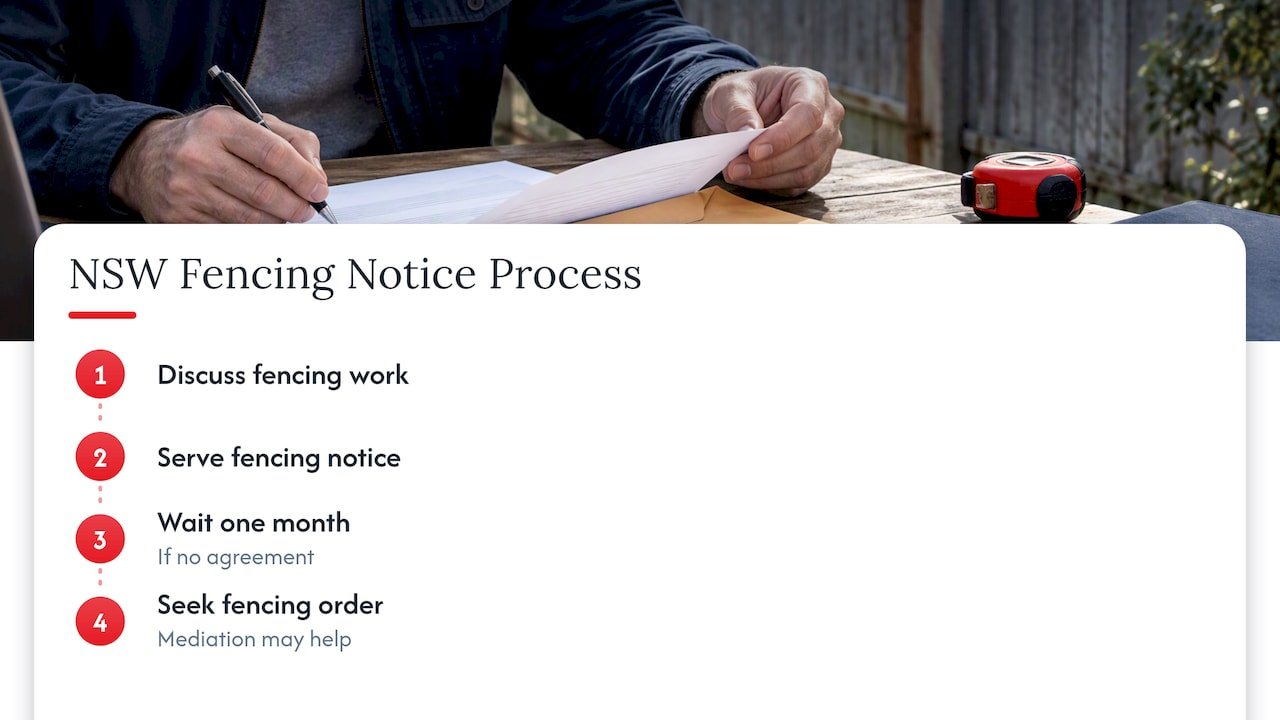
In NSW, Legal Aid explains that a neighbour wanting fencing work should first discuss it, then serve a fencing notice. After one month without agreement, the applicant may seek a fencing order, and mediation may help. “Fencing work” covers design, construction, replacement, repair and maintenance of all or part of the dividing fence.
Step 3: Mediation or a tribunal
In Queensland, unresolved disputes can go to mediation through the state government and are decided by QCAT if they cannot be settled. In Western Australia, the Department of Health guidance says that if negotiation fails and the local government cannot require removal, the matter may go to the Magistrates Court.
Step 4: Health authorities, where the fence is a hazard
The same WA guidance says that when a fence presents a significant public-health risk, or neighbours cannot agree, an environmental health officer may become involved. Condition and context matter: access by children, the chance of further damage, the fence’s security role, weathering and the availability of qualified help all affect whether monitoring, repair, replacement or urgent removal is appropriate.
Do not remove it on your own
In South Australia, the law handbook states that removing or altering an existing fence needs the neighbour’s permission or a court order, even if you offer to pay the whole cost. Assume the same caution everywhere: take the fence down without agreement and you can create a legal problem on top of an asbestos one.
Renting? Who is responsible then
Tenants should not touch damaged asbestos fencing. In Queensland, the state asbestos site says the landlord or agent is usually responsible for making damaged asbestos safe, because the landlord must keep the rental in good repair and fit to live in. A tenant should notify the landlord or agent. Do that in writing, with photos, and keep children and pets away from the area.
Where the waste goes
Disposal is the part people underestimate. The national asbestos authority says asbestos waste can go only to a licensed facility. Putting it in a household rubbish bin or a waste skip, or dumping it, is illegal. Facilities may also impose advance-notification, wrapping and acceptance rules, so a load turning up unannounced can be refused.

A licensed removalist handles the wrapping, transport and tip documentation as part of the job. When you compare quotes, check that disposal is included and that the paperwork will be handed to you at the end.
Getting it done: what we offer
If your fence is confirmed or presumed to be asbestos, we can look after the whole job: inspection and testing, licensed removal, transport and disposal at a licensed facility, and a clean site at the end. We work on residential, commercial and industrial properties, including asbestos removal in Sydney and related work such as asbestos garage removal, asbestos roof removal and disposal, and full demolition where a whole structure is coming down.
If you and your neighbour have agreed to replace the fence, send us the boundary length and any lab results through our website and we will talk you through the next steps. Sharing one quote between both households often keeps the cost split simple.
Our perspective
Most fence disputes we hear about are not really about asbestos. They are about one neighbour feeling the other is not pulling their weight. Asbestos makes that worse, because the fence cannot simply be patched or thrown on a trailer.
Our view is simple. Get the fence tested first, because a lab result stops the guessing. Then agree the replacement and the split in writing, and bring in a licensed team to remove and dispose of the old sheets in one visit. One scope and one quote both neighbours can read keeps the job moving.
We design our asbestos work around safety compliance, licensed handling and responsible waste disposal, because those are the parts of the job that go wrong when people cut corners. For a fence, that means the panels come down intact, the waste is wrapped and sent to a licensed facility, and nothing is left behind on either side of the boundary.
Having the right people do it from the start is the fastest way to a new fence and a neighbour you can still wave to.
Tarek
FAQ
Who pays when an asbestos fence needs to be replaced?
Usually both neighbours, in equal shares, for a sufficient replacement fence. Exceptions include damage caused by one owner, a fence built to a higher standard at one owner’s request, a pool-barrier fence or an agreement that one owner pays. Check your state’s fencing legislation for the exact rules.
Can I remove an asbestos fence myself?
It depends on your state and the amount. In NSW a homeowner may remove less than 10 m² of non-friable asbestos, but more than that needs a licensed removalist. In the ACT homeowners cannot remove any asbestos themselves. Most boundary fences exceed 10 m², so a licensed removalist is the usual route.
Can I put asbestos fence sheets in a skip?
No. Asbestos waste can be taken only to a licensed facility, and putting it in a household bin, a skip or dumping it is illegal. Licensed removalists wrap and transport it, and the facility may require advance notice.
What if my neighbour will not agree to replace a damaged asbestos fence?
Talk first, then use your state’s formal process, such as a fencing notice and order in NSW, or mediation and QCAT in Queensland. If the fence is a public-health hazard, contact your local council’s environmental health officer.
How do I know if my fence is asbestos?
You cannot tell by appearance. Cement-sheet fencing installed before 1990 is highly likely to contain asbestos, and only testing by a NATA-accredited laboratory can confirm it. Do not break off a sample yourself.
Sources
- Dividing fences, WA Government
- Fences, boundaries and retaining walls FAQs, Legal Aid NSW
- Sharing costs between neighbours, South Australian Law Handbook
- Guidance note on asbestos cement fences, WA Department of Health
- Fencing, Logan City Council
- Unlicensed asbestos removal, NSW Asbestos
- Householders and home renovators, Asbestos Safety and Eradication Agency
- Asbestos identification, removal and disposal, Asbestos Safety and Eradication Agency
- The home, Asbestos Safety and Eradication Agency
- Report asbestos issues, City of South Perth
- Residential tenants, lessors and landlords, Queensland asbestos site