Before any demolition starts in Australia, you lodge a free Before You Dig Australia (BYDA) enquiry, read the plans that come back, then have a qualified locator confirm the services on site. The plans are indicative only, so buried gas, electricity, water, sewer and telecommunications lines must be physically verified, usually by potholing, before machinery breaks the ground. Licensed professionals then disconnect or isolate every service. This guide walks owners, builders and project managers through that sequence.
TL;DR
- Lodge a free BYDA enquiry with your site address, dates and type of work. Plans usually arrive within minutes, but allow up to two business days.
- BYDA plans do not pinpoint exact locations. Services must be positively located before excavation, typically by potholing or hydro-vac.
- Demolition contractors must take reasonable steps to get current underground services information and keep it available for inspection.
- All services to the property must be disconnected by licensed professionals before demolition, and penalties can apply if they are not.
- Engage a certified locator for anything beyond a simple site, and book the disconnections early, because they set your start date.
Table of Contents
- Why utilities come first on a demolition site
- Step 1: Lodge a BYDA enquiry
- Why plans alone are not enough
- Step 2: Inspect the site and read the clues
- Step 3: Locate and verify on the ground
- Step 4: Disconnect, isolate or protect
- Who is responsible for what
Why utilities come first on a demolition site
A demolition job disturbs the ground in more ways than most owners expect. Machines track across the site, footings and slabs get broken out, and stormwater and sewer connections are cut. Any of that can reach a buried service.
The consequences are serious. Damage to underground assets can cause electric shock, gas releases or explosions, and loss of service to the neighbours. For a homeowner it also means stop-work time, repair bills and a build programme that slips.
Locating utilities is therefore not an admin step. It decides how the demolition is planned, which machines can be used where, and when the site can safely open.
Step 1: Lodge a BYDA enquiry
Before You Dig Australia is a free national enquiry service. It sends your request to registered asset owners with infrastructure near your project area, and they email plans and safety information directly to you.
To lodge, you log in and search for the site by street address, lot number or latitude and longitude. You then draw the proposed work area on the map and add the location, start and end dates and the type of work. Plans typically arrive within minutes, but allow up to two business days.
A few practical points:
- Draw the area to include the whole demolition footprint, plus the access route for trucks and machinery and any adjoining footpath or nature strip you will use.
- Describe the work as demolition, not just excavation, so asset owners see the full scope.
- Lodge as early as you can. If a plan reveals a major asset, you will want weeks, not days, to arrange isolation or protection.
- Read every plan that arrives, including the safety instructions from each asset owner. They often contain conditions for working near their infrastructure.
In New South Wales, BYDA guidance states that notifying BYDA is a legal requirement for anyone excavating near gas and electricity networks. The NSW Planning Portal also recommends a free pre-demolition enquiry for knockdown-rebuild projects.
Why plans alone are not enough
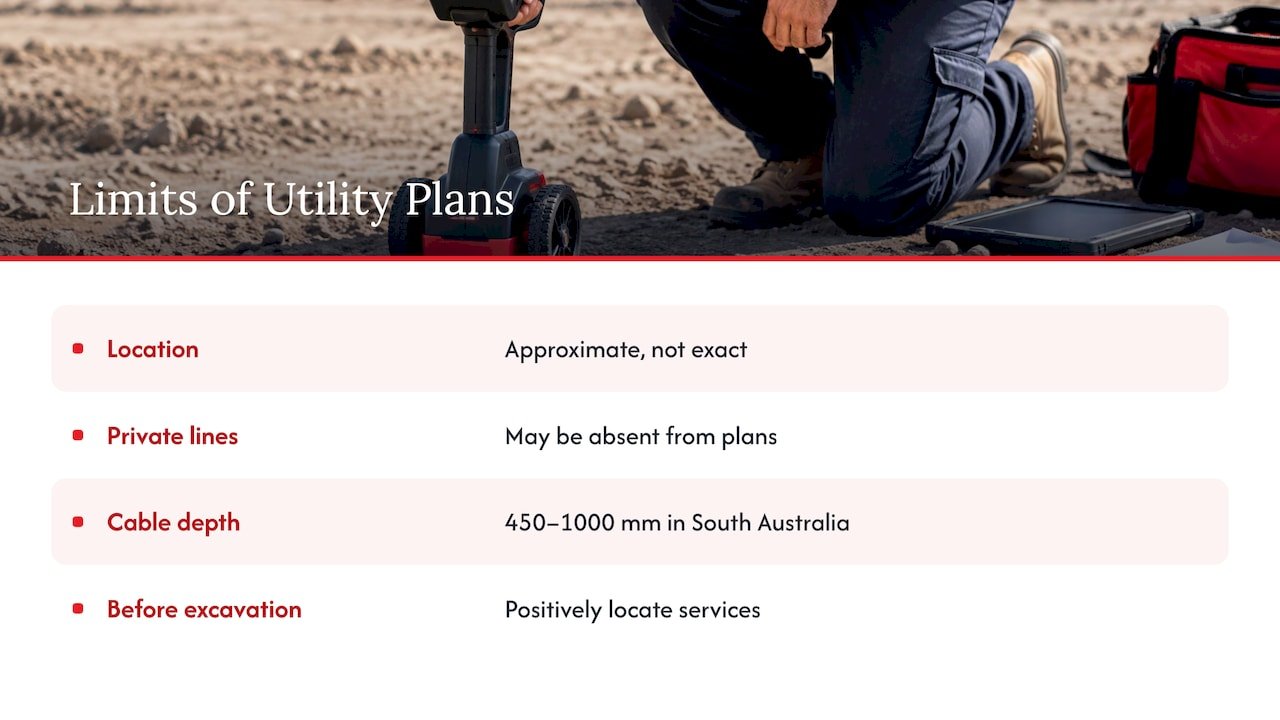
This is the point that catches people out. Asset owners provide the presence, the approximate location and instructions for working around their infrastructure, but this does not pinpoint exact locations. Ground profiles change after installation, and in most cases depth and alignment measurements are not supplied.
There are other gaps. In South Australia, official guidance notes that Dial Before You Dig may not show every pipe or cable, because some are private installations and some asset owners are not members. A private water line to a shed, a feed to a pool pump or an old gas line to a former outbuilding is the typical example.
Depth is unreliable too. Cables in South Australia are typically buried between 450 mm and 1000 mm, but soil may have been added or removed, so you cannot assume a consistent depth.
The Victorian guidebook says the same thing: BYDA and other as-installed plans only indicate where services should be and should not be the only investigation before work begins. The services must be positively located before manual excavation or other permitted methods.
Step 2: Inspect the site and read the clues
With plans in hand, walk the site with them. Look for visible identifiers: meter boxes, pits and valve covers, gas regulators, pole risers, pavement patches and fresh trenching lines. Compare what you see with what the plans show, and note anything that does not match.
The Victorian guidebook frames this as site assessment: visual identifiers and contacting service owners directly where the plans leave questions. It then moves to a documented safe system of work, including a job safety analysis, risk assessment and, for high risk construction work, a safe work method statement and any permits.
Safe Work Australia’s model code adds a demolition-specific point. Underground essential services information may not be accurate, so the demolition method should include an initial examination of the area. Queensland’s 2021 code says the same and gives an example: exposing a short section or potholing.
Step 3: Locate and verify on the ground
This is where a professional locator earns their fee. BYDA’s Best Practice Guide recommends engaging a DBYD Certified Locator unless the asset-owning member advises otherwise. A locator can interpret the plans, locate member assets and, where possible, non-member or unrecorded assets, and report results to AS 5488-2013 specifications.
What the quality levels mean
AS 5488-2013 classifies how certain a utility location is. The levels, as set out in an excerpt of the standard, are:
| Level | Basis | Accuracy |
|---|---|---|
| QL-D | Existing records, cursory site inspection or anecdotal evidence | Lowest certainty |
| QL-C | Surface features correlated with records | ±300 mm horizontal |
| QL-B | Relative subsurface location by electronic methods | ±300 mm horizontal, ±500 mm vertical |
| QL-A | Positive identification by exposure | ±50 mm horizontal and vertical |
Only QL-A defines a utility as validated. BYDA’s guide says plans and electronically located assets need potholing and exposure to reach QL-A before excavation.
Electronic detection and its limits
Electromagnetic and ground-penetrating methods are a good first pass, and they map the likely routes quickly. They have limits, though. Some equipment cannot detect electric cable unless current is flowing, or non-metallic pipes unless there is detectable marker tape. Water Corporation (WA) notes that electronic detection may find metallic assets, but non-metallic assets cannot be detected this way, and a pipe may change material along its length.
South Australian guidance adds that anyone locating services themselves must be trained, and the equipment calibrated and suited to every cable and pipe type. On a demolition site that is a job for a trained locator, not a borrowed scanner.
Potholing and hydro-vac
Potholing physically exposes the buried asset so you can see it. Water Corporation states it is the only way of determining pipeline location with certainty. For work running parallel to a pipeline it asks for potholes at 5 m intervals, because alignments vary, and for clean bedding material over the exposed asset when backfilling.

Method matters. BYDA’s guide says to use careful hand digging or hydro-vac, and not mechanical aids such as backhoes. The NSW earthmoving checklist expects underground and overhead assets to be identified before mechanical excavation by potholing, hydro-vac or hand digging with non-conductive tools, with flagging of the located assets and height marking of overhead lines.
Step 4: Disconnect, isolate or protect
Locating a service tells you where it is. It does not make it safe. Before demolition, all utilities and services to the property must be disconnected by licensed professionals, and penalties can apply when they are not. The same NSW page says the demolition contractor typically manages disconnection of water, sewerage and potential hazards in pipes or lines.
Where an asset has to stay live, for example a neighbour’s feed or a main in the footpath, the NSW checklist expects evidence that services have been isolated or protected before works start. The principal contractor must also ensure, so far as is reasonably practicable, that remaining active services pose no risk.
A practical order of events:
- Lodge BYDA and collect all plans.
- Inspect the site and cross-check against the plans.
- Book a locator and potholing where services sit near the work.
- Apply to each utility for disconnection, isolation or a permit.
- Confirm in writing that each service is disconnected or protected.
- Mark protected assets on site and brief every worker.
- Start demolition only after sign-off.
Our separate guide on how to verify utility disconnection before demolition covers step 5 in detail.
Some network operators add their own approvals. SA Power Networks, for example, requires a Network Access Permit for excavation deeper than 0.3 m near underground cables, and within set distances of poles and towers. Check what your local network operator requires, because these rules differ by state and utility.
Who is responsible for what
The model code puts a clear duty on demolition contractors. They must take all reasonable steps to obtain current information on underground essential services that could be disturbed.