
Power abolishment is the permanent removal of your electricity supply: the service line and the meter come off the property, and the network no longer has a live connection to it. It is not the same as asking your retailer to switch the power off. The account holder starts it through the electricity retailer (or, in some Victorian areas, the distributor’s portal), the network operator does the physical work, and demolition should not begin until you hold written or visible confirmation that it is done. If you are planning a demolition, build the abolishment into the schedule first, because it is often the longest wait on the job.
We manage demolition and asbestos removal projects, and our full-service project management covers approvals and utility disconnections. This guide explains the process so you can start it early and know what proof to ask for.
TL;DR
- Abolishment is permanent removal of the service line and meter. A standard disconnection only turns supply off and leaves the wiring live up to the meter.
- The account holder arranges it, usually through the electricity retailer. Each state and distributor has its own form, portal or service order.
- Allow several weeks. Published timeframes range from about 20 business days to 7 or more weeks depending on the network and crew availability.
- Demolition starts only after confirmation that the supply is removed, such as a written notice or the distributor’s sticker in the meter box.
- Solar, batteries and phone or internet lines need separate handling before the machines arrive.
Table of Contents
- What power abolishment actually means
- Why it has to happen before demolition
- Who arranges it
- The process, step by step
- How long it takes
- What it costs
- Common reasons abolishments stall
- Commercial sites and leased premises
- Perspective
- Getting your demolition started
- FAQ
- Sources
What power abolishment actually means
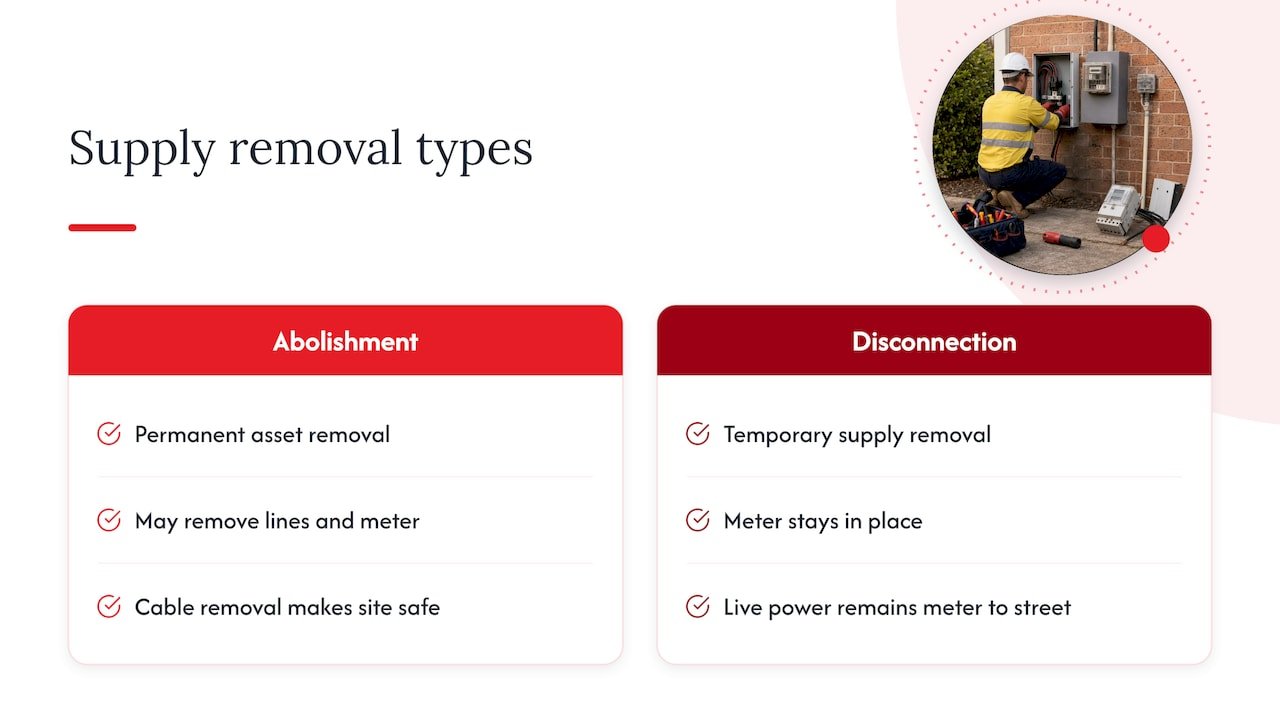
Abolishing a supply permanently removes the electrical assets from a property. CitiPower and Powercor explain that, unlike a temporary switch-off, a standard abolishment may include removing the overhead service lines and the electricity meters.
AusNet Services draws the same line. A meter abolishment is the permanent removal of the meter and/or service lines. A disconnection requested through the retailer is a temporary removal of supply, and the meter stays.
The difference matters on a demolition site. SafeWork SA points out that a disconnection alone leaves live electricity between the meter and the street. Physically removing the supply cable is what makes the site safe for excavators, hand demolition crews and anyone cutting walls.
It is also one-way. Ergon Energy says reconnection after abolishment needs a brand-new connection application. If you may rebuild on the same site, plan the new connection together with the demolition rather than treating it as an afterthought.
Why it has to happen before demolition
The reason is electrocution risk. Ergon Energy states that demolition cannot start under any circumstances until it has confirmed in writing that the connection removal is complete.
The duty is shared. SafeWork SA says owners, developers, builders and demolition businesses all have to make sure the supply is abolished before demolition. In Victoria, Jemena’s Electrician Hub notes that where a dwelling is to be demolished, the Abolition of Service must be completed before work begins. It also notes that under the Electricity Safety Act 1998 (Vic) it is prohibited to remove a meter or service line without the distributor’s approval.
So nobody on site should be pulling a meter off the wall, however old it looks. Removal is done by the network or an authorised person, and the paperwork is what closes the loop.
Who arranges it
The property owner, specifically the electricity account holder, starts the process. SafeWork SA says the owner contacts the electricity retailer to arrange it. One Melbourne site-preparation guide adds that privacy rules mean only the authorised account holder can arrange the abolishment, so a builder or demolition contractor cannot lodge it on your behalf. That is a common cause of delay when an owner is slow to respond.
If you are a developer, a landlord’s agent or a project manager working for an owner, get the account holder involved on day one. Have the bill handy: the 11-digit National Metering Identifier (NMI) on it is needed for the application, according to the same guide.
The process, step by step
The detail varies by state and distributor, but the sequence is consistent.
1. Confirm the site is ready and who your distributor is
Find the NMI and the distributor on your bill. The distributor owns the poles, wires and service lines in your area, and its rules decide the form you use. In Sydney’s west and the Hawkesbury, for example, that is Endeavour Energy. Other parts of Sydney have a different network operator, so check the bill rather than guessing.
2. Lodge the abolishment request
The route depends on where you are:
- South Australia: you contact your retailer, which does its checks and sends a service order to SA Power Networks. SAPN scopes the work and sends an SMS when it is ready to book. If you do not know your retailer, SafeWork SA lists SAPN on 13 12 61.
- Victoria: Red Energy explains that for CitiPower/Powercor, United Energy and AusNet the application goes directly through the distributor’s online portal. For Jemena it uses the VESI Abolishment of Electricity Supply form sent to the retailer.
- NSW: Alinta Energy’s guide says the steps depend on meter type. With a basic meter, an accredited electrician arranges removal of the supply and meter. With a smart meter, the electrician removes the supply and the customer also contacts the retailer to arrange meter removal through the meter provider.
- Queensland: the retailer sends the service order to Ergon Energy or the local network, and Ergon’s removal page sets out the rules for connections it owns.
If the property has both electricity and gas, lodge both applications at the same time. The Melbourne guide recommends this, as gas can run on its own timeline.
3. The retailer and distributor process the order
In Victoria, Jemena’s 2026 Electricity Retailer Handbook describes the sequence: the retailer sends a Supply Works Service Order for abolishment before any metering order. Jemena must respond within 5 business days and complete the work within 20 business days, and the NMI is then updated in the national market system.
In NSW, Endeavour Energy’s Retailer and Market Guide (version 29, 1 December 2025) says service work removal needs a Level 2 Accredited Service Provider, with Class 2B for underground, 2C for overhead and 2D for controlled load equipment. A Metering Coordinator removes type 1 to 4 meters. The provider must submit a Remove All Gear notification within two business days so the NMI can be marked Extinct. A fee applies under rate code NABO in Endeavour’s Ancillary Network Services Price Guide.
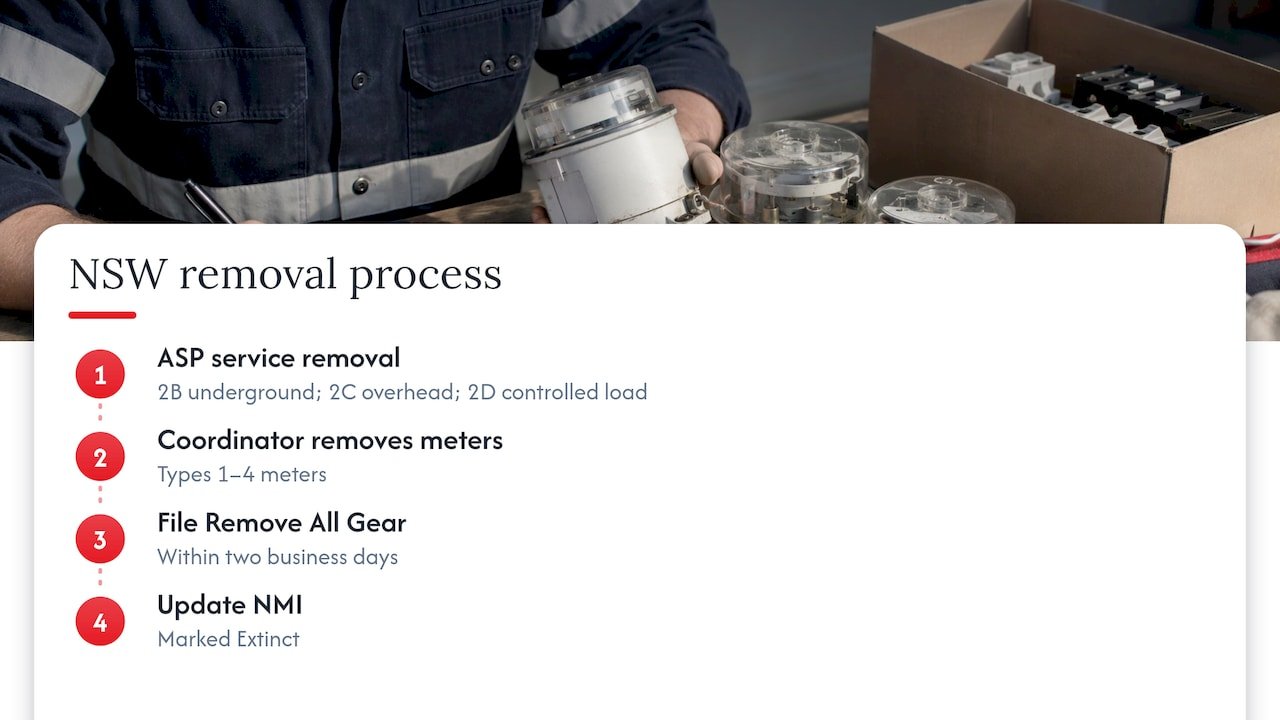
You will not usually see these steps. What you need to know is that there are several handoffs, and each can stall if a form is incomplete.
4. Deal with solar, batteries and communications
The distributor removes electricity wires only. SA Power Networks says telecommunications connections have to be removed by the relevant provider. It also says solar panels or batteries on the property must be decommissioned by a licensed electrician before demolition starts. Book those in parallel with the abolishment, not after it.
5. Get confirmation before anyone starts
Proof depends on the network:
- In South Australia, SafeWork SA says the builder must visually confirm that the meter has been physically removed and that SAPN’s yellow warning sticker is in the meter box. A danger sticker means the abolishment was not successful, and demolition must not start.
- In Queensland, Ergon requires written confirmation that the connection removal is complete.
- In NSW and Victoria, keep the distributor or retailer confirmation and the metering paperwork with your demolition file.
If you work in NSW, our guides on proving service disconnection before demolition and the five utilities to disconnect and the evidence pack show what to collect. For a national view, see how to verify utility disconnection before demolition.
How long it takes
Plan in weeks, not days. Published figures vary by network:
| Network | Published timeframe | Source |
|---|---|---|
| Ergon Energy (simple urban connection) | Removal within 20 business days of the retailer’s service order | Ergon Energy |
| Jemena (Victoria) | Respond in 5 business days, complete within 20 business days | Jemena 2026 handbook |
| CitiPower and Powercor | Up to four weeks from the date the property is advised vacant | CitiPower and Powercor |
| SA Power Networks | About 3 weeks until ready to book, plus 4 to 6 weeks for crew availability | SA Power Networks |
| Red Energy (Victoria) | Up to 5 weeks once the retailer has the application | Red Energy |
Rural and isolated sites take longer. Ergon says removal dates for those are agreed between the retailer and the network. Red Energy also warns that weather, safe access and emergencies can affect the end-to-end timeline.
The practical rule: lodge the request as soon as you have a demolition contract in view, and ideally before you finalise the start date. A start date set without an abolishment date is a guess.
What it costs
Costs are set by the distributor and passed on by the retailer, and they differ a lot by network and by job. Some examples with their periods:
- Ergon Energy’s network charges to the retailer for the 2026 to 27 financial year are $485.15 excluding GST for service-line removal and $107.33 excluding GST for meter removal. Further network work, such as transformer removal, can add charges.
- Ergon Retail’s self-service abolishment form says fees may be up to $2,117.20.
- CitiPower and Powercor say they do not usually charge for abolishments, though charges can apply if the work is more complex than expected or site access is not available.
- In South Australia, SA Power Networks says the cost is charged by the retailer on the final electricity bill.
These are published figures for their periods. Distributors update charges on their own schedules, so ask your retailer for a quote or check the distributor’s current price list before you budget. The main variables are overhead or underground supply, the number of meters, access to the site and whether extra network work is needed.
One cost lever is worth knowing about. Red Energy notes that locking or plugging a meter can be a more cost-effective option in some situations where full abolishment is not required. For a demolition, though, the aim is a supply that is physically gone, so confirm with your retailer which option the distributor accepts for your job.
Common reasons abolishments stall
- The wrong person applies. A builder or contractor lodges the request but is not the account holder.
- Missing details. The NMI, the meter number or the vacancy date is not supplied, so the order is rejected or paused.
- Tenants or occupants. The CitiPower and Powercor timeframe runs from the date the property is advised vacant. An occupied property pushes the date out.
- No access. The network crew cannot reach the pole, pit or meter box.
- Smart meter gaps. With a smart meter in NSW, the electrician’s work and the meter removal are separate steps, and the second can be forgotten.
- Solar and batteries left in place. A licensed electrician has to decommission them first.
A short checklist before you lodge: account holder identified, NMI to hand, site vacant or a vacancy date set, solar and battery systems listed, communications provider notified, and access to the meter box and service line clear.
Commercial sites and leased premises
On commercial and industrial sites, the supply can be more complex: multiple meters, three-phase supply, shared switchboards and tenancies with their own accounts. Each account holder needs to be involved, and you need to know which tenancy owns which meter. For a strip-out of a leased space, the electrical work inside the tenancy is part of the fitout and make-good picture. Tenants weighing their lease obligations can read about environmental due diligence for leased premises before they commit to a scope.
For interior works that leave the building standing, a full abolishment is usually not needed, and isolation of circuits is handled differently. Our strip out demolition guide covers how those projects are staged.
Perspective
Most delays we see on demolition jobs start before any machinery is booked: the power is still connected, and nobody has confirmed who owns the application.
Our view is that abolishment belongs in the project plan at the same level as the demolition approval. Our full-service project management covers approvals, utility disconnections, hazardous waste handling and final site cleaning, so the sequence is planned as one job rather than a string of separate phone calls.
If the building also has asbestos, the order matters even more. Asbestos inspection and licensed removal have to be programmed alongside the utility work, and we plan them together so the site is clean, safe and confirmed disconnected before demolition begins.
Tarek
Getting your demolition started
If you are a homeowner, developer or builder with a site to clear, we can plan the demolition around your abolishment timeline and take the utility coordination into our project management. We handle residential demolition, commercial and industrial demolition, licensed asbestos removal and site clearance across Sydney and Australia.
To discuss your site, start at Mission Demolition. For houses and sheds that may contain asbestos, our asbestos inspection and testing is where the programme begins, and our guide to removing asbestos before demolition sets out the order of work. Once the structure is down, post-demolition land preparation makes the site build-ready.
FAQ
Is power abolishment the same as disconnection?
No. A disconnection is a temporary switch-off, and the meter stays. Abolishment permanently removes the service line and meter, as set out by CitiPower and Powercor and AusNet Services. For demolition you need the abolishment.
Can my builder or demolition contractor apply for me?
Generally no. The account holder has to arrange it, usually through the retailer or the distributor’s portal. Your contractor can tell you the timing they need, and in South Australia the owner informs the builder or demolition business that the application has been lodged.
How early should I apply?
As early as you can, ideally when you sign the demolition contract. Published timeframes run from about 20 business days to several weeks more, and rural sites take longer. Ask your retailer for the current timeframe for your distributor.
What proof do I need before demolition starts?
Confirmation from the network that the supply is removed. In Queensland that is written confirmation from Ergon. In South Australia it is the meter physically removed and SAPN’s yellow sticker in the meter box. Keep the paperwork on file for your demolition contractor and certifier.
Do I need to remove solar panels first?
Yes, where they are installed. SA Power Networks says solar panels and batteries must be decommissioned by a licensed electrician before demolition begins, and that telecommunications lines are removed by the relevant provider.
Sources
- Abolish an electricity supply, CitiPower and Powercor
- Meter connections, AusNet Services
- Abolishment of electricity supply, SafeWork SA
- Remove your connection, Ergon Energy
- Permanent disconnections, SA Power Networks
- Disconnecting, locking or abolishing, Red Energy
- Remove electricity supply, Alinta Energy
- Electrician Hub, Jemena
- Electricity Retailer Handbook 2026, Jemena
- Endeavour Energy Retailer and Market Guide, 1 December 2025
- Site Prep 101: Demolition Contractor Melbourne Guide