
If a storm has cracked, lifted or broken your asbestos cement roof, stay off it, keep people and pets away, keep any debris damp, and call a licensed asbestos assessor or removalist before anything is moved. Do not sweep, hose, drive over or cut the material. Ageing sheets that have been weathered for decades release fibres more easily once they are broken, so the first few hours are about containment, not clean-up.
This guide sets out the safe first steps, what the official Australian guidance says you must never do, how insurance tends to treat asbestos, what happens to the debris, and what to check if you plan to sell. We are a Sydney demolition and asbestos removal company, so we also explain where professional help becomes the sensible option.
TL;DR
- Do not walk on the roof or enter damaged areas until it is confirmed safe. Keep children and animals clear and restrict access with closed gates and warning tape.
- Never use high-pressure water, compressed air, brooms, power tools or cutting on asbestos material. These actions spread fibres and, in NSW, high-pressure water or compressed air on asbestos is prohibited.
- Do not assume your insurance covers asbestos. Read the policy wording and call your insurer before any clean-up starts.
- Have the material identified by a licensed asbestos assessor, then use a licensed removalist for anything beyond minor, small-scale work.
- Asbestos waste never goes in household bins or kerbside collection. It must be wrapped, labelled and taken to an authorised facility.
Table of Contents
- Why a storm turns a stable roof into a hazard
- What to do in the first hours after storm damage
- Repair or replace: what is realistic
- Who is allowed to do the work
- Insurance: do not assume you are covered
- Debris, bagging and disposal
- Selling a house with a storm-damaged asbestos roof
- Perspective
- Getting help from Mission Demolition
- FAQ
- Sources
Why a storm turns a stable roof into a hazard
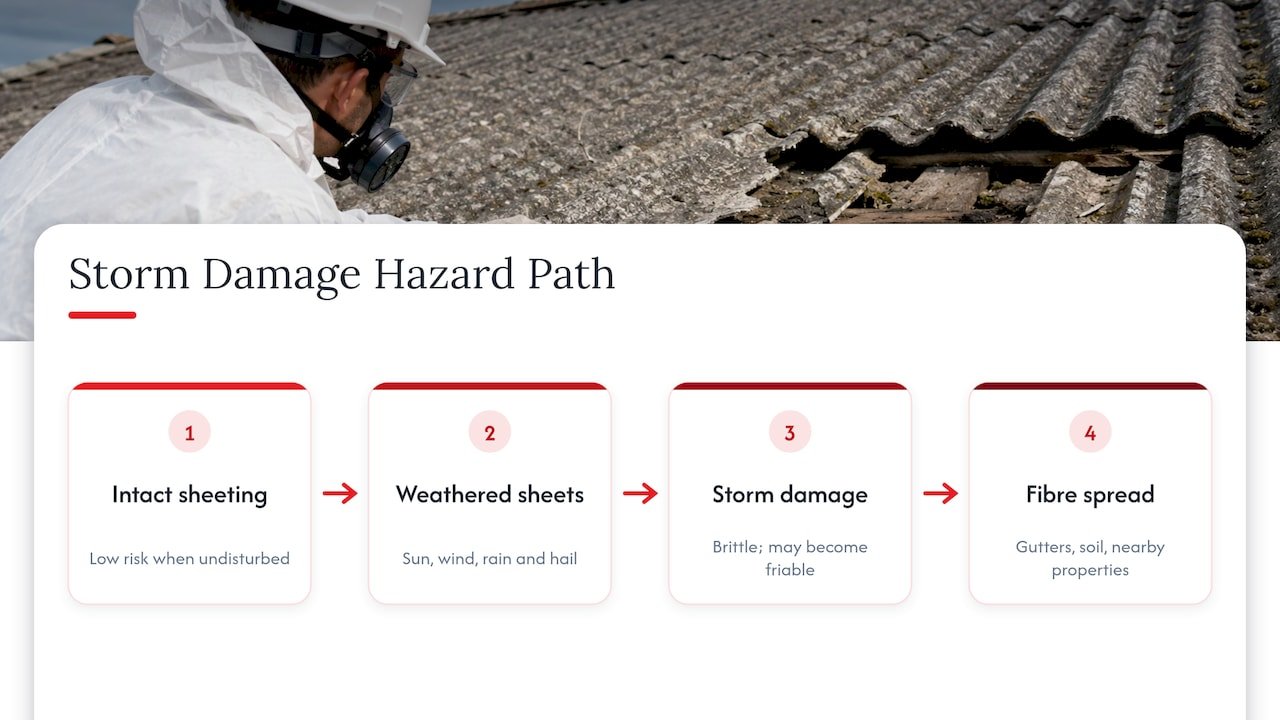
Asbestos cement sheeting is considered low risk while it is intact and undisturbed. Storms change that. The Asbestos Safety and Eradication Agency notes that asbestos cement roofs are often in poor condition after years of sun, wind, rain and hail, which makes them release fibres more readily and become brittle, raising the risk of breakage and collapse.
The same page explains that heavy rain can wash fibres into gutters, and that careless cleaning can contaminate neighbouring properties, vegetation, soil, footpaths, roads and stormwater systems. A cracked sheet is therefore rarely just a roof problem. It can become a site-wide and sometimes neighbourhood-wide one.
The NSW Environment Protection Authority adds a useful distinction. Storm-damaged or displaced asbestos can become friable, and non-friable material can turn friable when it is significantly damaged or in poor condition. Material that was wet when damaged can also release fibres once it dries. That is why the guidance asks you to treat all fibro found after a storm cautiously, whatever it looked like before.
How to tell whether your roof may contain asbestos
As a rule of thumb, Queensland guidance says buildings built before 1990 may contain asbestos. You cannot confirm it by eye, though. NSW guidance states that correct identification requires a licensed asbestos assessor or occupational hygienist, so treat any older corrugated or flat cement sheeting as suspect until it is tested. If you are unsure which product you have, our guide to asbestos roof types in Australia explains how the common sheet and tile types differ, and our asbestos testing methods page shows how samples are assessed.
What to do in the first hours after storm damage
The official advice from the Australian Government agency is consistent across states: do not rush in. Do not enter until advised it is safe, keep children and animals away, and avoid moving debris about.
A safe first-hour checklist
- Stay off the roof. NSW guidance warns that asbestos roofs can be brittle and slippery when wet and must not be walked on. Queensland guidance says the same about corrugated asbestos roofs.
- Restrict access. Queensland’s storm clean-up procedure says to close gates or doors and use warning tape so no one wanders into the debris.
- Keep debris damp. Lightly dampen broken pieces with a gentle spray. WorkSafe WA specifically says to lightly dampen debris and never use high-pressure sprays.
- Cover loose fragments. The Queensland procedure suggests temporarily covering debris with a moist, secured tarp.
- Photograph the damage from a safe distance. You will need it for your insurer and your assessor.
- Phone a licensed assessor or removalist before any clean-up starts.
If you must go near debris for a short time, the agency recommends sturdy footwear, heavy-duty gloves, disposable coveralls and a P2 mask. Those are a minimum for a brief, unavoidable task, not a licence to start clearing the roof.
What never to do
NSW guidance prohibits power tools, abrasive materials, cutting sheets, compressed air, brooms and high-pressure water cleaners on asbestos materials, because each can release or disperse fibres. SafeWork NSW goes further: under clause 446 of the Work Health and Safety Regulation, high-pressure water or compressed air on asbestos-containing materials is prohibited, except for firefighting or fire protection.
The same SafeWork NSW publication identifies pressure-cleaning roofs, gutters, downpipes, eaves and ridge or barge capping as high-risk, with the potential for widespread contamination and remediation costs that can reach hundreds of thousands of dollars. A well-meaning gutter rinse after a storm is exactly how a small problem becomes an expensive one.
Repair or replace: what is realistic
The answer depends on how much material is damaged and what shape it is in. NSW guidance allows for very limited first aid: small fractured or exposed edges may be sealed with paint or PVA glue if the material remains in its original form and location. Only material that is already broken, dislodged or sitting in debris should be removed, and removal should not happen unless it is necessary.
In practice that gives you three situations:
| Situation | Typical response |
|---|---|
| Minor fracture or exposed edge, sheet still in place | Seal the edge, keep people off the roof, have an assessor inspect it |
| Several broken or displaced sheets, debris on the ground | Contain and dampen debris, restrict access, engage a licensed removalist |
| Widespread hail or wind damage, unstable structure, debris in gutters | Treat as a contamination event, engage an assessor and licensed removalist urgently |
Sealing is a stopgap. A roof that has been cracked by hail or wind has usually been weathered for decades, and a licensed professional can tell you whether patching is sensible or whether the safest long-term answer is planned removal and a new roof. Our own view, covered in the Perspective below, is that planned removal under controlled conditions is almost always calmer, safer and often cheaper than living with a damaged roof through the next storm.
If you want to understand what a planned job looks like in Sydney, see our pages on asbestos roof removal and on asbestos roof tiles and the paperwork homeowners face.
Who is allowed to do the work
Rules differ between states, so check your own regulator. The general pattern:
- Identification and assessment: use a licensed asbestos assessor or occupational hygienist.
- Small jobs: NSW guidance says removal of less than 10 square metres of non-friable asbestos does not require a licensed removalist, though precautions and personal protective equipment are still required.
- Larger jobs: Queensland guidance says removal of more than 10 square metres must be done by a licensed asbestos removalist.
- Urgent or unsound structures (WA): WorkSafe WA says licensed removalists must notify it immediately when removal is urgently required because a structure is unsound or collapse is imminent, with notification within 24 hours and clearance required before re-entry.
A typical roof is far larger than 10 square metres, and friable or heavily broken material is a different matter again. For almost every storm-damaged roof, a licensed removalist is the right call. If you are comparing providers, our guide to asbestos removal contractors in Australia lists what to ask before you sign.
Insurance: do not assume you are covered
The most common reader question is whether insurance will pay. The honest answer is that it depends on your policy. The Asbestos Safety and Eradication Agency says policies may exclude asbestos or provide insufficient cover if asbestos is accidentally damaged or disturbed during a storm, and that policyholders should take reasonable precautions and declare potential risks, including asbestos, when obtaining insurance.
The agency also notes that comprehensive asbestos-related insurance is mainly available for planned removal by trained professionals, and that accidental-damage contamination can be more hazardous and expensive than planned removal.
What that means for you:
- Call your insurer before clean-up. Report the storm event and say you suspect asbestos.
- Read the wording on asbestos, contamination and clean-up. Ask directly whether removal, disposal and re-roofing are covered.
- Keep records. Photos, assessor reports and removalist quotes support the claim.
- Do not start removal first. Early unapproved work can complicate a claim, and DIY handling can make the contamination worse.
A written assessor’s report and a removalist’s itemised quote are the documents an insurer’s assessor will usually want to see. We can provide a quote for the removal work itself, but we cannot tell you what your insurer will accept.
Debris, bagging and disposal
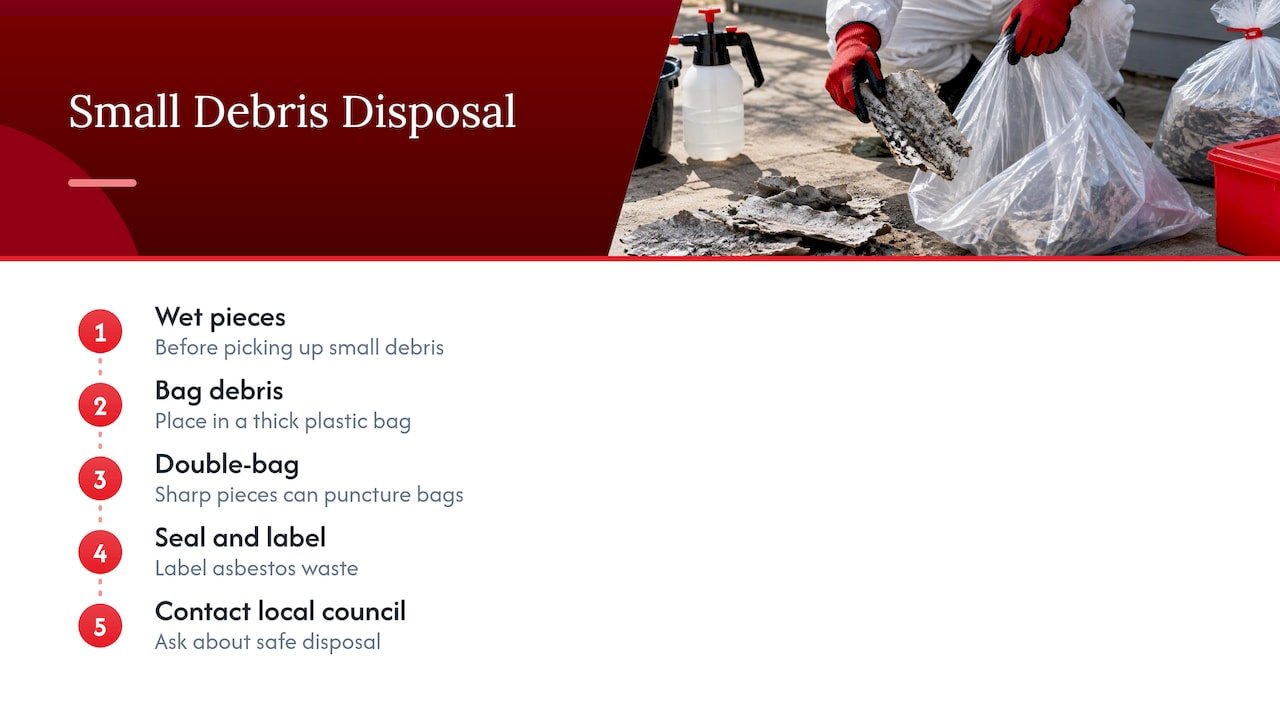
Small pieces of broken sheet and contaminated debris can be handled only with great care, and larger quantities belong with professionals. For small amounts, Queensland’s storm procedure says wetted debris may be picked up with an inverted plastic bag or a shovel, taking the immediately underlying soil, then double or triple bagged, since sharp pieces can puncture bags.
Queensland’s guidance on cleaning or removing asbestos after storms adds that you should wet pieces, place them in a thick plastic bag, double-bag, seal and label them, and contact the local council about safe disposal. It is clear that asbestos waste must not go into bins or kerbside collections.
If waste has to wait, the NSW EPA says wrapped asbestos waste stored after a disaster must be kept in a separate pile, securely covered, labelled and away from busy areas. Transport must be correctly wrapped and covered, and the destination must be an appropriate asbestos waste facility or local disposal point, not ordinary household waste.
That is also why a general junk or green-waste service is not the right call for asbestos. Ordinary branches and non-asbestos household debris are a different matter, and a guide to storm debris removal can help you keep people away from that material while the asbestos side is sorted out first.
Don’t forget the gutters and the ground
Because rain can wash fibres into gutters and onto soil, a proper inspection should cover more than the roof surface. Gutters, downpipes, eaves, ridge capping, fences, sheds and garages built from fibro can all be affected. Our asbestos garage removal page covers outbuildings, which often fail first in a storm.
Selling a house with a storm-damaged asbestos roof
Storm damage and asbestos both matter when you sell. The Asbestos Safety and Eradication Agency publishes a state-by-state summary of disclosure obligations. It says sellers should tell a buyer if the home contains asbestos, and that real estate agents must not give false or misleading information and must disclose known asbestos if a buyer asks.
Details vary by state or territory. For example, in the ACT, if a current asbestos assessment report by a licensed assessor exists, the seller or agent must provide it with the contract of sale. Check the table for your jurisdiction, and ask your conveyancer what must go into the contract.
Practically, a sale goes more smoothly when you can show the roof has been inspected, damage has been made safe and any removal was done by a licensed contractor with clearance documentation. A buyer facing an unexplained cracked asbestos roof will usually price in the worst case.
Perspective
We get calls after almost every serious storm season, and the pattern is always the same. The roof was sound for forty years, then one hailstorm leaves a few cracked sheets, and the owner’s first instinct is to get up there with a hose or a broom and tidy up. That instinct is understandable, and it is the one thing we ask people not to follow.
Our view is simple. Storm damage to an asbestos roof is a contamination question first and a building question second. Until a licensed assessor has looked at it, nobody should be moving, washing or cutting anything. Once the material is identified, the cleanest outcome is nearly always planned removal: controlled, documented, wrapped and delivered to an authorised facility, then a new roof that does not need a second thought.
That is what we are set up to do. Mission Demolition offers licensed asbestos removal, inspection and testing, roof removal, disposal, and the project management around it, including approvals and final site cleaning. We would rather be called early and keep a small problem small than be called after a pressure washer has turned one roof into three contaminated properties.
Tarek
Getting help from Mission Demolition
If your roof has been damaged, our team can arrange asbestos inspection and testing, licensed removal of damaged roofing, safe disposal, and where a structure is unsound, demolition of what cannot be saved. We work with homeowners, property managers, builders and developers across Sydney and Australia, and we handle the approvals, utility disconnections, hazardous waste handling and final clean as part of the job.
Start with our asbestos roof removal and disposal services, book an asbestos inspection and testing visit, or, if a garage, shed or structure is no longer safe, look at our emergency demolition services. You can also contact us through the Mission Demolition website for a quote.
FAQ
Will insurance cover an asbestos roof after a storm?
Not automatically. Some policies exclude asbestos or give limited cover when it is accidentally disturbed in a storm. Read your policy wording, tell your insurer you suspect asbestos before any clean-up, and keep an assessor’s report and removalist quote to support the claim.
Can I fix a cracked asbestos roof myself?
Official NSW guidance allows only minimal action: sealing small fractured or exposed edges with paint or PVA glue where the material is still in place. You must not walk on the roof, cut sheets or use power tools. For anything more, call a licensed professional.
Is a broken asbestos roof dangerous straight away?
It can be. Storm-damaged or displaced asbestos can become friable, and material that was wet when damaged can release fibres as it dries. Keep people clear, keep debris damp and avoid disturbing it until it is assessed.
Can I put broken asbestos sheeting in my bin?
No. Asbestos waste must not go into household bins or kerbside collection. It has to be wrapped, labelled and taken to an appropriate asbestos waste facility. Contact your local council for disposal advice.
Can I sell a house with an asbestos roof?
Yes, but you must be upfront about it. Sellers should disclose asbestos, and disclosure rules differ by state or territory. Ask your conveyancer what your contract must include.
Sources
- The dangers of asbestos cement roofs, Asbestos Safety and Eradication Agency
- Extreme weather and other disaster events, Asbestos Safety and Eradication Agency
- Asbestos liabilities and insurance, Asbestos Safety and Eradication Agency
- Disclosure of asbestos in residential property, Asbestos Safety and Eradication Agency
- Managing asbestos in emergencies and disasters, NSW Asbestos
- Safe Management of Asbestos in Disasters, NSW EPA
- Managing risks of exposure to asbestos, SafeWork NSW
- Asbestos safety after an emergency or disaster, WorkSafe WA
- Cleaning or removing asbestos after floods and storms, Queensland
- Safe cleanup of storm damaged materials that may contain asbestos, Queensland
- Storm debris removal guide