Salvage before demolition means taking out the reusable, saleable or recyclable parts of a building, such as hardwood timber, bricks, windows, fixtures and metals, before machines bring the rest down. It is worth doing when the value of what you recover, plus the disposal charges you avoid, outweighs the extra labour and time. It must always come after an asbestos check, never before.
This guide is for owners, builders and developers planning a demolition in Australia. It covers what is usually worth keeping, how to decide, how to sequence the work, and where the rules bite.
TL;DR
- Hardwood timber, bricks, windows, doors, cabinets, fixtures, flooring, roofing and metals are the usual salvage candidates, depending on their condition.
- Get a site survey first. It estimates the income and avoided disposal costs, so you only deconstruct where it pays.
- Asbestos is identified and removed by licensed professionals before salvage crews start work on affected areas. Buildings built before 31 December 2003 need a professional survey.
- Write a simple plan: stages, labour, machinery, space for sorting, and a buyer or recycler for each material.
- Waste must go to a lawful facility. Owner and transporter can both be liable if it does not.
Table of Contents
- Why salvage comes before the excavator
- What is usually worth recovering
- What is usually not worth the effort
- Asbestos comes first, always
- Planning and sequencing the salvage
- Approvals and waste rules
- Where salvaged materials go
- Is salvage worth it on your project?
- Our perspective
- Demolition and asbestos work handled together
- FAQ
- Sources
Why salvage comes before the excavator
Once a machine hits a house, most of what is valuable becomes mixed rubble. Timber splits, windows shatter and bricks are coated in mortar and contaminated. Taking things out by hand first keeps them intact.
The NSW EPA describes deconstruction as taking a building apart so materials can be sold at a profit, or reused or recycled free or at reduced rates, which cuts disposal and landfill charges. That second benefit is easy to miss. Every tonne you divert from landfill is a tonne you do not pay to dump.
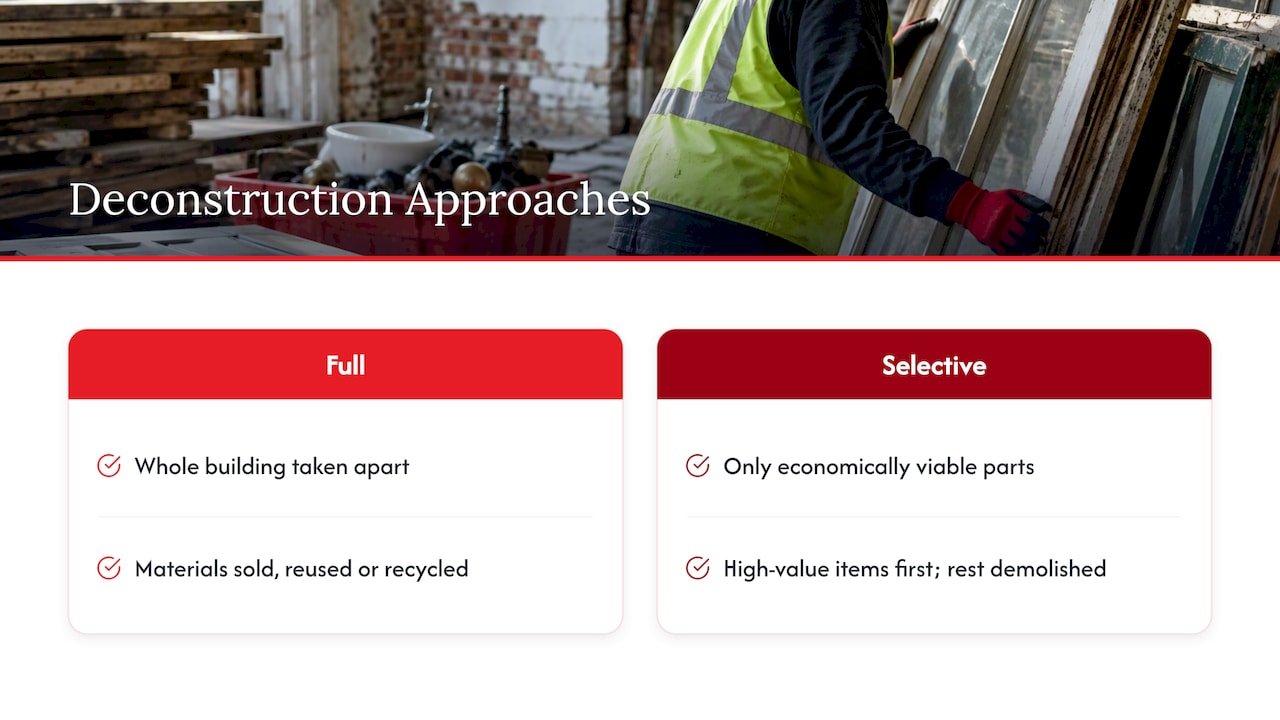
The same guide separates full deconstruction from selective deconstruction. Selective means you only deconstruct where it is economically viable. For most demolition projects that is the realistic approach: pull the high-value items, then demolish the rest.
What is usually worth recovering
The EPA lists timber, windows and doors, cabinets, plumbing products, plasterboard, electrical products, bricks, concrete, flooring and roofing materials as materials that can be reused or sold, depending on condition. Condition is the operative word. A sound item with a ready buyer is worth the labour. A damaged item with no buyer is rubbish.
| Material | Why it is worth a look | Watch for |
|---|---|---|
| Hardwood timber (framing, floorboards, beams) | Quality hardwood can attract high prices for reuse | Nails, rot, termite damage, old paint that needs testing |
| Bricks | Listed as a source of salvaged material for reuse | Hard cement mortar makes cleaning slow |
| Windows and doors | Reusable if frames and glass are intact | Old paint, broken glass, safety issues when lifting out |
| Kitchen cabinets and fixtures | Reusable or saleable in good condition | Water damage, sheet material that may contain asbestos in older homes |
| Copper, steel and aluminium | Piping and wire can be recovered and recycled | Strip safely and have power and gas isolated first |
| Roofing | Listed as reusable or saleable | Older cement sheet roofing is a common asbestos source and is not a salvage item |
| Concrete and brick rubble | Can be crushed for aggregate, road base or fill | Needs separating from contaminants |
Character items often matter more than commodity items on older homes: leadlight, fireplaces, period hardware and old floorboards. These suit specialist reuse buyers rather than general scrap.
What is usually not worth the effort
Some items cost more to remove than they return. Damaged plasterboard, painted or treated timber with no buyer, low-grade fittings and anything heavily contaminated usually go straight to recycling or disposal. Plasterboard appears on the EPA’s reusable list, but in practice it only makes sense when it is clean, dry and in quantity.

A good test: can you name the buyer or recycler before the item comes out? The EPA’s planning advice is to identify buyers or recyclers for each material. If you cannot, leave it for the demolition crew to sort into waste streams.
Asbestos comes first, always
Salvage crews take things apart by hand, which means close contact with ceilings, walls, eaves, roofing and floor coverings. In an older building, that is exactly where asbestos can be.
Asbestos was gradually phased out of Australian building materials during the 1980s, and supply and installation of asbestos-containing goods have been banned since 31 December 2003. Any building from before that date could contain it.
The SafeWork NSW demolition code of practice sets out the position:
- Asbestos must be identified by a competent person before demolition.
- All asbestos likely to be disturbed must be removed as far as is reasonably practicable before demolition starts.
- Professional asbestos surveys are needed for buildings constructed before 31 December 2003.
- Removal of more than 10 m² of non-friable asbestos needs a licensed contractor, and any friable asbestos removal needs a Class A licence (the code cites Queensland WorkSafe 2021 for this).
- Detailed safe work method statements are required for demolition work that involves, or is likely to involve, disturbing asbestos.
The point for salvage is practical. Undisturbed, sealed, non-friable asbestos can be safe left in place, but if it is broken, damaged or disturbed, fibres can become airborne. Prising off a sheet to save a cabinet, or lifting old flooring, is exactly the sort of disturbance to avoid. The code also notes that partial demolition can be used to safely access and remove asbestos before full demolition proceeds.
If you suspect asbestos, stop and have it tested. Do not salvage from the suspect area yourself. Our guides on removing asbestos before demolition and Class A versus Class B asbestos explain who needs to be involved and what clearance means.
Planning and sequencing the salvage
The EPA guide breaks planning into three documents, which you can keep as simple as the job demands: a site survey of reusable, saleable or recyclable materials, an organisational plan setting out stages, labour and machinery, and a materials management plan identifying destinations and tracking quantities. It also advises allocating enough space on site for separating and storing materials. Skipping that last point is the most common reason salvage turns chaotic.
A workable order for most houses and small commercial buildings:
- Survey the building. List what is worth recovering, estimate quantities, and note the likely buyer for each line.
- Test for hazardous materials. Asbestos is the main one in pre-2004 buildings. Lead paint and old treated timber also need thought.
- Remove asbestos using licensed professionals. Clearance comes before anyone else works in those areas.
- Disconnect services. Power, gas, water and sewer are isolated before fixtures, wiring and pipework come out.
- Strip the interior. Fixtures, cabinets, doors, windows and floor coverings go first, working from the top of the building down. Our interior strip-out service covers this stage on commercial and residential jobs.
- Recover structural items. Roof timber, beams and bricks, only where access is safe and the value is real.
- Demolish the remainder. Concrete and masonry go to crushing and recycling.
- Clear and clean the site. Final removal and cleaning, with waste records kept.
The EPA also advises contacting the relevant authorities, including the state workplace safety regulator and your local council, to understand health, safety and environmental obligations around waste. Planning a safe, organised project also protects people living nearby or staying on site, and this write-up of preconstruction safety steps covers the habits that carry over from renovation into deconstruction.
Approvals and waste rules
Salvage does not replace approvals. In most circumstances, demolishing a structure in Wollongong, for example, requires development consent or a complying development certificate, and other councils run their own processes. Check with your local council before you start pulling things out. For Sydney, see our guide to demolition permits.
Waste is where owners get caught. Under the NSW EPA’s construction and demolition waste fact sheet, waste must be disposed of or reused lawfully. If it goes to a place that cannot lawfully receive it, both the waste owner and the transporter may be guilty of an offence. That is why a materials management plan with named destinations is not paperwork for its own sake. Our checklist on preventing asbestos and illegal dumping before demolition covers the same ground in more detail.
Rules differ between states and territories, so treat NSW sources as NSW rules. If your project is elsewhere, confirm requirements with the local council and your state’s environment and workplace safety regulators.
Where salvaged materials go
Each material needs a destination decided in advance. The EPA’s plan asks you to mark each as sold, reused, recycled or disposed of.
- Sell: hardwood, bricks, character fittings and sound joinery suit salvage yards and recycled building material dealers, or direct sale to builders and renovators.
- Reuse on site: bricks, timber and fittings can go into the new build, which saves buying and hauling. It needs a decision before demolition, not after.
- Donate: useful items with no market value, such as serviceable fixtures and doors, may suit community reuse groups. Arrange collection dates before the demolition date.
- Recycle: set concrete and bricks can be crushed as aggregate for new concrete, road base or fill, and metals go to scrap recyclers.
- Dispose: asbestos and other hazardous waste goes only to licensed facilities through licensed removalists.
Is salvage worth it on your project?
The honest answer depends on three things. A US EPA study notes that cost-effectiveness of recovery depends on hauling and disposal costs, the value of recovered materials and labour costs. That is American research from 2000, so use it for the logic, not the numbers.
A simple way to apply it:
- Income: what will buyers pay for each recoverable item as it stands, not as new?
- Avoided cost: what would you pay to dispose of the same material as waste?
- Cost: labour hours to remove it carefully, storage, and transport to the buyer.
If income plus avoided cost beats the cost, salvage the item. If not, leave it. A site survey is what puts figures on these lines, which is why the EPA recommends one first.
Time also matters. Careful removal takes longer than machine demolition. If you have a builder waiting, a finance deadline or a tight site, restrict salvage to a short list of high-value items and a firm stop date.
Our perspective
Most salvage questions we hear start with a good item and end with an unknown. A homeowner has beautiful old floorboards, and nobody has checked what is under them or in the ceiling above. On pre-2004 buildings we treat the asbestos question as the gate: nothing comes out for reuse until the building has been assessed, and affected materials are handled by licensed people.
Our advice is to keep the salvage list short and specific. Pick the five or six items that someone will actually pay for or that you will actually reuse. Agree who removes them, by what date, and where they go. Everything else goes through the demolition and waste process, sorted so that concrete, brick and metal are recycled rather than dumped.
We would rather see a modest salvage plan finished safely than an ambitious one that delays the job or disturbs hazardous material. The best outcome is a clean site, lawful waste records and a few good materials in new hands.
— Tarek
Demolition and asbestos work handled together
If you want salvage coordinated with the demolition itself, we manage the whole sequence: asbestos inspection and licensed removal, utility disconnections, strip-out, demolition, hazardous waste handling and final site cleaning, for residential, commercial and industrial properties. Tell us what you want to keep and we will build it into the program.
Start with our residential demolition page for houses, or contact us through the Mission Demolition home page for commercial and industrial jobs. If asbestos is a question, begin with asbestos inspection and testing.
FAQ
Can I salvage materials from my house myself before demolition?
Sometimes, for low-risk items in a building tested and cleared for asbestos. You still need to follow workplace safety rules and any council conditions. Do not touch suspected asbestos materials, and have services isolated before removing fixtures or wiring.
Do I need to test for asbestos before salvaging?
In buildings constructed before 31 December 2003, yes, a professional survey is expected before demolition work. Asbestos likely to be disturbed must be removed as far as reasonably practicable before demolition starts. Salvage counts as disturbance if it touches affected materials.
What building materials sell best?
Quality hardwood timber, bricks, sound windows and doors, and character items from older homes tend to have the clearest reuse markets. Metals can be recycled. Value depends on condition and local demand, so ask buyers before removal.
Is salvage cheaper than straight demolition?
Not always. Salvage adds labour and time, but it can bring sale income and reduce disposal charges. A site survey that lists materials, buyers and removal effort will show whether it pays for your project.
What happens to concrete and bricks that are not salvaged?
They are usually crushed and recycled as aggregate, road base or fill. They must go to a lawful facility, and a materials management plan should record where each load went.
Sources
- Plan and conduct a house deconstruction, NSW EPA
- Waste minimisation, YourHome
- Code of Practice: Demolition work, SafeWork NSW
- Asbestos policy, North Sydney Council
- Construction and demolition waste disposal fact sheet, NSW EPA
- Asbestos management policy, Wollongong City Council
- Building savings strategies for waste reduction, US EPA