
Last Updated: October 30, 2026
Quick Summary
Demolition safety compliance is the set of legal duties, approvals and safe working practices that apply when a home is partly or fully pulled down. For homeowners, it means confirming council approval before work starts, requiring a written asbestos survey, verifying contractor licences and insurance, and keeping a complete record of the job.
- Confirm whether a development consent or complying development certificate is required before any demolition begins.
- Commission a written asbestos or hazardous materials survey before the quote is finalised.
- Verify the contractor’s licence, insurance and SWMS directly with the regulator and certificates, not just the quote.
- Photograph neighbouring property before work starts to create a baseline if damage is claimed later.
- Keep waste dockets, the asbestos clearance certificate and handover photographs together in one folder.
Table of Contents
- What Demolition Safety Compliance Means for Homeowners
- Demolition Permits and Approvals: Checking Council and State Requirements
- Asbestos Removal Before Demolition: Identification and Licensed Handling
- Verifying a Demolition Contractor’s Licence and Insurance
- Home Demolition Safety Checklist: From Planning to Site Handover
- Protecting Neighbours, the Public and Adjacent Property
- Booking Your Demolition Site Assessment and Free Quote
- Frequently Asked Questions
What Demolition Safety Compliance Means for Homeowners
Demolition safety compliance is the set of legal duties, approvals and safe working practices that apply when a home is partly or fully pulled down.
We see the same pattern on most jobs: a homeowner focuses on price and timing, and compliance gets treated as paperwork to sort out later.
Compliance in NSW draws on several layers at once. Local council controls approvals, state rules govern work methods and licensing, and Safe Work NSW enforces worker safety on site.
Demolition Permits and Approvals: Checking Council and State Requirements
Before any demolition begins, you need the correct approval for your property.
Start with your local council. Check whether your property has heritage listings, sits in a flood or bushfire zone, or carries easements or other constraints that change what you can do.
Keep a simple record of what you check and when:
- Council confirmation of the approval type required
- Copies of any consent or certificate issued
- Notice of the start date, where the approval requires it
Demolition approvals usually come with conditions about hours, dust, noise, traffic and waste. Treat those conditions as part of the job scope, not optional extras.
Asbestos Removal Before Demolition: Identification and Licensed Handling
Asbestos is the most serious hazard in older homes, and it is the one most often underestimated.
Ask for a hazardous materials or asbestos survey before any quote is finalised.
Common mistakes to avoid:
- Letting general demolition crews disturb suspected asbestos sheeting
- Accepting a verbal “it’s fine” in place of a written survey
- Assuming a small amount of asbestos does not need licensed handling
Confirm that the removalist holds the correct licence class for the material involved, and keep the clearance documentation. You will need it if questions come up later about the property or the sale of the house.
Verifying a Demolition Contractor’s Licence and Insurance
Before you sign anything, check the contractor’s licences and insurance directly with the regulator rather than relying on a logo on a quote. Licence details should match the legal entity named on the quote, and the licence class should cover the work being done. A licence held by one director does not automatically cover the whole company, so ask who is named on it and confirm the entity on the certificate matches the entity you are contracting with.
What to verify, and how to verify it
Work through this list before you pay a deposit:
- Demolition licence: Search the public licence register maintained by the state building regulator (in NSW, the NSW Fair Trading licence check) and confirm the licence number, class, entity name and current status. A licence that is suspended, expired or held by a different entity is a stop sign.
- Asbestos removal licence: Where any asbestos work is included, confirm the removalist holds the correct class for the material, a friable asbestos licence is a higher class than a non-friable licence, and the two are not interchangeable. Check the number on the Safe Work NSW asbestos licence register.
- Public liability insurance: Ask for a current certificate of currency, not just a policy number. Confirm the cover amount is adequate for the scale of the job and that the insured entity matches the contractor. A certificate that expired last month is not evidence of cover.
Questions that separate a compliant contractor from a risky one
A short conversation will tell you a lot. Ask:
- Who is the licensed entity on the contract, and can you show me the licence and insurance certificates in that name?
- Who will supervise the site day to day, and what are their qualifications?
- How will you manage unexpected asbestos or hazardous material found during the works?
- Where will waste and asbestos go, and will I receive dockets from the receiving facility?
- What records will I receive at handover, completion certificate, clearance certificate, waste dockets, photographs?
A contractor who answers these clearly and provides documents without pressure is a better sign than the lowest price. A contractor who offers to skip the paperwork to win the job is offering you the risk, not a saving.
Get a Free Demolition And Asbestos Removal Quote →
If the contractor is uninsured and someone is injured, or a neighbour’s property is damaged, the financial exposure can land back on you as the commissioning party. Verify cover before work starts, not after.
The Mission Demolition details to check are our demolition licence AD213693 and asbestos licence AD213684.
Home Demolition Safety Checklist: From Planning to Site Handover
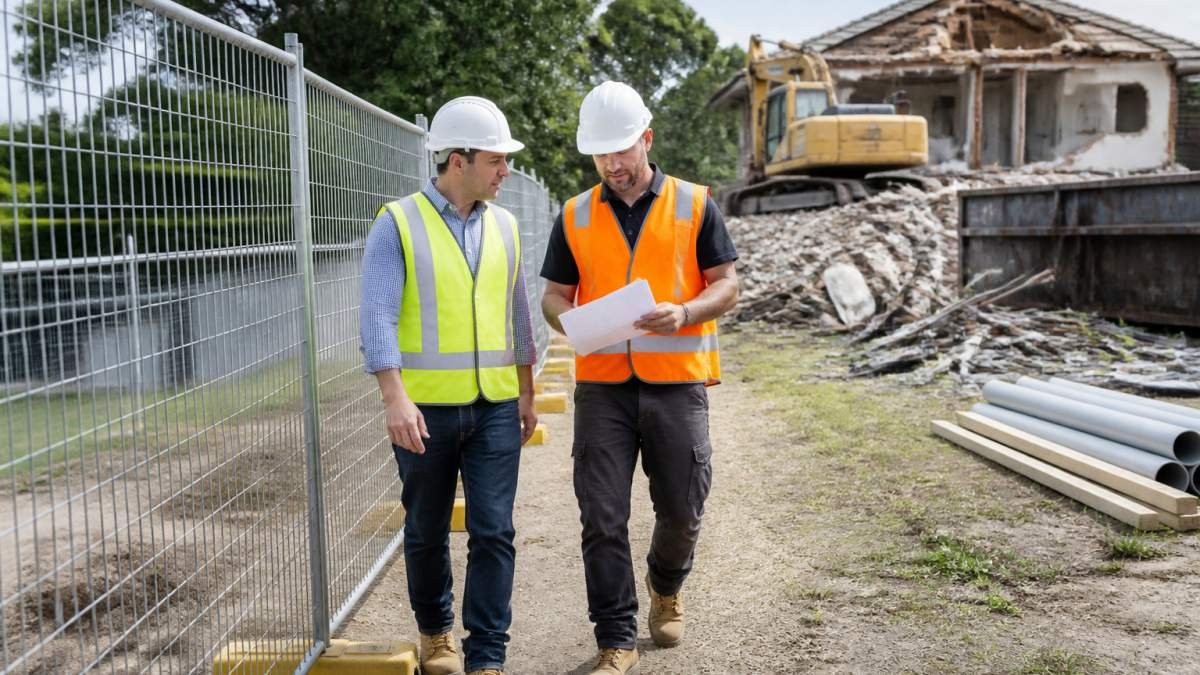
Use this sequence to keep compliance on track from first planning to final handover:
- Planning: Confirm the approval pathway with council and check heritage, flood and easement constraints.
- Hazard survey: Commission a written asbestos and hazardous materials survey before quotes are final.
- Contractor checks: Verify licences, insurance and the SWMS against the register and certificates.
- Utility disconnection: Obtain written confirmation that water, gas, electricity and sewer are safely isolated.
- Site preparation: Confirm fencing, exclusion zones, and dust and noise controls match the approval conditions.
- Notifications: Give neighbours and council any notice the approval requires before work begins.
- During works: Ask for a daily site log or regular updates, and stop work if any unexpected hazard appears.
- Waste: Request docket records showing asbestos and general waste went to licensed facilities.
- Handover: Collect the demolition completion records, waste dockets, asbestos clearance certificate and photographs of the cleared site.
Keep these records together in one folder. A clear paper trail protects you if a question arises about the work years later.
Protecting Neighbours, the Public and Adjacent Property
Demolition affects more than the site itself. Falling debris, dust, noise and vibration can reach neighbouring properties and footpaths, and the cost of getting this wrong can be significant. A documented protocol that protects you if a neighbour later claims damage is worth building before work starts. Establishing clear expectations for managing construction debris ensures that waste is handled responsibly and prevents the accumulation of hazards that might otherwise compromise the safety of the surrounding area.
Before work starts: the neighbour protection protocol
Ask the contractor for a plan covering each of the following, and keep a copy with your project records:
- Pre-demolition condition survey: A photographic and written record of neighbouring fences, walls, driveways, windows and structures, taken before any work begins. This is your baseline. If a neighbour claims damage later, a dated survey makes it far easier to resolve the claim fairly. In tight urban streets where houses are close, this is not optional.
- Protective hoarding and fencing: Hoarding or fencing that keeps the public away from the work zone, secured so it cannot be pushed over, with gaps closed at the end of each day.
- Sheltered walkways: Where pedestrians pass the site, a covered walkway protects them from falling material and dust. Confirm who installs it and who inspects it.
Neighbour notification and communication
Give neighbours advance notice of the start date, working hours and expected duration, and provide a contact number for concerns. A short letter or note is usually enough, and it reduces the chance of a complaint escalating. Where the approval requires notification, confirm the contractor has done it and keep a copy.
Public exclusion and site access
Members of the public should not be able to enter the work zone. Confirm that:
- The site perimeter is secured outside working hours.
- Exclusion zones are marked and enforced.
- Deliveries and waste removal do not block footpaths or create hazards for pedestrians.
If damage or a complaint occurs
Act on it quickly. Record the concern in writing, photograph the affected area, and ask the contractor to respond. A documented baseline from the pre-start survey, combined with a written record of the complaint and response, is what protects you if the matter escalates. Do not let a verbal assurance replace a written record.
The single most valuable step is the pre-demolition condition survey of neighbouring property. It costs little, takes an hour, and is the difference between a resolvable claim and a dispute.
Booking Your Demolition Site Assessment and Free Quote
The safest starting point is a site assessment. Request a free demolition and asbestos removal quote from Mission Demolition.
Pricing depends on quantity, dates and delivery, so for current prices request a free demolition and asbestos removal quote from Mission Demolition.
Frequently Asked Questions
What safety checks should homeowners make before demolition starts?
Before demolition starts, homeowners should confirm that council approval is in place, that utilities such as gas, water, electricity and sewer have been disconnected by the relevant providers, and that a site hazard assessment has been completed. Ask the contractor for a written safe work method statement and confirm that exclusion zones, barriers and dust and noise controls are planned. Check that the site is secured against public access and that neighbours have been notified of the works and their timing. Keeping these checks in writing gives you a record if questions arise later.
Do homeowners need approval before demolishing a house?
In most parts of New South Wales, demolition of a dwelling needs approval, and the type of approval depends on the works and the local council’s rules. Some straightforward demolitions may be able to proceed under a complying development certificate, while others require a development application. Councils also set requirements for asbestos management and waste disposal. Contact your local council before any work begins and ask for written confirmation of what applies to your property, because starting without approval can lead to fines and stop-work orders.
How can I check whether a demolition contractor is licensed and insured?
Ask for the contractor’s licence number and check it against the relevant licensing record in New South Wales. For asbestos removal, confirm that the licence class matches the work, particularly where friable material is involved. Request a current certificate of currency for public liability insurance and, where applicable, workers compensation cover. Ask who the principal contractor is for the site and how they will supervise subcontractors. A reputable contractor will provide these documents without hesitation and will welcome verification.
How should asbestos be identified and managed before demolition?
Asbestos should be identified before demolition by a competent person, usually through a pre-demolition or hazardous materials survey. Samples are tested by an accredited laboratory where material is uncertain. Where asbestos is present, removal must be carried out by a licensed asbestos removalist, following the requirements set out in the relevant Safe Work Australia and NSW regulations. The removalist should provide a clearance certificate once work is complete, and the waste should be taken to a licensed facility. Keep these records with your project documents.
What safety measures protect neighbours during demolition?
Neighbour protection starts with a documented plan that covers exclusion zones, fencing or hoardings, dust suppression, noise management and working hours. Pre-work dilapidation reports for adjoining properties help establish the condition of nearby structures before any work starts. Ask the contractor how they will control falling debris and vibration, and how they will respond if a neighbour raises a concern. Notifying adjoining owners in advance and providing a contact number for complaints is a simple step that prevents many disputes.
What should homeowners do if demolition work appears unsafe?
If demolition work appears unsafe, ask the supervisor to stop work and address the concern immediately. If the issue is not resolved, or if there is an immediate risk to people or property, stop work, move people away from the area and contact the contractor’s emergency contact. Document the issue with dated photographs and notes. For serious safety concerns, contact SafeWork NSW, which regulates workplace health and safety in New South Wales. Your council can also be contacted about unapproved or unsafe works on your property.
What documents should I keep after a demolition project?
Keep the council approval or certificate, the asbestos clearance certificate, waste disposal receipts from licensed facilities, the contractor’s licence and insurance details, the site safety plan and any dilapidation reports. Photographs of the site before, during and after works are also valuable. Store these documents in one place, as you may need them for future building approvals, insurance claims or property sales. Retaining them for several years after the project closes is a sensible precaution.