Every NSW demolition site needs two signage layers before work starts: a principal contractor sign showing name, contact numbers and site office location, and danger/exclusion signage warning of demolition hazards. The principal contractor is legally responsible for both, under SafeWork NSW’s Code of Practice. Erect these before the first cut or strip begins, confirm the wording against your development approval (DA) or certifier conditions, and leave hazard signage up until every demolition risk is actually cleared, not just partly managed.
TL;DR:
- Proper signage must include the principal contractor’s full details, contact numbers, and site office location, all of which are legally mandated in NSW demolition sites.
- Signage and fencing are considered one combined control measure; mismatched or absent signs with exclusion zones can result in non-compliance and safety risks.
- Sign size varies with site scale, with residential sites typically using 600x450mm signs, and larger sites requiring bigger, highly visible signage on hoarding boards.
- Signage must adhere to AS 1319 standards for clarity and symbolism, and all signage details should be thoroughly proofed and logged in the safety management plan before installation.
- Coordinating signage requirements early with demolition contractors and suppliers ensures compliance, reduces rework, and links signage directly to site safety and permit conditions.
Table of Contents
- Mandatory signage checklist for NSW demolition sites
- Which standards and rules actually govern demolition signage?
- What size and material should demolition site signs be?
- How do you commission compliant demolition signage?
- Choosing a signage supplier for a demolition site
- Common signage failures NSW inspectors flag
- Why signage is a live safety control, not a formality
- Coordinating signage with your demolition contractor
- Where to check the rules yourself
- Sources
- FAQ
Mandatory signage checklist for NSW demolition sites
Get the principal contractor sign wrong and you’re exposed the moment an inspector walks past. The WHS Regulation treats this sign as a specific control measure, not a courtesy, and failing to display it properly can be an offence in its own right.
Here’s what needs to be on site and visible from the public domain:
- Principal contractor’s name and business details, clearly legible from the footpath or nearest access point
- Daytime and after-hours contact numbers. Missing after-hours numbers are one of the most common inspection failures
- Site office location, or a clear note if there’s no fixed office on smaller jobs
- Licence or registration number, plus the words “licenced contractor” on residential jobs, as required by HIA guidance
- Principal certifier’s name and contact details, where one is appointed
- “Danger, demolition in progress” or equivalent warning signage on all exclusion zone fencing
- Asbestos warning signage wherever asbestos removal or disposal is part of the works
- DA reference number if your consent conditions specifically call for it
The SafeWork NSW Code of Practice treats exclusion zone signage and fencing as one connected control, not two separate boxes to tick. If the fencing goes up without matching signage, you haven’t met the requirement, you’ve just built a fence.
Which standards and rules actually govern demolition signage?
Three separate frameworks decide what your signs must say and where they go, and mixing them up is where most sites trip themselves up.
AS 1319 is the reference for safety sign classification. It sets out the categories, prohibition, warning, mandatory and emergency information, and governs how symbols and colours should be used so a “danger, demolition in progress” sign actually reads as a warning sign rather than a generic notice. If your supplier can’t tell you which AS 1319 category your hazard sign falls under, ask them to check before printing.
The SafeWork NSW Code of Practice for demolition work is the operational backbone. It spells out principal contractor duties, requires exclusion zones with fencing, barricades and signage to stop unauthorised entry, and gives inspectors the basis to issue notices when signage is missing or wrong.
NSW planning rules add a third layer that catches people out constantly:
- The NSW Planning Portal’s advertising and signage guidance confirms some signs qualify as exempt development, but development standards still apply to size, placement and illumination
- Councils and DA conditions can impose specific signage requirements that go beyond the WHS minimum
- Illuminated signs and large hoarding graphics often need separate approval, particularly on high-visibility city sites
Check DA and certifier conditions before you finalise artwork. A demolition permit review early in planning avoids reprinting signs after council flags a mismatch.
What size and material should demolition site signs be?
Sign size depends on the job scale, but there’s a practical floor. Residential demolition sites typically run principal contractor signs around 600mm by 450mm, legible from the street without squinting. Commercial and industrial sites usually go larger, often 900mm by 600mm or bigger on hoarding boards facing busy roads, because visibility distance matters more than compliance minimums once traffic and pedestrian volumes increase.
Material choice depends on how long the sign needs to survive:
- Corflute works well for short-term directional and hazard signage. It’s light, cheap and fast to print, but it degrades under sustained sun and wind, so treat it as a weeks-not-months solution
- Aluminium composite panel (ACP) suits the principal contractor sign and any board that needs to survive the whole demolition and early construction phase. Reusable ACP boards also make sense for builders running multiple sites, since the same board can be reprinted or re-skinned
- Vinyl banners cover large hoarding runs cheaply but need proper eyelet spacing and windproof fixing, or they’ll tear loose in a storm
Pro Tip: Mount signs at eye height for pedestrians, not truck cabin height. Inspectors and neighbours read signs from the footpath, and a sign angled for site traffic often fails basic legibility checks.
Pair signage decisions with your fencing setup, since exclusion zone signs are only as good as the fence they’re fixed to.
How do you commission compliant demolition signage?
Ordering the wrong sign twice costs more than getting the brief right once. Follow this sequence:
- Brief the supplier fully. Give them the exact WHS-mandated wording, DA reference numbers if required, certifier details, licence number, and after-hours contact. HIA’s advice to over-communicate rather than under-communicate on sign content is worth following here, particularly when DA conditions are ambiguous.
- Proof before printing. Check legibility from typical viewing distance, font size, contrast against the substrate colour, and confirm every mandatory field is present. Have a site manager or supervisor sign off internally, not just the graphic designer.
- Confirm lead times. Standard corflute and vinyl jobs often turn around within a few business days; ACP boards and larger hoarding runs take longer. Ask suppliers about urgent print options if your demolition start date is locked in.
- Record installation. Log sign placement, wording and date installed in your WHS management plan and safe work method statement (SWMS). This record is what you point to if an inspector questions compliance later.
Choosing a signage supplier for a demolition site
Not every sign shop suits a demolition job, and picking the wrong one costs you time you don’t have.
| Supplier type | Best for | Turnaround | Compliance advice |
|---|---|---|---|
| Local sign shop | Fast, small-run corflute and vinyl jobs | 1 to 3 days typical | Variable, some know WHS wording well |
| Online sign printer | Bulk hoarding banners, standard sizes | 3 to days typical | Limited, usually template based |
| ACP fabricator | Durable, reusable project boards | 1 to 2 weeks typical | Stronger on material specs, weaker on WHS wording |
For a single short demolition job, a local sign shop that already knows SafeWork NSW wording saves you rework. For builders running several sites a year, specifying reusable ACP boards through a fabricator pays off over time, since the board outlasts one project and can be re-skinned for the next. If your DA conditions are unusual or contested, lean towards a supplier who’ll actually read the conditions rather than one who just prints what you send.
Common signage failures NSW inspectors flag
Experienced site managers treat signage as a live document, not a one-off install. The two failures inspectors cite most often are missing after-hours contact numbers and incomplete licence numbers, and fixing just those two items clears most non-compliance findings on residential sites.
Update contact details the moment they change, not at the next site walk. Keep exclusion zone and danger signage in place until every demolition hazard, not just the obvious one, has actually been cleared. Cross-check DA conditions before artwork goes to print, and log every installation in your SWMS.
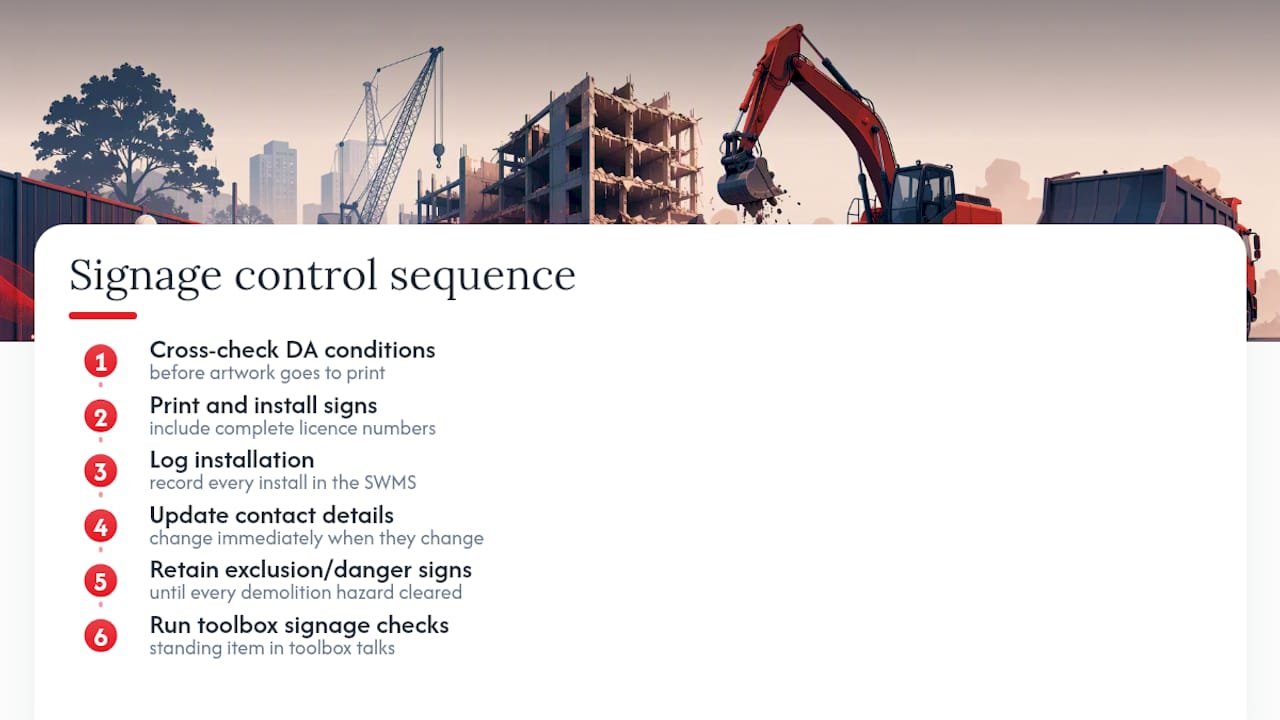
Pro Tip: Run signage checks as a standing item in toolbox talks, not just at project kickoff. Sites that treat signage as “set and forget” are the ones that get pinged months later when a contact number goes stale.
Why signage is a live safety control, not a formality
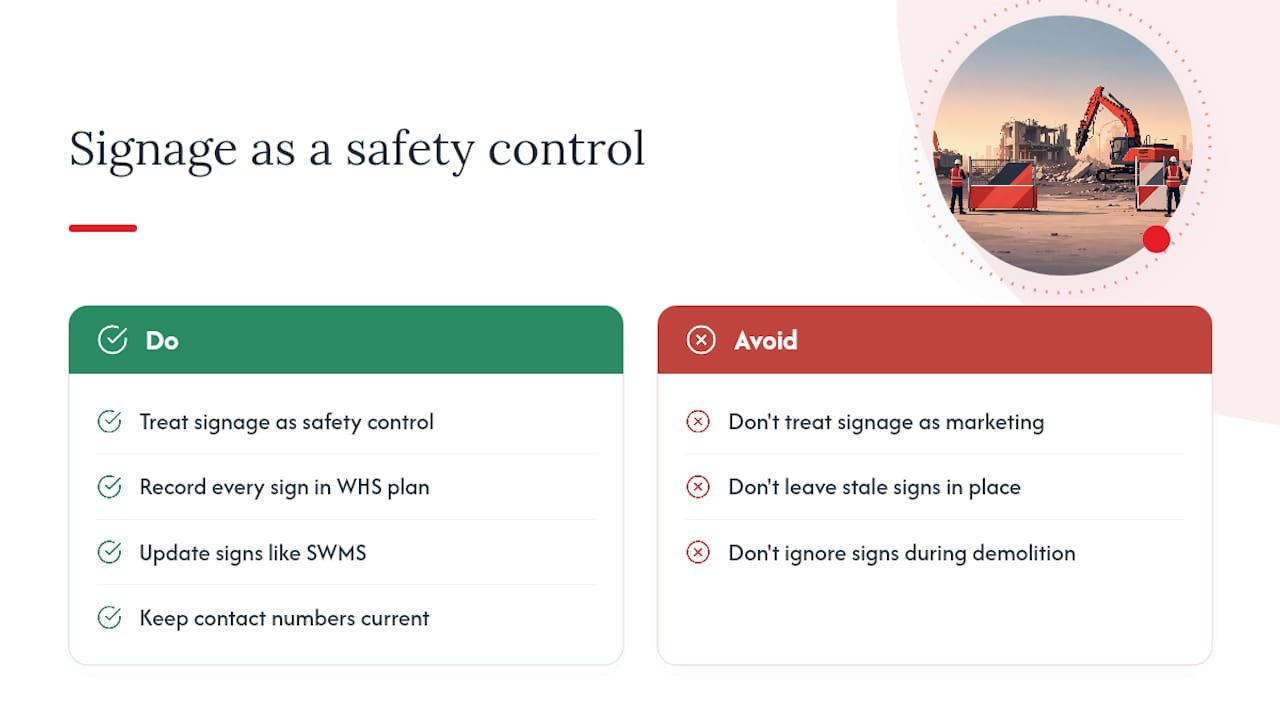
Signage on a demolition site isn’t marketing, and treating it that way is the mistake I see most often. It’s a working part of your exclusion zone control, sitting alongside fencing and barricades to keep the public and adjoining neighbours out of harm’s way while structures come down.
Contractors who run tight sites record every sign in the WHS management plan and update it the same way they’d update a SWMS, because a stale sign with a wrong number is functionally the same as no sign at all.
— Tarek
Coordinating signage with your demolition contractor
Getting signage right shouldn’t be a separate headache bolted onto your demolition project, and it doesn’t have to be. Signage coordination can be incorporated into the demolition contract, including checking DA and certifier conditions against your site signage before artwork goes anywhere near a printer, rather than leaving you to chase compliance after the fact.
That’s the practical difference: instead of managing a signage supplier, a certifier and a demolition crew as three separate conversations, Some demolition contractors handle permit liaison, licensed demolition and asbestos removal, and site clearance under one project plan. Whether you’re clearing a single residential block or managing a commercial demolition with tighter DA conditions, get a compliance check and quote before you lock in a start date, so the signage, the fencing and the demolition sequence line up from day one.
Where to check the rules yourself
Bookmark SafeWork NSW’s demolition Code of Practice and the NSW Planning Portal’s advertising and signage guidance for the baseline rules. Cross-reference AS 1319 for sign classification and symbol use. Always check your specific DA and council conditions too, since local requirements can sit on top of the state minimum. For sites near public roads, Transport for NSW’s traffic control guidance governs how traffic signage integrates with your SWMS.
Sources
- Code of Practice: Demolition work – SafeWork NSW
- NSW site signage and advertising requirements – HIA
- Advertising and signage – NSW Planning Portal
- Traffic control at work sites — Transport for NSW
FAQ
What are the site signage requirements in NSW?
NSW demolition sites need a principal contractor sign showing name, contact numbers, site office location and licence details, plus danger and exclusion zone signage under the SafeWork NSW Code of Practice. DA conditions or council rules can add further requirements on top of this baseline.
What signage is required on a construction site?
Construction sites generally need the same principal contractor sign as demolition sites, showing licensee name, licence number and contact details, per HIA’s site signage guidance. Where a principal certifier is appointed, their details also need to be displayed.
What is the Code of Practice for demolition in NSW?
The SafeWork NSW Code of Practice: Demolition Work sets out principal contractor duties, exclusion zone controls, and the signage that must identify the contractor and warn of demolition hazards. It works alongside WHS Regulation clauses covering specific control measures for demolition sites.
What are the Australian standards for signage?
AS 1319 is the relevant standard for safety sign classification on construction and demolition sites, covering prohibition, warning, mandatory and emergency information signs. Check the standard directly for symbol and wording specifics before finalising artwork with your supplier.
Can Missiondemolition help with site signage compliance?
Missiondemolition coordinates signage requirements as part of its demolition and site clearance services, checking DA and certifier conditions alongside licensed demolition and asbestos removal work. Current project pricing is available on request through the Missiondemolition site.

One Response