
Most knockdown rebuilds in Australia take 12 to 24 months from the first design conversation to moving in. Demolition is the shortest stage, often a matter of weeks. The long parts are design and approvals before it and construction after it. The way to protect your timeline is to have the demolition stage ready the day your approvals land: asbestos checked, utilities disconnected, paperwork in order. That is the stage we handle at Mission Demolition, from approvals support to final site clean.
TL;DR
- Allow 12 to 24 months overall. Builders’ Sydney guides commonly put Sydney at 14 to 20 months.
- Design and approvals take the longest before work starts; construction is typically the biggest block after it.
- Demolition itself is short, but asbestos, utility disconnection and neighbour notice must be finished first or it stalls.
- In NSW, a complying development certificate (CDC) can cut months off a development application (DA) pathway.
- Budget rent for the top of the range, and sign a lease that can extend.
Table of Contents
- The timeline at a glance
- Stage 1: Planning, finance and site checks (2 to 4 months)
- Stage 2: Design and documentation (2 to 12 months)
- Stage 3: Approvals, the biggest swing factor
- Stage 4: Pre-demolition work (2 to 6 weeks)
- Stage 5: Demolition itself (1 to 3 weeks)
- Stage 6: Construction (8 to 18 months)
- Where the time goes wrong
- Planning where you live
- Who this timeline matters most to
- Our approach to the demolition stage
- Our view
- FAQ
- Sources
The timeline at a glance
Published timelines differ because they measure from different starting points and cover different states. The table pulls them into one realistic picture for a typical house. Treat the ranges as planning figures, not promises: your council, site and design decide where you land.
| Stage | Typical duration | What drives it |
|---|---|---|
| Planning, site checks, finance pre-approval | 2 to 4 months | Heritage, bushfire, flood and soil constraints |
| Design and documentation | 2 to 12 months | Size, custom features, number of revisions |
| Approvals (CDC or DA) | A few weeks (CDC) to 4+ months (DA) | Council workload, neighbour objections |
| Asbestos inspection and removal | 1 to 4 weeks | Type and amount of asbestos |
| Utility disconnection and demolition | 2 to 6 weeks | Service provider booking times, access |
| Construction | 8 to 18 months | Home size, weather, supply of materials |
| Handover and landscaping | 2 to 8 weeks | Defects, final inspections |
The ranges come from several builder and design guides: one lists asbestos removal at 1 to 4 weeks and construction at 10 to 18 months, while another puts NSW demolition at 2 to 6 weeks. Overall totals reported run from 10 to 14 months from demolition to move-in for a well-organised build, up to 18 to 30 months when design is slow and the site is complicated.
The NSW Government’s own planning guidance says the knockdown and rebuild process can take up to 12 months, which is a useful floor for a smooth project rather than a ceiling.
Stage 1: Planning, finance and site checks (2 to 4 months)
The NSW MyHome Planner advises getting a construction loan pre-approved several months ahead, testing the soil before you commit to a block, and checking planning controls before you start. It also suggests allowing for rent if you will live elsewhere during the build.
This is where the later timeline is won or lost. Heritage overlays, flood mapping, bushfire zones, easements and contamination all change what you can build and how fast it is approved. A builder’s NSW guide warns that rushing site assessment leads to costly changes during construction.
For older homes, add an asbestos inspection to this stage. Houses built before the mid-1980s commonly contain asbestos in eaves, roofing, wall sheeting and flooring. Knowing what is there before you design lets you book removal at the right time instead of discovering it when the excavator arrives. Our asbestos inspection and testing is built for this step.
Stage 2: Design and documentation (2 to 12 months)
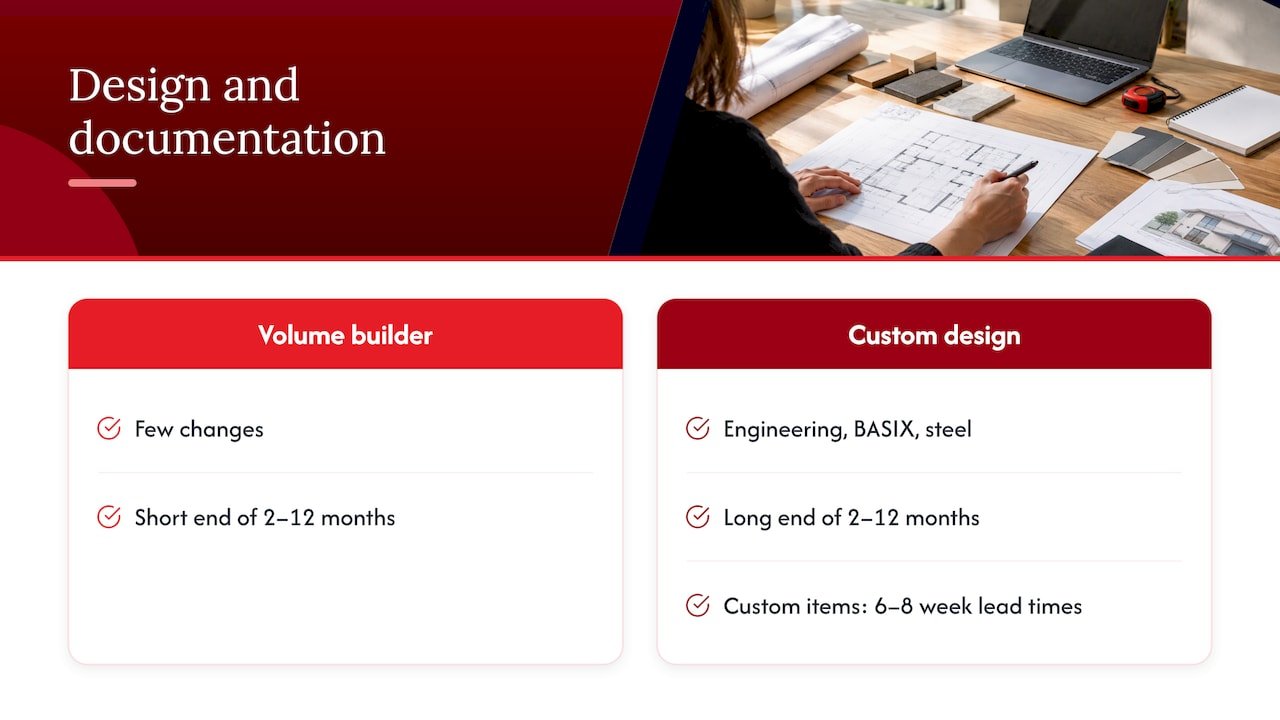
This is the widest range in the whole process. A project home from a volume builder with few changes sits at the short end. A custom design with engineering, BASIX (the NSW sustainability certificate for new homes) and structural steel sits at the long end. One Sydney guide lists late design changes among the biggest timeline risks, and another notes that custom items such as stone benchtops and structural steel can carry 6 to 8 week lead times.
A practical rule: freeze the design before lodging. Every revision after lodgement can restart a council conversation.
Stage 3: Approvals, the biggest swing factor
In NSW you cannot demolish your existing house until approval for the new home has been granted, and the demolition approval is a separate application, according to the NSW Planning Portal. Demolition can proceed under a CDC or a DA, which is why the pathway matters.
- CDC: a fast-track approval for proposals that meet every state code standard. One NSW guide reports 3 to 6 weeks from lodgement to certificate, and another says a certifier must determine a CDC within 20 days where neighbour notice is required.
- DA: a merit assessment by council. The same source reports the NSW statewide average assessment time had fallen to 84 days by 31 May 2026, with big differences between councils. Add the separate construction certificate afterwards.
One Sydney timeline compares the pathways: 9 to 16 months on a CDC against 12 to 18+ months on a DA. If your block qualifies, the CDC route is the fastest. Our guide to CDC demolition in NSW explains the rules, and the demolition approval timeline and demolition permits guide cover the paperwork.
Nationally, the Australian Bureau of Statistics found the average gap between demolition approval and building approval was 5.60 months in 2024/25, down from 6.23 months the year before. The figure for detached houses was 5.76 months. It is measured on approvals, so it is a guide to how long approvals sit in the system, not to your own project.
Outside NSW the pathway has different names. Victorian guides treat the planning permit as the key variable: 3 to 6 months without one and 6 to 18 months where one is required, such as in heritage overlays. Check your own council and state planning authority for the current process.
Stage 4: Pre-demolition work (2 to 6 weeks)
This is the stage people underestimate, and it is the one that most often turns a one-week demolition into a six-week wait. Before machinery arrives:
- Asbestos is identified and, where present, removed. One Sydney guide notes friable asbestos, or more than 10 m² of bonded asbestos, needs a licensed removalist and SafeWork NSW notification, and the site reopens only after a clearance certificate. Removal typically takes 1 to 4 weeks. See our process for removing asbestos before demolition.
- Utilities are disconnected by licensed professionals. The Planning Portal states that all services must be disconnected before demolition, temporary fencing installed, and a council bond may be required. Providers book in advance, so request early. We explain the evidence you need in 5 utilities to disconnect and proving service disconnection.
- Neighbours are notified where the approval pathway requires it. See neighbour notification for demolition, and safe demolition near neighbouring houses if your block is tight.
- The site is made ready. Clearing overgrown garden beds and green waste beforehand, such as through garden bed cleanup and green waste removal, gives the demolition crew clear access.
After demolition, the contractor must certify that no contaminated materials remain on the land. Noise limits may also apply, so read the NSW demolition noise rules.
Stage 5: Demolition itself (1 to 3 weeks)
With everything in place, a single house usually comes down quickly. Guides put demolition at 1 to 2 weeks on site, or 2 to 5 days for a single-storey home, with a few extra days if asbestos work is needed. Slab removal, if your design needs it, adds time; see concrete slab removal.
Then comes site preparation: levelling, drainage and set-out. Site surprises appear here. Reactive clay, rock or poorly compacted fill can force deeper footings and re-engineering, which costs both time and money.
Stage 6: Construction (8 to 18 months)
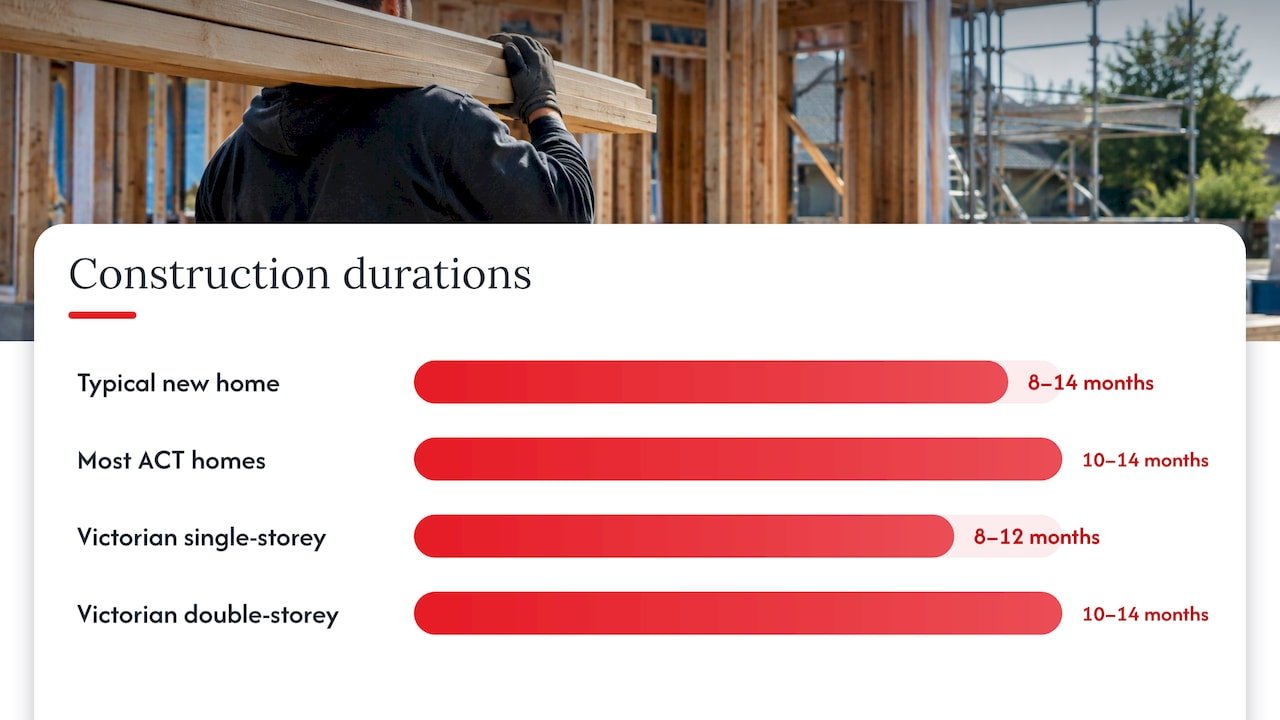
This is the long block. Reported ranges include 8 to 14 months for a typical new home and 10 to 14 months for most ACT homes. Victorian figures separate 8 to 12 months for single-storey from 10 to 14 months for double-storey. Rain is the main weather delay, hitting slab pours and roofing, and material supply can stretch the schedule further.
Your builder runs this stage. Your job is to make sure nothing from the demolition stage, such as a missing clearance or unfinished site cleaning, holds them up on day one.
Where the time goes wrong
- Starting demolition planning after approval. The pre-demolition work takes weeks. Do it in parallel with approvals so it is finished when the certificate arrives.
- Asbestos found late. A pre-demolition inspection turns a surprise into a scheduled task.
- Disconnection delays. Service providers set their own lead times.
- Design changes after lodgement. Each one can restart assessment.
- Council variation. A reported league table showed average DA assessment times across Greater Sydney from 41 to 122 days depending on the council.
Planning where you live
A longer timeline means a longer rent bill. One builder guide suggests allowing 12 to 18 months of rent in the budget, and a design firm advises signing a lease with a month-to-month tail rather than a hard end date, since delays are normal. Another points out that staying in the house during design and approval means you only rent from demolition onward, which can cut 8 to 12 months off the accommodation bill.
On finance, a construction loan drawn at milestones is standard, so keep a cash float for the gap between paying for demolition and the first drawdown.
Who this timeline matters most to
If you are a developer or builder clearing several sites, the same logic applies at scale: sequence asbestos, disconnections and approvals so demolition lands the week your certificate does. For commercial or industrial sites, see our industrial demolition and site clearance services and strip-out work.
A national perspective helps too. The ABS found that 19.2% of all dwellings approved between July 2019 and June 2025 were knockdown rebuild projects, so councils and contractors handle these every day.
Our approach to the demolition stage
Mission Demolition runs residential, commercial and industrial demolition, licensed asbestos inspection and removal, and full-service project management covering approvals, utility disconnections, hazardous waste handling and final site cleaning. For a knockdown rebuild, that puts the pre-demolition steps that stall most projects under one contract, so your builder receives a clean, cleared site. To start, see our residential demolition service.
If you are still deciding on your pathway, talk to us about your site through Mission Demolition before you finalise your programme, so the demolition window is built in from the start.
Our view
Most homeowners plan a knockdown rebuild around the builder’s build time, because that is the number they are given. We think the better plan starts with the weeks before the excavator arrives.
Asbestos, utility disconnections, approvals and neighbour notice are separate tasks with separate lead times. When they are handled by different people, each waits for the last. When one team coordinates them, they run side by side and the site is ready the day the approval comes through.
That is why our service covers approvals, utility disconnections, hazardous waste handling and final site cleaning together, with licensed asbestos work and environmentally responsible waste disposal. A clean handover to your builder protects every month that follows.
Tarek
FAQ
How long does a knockdown rebuild take in Australia?
Most take 12 to 24 months from the first design conversation to moving in, according to one national builder. Sydney projects are often reported at 14 to 20 months. A fast CDC project can be much shorter, and a complex DA can run longer.
How long does the demolition part take?
On site, demolition of a typical house takes about one to two weeks. The preparation before it, including asbestos removal and utility disconnection, can add several weeks, so plan it alongside your approvals.
Can I demolish before my new home is approved?
In NSW, the Planning Portal states you cannot demolish your existing house until approval for the new home has been granted. Rules differ in other states, so check with your local council.
Do I need to move out?
Yes, for the demolition and construction. You can stay in the house during design and approval, and rent only from demolition onward. Budget for the longer end of the range and choose a flexible lease.
Sources
- NSW Planning Portal: Plan phase, MyHome Planner
- NSW Planning Portal: Knockdown rebuild considerations for project homes
- ABS: Approvals of knock-down rebuilds
- Knockdown rebuild Sydney costs and mistakes guide
- Knockdown rebuild Australia process guide
- Knockdown rebuild process and timeline NSW 2026
- Renovation timeline guide
- Knockdown rebuild Sydney timeline
- Knock down rebuild Sydney approvals 2026
- Knockdown rebuild guide for costs
- Knockdown rebuild process in the ACT
- Knockdown rebuild checklist for Victorian homeowners
- Knockdown rebuild Melbourne guide
- Eight stages of building a house, knockdown rebuild style
- Hidden costs of knock-down rebuild
- Knockdown rebuild cost Australia guide
- Knock down rebuild cost guide
- Garden bed cleanup and green waste removal