
Table of Contents
- Residential Demolition Cost Factors Sydney 2026: What Actually Drives the Price
- How Dwelling Size, Footprint and Construction Type Change the Demolition Cost
- Site Access, Sloping Blocks and Machinery Constraints
- Asbestos Removal Cost and Hazardous Materials Decisions
- Demolition Quote Inclusions: What Should Be in Writing
- Demolition permits and approvals: The Compliance Pathway
- House Demolition Timeline, Waste Disposal and Hidden Costs
- Cost-Saving Options, Trade-Offs and Getting a Reliable Quote
- Frequently Asked Questions
Last Updated: October 21, 2026
Residential Demolition Cost Factors Sydney 2026: What Actually Drives the Price
Residential demolition cost factors in Sydney in 2026 come down to a short list: the size and construction of the dwelling, how easily machines can reach the block, how much asbestos is present, what the tip fees and approvals add, and how much of the material can be salvaged or recycled. Every quote you receive is an estimate of those variables, weighted by risk.
What most homeowners get wrong is assuming the number is driven mainly by floor area. It isn’t. A small brick cottage on a sloping block with rear-lane access can cost more to clear than a larger weatherboard house on a flat, open site.
The demolition cost is driven by access, hazardous materials and waste volume at least as much as by the size of the house. Ask for a quote that separates those three.
How Dwelling Size, Footprint and Construction Type Change the Demolition Cost
The size of the structure sets the baseline: a larger house footprint means more floor area, more roof, more wall and more rubble to load, transport and tip. But the construction type changes the labour and disposal profile far more sharply than most people expect.
Timber frame homes come down quickly with mechanical demolition and produce waste that is comparatively easy to sort. Full brick construction and multi-storey houses take longer, need heavier machinery, and generate significantly more masonry rubble, which carries a higher disposal cost per tonne. A knockdown rebuild on a double-brick home is a different job from clearing a fibro cottage.
- Timber frame: fastest to demolish, lighter waste load
- Brick veneer: moderate, mixed waste stream
- Full brick or double brick: slower, heavy rubble, higher tip fees
- Multi-storey: additional height safety, plant and sequencing
Site Access, Sloping Blocks and Machinery Constraints
Site access is where quotes diverge most. An excavator needs room to enter, turn and load. On a narrow inner-west block with neighbouring fences on both sides, that room doesn’t exist, so the work slows down and sometimes requires smaller plant, manual handling or a crane.
Sloping blocks add another layer. A steep site restricts where machinery can sit safely and can require retaining measures before demolition starts. Restricted access, tight laneways and overhead power lines all push labour hours up.
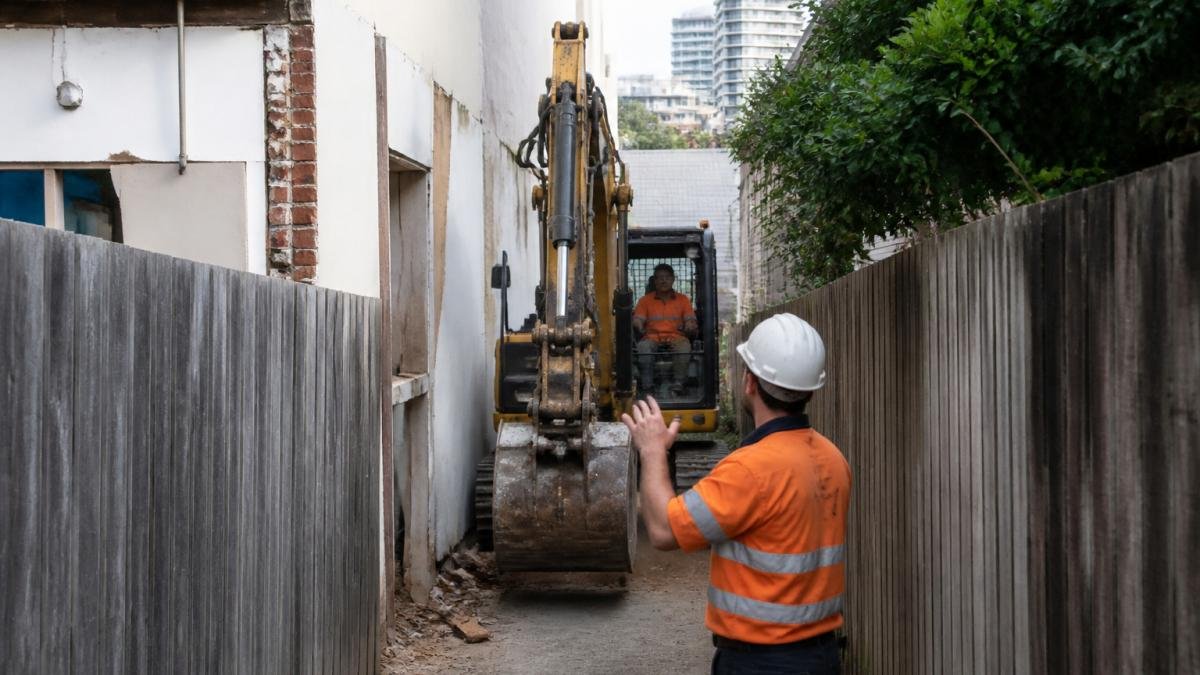
The most common quote blowout we see is a homeowner comparing a quote built for open suburban access against their actual tight site. Always disclose access constraints before the quote is priced, not after.
Asbestos Removal Cost and Hazardous Materials Decisions
Asbestos is the single biggest cost variable in residential demolition, and it is the one homeowners worry about most.
The cost is not a single rate. It is built from four decisions, and each one moves the number.
1. Testing and assessment. Before anything is priced, the material has to be identified. A licensed asbestos assessor takes samples and issues a report identifying what is present, where, and in what condition.
2. Location and accessibility. Asbestos in a fibro fence or external eaves is comparatively straightforward to remove before the structure comes down.
3. Quantity and condition. Small quantities of bonded (non-friable) sheeting are a different job from friable material, which crumbles easily and releases fibres. Friable removal requires stricter containment, decontamination and disposal controls.
4. Removal method and sequencing. Asbestos is usually removed before the main demolition, not during it. That sequencing matters: removal first, clearance documentation, then machines move in. Trying to demolish around asbestos slows the whole job and creates a compliance problem.
Licensed work versus ordinary demolition. Not all asbestos work is the same. In most cases, removal of bonded asbestos above a small threshold must be carried out by a licensed asbestos removal contractor, and friable asbestos work requires the higher class of licence.
Disposal and documentation. Asbestos waste must be tracked and disposed of at a facility approved to accept it, with documentation showing what was removed and where it went.
- Has the home been assessed for asbestos by a licensed assessor?
- Does the quote include testing, or assume a report already exists?
- Is the removal being done under the correct class of asbestos licence?
- Is friable material identified separately from bonded sheeting?
- Will you receive clearance and disposal documentation?
Ask for the asbestos clearance and disposal paperwork as part of the job, not afterwards. It is your record that the material was handled and tipped lawfully, and it is far easier to obtain at the time than to reconstruct later.
A quote that lists a single “asbestos allowance” without stating what it covers, testing, removal, containment, disposal, documentation, is not a price. It is a placeholder that will be revisited once the material is found.
Demolition Quote Inclusions: What Should Be in Writing
A demolition quote should itemise what is included, not just total a figure. The inclusions that matter most are the ones that quietly become variations later.
Insist on written detail for: the scope of demolition, asbestos handling and disposal, waste removal and tip fees, utility disconnection and service capping, site protection for neighbouring property, permits and approvals, and the final site condition. Anything vague is a future argument.
| Quote element | Why it matters |
|---|---|
| Scope and method | Defines what is actually being removed |
| Asbestos allowance | Prevents surprise variations |
| Waste and tip fees | Usually the largest variable line |
| Utility disconnection | Must be arranged before work starts |
| Site protection | Covers neighbouring fences and structures |
| Approvals | Confirms who lodges and pays |
Demolition permits and approvals: The Compliance Pathway
Demolition permits and approvals are the step homeowners most often underestimate, and the one where a vague answer costs the most time.
Get a Free Demolition And Asbestos Removal Quote →
Step 1: Confirm what approval applies to your property. The starting point is the local council.
Step 2: Confirm who lodges and who certifies. Depending on the approval pathway, the application may be lodged by the owner, the demolition contractor or a planning consultant, and it may be assessed by council or by a private certifier.
Step 3: Coordinate utility disconnection and service capping. Approvals and utility coordination run in parallel, not in sequence. Electricity, gas, water and telecommunications must be disconnected and services capped before machines move in, and the utility providers work to their own timeframes.
Step 4: Satisfy conditions before work starts. Approval conditions may cover site protection, dust and noise controls, hours of work, tree protection, and notification of neighbours. High-risk work and load-bearing structural elements may require additional planning and supervision.
Safety obligations run alongside approvals. Demolition work carries work health and safety duties that sit separately from planning approval.
Verify, don’t assume. Because requirements are property-specific, the practical advice is to confirm the pathway for your address before you book a start date, and to ask your contractor to put the approval responsibility in writing.
Starting demolition before approvals are in place can result in stop-work orders and penalties, and can complicate a later rebuild application. Confirm the approval pathway before you book a start date, not after.
- Has the council confirmed what approval applies to this address?
- Is it clear who lodges the application and who pays the fees?
- Are utility disconnections booked, and who is coordinating them?
- Are approval conditions listed and assigned to a responsible party?
- Are work health and safety obligations addressed in the scope?
House Demolition Timeline, Waste Disposal and Hidden Costs
A house demolition timeline for a typical Sydney dwelling runs from a few days for a straightforward timber structure to considerably longer where asbestos, restricted access or heavy brick construction is involved. The physical demolition is usually the shortest part; approvals, asbestos removal and waste logistics take the time.
Waste volume is the hidden cost driver. Every tonne of rubble is loaded, transported and tipped, and disposal fees apply per tonne. Recycling and salvage reduce both the volume and the fee, but they add sorting time. Utilities must be disconnected and services capped before machines move in.
Separating recyclable material on site, rather than tipping a mixed load, is one of the few genuine cost savings available on a demolition job.
Cost-Saving Options, Trade-Offs and Getting a Reliable Quote
Cost-saving options exist, but each carries a trade-off. Salvaging materials or stripping the interior before demolition can reduce waste volume, at the cost of extra labour and time. Scheduling around site constraints rather than forcing large plant in can lower the machinery bill.
The most reliable saving is a transparent, itemised quote from a licensed, insured contractor. Mission Demolition provides full and partial demolition, asbestos removal, strip-outs and site clearance, with strict health and safety compliance and environmentally responsible disposal. Our asbestos licence AD213684 and demolition licence AD213693 are current, and every quote is built line by line.
- Is the contractor licensed and insured?
- Is asbestos handling itemised separately?
- Are waste and tip fees included?
- Is the site protection scope written down?
- Are approvals and disconnections accounted for?
Frequently Asked Questions
What factors affect residential demolition costs the most?
Dwelling size and construction type usually carry the most weight, followed by asbestos, site access and waste volume. A large brick home with restricted machinery access and friable asbestos will cost far more to clear than a small timber-frame house on an open block. Method, complexity and hidden items such as service capping and undisclosed hazardous materials also shift the demolition cost. Ask for an itemised quote so each factor is priced separately.
What is usually included in a house demolition quote?
A solid quote should list site establishment, mechanical demolition, asbestos removal and disposal, waste sorting and tip fees, service disconnection and capping, dust and noise controls, and site clearing. Check whether permits, approvals and unexpected finds are covered or charged as variations. Ask for the asbestos disposal documentation too. If a quote is one line with a single figure, you cannot see what is excluded, and that is where budget blowouts start.
How does asbestos affect demolition costs?
Asbestos removal cost depends on how much is present, its condition, and whether it is friable or bonded. Friable asbestos requires stricter controls and costs more to remove and dispose of than bonded sheeting. A licensed removalist must handle it, and disposal must go to a facility licensed to accept asbestos waste. Homes built before the 1990s should be tested before demolition starts, because finding asbestos mid-job turns a fixed price into a variation.
How long does it take to demolish a house?
A straightforward single-storey home on an accessible block can come down in a few days, but the house demolition timeline runs longer than the machine work. Add time for permit and approval processing, asbestos removal, service disconnections and waste haulage. Multi-storey homes, tight terraces or sloping blocks stretch the schedule. Ask your contractor for a written sequence with dates, and build a buffer before your new build starts.
Do site access and slope affect demolition costs?
Yes, significantly. Restricted access limits machine size, so work takes longer and may need smaller equipment or manual handling. Sloping blocks require benching, retaining or extra safety measures. Tight urban sites with neighbours on both sides need protection for fences and adjoining structures, plus more careful sequencing. All of this adds labour and time, which is why two houses of the same size can attract very different quotes.
What extra costs should I budget for before demolition?
Budget for demolition permits and approvals, utility disconnection and service capping, asbestos testing and removal, and waste disposal fees that rise with volume. Allow a contingency for unexpected finds such as buried tanks, extra footings or undisclosed hazardous materials. Carrying costs on the property while it sits empty also count. Ask your contractor which items are fixed and which are charged as variations so nothing surprises you mid-project.
Demolition costs in Sydney are driven by access, asbestos, waste and approvals, not just the size of the house. Getting a quote that itemises each of those removes the guesswork and the hidden costs. Get a free demolition and asbestos removal quote from Mission Demolition and start your project with a clear, itemised price and full compliance documentation.