
Last Updated: October 28, 2026
Quick Summary
Safe demolition near neighboring houses starts with a written site assessment and documented demolition method before any permit is lodged or machine arrives. It then relies on physical barriers, a pre-demolition dilapidation report and a controlled sequence that keeps machines away from shared structures.
- A pre-demolition site assessment records structural condition, hazardous materials, boundaries and nearby structures.
- A dilapidation report is a dated photo and written record of neighbouring properties’ condition before work starts.
- Send neighbours a notification letter with dates, hours, contractor contacts and the complaint process.
- Set dust, noise and vibration trigger levels before work, with clear stop-work thresholds.
- Verify the contractor’s demolition and asbestos licences and insurance certificates before signing.
Table of Contents
- Safe Demolition Starts With Site Assessment and Planning
- Demolition Approvals and Requirements NSW Homeowners Must Meet
- Protecting Adjoining Properties During Demolition
- The Pre-Demolition Dilapidation Report Explained
- Sending a Demolition Notification Letter to Neighbours
- Dust, Noise and Vibration Controls That Keep Neighbours Safe
- Who Is Responsible for What During Safe Demolition
- Book a Site Assessment With Mission Demolition
- Frequently Asked Questions
Safe Demolition Starts With Site Assessment and Planning
Safe demolition near neighboring houses begins with a written site assessment and documented demolition method, completed before any permit is lodged or machine arrives.
A terrace knocked down in the wrong order can pull a shared wall with it. A misjudged exclusion zone can put a neighbour’s car under falling brick.
Safe demolition is the planned removal of a building using documented methods, licensed contractors, and controls that protect people, adjoining properties and the environment. It covers everything from the site assessment to the final clean-up.
Here is how a typical residential demolition runs:
| Stage | What happens | Who leads |
|---|---|---|
| 1. Site assessment | Condition survey, hazardous materials check, access review | Contractor and licensed assessor |
| 2. Approvals | Council development consent or complying development certificate | Homeowner with contractor input |
| 3. Dilapidation report | Photo and written record of neighbouring properties | Contractor or independent surveyor |
| 4. Neighbour notification | Written notice with dates, contacts and complaint process | Homeowner and contractor |
| 5. Controls and monitoring | Hoarding, dust screens, vibration and noise limits | Contractor |
| 6. Demolition and clean-up | Staged removal, waste tracking, site made safe | Contractor |
What a Pre-Demolition Site Assessment Covers
A pre-demolition site assessment records the condition of your building and everything close to it, and identifies hazards that change the method.
The assessment should cover:
- Structural condition of your building and any shared walls
- Hazardous materials, including asbestos in older homes
- Boundary and access, including tight access for machines
- Nearby structures, such as fences, retaining walls and neighbouring homes
- Services, including power, water, gas and sewer disconnection points
Asbestos is one hazard to consider in older homes. Our guide to removing asbestos before demolition covers identification, licence and disposal.
Demolition Approvals and Requirements NSW Homeowners Must Meet
Demolition approvals and requirements NSW homeowners must meet depend on your project type, council and whether the site is restricted. Most full house demolitions need development consent or a complying development certificate before work begins.
The main approval types are:
- Development application (DA) through your local council, for most knockdown rebuilds
- Complying development certificate (CDC), a faster pathway when the project meets set standards
- Heritage or conservation approval, where the building or area is protected
- Protection work notices, where excavation or demolition could affect an adjoining property
Protection work is the part homeowners underestimate. Where work could affect a neighbour’s property, the process typically requires a notice, and sometimes an insurance arrangement, before work starts. Your council and the NSW Planning Portal set out which pathway applies.
Noise rules sit alongside the approvals. Our breakdown of NSW demolition noise rules and permit triggers explains when the EPA’s construction noise guidance applies and which council hours you must work within.
Protecting Adjoining Properties During Demolition
Protecting adjoining properties during demolition comes down to three things: physical barriers, a documented condition record, and a method that keeps machines away from shared structures.
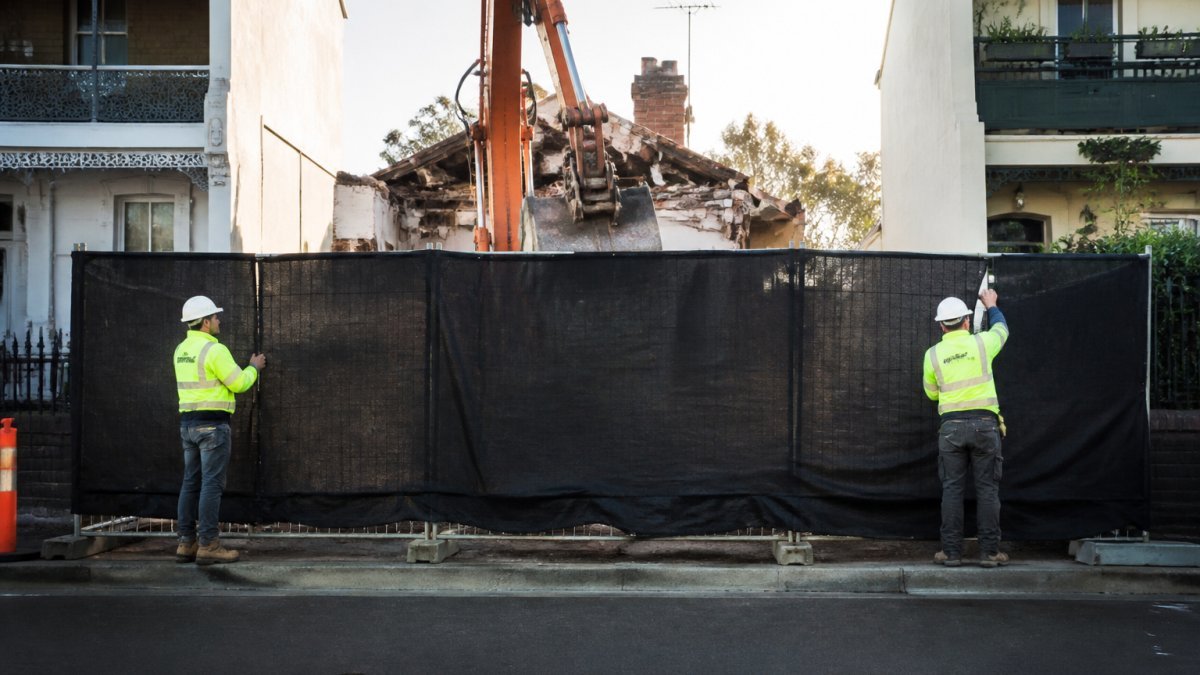
- Hoarding and fencing along every boundary, with a secure perimeter and no public gaps
- Dust screens fixed to the hoarding to stop airborne dust crossing the fence line
- Shoring where an excavation or removal could undermine a neighbouring footing
- Exclusion zones marked on site so no machine or stockpile sits against a shared wall
- Staged demolition that removes the structure in a controlled sequence rather than pulling it down
A common mistake is treating the boundary fence as the only protection needed. Vibration, dust and ground movement cross fences easily.
The Pre-Demolition Dilapidation Report Explained
A pre-demolition dilapidation report is a photo and written record of neighbouring properties’ condition before work starts, and your evidence if a neighbour later claims damage. What protects you is the process around it.
What the report should record
The report should capture, for every affected boundary:
- Cracks in walls, paths and driveways, with measurements and a scale reference in each photo
- Fence and retaining wall condition, including lean, rot and existing movement
- Existing damage inside neighbouring homes, where access is granted
- Date-stamped photos of every affected boundary, taken from a consistent position
- A written description that matches each photo, so the record reads as one document
Get this done before demolition. Without a condition survey, a pre-existing crack becomes your problem to argue about.
Who prepares it and when
The report can be prepared by the demolition contractor or an independent surveyor. Complete and date it before mobilisation, offer a copy to each surveyed neighbour, and keep the signed acceptance on file.
Documenting and resolving a damage claim
If a neighbour reports damage during or after work, the process should be the same every time:
- Record the report, date, time, who reported it, and exactly what they described.
- Photograph immediately, the same boundary, the same angle as the dilapidation photo, so the two can be compared side by side.
- Compare against the dilapidation record, is this new, or pre-existing and now noticed?
- Notify the contractor in writing, the site supervisor and the contractor’s insurer, not just a phone call.
- Agree the next step, independent assessment, repair, or referral to the contractor’s insurer.
- Escalate if unresolved, to the contractor’s insurer, then to the relevant consumer or building authority, and to council where the damage affects a boundary structure.
Keep every photo, email and log entry in one file from day one. A damage claim is won or lost on whether the pre-work record and the post-work record can be laid side by side.
The most common mistake
Skipping the dilapidation report to save time is the most common cause of neighbour disputes after a knockdown. It costs little next to a damage claim, and the process above turns it into a defence.
Sending a Demolition Notification Letter to Neighbours
A demolition notification letter to neighbours should go out before work starts, telling them the dates, hours, contractor contacts and how to raise a complaint. Keep it short and plain.
Get a Free Demolition And Asbestos Removal Quote →
A template you can adapt:
Dear [Neighbour’s name],
We are demolishing the house at [your address]. Work is scheduled to start on [date] and run for approximately [number] days, between [start time] and [end time], Monday to Friday.
The demolition contractor is [company] (licence [number]). The site supervisor is [name], contactable on [phone] and [email].
Protective fencing, dust screens and monitoring will be in place for the duration. If you have a concern about noise, dust or vibration, please contact the site supervisor directly. If the issue is not resolved, you can contact [council name] on [phone].
Kind regards,
[Your name]
Deliver it ahead of work, and keep a copy.
Dust, Noise and Vibration Controls That Keep Neighbours Safe
Dust, noise and vibration controls are considerations for demolition near neighbouring properties.
Set trigger levels before work starts
A workable structure looks like this:
| Control | What is measured | Investigation level | Stop-work level | Monitoring method |
|---|---|---|---|---|
| Dust | Visible dust crossing the boundary | Any visible plume leaving the site | Sustained visible dust at a neighbour’s facade | Boundary observer plus daily photographic log |
| Noise | Sound pressure at the nearest sensitive receiver | Approach to the approved hours or a sustained elevated reading | Reading that clearly exceeds the approved construction noise limit | Hand-held meter at the boundary, calibrated before use |
| Vibration | Peak particle velocity at a sensitive boundary | Low-level reading with a clear trend | Reading at or above the level set for the adjoining structure | Real-time sensor fixed to the boundary or neighbouring footing |
Dust suppression and air-quality control
Our guide to controlling demolition dust covers equipment and health standards.
Noise control within approved hours
Our breakdown of NSW demolition noise rules and permit triggers explains when each applies.
Vibration monitoring on sensitive boundaries
This walkthrough of real-time noise and vibration monitoring sets out the trigger levels and calibration steps contractors use.
Warning signs that should stop work
The practical stop-work triggers are rarely subtle. Pause and review when:
- Visible dust crosses the boundary and does not settle within minutes of suppression
- A vibration reading trends upward across consecutive loads rather than spiking and settling
- A neighbour reports a new crack, a sticking door or a dropped tile during work
- The noise reading at the boundary approaches the approved limit before mid-morning
- Ground movement, settlement or water egress appears at the boundary footing
Who Is Responsible for What During Safe Demolition
| Task | Homeowner | Contractor |
|---|---|---|
| Lodge development application or CDC | Leads | Advises |
| Confirm asbestos presence | Arranges or delegates | Advises and removes under licence |
| Dilapidation report | Approves and keeps copy | Prepares or arranges |
| Neighbour notification | Sends or co-signs | Provides details |
| Site controls and monitoring | Checks they are in place | Implements |
| Waste disposal and tracking | Requests documentation | Provides |
| Insurance and licences | Verifies before signing | Holds and provides |
Before signing, verify the contractor’s demolition and asbestos licences and ask for certificates of currency for insurance.
Book a Site Assessment With Mission Demolition
Mission Demolition is fully licensed and insured, with demolition licence AD213693 and asbestos licence AD213684.
We handle full and partial demolition, asbestos removal, strip-outs and site clearance across residential and commercial projects, working to strict health and safety compliance.
If you are planning a knockdown, Get a Free Demolition And Asbestos Removal Quote.
Frequently Asked Questions
Do you need a licence to demolish a house in NSW?
Mission Demolition holds Demolition Licence AD213693 and Asbestos Licence AD213684.
What happens if demolition damages a neighbouring house?
Damage to an adjoining property is handled through the condition survey and dilapidation report completed before work starts. The report records existing cracks, movement and defects so new damage can be identified and attributed correctly. If damage occurs, the contractor’s insurance and the protection work provisions apply. This is why documenting conditions at neighbouring properties before demolition begins matters as much as the demolition method itself, and why a pre-demolition dilapidation report should never be skipped to save time.
Should adjoining property owners be notified before demolition?
Yes. Neighbours should receive written notice well before work begins, ideally at least seven days ahead. A demolition notification letter to neighbours should include the start and finish dates, working hours, the contractor’s contact details, what to expect in terms of noise, dust and vibration, and who to call with concerns. Good notification prevents most complaints and gives neighbours time to move cars, secure pets and arrange any access needed for the pre-demolition dilapidation report.
How do you demolish a house safely next to neighbouring homes?
Safe demolition near neighbouring houses relies on a sequence of controls rather than a single method. That means a site assessment, approved demolition plans, a dilapidation report on adjoining properties, protective hoarding and dust screens, shoring where structures share a boundary, and monitored vibration limits. Work should stop if monitoring shows thresholds are being approached. Choosing a licensed contractor experienced with tight access and restricted sites is the single biggest factor in keeping adjoining properties protected.
Demolition next to neighbouring homes is a planning problem before it is a demolition problem. Get the assessment, approvals, dilapidation report and notification right, and the build itself runs quieter and cleaner. Get a free demolition and asbestos removal quote from Mission Demolition and start with a site assessment that covers every boundary.