A strata asbestos register is a written record of every material in a building that contains asbestos, is assumed to contain it, or is likely to contain it but cannot be reached for sampling. For most strata schemes with commercial or mixed-use common property built before 2004, it is a legal requirement. For anyone planning demolition, a refurbishment or a strip-out, it is the first document the contractor will ask for. We remove asbestos and demolish buildings across Sydney and Australia, and a missing or out-of-date register is one of the most common reasons a project stalls before it starts.
TL;DR
- An asbestos register lists the location, type, condition and date of identification of asbestos or suspected asbestos in a building, with labelled photographs.
- Under the model WHS laws, a register is needed for workplaces built before 31 December 2003 (Queensland uses 31 December 1989). Purely residential strata with no employees are generally exempt in model WHS states.
- The register must be kept accessible at the site and reviewed at least every five years, and sooner when asbestos is found, removed, disturbed or sealed, or before refurbishment or demolition.
- There is no public asbestos registry. The register is held by the person who manages or controls the building, and handed to contractors before work starts.
- Before a demolition or strip-out, an up-to-date register lets the right licensed removalist be engaged first, which keeps the program and budget under control.
Table of Contents
- What a strata asbestos register actually is
- Which strata buildings need one
- Who is responsible for the register
- What the register should contain
- Where to keep it and who must see it
- How often the register must be reviewed
- Why the register matters before demolition or strip-out
- Getting from an old register to a project-ready one
- Our approach for strata, owners and developers
- Perspective
- FAQ
- Sources
What a strata asbestos register actually is
Asbestos was widely used in Australian buildings until it was banned nationally from 31 December 2003. It turns up in roof sheeting, eaves, wall linings, vinyl floor backing, pipe lagging, fire doors, meter boards and car park or garage structures. It is only dangerous when fibres are released, usually when material is drilled, cut, broken or deteriorates.
The register is how a building’s management keeps that risk visible. SafeWork Australia’s guide to asbestos registers says it records the location, type, condition and date of identification of material that is confirmed as asbestos, assumed to contain asbestos, or likely to contain it but inaccessible for sampling. Labelled photographs should be included.
Two points often confuse committees:
- A register is not the same as an asbestos report. A report is the output of an inspection or testing. The register is the living document that carries those findings, and it must be kept up to date.
- A register can say “no asbestos identified”. SafeWork NSW states that the register must say so where no asbestos has been identified.
A register usually sits alongside an asbestos management plan, which sets out how the identified material will be managed: who is responsible, how it will be monitored and when it will be reviewed.
Which strata buildings need one
The answer depends on the state, the age of the building and how the common property is used.
Under the model WHS Regulations, a register is required for a workplace unless the building was constructed after 31 December 2003, no asbestos has been identified and none is likely to be present, according to SafeWork Australia’s Code of Practice on managing and controlling asbestos. The model laws apply in every jurisdiction except Victoria, which has its own OHS Regulations. Queensland uses a 31 December 1989 construction cutoff instead.
| Situation | What generally applies |
|---|---|
| Mixed-use or commercial strata, common property built before 2004 | Register required where the body corporate is a business or undertaking in charge of the workplace |
| Residential-only strata, no employees, model WHS state | Generally exempt: the Strata Community Association’s 2021 article explains that residential-only premises do not have to obtain a register and management plan |
| Residential strata that employs a caretaker or other worker | The exemption is lost, and the register requirement applies |
| Residential strata with any non-residential use of common property | The exemption is lost |
| Queensland strata | Most bodies corporate are excluded from the duty unless they employ a worker, per the Queensland asbestos guidance |
| Victoria | Register duties sit under Division 5 of the OHS Regulations, per WorkSafe Victoria |
The same Strata Community Association article notes that the exemption is lost if the body corporate engages a worker as an employee, such as a caretaker, or if common property has non-residential use. A shopfront, a childcare room, a gym or a commercial car park can be enough.
Hiring a tradesperson matters too. According to asbestossafety.gov.au, a body corporate that engages a plumber, electrician or carpenter is considered a person conducting a business or undertaking (PCBU), and the specific WHS laws apply. Even a residential-only scheme can find itself with duties the moment it books a contractor.
If you are unsure which side of the line your scheme sits on, ask your strata manager or your state’s work health and safety regulator. Whatever the answer, a building from before 2004 that is about to be renovated or demolished should have its asbestos position documented first, because the contractor’s own obligations kick in regardless.
Who is responsible for the register
The duty falls on the person with management or control of the workplace. In strata, that is normally the body corporate (owners corporation) for the common property. The asbestossafety.gov.au guidance says a body corporate manages common property and its asbestos risks, and for common areas built before 31 December 2003 its duties may include preparing, maintaining and reviewing a register and making it accessible to workers or contractors.
In practice:
- The committee or owners corporation is accountable, even when the strata manager keeps the paperwork.
- The strata manager often holds the documents and passes them to contractors, but the legal duty does not transfer by default.
- Individual lot owners are generally responsible for their own lots, which matters when a lot owner plans a renovation. The contractor will still need to know what is in the shared structure around it.
- A change of management triggers a handover. SafeWork NSW states the register must be given to the new employer or business when management or control changes.
WorkSafe Victoria’s compliance code adds that in some circumstances two separate registers, one for the person with management or control and one for an employer, can relate to the same workplace. That is worth knowing in a mixed-use building with commercial tenants.
What the register should contain
The core entries are the same across states. Based on the SafeWork Australia and SafeWork NSW material, each entry should show:
- Where the material is (a specific location, not just “roof”).
- What type it is (for example, bonded cement sheeting or friable lagging).
- Its condition.
- The date it was identified.
- Whether it is confirmed by analysis, assumed, or likely but inaccessible.
WorkSafe WA notes that a comprehensive register may also hold analysis results confirming a material is or is not asbestos, inaccessible areas, past removal work, and photographs or drawings showing locations. In Victoria, WorkSafe’s March 2026 safety alert adds friability, the likelihood of damage or deterioration, and activities likely to disturb the material.
There is no mandatory format in Victoria, but the register must be current, and the compliance code suggests it include copies of laboratory analysis reports from NATA-accredited labs.
Where possible the asbestos itself should also be labelled. SafeWork NSW gives the example of a label in the electrical meter box saying the building contains asbestos and where the register is kept.
Worked example
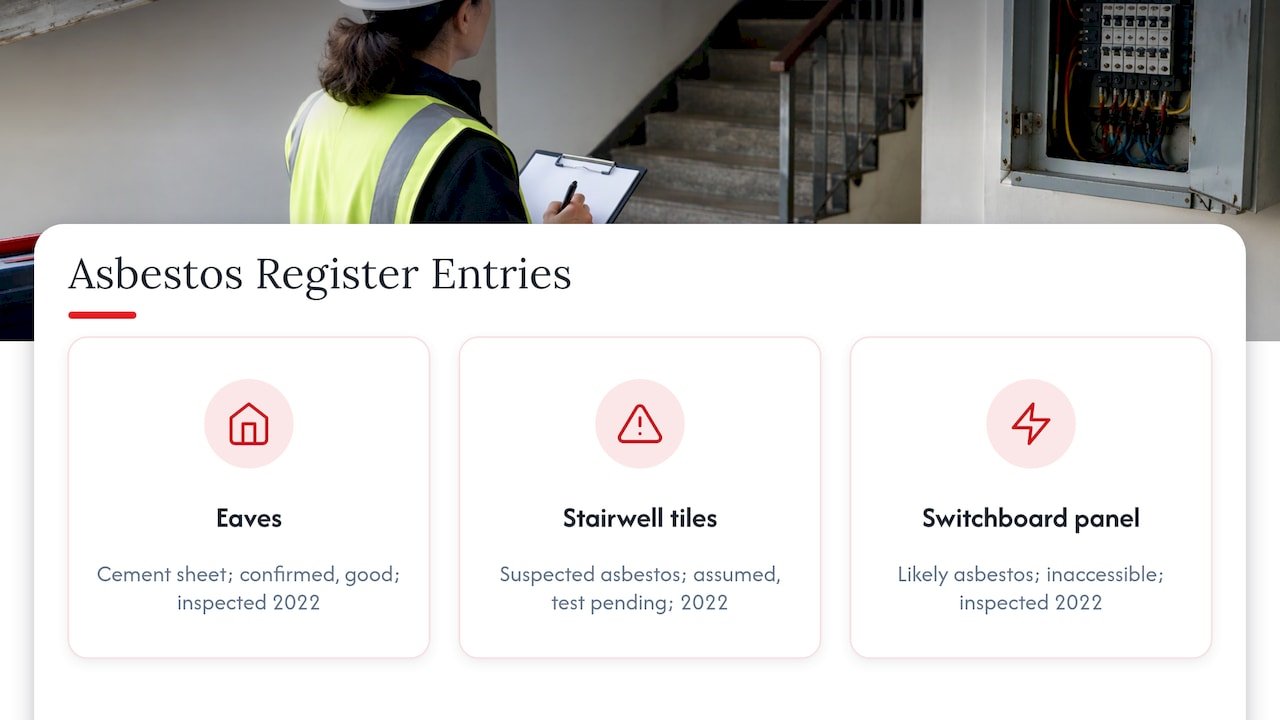
An eight-lot mixed-use building from 1985 has two ground-floor shops and a residential block above. A 2022 inspection found cement sheet eaves in good condition, vinyl tiles with suspected asbestos backing in the shared stairwell, and a switchboard backing panel that could not be sampled without cutting. The register has three entries: eaves (confirmed, good condition), stairwell tiles (assumed pending testing), and switchboard panel (likely, inaccessible). Each has a location, a photo and a date. When the committee later plans to upgrade the switchboard, the electrician gets the register first and knows to stop and have the panel assessed before drilling. That is exactly the situation the register exists for.
Where to keep it and who must see it
There is no public asbestos registry. The register is a workplace document. SafeWork Australia says it must be easily accessible at the workplace at all times, whether stored online, on a local server or as a paper copy.
The Code of Practice requires it to be readily accessible to workers, health and safety representatives, and any PCBU who carries out or intends to carry out work there. A copy must be provided to a PCBU whose work involves a risk of exposure to airborne asbestos. In Queensland, a contractor must obtain a copy before demolition, refurbishment, maintenance or service work starts, and must not start without one until the structure is inspected for asbestos.
For a strata scheme, sensible practice is:
- Keep a paper copy in a lockable but accessible place on site, such as the main switchboard room or the caretaker’s office, and label the meter box accordingly.
- Keep a digital copy with the strata manager.
- Record every time it is handed to a contractor, with the date and name.
- Make sure your strata manager knows the register must go to new management on a change of control.
When a reader asks “how do I check the asbestos register?”, the answer is to ask the body corporate or strata manager for it. If you are a contractor, builder or owner about to start work, ask in writing before the job is quoted.
How often the register must be reviewed
The Code of Practice (WHS Regulation 426) requires a review at least once every five years. It must also be reviewed sooner when:
- the asbestos management plan is reviewed;
- more asbestos or suspected asbestos is identified;
- asbestos is removed, disturbed, sealed or enclosed; or
- refurbishment or demolition work is to be undertaken.
The review includes a visual inspection by a competent person. Queensland’s guidance states the same five-year cycle and the same triggers. WorkSafe Victoria’s compliance code says registers must be reviewed every five years even when nothing has changed, and the review must be documented: when it happened, what was reviewed, the outcome and who did it.
The five-year review is a floor, not a schedule to aim for. If an asbestos roof sheet cracks in a storm, or a removal job finishes, the register should change that week.
The rules were last consolidated in SafeWork Australia’s November 2026 Code of Practice for model WHS jurisdictions. Each state regulator decides how that code applies locally, so check your own regulator’s page for the version that applies to you.
Why the register matters before demolition or strip-out
For owners, developers and builders, the register is where the risk and the programme meet. SafeWork Australia explains that giving the register to people before planned work allows control measures to be put in place for drilling and similar tasks, and the appropriate licensed removalist to be engaged before demolition or refurbishment.
Victoria’s safety alert spells out the sequence: review the register before demolition or refurbishment, revise it if it is inadequate, and hand it to the person doing the work.
In practice, three things go wrong when the register is missing or stale:
- The scope is wrong. A strip-out is priced as ordinary demolition, then suspected material turns up behind a ceiling or under floor coverings, and work stops.
- The sequence is wrong. Removal must happen before demolition begins, so the order of trades changes after contracts are signed. Our guide to removing asbestos before demolition covers the Australian process step by step.
- The waste plan is wrong. Asbestos waste has to be handled and disposed of lawfully, which is easier to plan when quantities are known. See our note on disposing of asbestos waste legally.
If you manage properties and want to check where you stand, our asbestos register requirements audit for property managers sets out what to look at.
Getting from an old register to a project-ready one
When a register is out of date, or a building has none and is likely to need one, the practical route is:
- Find what exists. Ask the strata manager for earlier reports, removal records and any clearance certificates.
- Have the building inspected and sampled. Material that is suspected is either assumed to contain asbestos or sampled and analysed. Our asbestos inspection and testing service covers this.
- Update the register. Add new findings, dates, photos and conditions, and record what has since been removed.
- Plan removal if work is coming. Removal of the affected material is done by licensed asbestos removalists, and the register is updated again when it is complete.
- Record the handover. Note when the register went to the contractor.
If you are a builder or developer, ask for the register at tender stage. If there is not one, build the inspection into your programme before demolition dates are fixed.
Our approach for strata, owners and developers
Mission Demolition provides asbestos inspection and testing, licensed asbestos removal, asbestos roof removal and asbestos disposal, alongside residential, commercial and industrial demolition, strip-outs and site clearance across Sydney and Australia. For projects that involve both hazardous materials and demolition, we manage approvals, utility disconnections, hazardous waste handling and final site cleaning as one project.
If you have a building where the register is unclear and work is coming, start with our asbestos removal in Sydney page or contact us through the Mission Demolition site.
For strip-outs, our interior strip out services cover the work once asbestos has been identified and dealt with.
Perspective
Most of the delays we see on older buildings come down to one question that was not asked early enough: what is in this building, and where is it written down?
We treat the register as the starting point of a demolition or strip-out, not an administrative extra. A clear register means the licensed removal can be scheduled first, the waste can be planned, and the demolition crew arrives to a site that has already been made safe. A vague one means the program is guessing.
Our work covers the whole chain: inspection and testing, licensed removal, disposal, and then the demolition or strip-out itself, with approvals, disconnections and final cleaning handled together. For a strata committee, a developer or a builder, that is one contract and one team accountable for the outcome, rather than several trades handing problems to each other.
If your building predates 2004 and work is on the horizon, get the asbestos position settled before you settle the dates.
Tarek
FAQ
Does my residential strata building need an asbestos register?
In model WHS states, residential-only common property with no employed workers is generally exempt. The exemption is lost if you employ a caretaker or if any common property has non-residential use. Queensland and Victoria have their own rules, so check with your regulator or strata manager.
Is there a public asbestos registry I can search?
No. The register is a document held at the workplace by the person with management or control of it. Workers, health and safety representatives and contractors who are doing or planning work there are entitled to access it, so ask the body corporate or strata manager.
How often does the register need updating?
At least once every five years, and sooner if new asbestos is found, material is removed, disturbed, sealed or enclosed, the management plan is reviewed, or refurbishment or demolition is planned. In Victoria the review must be documented even if nothing has changed.
Who has to keep the register in a strata building?
The person with management or control of the common property, normally the body corporate or owners corporation. A strata manager may hold the paperwork, but the duty sits with the body corporate, and the register must be handed over when management changes.
What should I do if the register shows asbestos and I want to renovate or demolish?
Give the register to the contractor before work begins, and have the affected material assessed and removed by a licensed asbestos removalist before demolition or refurbishment proceeds. Then update the register to record what was removed.
Sources
- Asbestos registers at the workplace, SafeWork Australia (August 2023)
- How to manage and control asbestos in the workplace, SafeWork Australia
- Asbestos registers and management plans, SafeWork NSW
- Asbestos register and asbestos management plan, WorkSafe WA
- Use asbestos registers to help keep workplaces safe, WorkSafe Victoria
- Managing asbestos in workplaces compliance code, WorkSafe Victoria
- Asbestos registers for workplaces, Queensland Government
- Asbestos in strata and community schemes, Strata Community Association
- Landlords and body corporates, Asbestos and Silica Safety and Eradication Agency