Individuals caught dumping or mishandling asbestos in NSW face on-the-spot fines set at $15,000, while corporations can be hit with $30,000 infringement notices for the same offence. Court penalties run much higher: since the 2024 reforms, tier 1 corporate maxima can reach $10 million and individual maxima up to $2 million for the most serious breaches. If you find asbestos on your property, stop work immediately, isolate the area, and call a licensed assessor rather than touching it yourself.
TL;DR:
- Fines for unlawfully dumping or handling asbestos in NSW can reach $15,000 for individuals and $30,000 for companies through infringement notices, with court penalties going up to $10 million for corporates.
- Most violations involve small-scale disposal like kerbside dumping, with larger fines imposed for concealment, repeated offenses, or dumping in sensitive areas such as waterways or school zones.
- Jobs involving more than 10 square meters of bonded asbestos require licensed removalists, and a clearance certificate is mandatory before reoccupying the site.
- Proper disposal involves using authorized facilities, double-wrapping the waste, and keeping all documentation to prove lawful handling during inspections.
- Using licensed asbestos professionals significantly reduces the risk of fines or court action, especially for complex or large-volume removals.
Table of Contents
- Understanding asbestos fines NSW: the legal framework behind the numbers
- Common infringement fines and on-the-spot penalties
- What counts as unlawful disposal or transport of asbestos waste
- Licensing thresholds and clearance certificates under SafeWork NSW
- Legal disposal and safe transport of asbestos waste
- How the EPA and courts enforce asbestos breaches
- Compliance checklist to avoid asbestos fines
- How Missiondemolition builds compliance into every job
- Talk to a licensed asbestos removalist before it becomes a fine
- Official guidance and legislation to consult
- Sources
- FAQ
Understanding asbestos fines NSW: the legal framework behind the numbers
NSW enforces asbestos rules mainly through the Protection of the Environment Operations Act 1997 (the POEO Act), backed by SafeWork NSW codes for workplace handling. Two sections do most of the heavy lifting.
Section 144AAA covers unlawful disposal of asbestos waste. It’s the provision the NSW EPA uses against people dumping sheeting, offcuts, or contaminated soil outside approved channels. Section 143 covers unlawful transporting or depositing of waste more broadly, which catches vehicles carrying asbestos to unauthorised sites.
Penalties escalate through three tiers depending on how the matter is dealt with:
- Infringement notices (SEINS) — fixed on-the-spot fines issued by an EPA or council officer without going to court.
- Local Court prosecutions — capped penalties measured in penalty units, used for mid-level offences or repeat conduct.
- Land and Environment Court prosecutions — reserved for serious or wilful breaches, with the highest maximums and the possibility of continuing daily penalties for ongoing pollution.
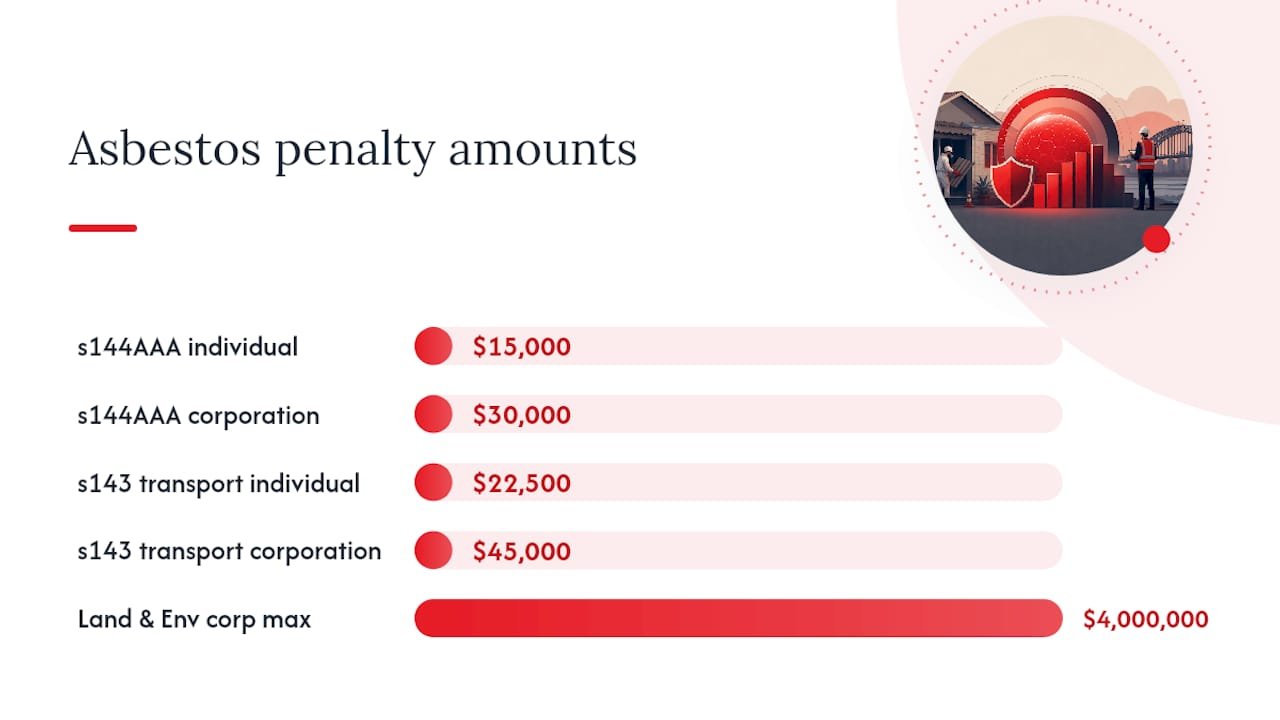
The lawcodes entry for section 144AAA sets the current infringement figure at $15,000 for a natural person and $30,000 for a corporation, current as of 3 April 2024. The section 143 entry shows transport-related infringements as high as $22,500 for individuals and $45,000 for corporations in some circumstances, with Land and Environment Court maxima reaching $4 million for corporate offenders.
Common infringement fines and on-the-spot penalties
Most people who fall foul of asbestos rules never see a courtroom. They get a SEINS notice, pay it, and move on, which is exactly the point of the infringement system: quick, proportionate enforcement for conduct that doesn’t warrant a full prosecution.
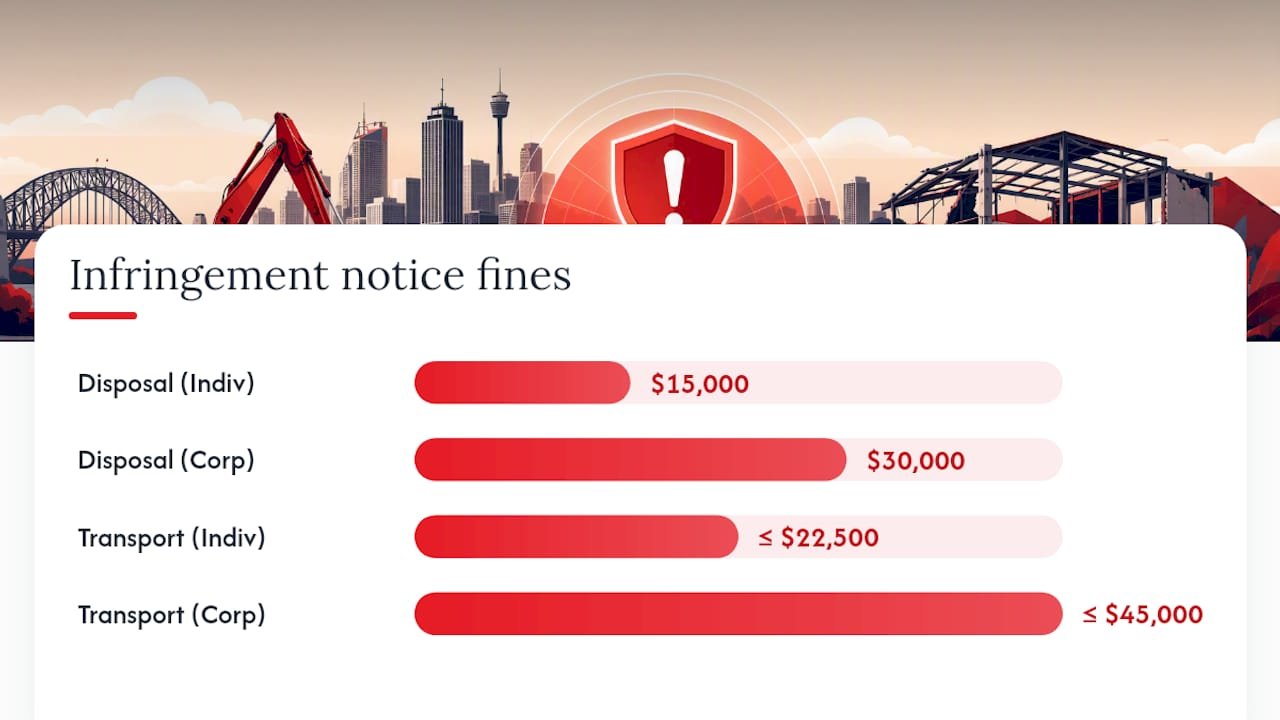
- Unlawful disposal (individuals): $15,000 per lawcodes
- Unlawful disposal (corporations): $30,000
- Unlawful transport (individuals): up to $22,500 depending on the offence
- Unlawful transport (corporations): up to $45,000
A single trailer load of asbestos sheeting dumped at an unauthorised site can trigger a $30,000 infringement notice for a business on the spot, before any court is involved.
Regulators generally reach for infringement notices when the conduct is a one-off, the volume is limited, and there’s no attempt to hide what happened. Court action becomes the likely path when someone conceals asbestos, repeats the offence, dumps in a sensitive location such as a waterway or bushland, or when the volume points to a business systematically avoiding proper disposal costs. Directors and site managers should note that repeat conduct doesn’t just mean a bigger fine. It shifts the matter from an administrative penalty to a criminal prosecution with a public record.
What counts as unlawful disposal or transport of asbestos waste
The rules sound abstract until you see them applied to ordinary situations. Three patterns account for most enforcement action:
- Kerbside and household bin disposal. Putting broken asbestos sheeting, roof fragments, or contaminated insulation in a red-lid bin or council kerbside collection counts as unlawful disposal, even if it seems like a small amount.
- Unauthorised landfill or fill dumping. Taking asbestos-contaminated soil or demolition rubble to a site not licensed to receive it, including using it as fill on another property, is a transport and disposal offence.
- Concealment in general waste or mulch. Mixing asbestos fragments into green waste, mulch, or general skip loads to avoid detection is treated as an aggravating factor, not a mitigating one, because it increases the risk of exposure downstream.
Volume and concealment both push a matter toward prosecution rather than a fixed fine. Dumping near schools, waterways, or residential areas adds another layer of seriousness that courts weigh heavily when setting penalties.
Licensing thresholds and clearance certificates under SafeWork NSW
SafeWork NSW draws a clear line: any removal job involving more than 10 square metres of bonded asbestos generally requires a Class A or Class B licensed removalist, not a handyman or unlicensed contractor. Class A licences cover both friable and non-friable asbestos; Class B is limited to non-friable material only.
- Jobs under 10 m² of non-friable asbestos can sometimes be done by a competent person, but this is the exception, not the rule.
- All friable asbestos work, regardless of size, needs a Class A licence.
- After licensed removal, the code of practice requires a clearance inspection and a written clearance certificate before the area is reoccupied or handed back.
Pro Tip: Ask for the clearance certificate before you pay the final invoice, not after. If a contractor can’t produce one, that’s your first sign something’s been skipped.
Legal disposal and safe transport of asbestos waste
Asbestos-containing material has to go to a facility specifically licensed to receive it, not any general waste transfer station. Councils and the EPA maintain lists of approved receiving sites, and it’s worth confirming acceptance before you load a vehicle.
- Standard skip bins are usually not approved for asbestos. Kerbside skip hire almost never covers it, and mixing it in is an offence, not a shortcut.
- Asbestos must be double wrapped in heavy-duty plastic, clearly labelled, and kept separate from general waste during transport.
- Keep the waste transport docket and disposal receipt from the receiving facility. These become the paper trail that proves lawful handling if a regulator ever asks.
How the EPA and courts enforce asbestos breaches
Enforcement in NSW doesn’t jump straight to court. The EPA has a graduated toolkit, and most matters resolve well before a judge gets involved.
- Clean-up notices require the responsible party to fund and organise remediation, often at significant personal cost.
- Prevention notices order changes to stop a risk recurring, such as fixing site storage practices.
- Enforceable undertakings let a company avoid prosecution by funding remediation or training programs, though these require public acknowledgement of the breach.
- Prosecution is reserved for serious, repeated, or concealed conduct.
The Wheeny Creek matter shows what that last option looks like in practice. A Sydney man and his company were found guilty over asbestos-contaminated waste dumped near the creek, with the case demonstrating that courts can impose combined penalties running into the hundreds of thousands or millions of dollars and hold individuals personally liable alongside their company.
The Wheeny Creek prosecution confirms what regulators have been signalling since the 2024 reforms: directors and site operators can’t hide behind a corporate structure when asbestos ends up somewhere it shouldn’t.
Compliance checklist to avoid asbestos fines
Avoiding a fine mostly comes down to sequencing. Do things in the right order and the paperwork looks after itself.
- Stop and isolate. If you suspect asbestos during renovation or demolition, stop work immediately and keep the area sealed off. Never sweep, cut, or bin suspected material yourself.
- Call a licensed assessor. Get material tested before you decide what to do with it. A quick assessment is far cheaper than a fine.
- Check supplier and contractor certificates. Before any removal work starts, confirm the contractor’s licence class, insurance, and public liability cover.
- Keep every document. Waste transport dockets, clearance certificates, and disposal receipts should be kept for at least five years, since they’re your evidence of lawful handling if questions arise later.
Pro Tip: Photograph the waste docket and clearance certificate the day you receive them and email copies to yourself. Paper records get lost in renovation chaos; a digital backup doesn’t.
Businesses managing larger sites should also check whether their environmental liability insurance extends to contaminated-material handling, since a clean-up notice can create costs well beyond the infringement fine itself.
How Missiondemolition builds compliance into every job
A licensed asbestos removal service manages licensed asbestos removal, arranges clearance inspections, and handles lawful disposal through approved facilities on every project. Before engaging any contractor, ask for licence details, current insurance, and a written clearance certificate on completion. Documented waste tracking isn’t an afterthought here. It’s how every job gets signed off.
Talk to a licensed asbestos removalist before it becomes a fine
Most asbestos fines in NSW trace back to one decision: someone tried to handle it themselves instead of calling a licensed professional. Using a licensed professional is the local alternative to guessing your way through disposal rules. Full licensing, insurance, and a written clearance certificate are important on every job, so you’re never the one explaining a missing docket to an EPA officer.
Whether you’re clearing a single garage roof or managing a full commercial strip-out, our asbestos inspection and testing service tells you exactly what you’re dealing with before any work starts. From there, our asbestos removal Sydney team handles the licensed removal, transport, and disposal end to end, and hands you the clearance certificate and waste dockets you’ll need on file. If you’ve found suspected asbestos on a residential or commercial property, get in touch through Missiondemolition for a quote before you touch anything.
Official guidance and legislation to consult
- EPA NSW household asbestos guidance
- SafeWork NSW asbestos hazards page
- Asbestos state resource hub
- Lawcodes penalty tables for exact infringement figures
This article is general information, not a substitute for advice from a qualified lawyer. Consult a qualified legal professional about your own circumstances before acting on anything here.
Sources
- Law Part Code 102266 – PEO 144AAA(1) | Lawcodes – Judicial Commission of NSW
- Biggest boost to environmental regulation in three decades | EPA
- Asbestos hazards and regulation | SafeWork NSW
FAQ
What is the maximum amount of asbestos you can remove without a licence?
Under SafeWork NSW guidance, a competent person can sometimes remove up to 10 square metres of non-friable asbestos without a licence. Anything larger, or any friable asbestos regardless of size, needs a licensed Class A or Class B removalist.
Is asbestos removal free in NSW?
No, licensed asbestos removal is a paid service, though some councils run subsidised drop-off days for small household quantities. Missiondemolition’s asbestos removal pricing is available on request based on the scope of the job.
Would a house built in 1976 have asbestos in Australia?
Very likely. Asbestos was used extensively in Australian building materials before it was fully banned, so any home built before the ban should be treated as a potential asbestos risk during renovation.
What are the rules for asbestos removal in NSW?
Removal must follow the SafeWork NSW code of practice, with licensed removalists required above the 10 square metre threshold and for all friable material. A written clearance certificate is required after licensed removal before the area can be reoccupied, and waste must go to an approved receiving facility, never kerbside bins or unlicensed landfill.
What happens if I get caught dumping asbestos illegally in NSW?
You can expect an infringement notice starting around $15,000 for individuals or $30,000 for corporations under section 144AAA. Repeat, concealed, or large-scale dumping can instead lead to court prosecution with much higher maximums, as seen in the Wheeny Creek case.
