The moment a structure becomes unstable and demolition can’t wait for the usual approvals, phone SafeWork NSW on 13 10 50 and log the exact time of the call. If asbestos is present or suspected, telephone first and lodge the written emergency notification form within 24 hours. Secure exclusion zones, confirm a named competent supervisor is on site, and only start demolition once you’ve matched the situation against the notification rules or a genuine emergency exemption.
TL;DR:
- Emergency demolition requires immediate phone notification to SafeWork NSW, with detailed record-keeping of calls, structures, and asbestos risks.
- Exclusion zones, utility disconnections, and public protections must be set up before demolition begins, especially if asbestos is suspected.
- Licensed supervisors with appropriate training must oversee the work, and all licensing and training obligations remain in effect during emergencies.
- Asbestos risk should be assumed for buildings built before 1990, with removal and safe handling plans implemented as soon as practical.
- Using licensed emergency demolition services can streamline compliance, site safety, and asbestos disposal during a crisis.
Table of Contents
- What are the immediate steps for emergency demolition safety in NSW?
- How much notice does SafeWork NSW require for demolition work?
- Managing asbestos risk in an emergency demolition
- Who needs a demolition licence, and what training applies?
- What emergency plans and SWMS does demolition work require?
- Setting exclusion zones and protecting the public
- What must the on-site supervisor do during an emergency demolition?
- What records do you need after an emergency demolition?
- On-the-ground priorities and common compliance failures
- Get licensed emergency demolition support when every hour counts
- Sources
- FAQ
What are the immediate steps for emergency demolition safety in NSW?
Every emergency demolition follows the same sequence, whether it’s a fire-damaged terrace in Marrickville or a collapsed warehouse wall in Wollongong. Get the order wrong and you’re either putting people at risk or handing SafeWork NSW an easy enforcement case.
- Call 000 first if anyone is hurt or trapped. Fire and Rescue NSW or NSW Police will stabilise the immediate danger before anything else matters.
- Phone SafeWork NSW on 13 10 50 immediately, even before you’ve worked out the full scope of the job. Record the call time, the operator’s name if given, and what you told them.
- Establish whether asbestos is involved or likely. Older structures, especially anything built or renovated before 1990, should be treated as a probable asbestos risk until a competent person says otherwise.
- Isolate utilities. Get gas, electricity and water disconnected through the relevant authority or a licensed tradesperson before crews go near a compromised structure.
- Set exclusion zones and public protection with barricades, signage and hoarding before any plant or personnel enter the danger area.
- Assess whether the work is “notifiable.” Under WHS Regulation clause 142, demolition involving a structure 6 metres or taller, load-shifting machinery on a suspended floor, or explosives, triggers formal notification duties, emergency or not.
- If asbestos removal can’t wait, telephone SafeWork NSW then submit the written asbestos notification within 24 hours.
Pro Tip: Keep a laminated card in the site ute with the SafeWork NSW number, the asbestos notification email, and your company’s emergency contact tree. In the adrenaline of an actual collapse, nobody remembers where the PDF is saved.
The demolition work code of practice treats an emergency as a structure that is structurally unsound or where collapse is imminent, a narrower threshold than simply “urgent.” Document why you believe the threshold is met before you rely on an emergency pathway instead of standard notification.
How much notice does SafeWork NSW require for demolition work?
The standard rule is a written notice period before starting any notifiable demolition. Genuine emergencies don’t wait five days, and the regulator knows it. That’s why the notification system has a separate, faster lane for exactly this situation.
Standard notification path:
- Notify SafeWork NSW at least five calendar days before starting any notifiable demolition work (structures ≥6 m, machinery on suspended floors, or explosives).
- Interstate demolition licence holders operating in NSW must also lodge notification before commencing work here.
- Non-compliance carries on-the-spot fines and can trigger broader enforcement action, including stop-work directions.
Emergency notification path:
- Telephone SafeWork NSW on 13 10 50 the moment you identify the emergency, before demolition starts wherever that’s practical.
- Where asbestos is involved, follow up with the written emergency form within 24 hours of the phone call.
- Lodge notifications and correspondence to adu@safework.nsw.gov.au, or through SafeWork NSW’s online notification system for standard jobs.
Inspectors don’t just check whether you notified. They check when, and whether your account of “emergency” matches the physical evidence on site. A supervisor who calls 13 10 50, then starts demolishing an hour later without any attempt to stabilise or assess the structure first, is going to face harder questions than one who called, secured the site, and waited for guidance where waiting was safe. Local councils also have their own enforcement teeth: LGNSW’s own guidance on demolition orders and enforcement shows councils will act against unlicensed or unsafe demolition regardless of what SafeWork NSW is doing in parallel.
Managing asbestos risk in an emergency demolition
Asbestos is the single biggest complication in any emergency demolition, and it’s also where supervisors get caught out fastest. The default assumption for any building constructed or renovated before 1990 should be that asbestos is present until a competent person proves otherwise.
Where practical, check the asbestos register or have a competent person inspect the structure before any demolition plant touches it. If asbestos-containing material is likely to be disturbed, it should be removed as far as reasonably practicable before demolition begins, unless the emergency itself makes that impossible.
- Telephone SafeWork NSW on 13 10 50 the moment you know immediate asbestos removal is unavoidable.
- Lodge the written notification within 24 hours using the process described in the asbestos removal notification guidance.
- Build the removal control plan or SWMS around isolation, negative-pressure enclosures where friable material is present, decontamination units, Class H vacuums, and sealed, licensed disposal.
- Treat hot plant, friable material, and contaminated soils as special cases requiring tighter controls than standard bonded asbestos sheeting.
One of the most consistent failures inspectors flag after an incident isn’t the paperwork. It’s relying on a site foreman or labourer to “eyeball” a wall for asbestos instead of engaging someone actually qualified to make that call. That single shortcut turns a manageable emergency into a notifiable exposure event.
Keep the scanned, lodged asbestos notification form and the telephone call reference number together in your incident pack from the first hour. It’s far easier to capture that detail in real time than to reconstruct it three weeks later when SafeWork NSW asks for it. Mission Demolition’s NSW asbestos removal regulations guide walks through the broader licensed removal process in more detail if you need the full regulatory picture beyond the emergency scenario.
Who needs a demolition licence, and what training applies?
NSW splits demolition licensing into two tiers, and getting the wrong one for the job is a compliance failure that surfaces the moment an inspector asks to see it.
- Unrestricted licence (DE1) covers demolition of any structure, including those over 6 metres and work involving explosives.
- Restricted licence (DE2) covers a narrower scope, generally structures under a set height threshold without explosives or the more complex load-shifting scenarios.
- A named supervisor with appropriate qualifications must be present for licensed demolition work, not just nominally listed on the licence.
- Training requirements sit on both supervisors and workers, tied to specific SafeWork NSW–approved CPCCDE units, and restricted demolition licences run for five years before renewal.
- Interstate licence holders must still notify SafeWork NSW before working on a NSW site, licence or no licence.
- Training records need to be kept accessible, not filed away in an office three suburbs from the job. An inspector who asks for evidence of a supervisor’s qualifications on the day expects to see it that day.
Emergencies don’t suspend licensing requirements. They just compress the timeline for proving you’ve met them.
What emergency plans and SWMS does demolition work require?
The WHS Regulation places a direct duty on the person conducting the business to prepare, maintain and implement a site emergency plan, not as a filing exercise but as a working document that covers structural collapse, engulfment, gas leaks and rescue scenarios.
At minimum, the emergency plan needs:
- Clear evacuation procedures specific to the site layout, not a generic template.
- Contact protocols for notifying emergency services and SafeWork NSW without delay.
- Arrangements for medical assistance, including who calls it and from where.
- Communication methods that work even if normal site systems fail.
- A testing schedule, because an untested plan is a theory, not a procedure.
A safe work method statement (SWMS) becomes mandatory for high-risk demolition work under the demolition code of practice, and it must describe the specific hazards on that job, the controls in place, how those controls are monitored, and evidence that workers were consulted in developing it. Where asbestos is present, fold the asbestos removal control plan directly into the SWMS rather than running two disconnected documents that contradict each other.
Pro Tip: Run a five-minute walk-through of the emergency plan with every crew member before work starts, not just a signature on a induction sheet. Inspectors ask workers directly what they’d do if the wall started to go, and “I don’t know” is the answer that ends up in the incident report.
Setting exclusion zones and protecting the public
Public protection failures are among the fastest ways an emergency demolition turns into a prosecution, because the risk to bystanders is often higher than the risk to the crew.
- Define the exclusion zone based on the structure’s height and likely collapse pattern, not a rough guess at “far enough.”
- Install barricades, signage and lockable hoarding before plant enters the site, not after.
- Extend hoarding well beyond the calculated falling-object zone, and add overhead protection on footpaths or laneways that can’t be closed entirely.
- Liaise with council and NSW Police early on road closures and pedestrian rerouting, particularly where the site fronts a public road.
- Inspect public protection measures regularly and keep an accessible log of every check, with times and initials.
The Safe Work Australia model code reinforces the same principle NSW practice already follows: exclusion zones are only as good as the maintenance behind them. A hoarding panel knocked loose by wind on day three is just as dangerous as never installing it. Mission Demolition’s guide to demolition site signage covers the practical specifics of getting signage right the first time, which matters more in an emergency than in a planned job where you’ve got weeks to get it perfect.
What must the on-site supervisor do during an emergency demolition?
The supervisor carries the weight of every decision an inspector will later scrutinise, so the actions taken in the first hours need to be deliberate, not improvised.
- Confirm and record the competent person’s credentials for any structural or asbestos assessment before relying on their sign-off.
- Check PPE, decontamination units and Class H vacuums are actually in use, not just sitting in the site shed.
- Keep a running event log covering every decision, every notification made, who was on site, and any point where the crew deviated from the SWMS and why.
- Coordinate directly with emergency services and the regulator, so nobody on site is giving conflicting instructions to different agencies.
- Preserve physical evidence where an incident has occurred, resisting the urge to “tidy up” the scene before it’s been assessed.
A supervisor who can hand an inspector a clean, contemporaneous log is in a fundamentally different position to one reconstructing events from memory a week later.
What records do you need after an emergency demolition?
The paperwork trail is what separates a defensible emergency response from an enforcement action, and it needs to exist before anyone asks for it.
- Telephone notification logs, including call times and reference numbers where SafeWork NSW provides them.
- The completed and lodged notification form, whether standard or emergency asbestos notification.
- The SWMS as actually followed on the day, not just the version drafted beforehand.
- Asbestos removal records, disposal receipts, and training logs for everyone involved.
Written emergency asbestos notifications must reach SafeWork NSW within 24 hours of the phone call, while standard notifiable demolition still runs on the five calendar day rule when there’s no emergency driving the timeline. Inspectors typically request the full set above as a package, so build an incident pack as you go rather than assembling it retrospectively. Close the site out by confirming asbestos-containing waste has gone to a licensed facility, with disposal dockets kept alongside the rest of the file.
On-the-ground priorities and common compliance failures
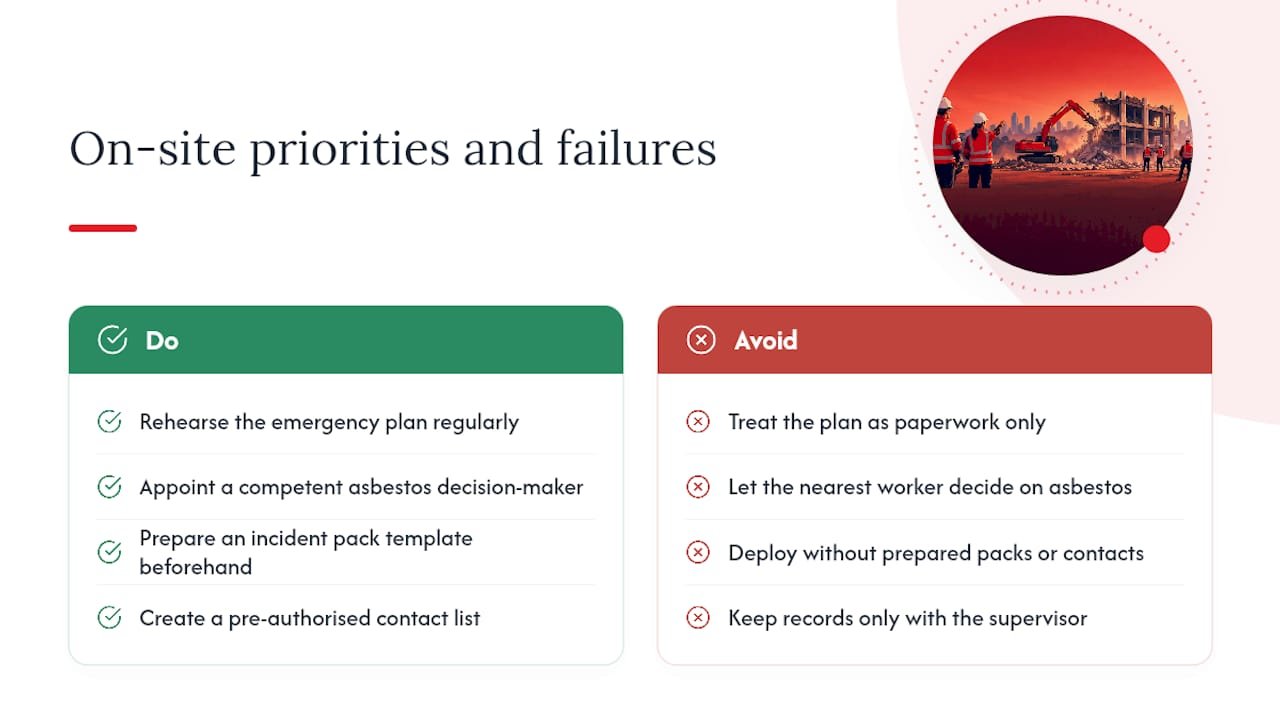
Most supervisors don’t get caught out by the big, obvious rules. They get caught out by treating the emergency plan as a document that exists rather than a procedure that’s actually been rehearsed. An emergency plan nobody’s walked through is worth less than the paper it’s printed on, and inspectors can tell the difference within minutes of asking a worker what they’d do if the structure started to move.
The second recurring failure is letting whoever’s closest to the job make the asbestos call instead of a genuinely competent person. It feels efficient in the moment and creates the single biggest liability on the file afterwards. The supervisors who come through an emergency cleanly are usually the ones who’d already built an incident pack template and a pre-authorised contact list before they ever needed either. Clear command structure and records anyone on the crew can lay hands on, not just the supervisor, cut enforcement risk more than any single technical control.
— Tarek
Get licensed emergency demolition support when every hour counts
There are licensed emergency demolition and asbestos removal services set up to move fast on notifications, site safety and lawful hazardous waste disposal across Sydney and New South Wales that can assist in mid-crisis situations.
During an emergency, a licensed demolition and asbestos removal contractor can provide a rapid on-site assessment, coordinate SafeWork NSW notifications on your behalf, manage exclusion zones and public protection, and carry out safe removal with disposal that meets NSW licensing requirements from start to finish. That’s the difference between handling a structural emergency solo and handing the regulatory and safety burden to a crew that’s done it before. If asbestos is a possibility, the team’s asbestos inspection and testing service can confirm the risk before anyone goes near the structure with plant. Reach out through the emergency demolition services page now to get a crew moving on your site today.
Sources
- Demolition notifications | SafeWork NSW
- Code of practice: Demolition work (SafeWork NSW)
- Emergency demolition notification where asbestos is involved (SafeWork NSW)
- Model code of practice: Demolition work (Safe Work Australia)
FAQ
What are the demolition regulations in NSW?
NSW demolition work is governed by the WHS Regulation and the SafeWork NSW code of practice, which sets requirements for licensing, notification, SWMS, emergency plans, asbestos management and exclusion zones. Notifiable demolition, structures 6 metres or taller, machinery on suspended floors, or work involving explosives, needs five calendar days’ written notice before it starts.
What Australian standards apply to demolition work?
Demolition in NSW is primarily governed by state WHS legislation and the SafeWork NSW code of practice, supplemented by the Safe Work Australia model code used across jurisdictions for consistent guidance on exclusion zones, SWMS and asbestos risk. There isn’t a single standalone “Australian Standard” number that covers demolition safety comprehensively. These codes fill that role.
What safety measures are required during demolition?
Required measures include a tested site emergency plan, a SWMS covering identified hazards and controls, licensed asbestos assessment and removal where relevant, secured exclusion zones with hoarding and signage, and a named, appropriately trained supervisor on site throughout the work. Mission Demolition builds all of these into its demolition services as standard practice on every project.
What should I do first in an emergency demolition in NSW?
Phone SafeWork NSW on 13 10 50 immediately and record the call time. If asbestos is involved, follow that call with a written notification within 24 hours, and secure exclusion zones before any plant enters the site.
What are the current demolition safety regulations in NSW?
Current NSW requirements combine the five-day notification rule for standard notifiable demolition with a telephone-first emergency pathway for genuine structural emergencies, alongside mandatory licensing (DE1 or DE2), named supervisor requirements, and asbestos-specific removal and notification rules. All of these sit under the SafeWork NSW code of practice as the primary reference document.
