
Most heritage demolitions in NSW need one of two approvals before any wall comes down: a Section 60 approval from Heritage NSW if the property sits on the State Heritage Register or under an Interim Heritage Order, or council development consent if it’s a local heritage item or inside a conservation area. Complying development certificates almost never cover full demolition in these situations, and asbestos and SafeWork NSW obligations apply regardless of which pathway you take.
TL;DR:
- Demolition of heritage-listed properties in NSW requires approval from Heritage NSW via Section 60 or through council development consent, depending on listing status.
- Applications involving original fabric removal or affecting conservation areas must demonstrate heritage significance and are subject to a “significance first” test.
- Fast-track Section 60 approvals for minor works take approximately three weeks, while standard applications can take about six weeks or longer if public advertising occurs.
- A thorough heritage impact statement and supporting reports, including structural and asbestos assessments, are crucial to avoid delays or application refusal.
- SafeWork NSW licensing and notification procedures must be followed, with licensed contractors handling asbestos removal and supervising demolitions.
Table of Contents
- Heritage demolition approval NSW: quick checklist for your site
- How heritage listings change the approval pathway
- Section 60 works approvals: fast-track vs standard timeframes
- DA vs CDC for demolition: why the Demolition Code rarely helps here
- What technical evidence do councils and Heritage NSW expect?
- What licences and SafeWork NSW notifications do you need before demolition starts?
- A step-by-step checklist for heritage demolition approval in NSW
- What actually separates a smooth approval from a stalled one
- How Missiondemolition helps you move from approval to demolition day
- Sources
- FAQ
Heritage demolition approval NSW: quick checklist for your site
Before you call a contractor, work out exactly what you’re dealing with. The pathway depends entirely on listing status, and guessing wrong here causes more stalled projects than any other single mistake.
Start with these checks:
- Confirm listing status first. Search the property against the State Heritage Register, your council’s Local Environmental Plan (LEP) schedules, and check whether an Interim Heritage Order is in place.
- Match the listing to the pathway. SHR or IHO sites go through Heritage NSW’s Section 60 works application; locally listed items or conservation area properties usually need a development application (DA) through council.
- Don’t assume a CDC covers you. Complying development certificates are heavily restricted or excluded outright for full demolition on heritage-affected land.
- Watch for red flags. A heritage item, a “contributory” building in a conservation area, or works that alter street presentation or original fabric all push you toward a DA or Section 60 approval, not a fast exemption.
- Check council delegation. Some councils hold delegated authority to assess minor Section 60 works themselves; others refer everything back to Heritage NSW.
Get this mapping wrong and you risk a stop-work order after demolition has already started, which costs far more than the week it takes to check properly.
How heritage listings change the approval pathway
Clause 5.10 of most NSW local environmental plans is the trigger clause for heritage-affected demolition. It requires development consent for demolishing a heritage item or a building within a heritage conservation area, and it forces the council to weigh the building’s heritage significance before granting approval. The Dentons analysis of heritage significance in demolition matters notes that Development Control Plans (DCPs) are typically the working document councils use to test whether demolition is supportable.
For State-listed properties, the trigger sits in the Heritage Act 1977 (NSW) rather than the LEP. Section 63 sets out the offence provisions, and Section 60 is the approval mechanism itself: any works affecting an SHR item, or a place under an Interim Heritage Order, need Heritage NSW approval, or approval from a council holding delegated authority.
The practical upshot:
- Removing original fabric from a contributory building almost always needs formal approval, not an exemption.
- Threatening the character of a conservation area, even through partial works, tends to trigger the same consent requirement as full demolition.
- Councils and Heritage NSW both apply a “significance first” test, meaning your justification for demolition has to address heritage value directly, not just cost or convenience.
Section 60 works approvals: fast-track vs standard timeframes
Heritage NSW runs two tracks for Section 60 applications, and knowing which one applies changes your whole project schedule. The fast-track pathway covers minor works estimated up to a defined cost threshold, with an assessment target of about three weeks. Standard applications take roughly six weeks, stretching longer if Heritage NSW decides to advertise the application for public comment.
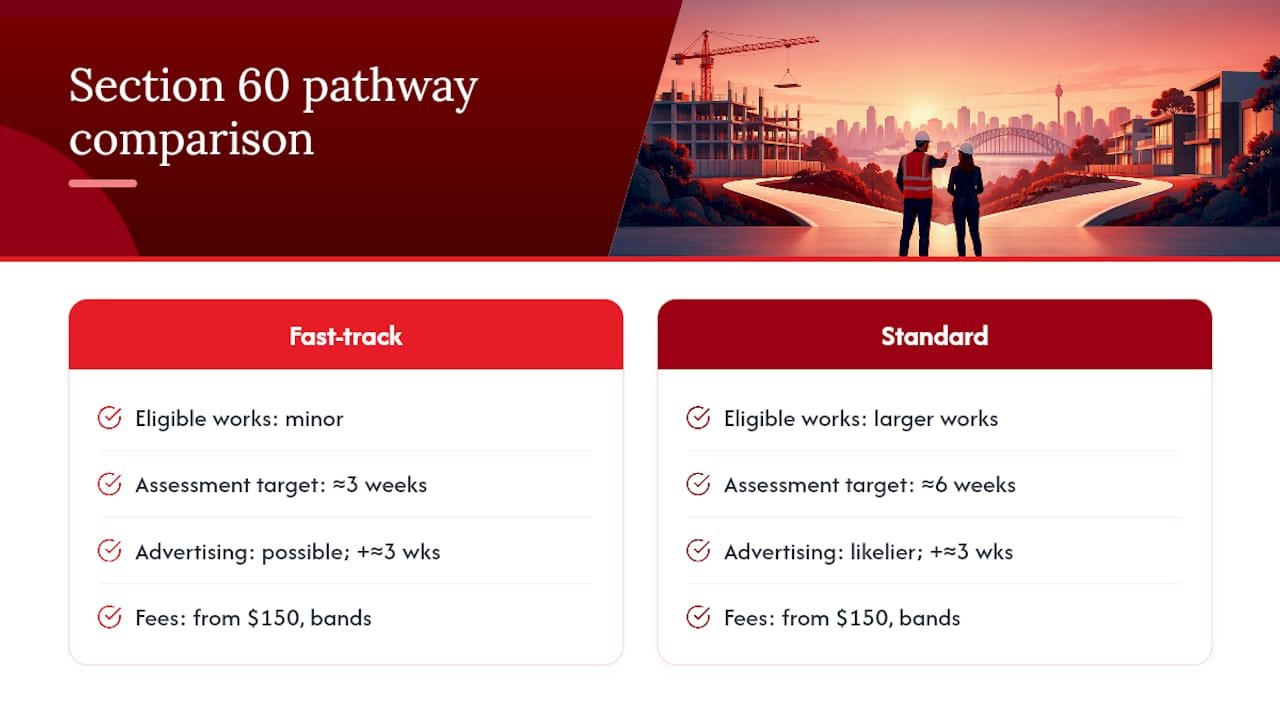
Fees scale with estimated project cost, starting from $150 for small private house works and rising through published bands for larger commercial or multi-million dollar projects. Check the current fee schedule before you budget, because the bands are reviewed periodically.
Advertising adds real delay. If your project is large, contentious, or affects a highly visible heritage item, expect Heritage NSW or the delegated council to open it for public submissions, which can add three weeks or more on top of the standard timeframe.
DA vs CDC for demolition: why the Demolition Code rarely helps here
The NSW Demolition Code sets out which demolitions qualify as exempt or complying development, letting many standard residential demolitions skip a full DA. Heritage conservation areas break that shortcut. In those areas, only specific detached structures or limited internal works typically qualify for a complying development certificate; full demolition of the main dwelling almost always requires council consent instead.
Before you book a demolition contractor, get written confirmation from council or an accredited certifier about which pathway actually applies to your property. Starting demolition under an assumed CDC exemption that doesn’t actually cover a heritage-listed structure is an illegal start, and it’s one of the fastest ways to attract a stop-work notice and penalty action.
What technical evidence do councils and Heritage NSW expect?
A weak application is the single biggest cause of delay in heritage demolition matters. Heritage NSW’s guidelines for preparing a statement of heritage impact set out what a SOHI (sometimes called a heritage impact statement, or HIS) actually needs to demonstrate.
- A statement of heritage impact (SOHI/HIS) explaining why demolition is necessary and confirming retention or adaptive reuse was genuinely considered first.
- A quantity surveyor’s cost comparison, when demolition is argued on economic grounds, showing the real cost gap between retention and rebuilding.
- A structural engineer’s report, particularly for weatherboard or older masonry buildings where deterioration is part of the argument.
- A pest inspection, especially where termite or timber decay forms part of the justification.
- An asbestos survey, with licensed removal arranged wherever asbestos-containing material is confirmed.
Pro Tip: Don’t submit a SOHI built on the assumption that a building is “non-contributory” to a conservation area without solid evidence. The Dentons review of heritage significance cases flags an incorrect factual premise about a building’s heritage contribution as one of the most common reasons applications get refused.
What licences and SafeWork NSW notifications do you need before demolition starts?
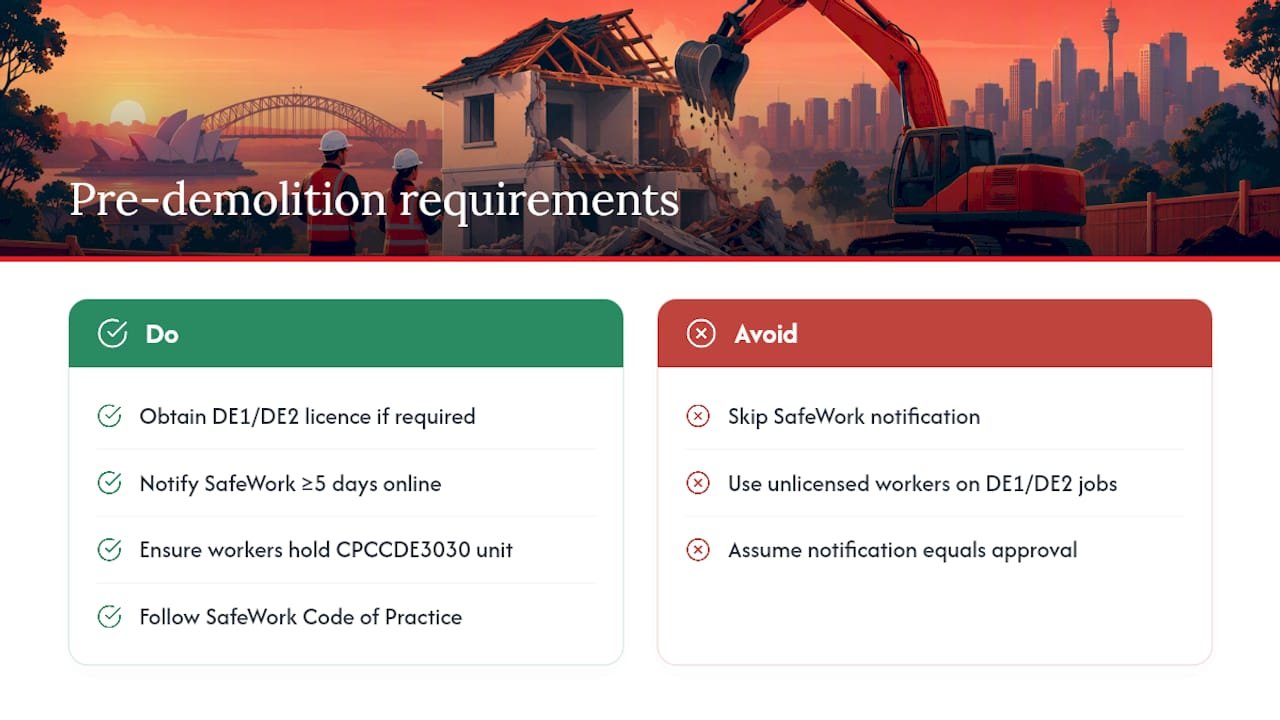
Getting heritage approval is only half the job. SafeWork NSW requires a demolition licence for certain classes of work, split between restricted (DE2) and unrestricted (DE1) licences depending on the scale and complexity of the structure. Unrestricted licence holders must supervise more complex jobs on-site personally.
You must also notify SafeWork NSW at least five calendar days before starting notifiable demolition work, lodged through the asbestos and demolition online notification system. That notification doesn’t grant approval on its own. It simply confirms SafeWork has been told, and work can proceed once the five-day window has passed.
Workers on licensed demolition sites generally need to hold or be working toward the CPCCDE3030 demolition training unit, and the whole job needs to run under SafeWork’s Code of Practice for demolition work. Skipping the notification, or running unlicensed workers on a job that needs a DE1 or DE2 licence, is one of the more common enforcement triggers on NSW sites.
A step-by-step checklist for heritage demolition approval in NSW
Here’s the order that tends to work, based on how these approvals actually move through councils and Heritage NSW in practice.
- Check listing status against the SHR, LEP schedules, and any Interim Heritage Order, then confirm the correct pathway with council or an accredited certifier.
- Commission a SOHI early, before you’ve locked in a demolition date, so any weaknesses in the heritage argument surface while there’s still time to fix them.
- Line up supporting reports (quantity surveyor, structural engineer, pest inspection) if demolition is being argued on cost or condition grounds.
- Arrange an asbestos survey and book licensed removal if asbestos-containing material is found on-site.
- Lodge the application, either Section 60 with Heritage NSW or a DA with council, and calculate fees against the correct fee band for your project’s estimated cost.
- Notify SafeWork NSW at least five calendar days before notifiable demolition work begins.
- Book a licensed demolition contractor holding the correct DE1 or DE2 licence, with an on-site supervisor for complex jobs.
- Prepare salvage, waste and site management plans, since most heritage-related consents attach conditions covering material salvage and hoarding or fencing standards.
Pro Tip: Line up your asbestos survey and SOHI at the same time rather than sequentially. Running them in parallel can shave weeks off your overall timeline, particularly if either report comes back needing revisions.
What actually separates a smooth approval from a stalled one
The applications that move fastest are the ones where the heritage case was built properly from day one, not bolted on after a council raised concerns. I’d argue the single biggest predictor of delay isn’t the property itself. It’s whether the applicant treated the SOHI as a formality or as the actual argument.
The refusals I see follow a pattern: thin heritage evidence, a demolition case built on cost without a quantity surveyor’s report to back it, or an asbestos issue nobody flagged until a contractor found it mid-job. None of that is complicated to avoid. It just needs to happen before the application goes in, not after council asks for it.
Do the groundwork properly and heritage approval stops being the obstacle everyone assumes it is.
— Tarek
How Missiondemolition helps you move from approval to demolition day
A demolition contractor is the practical next step once your heritage approval pathway is confirmed, delivering licensed asbestos removal, whole-of-project demolition, and on-site coordination that keeps you compliant with SafeWork NSW notification and supervision rules.
That matters most on heritage-affected sites, where a demolition contractor needs to understand salvage conditions, site fencing standards, and asbestos handling all at once, not treat them as separate problems. Missiondemolition combines modern demolition equipment with hands-on experience across residential, commercial and industrial jobs throughout Sydney, backed by licensed asbestos removal capability for the surveys and remediation that heritage approvals commonly require.
If you’ve confirmed your Section 60 or DA pathway and you’re ready to line up a contractor, get in touch through Missiondemolition’s services page to talk through your site, your approval conditions, and a practical delivery plan. Check the demolition permits guide first if you’re still confirming which approval you need.
Sources
- Demolition of buildings – Rules for exempt and complying development — Planning NSW
- Demolition — SafeWork NSW
- Consideration of effect on heritage significance demolition — Dentons
FAQ
How Do I Get Approved for Heritage Demolition in NSW?
Check the property’s listing status first. If it’s on the State Heritage Register or under an Interim Heritage Order, apply through Heritage NSW’s Section 60 process. If it’s a local heritage item or in a conservation area, you’ll need a development application through council instead.
What Standards Apply to Demolition of Heritage Structures in NSW?
Demolition work must comply with the SafeWork NSW Code of Practice for demolition, which sets licensing, training (CPCCDE3030) and notification requirements. Heritage-specific standards come from the Heritage Act 1977 and each council’s LEP clause 5.10 provisions.
Do I Need Planning Permission to Demolish a Heritage Building?
Yes, in almost all cases. A heritage item or a building in a conservation area needs development consent under clause 5.10, and complying development certificates rarely cover full demolition in these situations, per Planning NSW’s Demolition Code.
How Much Does a Section 60 or DA Approval Cost in NSW?
Section 60 fees start from $150 for small private house works and scale up through published bands for larger projects. Council DA fees vary by local government area and project value, so check with your specific council for its current schedule.
What Happens If I Demolish a Heritage Building Without Approval?
Unauthorised demolition of a heritage-listed property is an offence under the Heritage Act 1977, carrying significant fines and the possibility of ministerial orders restricting land use for years afterward. Councils and Heritage NSW treat unapproved heritage demolition as one of the most serious compliance breaches in the planning system.
