
Yes, if your load weighs 100 kg or more, or contains 10 m2 or more of asbestos sheeting, you must track it through the Integrated Waste Tracking Solution (IWTS) before it leaves the site. Businesses need to register as a transporter or receiver now, and householders disposing of smaller amounts should check whether a separate household disposal pathway applies to them.
TL;DR:
- Loads of 100 kg or more or covering 10 square meters of asbestos sheeting must be tracked through IWTS before leaving the site, including registered transporters and receivers.
- Householders disposing of smaller amounts generally do not need IWTS accounts but must use licensed facilities and may need to complete a household disposal form.
- Registering for IWTS takes 24 to 48 hours, so businesses should plan ahead and confirm the receiving facility’s acceptance before scheduling pickup.
- Consignments require steps like creating authorizations, drafting transport certificates, and ensuring the load matches paperwork; skipping steps can cause rejection at the site gate.
- Enforcing authorities pursue illegal asbestos dumping, with fines up to $30,000, making proper record-keeping of signed certificates and disposal dockets essential for compliance.
Table of Contents
- What the IWTS is and which asbestos loads must be tracked
- Who must register, household reporting and timing for registration
- Step-by-step: creating consignments, transport certificates and completing IWTS movements
- Responsibilities and record-keeping for consignors, transporters and receivers
- Reporting untracked movements and enforcement risks
- Practical checklist: what householders and businesses must do before transport
- Where to get help: IWTS help centre, EPA and SafeWork NSW contacts
- Why professional handling and correct IWTS use reduce risk
- Licensed asbestos removal with IWTS handled for you
- FAQ
- Sources
What the IWTS is and which asbestos loads must be tracked
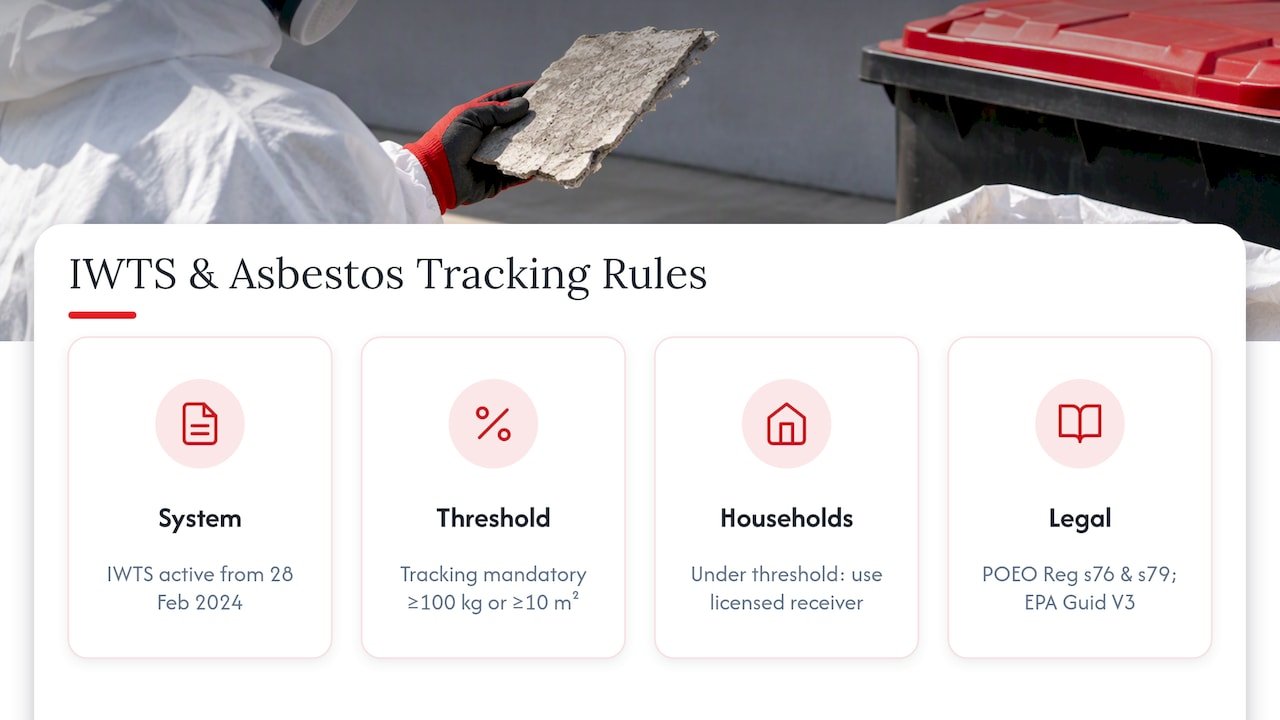
The Integrated Waste Tracking Solution is the NSW EPA’s online system for recording asbestos waste movements from pickup to disposal. It replaced the older WasteLocate and Online Waste Tracking systems, with asbestos and other trackable waste moving onto IWTS from 28 February 2024, according to the EPA’s tracking guidance.
Tracking becomes mandatory once a single load reaches 100 kg or 10 square metres of asbestos sheeting. Anything below that threshold still needs lawful disposal, but it does not need to run through the IWTS system itself. Householders disposing of smaller amounts of asbestos, such as material from a small home repair, often fall outside the business registration requirements, though they still need to use a licensed receiver and may need to complete a separate household form.
The legal foundation sits in clauses 76 and 79 of the Protection of the Environment Operations (Waste) Regulation 2014, with the practical detail spelled out in the EPA’s Asbestos and Waste Tyres Guidelines (Version 3), which came into effect alongside the asbestos tracking requirement. These guidelines are the reference point for consignors, transporters and receivers working out exactly what they owe each other on paperwork.
Who must register, household reporting and timing for registration
Transporters and receivers of tracked asbestos loads must hold IWTS accounts before any movement happens. Consignors, generally the business or site generating the waste, are also drawn into the system where their contracts require it. None of these accounts activate instantly: the EPA notes that registration verification typically takes 24 to 48 hours, so leaving registration until the morning of a scheduled pickup is a common way to delay a job.
Householders sit outside most of this. If you are disposing of a small amount of asbestos from your own property, you are generally expected to use a licensed disposal facility and complete a household asbestos disposal form rather than open a full IWTS account. The NSW Government has also flagged a trial program offering free collection for household asbestos waste as part of a $9 million initiative, with implementation planning underway, so it is worth checking current availability before assuming you need to pay for disposal yourself.
Businesses should treat the 24 to 48 hour verification window as a planning constraint, not a formality, and register well ahead of any demolition or strip-out date.
Step-by-step: creating consignments, transport certificates and completing IWTS movements
Setting up a tracked movement in IWTS follows a fairly fixed sequence, and skipping a step is usually what causes a load to be rejected at the gate.
- Confirm the receiving facility is registered on IWTS and willing to accept the specific type and quantity of asbestos waste before you book transport.
- Create the consignment authorisation in IWTS and draft the transport certificate, naming the consignor, transporter and receiver.
- Record the required details on the certificate: driver licence number, vehicle registration, waste quantity, and the pickup and drop-off addresses and dates.
- Print the paper transport certificate and keep it with the load for the entire journey, since the vehicle must carry it alongside the digital record.
- Update the movement status in IWTS as the load progresses: picked up, arrived, accepted or rejected, and finally processed once disposal is confirmed.
- If a receiver rejects the load, correct the documentation or waste classification and resubmit rather than diverting the vehicle to an unregistered site.
If the IWTS platform is temporarily unavailable, the paper transport certificate still needs to travel with the load, and the movement should be entered into the system as soon as access returns, using the exception reporting options the EPA guidelines describe.
Responsibilities and record-keeping for consignors, transporters and receivers
Clauses 76 and 79 of the POEO Waste Regulation split the compliance burden across three roles rather than leaving it on one party. That matters because a gap in any one party’s paperwork can expose the others to enforcement action.
- Consignors must ensure the waste is accurately described and that a registered transporter and receiver are engaged before the load leaves site.
- Transporters must carry the printed transport certificate, keep the IWTS record current, and deliver only to the receiver named on the certificate.
- Receivers must confirm the load matches the certificate, accept or reject it in IWTS, and retain the signed certificate and disposal docket.
Keeping these records matters well beyond the day of transport. Businesses should also check their records against the site’s Asbestos Register and Asbestos Management Plan, which SafeWork NSW treats as a separate but connected obligation: the register records where asbestos is located, while the management plan sets out how it is controlled, and both should be accessible on site alongside your transport paperwork. If you manage a commercial property, a quick audit of register requirements is a sensible companion check.
Reporting untracked movements and enforcement risks
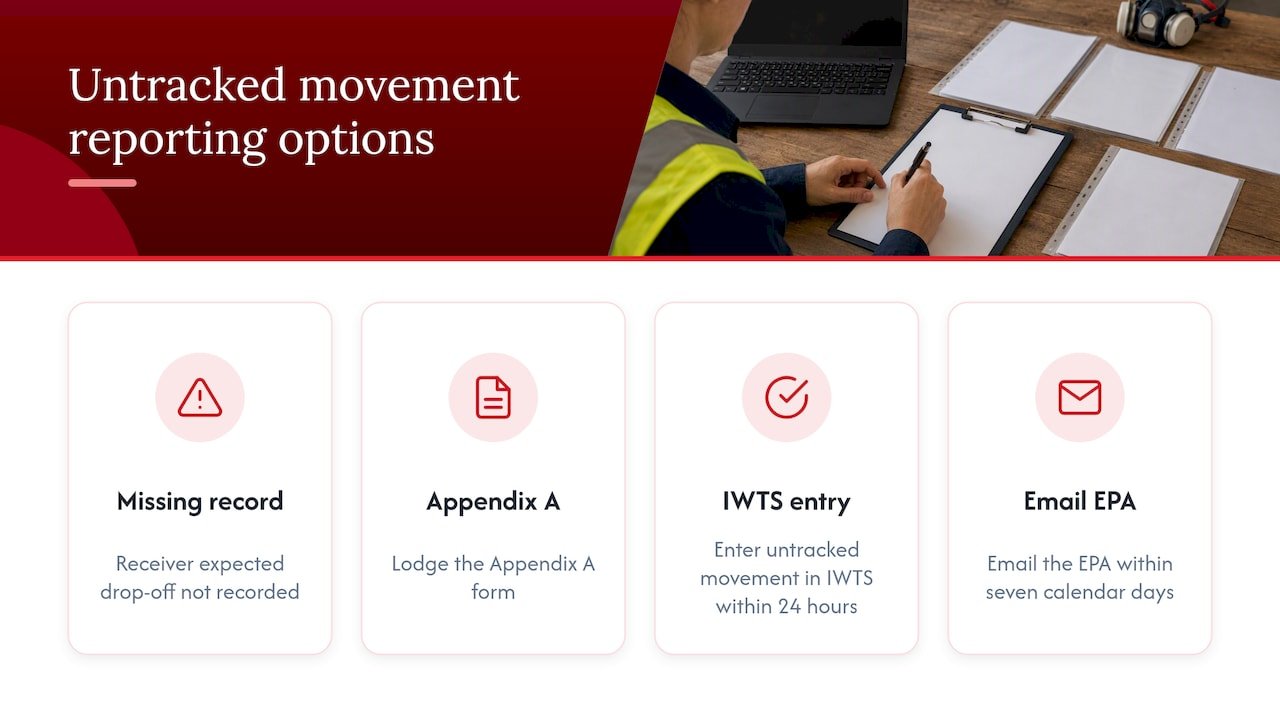
If a receiver expects a tracked load and it never shows up as dropped off in IWTS, the guidelines give three reporting routes: lodging the Appendix A form, entering the untracked movement directly in IWTS within 24 hours, or emailing the EPA within seven calendar days, as set out in the Asbestos and Waste Tyres Guidelines. Missing all three windows leaves a gap in the record that is hard to explain later.
The EPA pursues illegal dumping of asbestos with real consequences. In one recent case, the agency fined a dumper $30,000 over asbestos dumped near Mt Keira, a reminder that responsibility for the waste stream sits with whoever consigned, transported or received it, not just whoever physically dumped it. Keeping signed transport certificates and disposal dockets on file is the simplest defence if a movement is ever questioned.
Practical checklist: what householders and businesses must do before transport
The steps differ slightly depending on who you are, but both groups benefit from acting early rather than on the day of removal.
- Householders should locate a licensed receiver, complete the household asbestos disposal form if their facility requires one, and consider engaging a licensed removalist for anything beyond a small, non-friable job.
- Businesses and contractors should register IWTS accounts early, confirm the receiver’s licence and willingness to accept the load, prepare the transport certificate details in advance, and retain every signed record.
Pro Tip: Register on IWTS at least 48 hours before your planned transport date and get written confirmation that the receiving facility will accept your specific load before the truck leaves site.
For jobs that sit close to the regulatory thresholds or involve friable material, our guide to NSW asbestos removal regulations covers licensed versus unlicensed removal limits in more detail.
Where to get help: IWTS help centre, EPA and SafeWork NSW contacts
For technical IWTS account issues, the EPA’s tracking guidance page links to the help centre and support contacts. For illegal dumping reports or general compliance questions, the EPA’s main environment line is the right first call. SafeWork NSW’s removal guidance covers removal standards and management plan templates for workplaces.
Why professional handling and correct IWTS use reduce risk
Licensed asbestos removal and IWTS-compliant disposal are handled on projects across Sydney. Getting the paperwork wrong is usually what turns a routine removal into a dumped-truck problem, so for anything beyond a small, non-friable household job, a licensed removalist carrying the tracking burden is the lower-risk path.
— Tarek
Licensed asbestos removal with IWTS handled for you
Mission Demolition’s asbestos removal team manages the packing, transport and IWTS consignment paperwork on every job, so you are not the one chasing a rejected transport certificate. We also handle asbestos inspection and testing to confirm what you are dealing with before a single sheet moves.
Every job leaves you with the signed transport certificate, the disposal docket and the IWTS entry confirming the waste was accepted and processed. If you have a removal or demolition project in Sydney that needs this handled properly, get in touch with a licensed removal service provider to arrange an assessment.
FAQ
Is there a free disposal service for asbestos waste in NSW?
The NSW Government has announced a trial household asbestos collection program backed by a $9 million commitment, aimed at offering free pickup for household quantities. Availability depends on where you live and the stage of rollout, so check the EPA’s current guidance before assuming your council area is covered yet.
How much does it cost to dispose of an asbestos tonne?
Disposal costs vary by facility, waste type and location, and no NSW government source publishes a single per-tonne figure. For an accurate quote, contact a licensed receiving facility directly or ask a licensed removalist to include disposal in a project quote.
What is the maximum amount of asbestos you can remove without a licence?
SafeWork NSW allows limited unlicensed removal of small amounts of non-friable asbestos in specific circumstances, but it maintains there is no safe level of exposure and recommends engaging licensed professionals wherever possible. Friable asbestos or larger jobs require a licensed asbestos removalist regardless of quantity.
Who is the biggest waste management company in Australia?
This is not published as a ranked, verifiable figure in NSW government sources, and it is not relevant to how you track or dispose of asbestos waste. What matters for compliance is using a receiver registered on the IWTS, regardless of the company’s size.
