
Demolition noise in NSW sits under the EPA’s Interim Construction Noise Guideline, the Protection of the Environment Operations Act, and your council’s development consent conditions, which usually override general guidance. Before booking any noisy plant, check your consent conditions and local council Development Control Plan for specific hours, then arrange an acoustic assessment if your site sits near sensitive neighbours or runs outside standard hours.
TL;DR:
- Demolition noise must comply with specific council hours and conditions, which often override general NSW guidelines.
- Noise management levels are based on background noise plus 10 decibels during standard hours and plus 5 decibels outside those hours.
- Several triggers such as deep excavation or long high-noise plant use require Construction Management Plans before work starts.
- Enforcement involves councils, the EPA, police, and directions can mandate immediate work modification or cessation.
- Effective noise mitigation includes source control, scheduling, physical barriers, community engagement, and detailed planning before scheduling demolition.
Table of Contents
- How the EPA and the Interim Construction Noise Guideline frame demolition noise control
- Standard hours and council variation across Sydney
- What the noise numbers in NSW guidance actually mean
- When you need a management plan and how out-of-hours permits get decided
- Who enforces the rules and what a noise abatement direction means
- A practical mitigation checklist for demolition sites
- How experienced contractors put the rules into practice
- Where NSW noise policy is heading next
- Compliant demolition and noise management support from Mission Demolition
- FAQ
- Sources
How the EPA and the Interim Construction Noise Guideline frame demolition noise control
The Interim Construction Noise Guideline covers construction, demolition and remediation work across NSW, setting out recommended standard hours and noise management levels. These figures are guidance rather than automatic legal limits, so an exceedance on its own does not breach the law; what matters is whether you can justify it through your approval or assessment process.
The EPA’s construction noise guidance explains that the regulator uses the ICNG when setting conditions in environment protection licences, and a modernised draft guideline is being prepared, though the existing ICNG still applies wherever a licence or consent references it.
Regulators expect you to work through a mitigation hierarchy before accepting noisy conditions as unavoidable:
- Reduce noise at the source, through equipment choice and maintenance.
- Apply administrative controls, such as scheduling and task sequencing.
- Limit noise propagation with barriers, screens or distance.
- Engage affected residents early so complaints are less likely.
Standard hours and council variation across Sydney
Standard construction hours in the ICNG are a starting point, but your council’s Development Control Plan usually sets the real rule for your site. City of Sydney’s construction site noise guidance restricts potentially noisy work in the city centre to 7:00 am to 7:00 pm on weekdays and 7:00 am to 5:00 pm on Saturdays, with different hours applying elsewhere in the local government area. Sunday and public holiday work is generally not permitted, though councils can grant case-by-case exceptions.
North Sydney’s Development Control Plan sets its own primary construction hours and lists the triggers that require a Construction Management Plan or Noise and Vibration Management Plan, along with the tests used to decide out-of-hours permit applications.
Two points matter for anyone planning demolition:
- Council conditions and your development consent can be stricter than the ICNG defaults.
- Always check your specific consent and the relevant council policy before scheduling plant, since assumptions based on a neighbouring project’s hours can be wrong.
What the noise numbers in NSW guidance actually mean
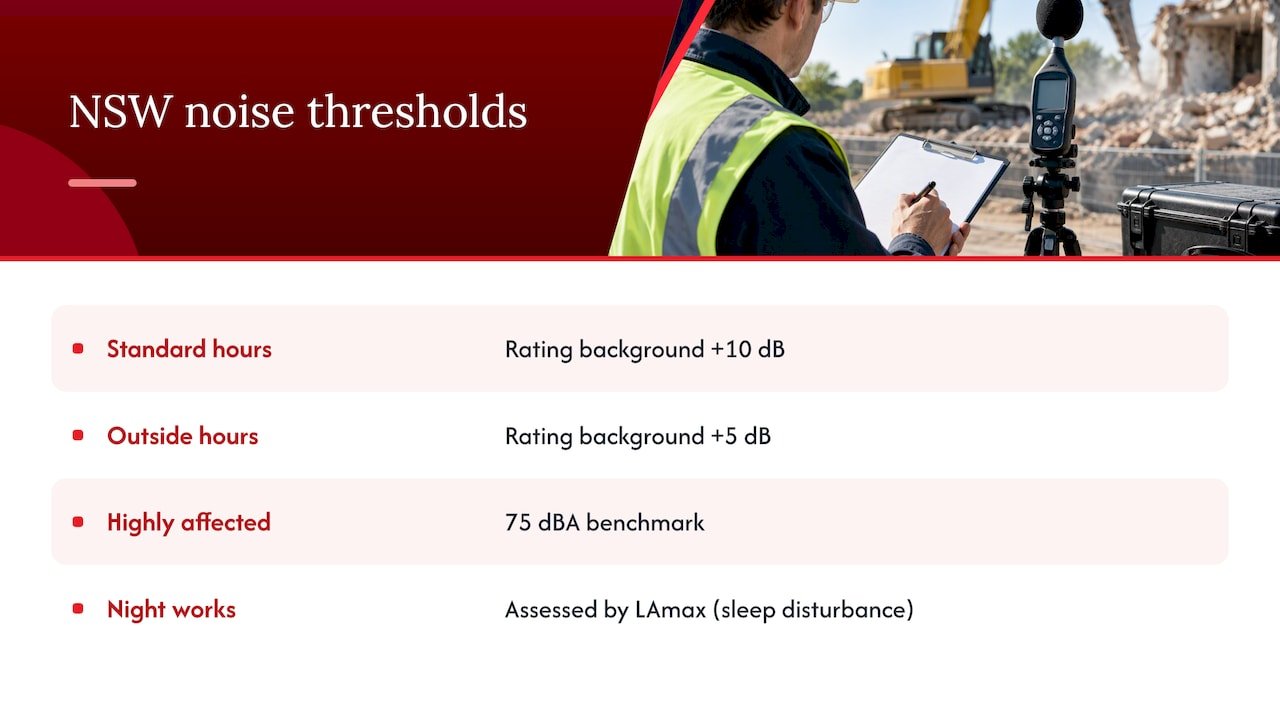
Project-specific noise management levels start with the rating background level, a measure of the ambient noise at a site before work begins. Under the ICNG, the standard-hours noise management level is set at the rating background level plus 10 decibels, while work proposed outside standard hours is held to a tighter rating background level plus 5 decibels.
A separate benchmark applies at 75 dBA, described in the guideline as the point where residents are considered “highly affected” by construction noise. Where night works are proposed, councils and the EPA also weigh sleep-disturbance effects, using maximum noise level (LAmax) readings rather than relying only on average levels, because a single loud bang can wake someone even if the average noise stays low.
None of these figures are blanket legal ceilings. If your predicted or measured levels exceed the noise management levels, the expected response is to document feasible and reasonable mitigation, such as swapping a rock breaker for a saw or hydraulic crusher, staging noisy tasks, or adding respite breaks, and present that evidence to your consent authority rather than simply pushing ahead.
When you need a management plan and how out-of-hours permits get decided
Several triggers commonly require a Construction Management Plan or Noise and Vibration Management Plan before work starts:
- Basement excavation or deep footings near neighbouring buildings.
- External works above a council-set value threshold.
- Demolition close to the street alignment or boundary.
- Multi-storey demolition or any site with sustained high-noise plant use.
A Noise and Vibration Management Plan typically needs predicted noise and vibration levels, a list of plant and their emission ratings, specific mitigation measures, a respite schedule for extended works, and contact details for site signage, as outlined in North Sydney’s construction management provisions.
Councils weigh several factors when deciding out-of-hours permit applications: the urgency or nature of the work, how sensitive nearby residents are, safety or traffic requirements that force unusual timing, whether another permit has already been issued for the same street, and the strength of the mitigation evidence you provide.
Who enforces the rules and what a noise abatement direction means
Enforcement splits across three bodies. Councils handle most non-licensed construction and demolition noise complaints. The EPA regulates licensed activities and can attach or vary noise conditions on an environment protection licence. Authorised council officers and NSW Police can issue directions under the Protection of the Environment Operations Act, including a section 276 noise abatement direction ordering work to stop or be modified immediately.
Breaching a direction or a licence condition can lead to penalty notices or prosecution, though genuine emergency works and some exempted activities carry limited protection. If you receive a direction, stop or adjust the offending activity straight away, record your noise readings and mitigation steps, and contact the regulator and affected neighbours to explain your response.
A practical mitigation checklist for demolition sites
Reducing noise at the source is usually the most effective lever available on a demolition job. Favour saws or hydraulic jaw crushers over rock breakers wherever the material allows, keep plant well maintained, and use newer or acoustically treated equipment where it is available for hire.
Operational habits make a measurable difference too:
- Break noisy tasks into shorter blocks with planned respite periods rather than running continuously.
- Sequence works so multiple high-noise activities don’t overlap.
- Manage truck movements and reversing alarms, and use acoustic screens or hoarding around the boundary.
- Keep written monitoring records so you can demonstrate compliance if questioned.
Community liaison closes the loop: targeted notifications before noisy stages, a direct phone call to particularly sensitive neighbours, and clear site signage with a contact number all reduce the chance of a complaint escalating.
Pro Tip: Offer a short respite window, even 15 minutes mid-morning, on sites running continuous high-noise plant; it costs little and significantly cuts complaint volume from adjoining properties.
How experienced contractors put the rules into practice
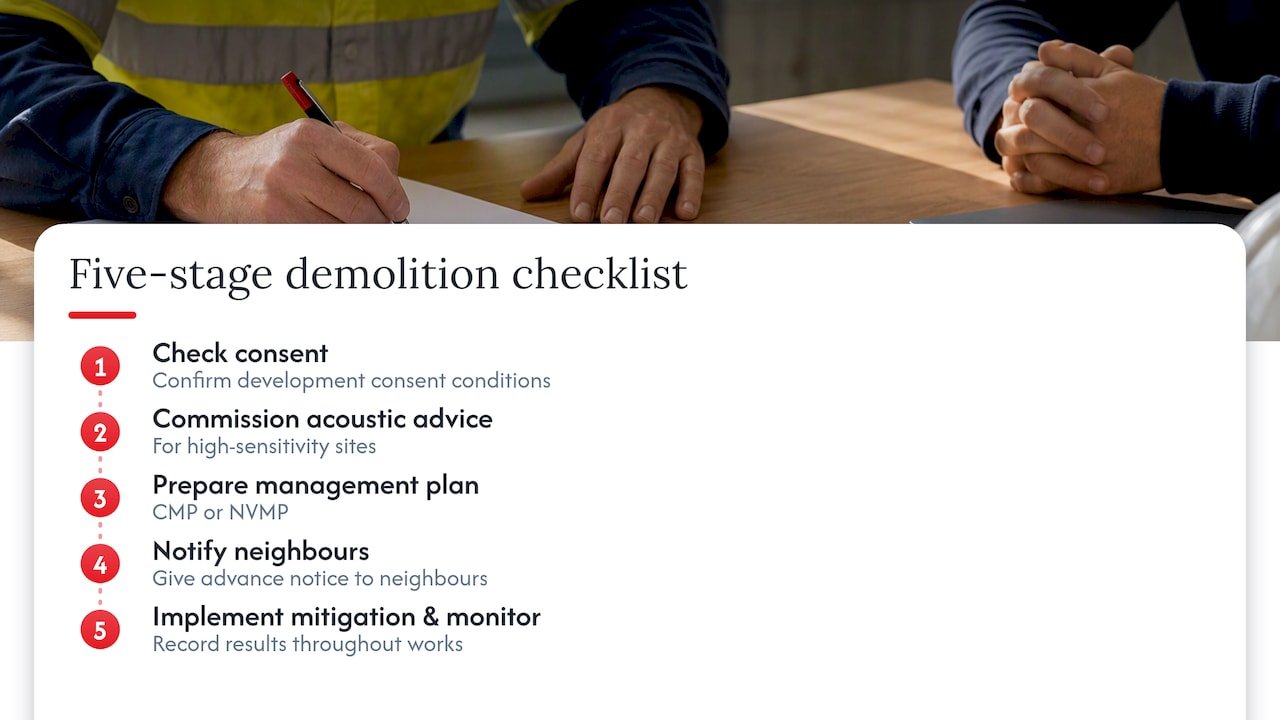
A well-run demolition follows a clear sequence: check the development consent, commission acoustic advice where sensitivity is high, prepare the Construction Management Plan or Noise and Vibration Management Plan, notify neighbours, implement the agreed mitigation, then monitor and record results throughout.
We specialise in demolition and licensed asbestos removal across a range of sites, and we provide permit and signage guidance based on extensive experience from many completed projects. Engaging a licensed contractor early means the documentation needed for council approval is ready before works are scheduled, not assembled after a complaint arrives.
Where NSW noise policy is heading next
Noise regulation in NSW is shifting toward documented, risk-based mitigation rather than a single pass-or-fail number. The draft modernisation of the ICNG and the detailed modelling expected under Transport for NSW’s construction noise and vibration guideline both point the same way: more evidence, earlier.
For project teams, the practical lesson is to commission acoustic input before locking in a schedule, not after a neighbour calls council. Complex demolition sites should expect councils to demand more detailed Noise and Vibration Management Plan evidence than they did a few years ago.
— Tarek
Compliant demolition and noise management support from Mission Demolition
Planning a demolition that needs council sign-off, a Noise and Vibration Management Plan, or licensed asbestos removal alongside the structural work takes coordination most property owners haven’t had to manage before. We handle that coordination directly, from site assessment through to the mitigation measures and documentation your consent requires.
Our demolition services cover residential, commercial and industrial projects across Sydney, and our licensed asbestos removal team manages hazardous material safely where it turns up during strip-out or demolition. Get in touch for a site assessment before you lock in a schedule.
FAQ
What time can builders start making noise in NSW?
Standard ICNG hours allow noisy construction within typical daytime periods on weekdays and Saturdays, but your council’s Development Control Plan can set different hours. City of Sydney, for example, permits work in the city centre during extended daytime hours on weekdays. Always check your development consent first, since it typically overrides the general guidance.
Can the NSW Police issue a noise abatement order?
Yes, authorised council officers and NSW Police can issue a direction under section 276 of the Protection of the Environment Operations Act ordering demolition noise to stop or be reduced immediately. Ignoring the direction can lead to penalty notices or prosecution, so works should be modified or paused straight away.
What are the EPA noise guidelines for NSW?
The Interim Construction Noise Guideline is the EPA’s core document, setting recommended hours and noise management levels for construction, demolition and remediation work. These are management benchmarks rather than hard legal limits, and the EPA applies them when setting conditions on environment protection licences.
What are the noise rules for strata housing in NSW?
There’s no single statewide demolition noise timetable for strata schemes; owners corporations manage disputes through by-laws, with escalation to mediation or NCAT when needed, as outlined in NSW Government strata guidance. Strata approvals for related works, such as solar installation, follow a similar by-law process, explained in this strata approval guide.
Sources
- Construction noise — NSW EPA
- Construction site noise – City of Sydney
- Construction noise and vibration guideline for road and maritime works — Transport for NSW
- NSDCP 2013 – Part B – Section 11 – Construction Management
