Last Updated: November 2, 2026
Quick Summary
You verify legal asbestos waste disposal in Sydney by checking three links: the contractor’s SafeWork NSW licence, compliant packaging, and a receiving facility authorised to accept asbestos. Keep the disposal receipt showing the facility name, date and quantity as proof.
- Ask for the contractor’s licence number in writing and search it on the SafeWork NSW register.
- Non-friable asbestos must be wrapped in plastic sheeting at least 200 microns thick and sealed.
- Call the facility directly and re-confirm acceptance on the morning of disposal.
- A disposal receipt should show the facility name, EPA licence reference, date and quantity.
- Treat a price well below every other quote as a red flag.
Table of Contents
- What Legal Asbestos Waste Disposal in Sydney Actually Requires
- Asbestos Waste Packaging Requirements Before Anything Leaves the Site
- How to Check an Asbestos Removal Contractor Licence in NSW
- NSW Facilities That Accept Household Asbestos: How to Confirm Yours
- The Asbestos Waste Disposal Receipt and Documents to Keep
- Red Flags for Unlawful or Unreliable Disposal Services
- What to Do If Disposal Can’t Be Verified or Waste Was Dumped
- Get a Free Demolition and Asbestos Removal Quote
- Frequently Asked Questions
What Legal Asbestos Waste Disposal in Sydney Actually Requires
Legal asbestos waste disposal in Sydney means three things line up: a licensed removal process, compliant packaging, and a receiving site authorised to take asbestos. Miss any one and the waste is unlawful, even if it never leaves the property.
At Mission Demolition, we hold Asbestos Licence AD213684 and Demolition Licence AD213693. The core principle is duty of care: whoever generates the waste stays responsible for it until an authorised facility accepts it.
Below, we show you exactly how to check each link: the contractor, the packaging, the destination, and the paperwork.
Asbestos Waste Packaging Requirements Before Anything Leaves the Site
Packaging is where most DIY removals fall apart. The rules exist to stop fibre release during handling and transport.
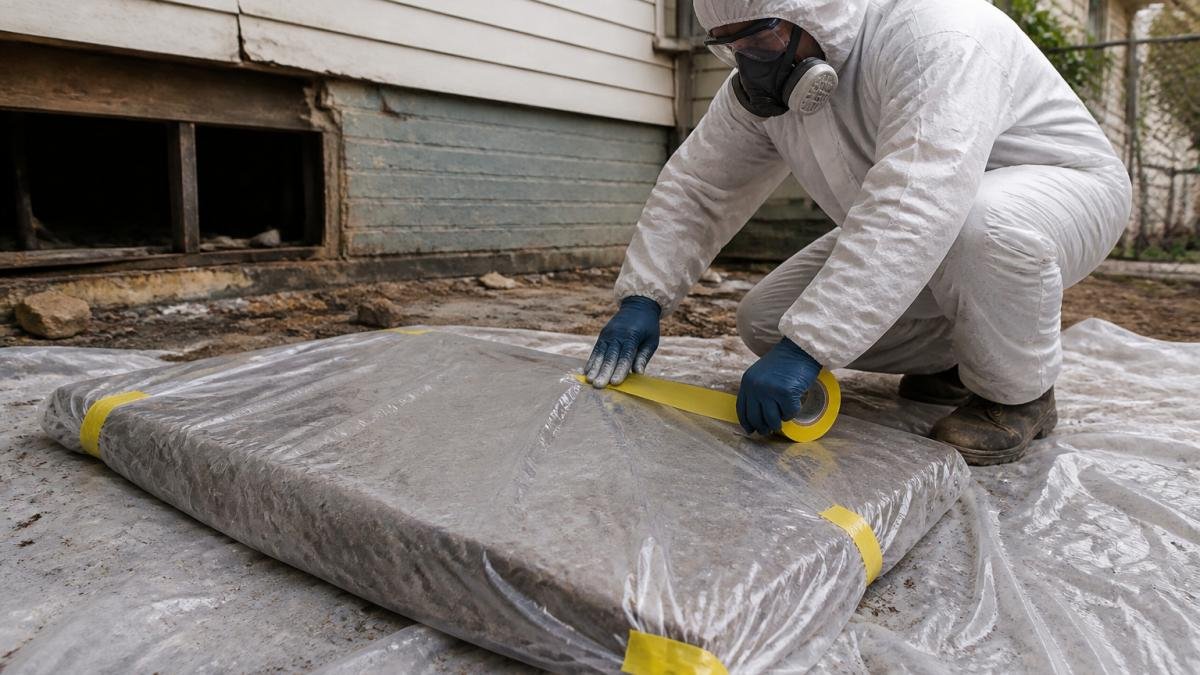
Non-friable asbestos, such as flat or corrugated sheeting, must be:
- Wrapped in heavy-duty plastic sheeting, at least 200 microns thick
- Sealed with tape along every edge and join
- Labelled clearly as asbestos waste
Friable asbestos, which crumbles under hand pressure, needs double-bagging in asbestos-rated bags and should only be handled by licensed contractors.
Watch out: torn wrapping on a trailer tray is a common cause of breaches. Fibres can escape, and the load may become unlawful.
How to Check an Asbestos Removal Contractor Licence in NSW
Every asbestos removal contractor in NSW must hold a licence from SafeWork NSW. You can check it yourself in minutes, and you should, every time.
Here is the verification checklist we suggest:
- Ask for the licence number in writing
- Search the number on the SafeWork NSW licence register
- Confirm the licence class matches the job: friable work needs a different licence to bonded work
The SafeWork NSW licensing guidance sets out the classes and what each one covers. A contractor who hesitates on any of these questions is a contractor to walk away from.
Here is the verification checklist we suggest for confirming a contractor’s licence before work begins.
| Check | What to confirm |
|---|---|
| Licence number | Ask for it in writing |
| SafeWork NSW register | Search the number on the register |
| Licence class | Friable work needs a different licence to bonded work |
| Licence status | Current, not expired or suspended |
| Business name | Matches the name on the quote |
| Insurance | Ask for a certificate of currency |
NSW Facilities That Accept Household Asbestos: How to Confirm Yours
Not every landfill takes asbestos, and the ones that do usually require booking, impose quantity limits and change their acceptance conditions without notice. The gap most guides leave is the how: a repeatable workflow that confirms a destination is authorised and still accepting on the day you travel. Use the four-stage check below.
Stage 1, Confirm the facility is authorised to receive asbestos
Start with the regulator, not the phone book. The NSW Environment Protection Authority’s waste guidance sets out how waste is classified and which facilities can lawfully receive it. Cross-check any site you are considering against the EPA’s published information and the facility’s own environment protection licence. A site that cannot point you to its EPA licence, or that appears only on a directory with no licence reference, is not a confirmed destination.
Stage 2, Call the facility and ask a fixed set of questions
Ring the weighbridge or waste office directly, not a general council switchboard, and work through the same list every time:
- Do you accept asbestos waste today? Ask specifically about the day you plan to travel, not ‘generally’.
- What class? Confirm whether the site takes bonded (non-friable) only, or also friable. Many household-facing sites take bonded sheeting but not friable material.
- What is the maximum quantity per load or per household? Some sites cap domestic loads; ask whether the cap is per visit, per day or per property.
- Is a booking required? Most authorised sites require notice, and some require a booking reference before the gate will accept the load.
- What packaging and labelling do you require on arrival? Confirm wrap thickness, labelling wording and whether the load must be on a pallet or in a sealed bin.
- What paperwork must accompany the load? Ask whether they need a completed waste form, proof of the generator’s identity, or a tracking document.
- What are your acceptance hours for asbestos? Asbestos is often accepted only in defined windows, not all opening hours.
- What is the current gate fee, and how is it calculated? Ask whether it is per tonne, per load or per cubic metre, and whether there is a minimum charge.
Record the name of the person you spoke to, the date and time, and the answers. That record is itself part of your verification trail.
Stage 3, Re-confirm on the morning of disposal
Acceptance conditions change. A site that took asbestos last month may have closed its asbestos cell, changed its booking system or hit a daily limit. Ring again on the morning you intend to travel and ask two questions: ‘Are you still accepting asbestos today?’ and ‘Is my booking reference still valid?’ If the answer to either is no, do not load the trailer.
Turning up at a gate with an unbooked or non-compliant asbestos load is not a minor inconvenience. The load can be refused, and you remain responsible for it under duty of care until an authorised facility accepts it. A refused load is still your waste.
Stage 4, Have a fallback before you leave
Identify a second authorised facility before the first load goes on the trailer. If your primary site refuses the load, you need a lawful destination you have already confirmed, not a phone search at the gate. Confirm the fallback’s booking requirements and acceptance hours in the same call.
What to do if no facility will confirm
If you cannot get a facility to confirm acceptance, do not transport the material. Options are to hold it securely on site in compliant packaging while you resolve the destination, or to engage a licensed removal contractor who already holds accounts and bookings with authorised facilities. The SafeWork NSW licensing guidance explains the licence classes a contractor must hold to handle and transport the material lawfully.
The Asbestos Waste Disposal Receipt and Documents to Keep
Paperwork is your proof. If a regulator, insurer or buyer ever asks where the asbestos went, a receipt is the only thing that answers the question, but only if it contains enough detail to be checked. The gap most guides leave is what each document should actually contain and how the documents chain together. Use the evidence trail below.
The evidence trail, document by document
**1.
Get a Free Demolition And Asbestos Removal Quote →
**2.
**3.
4. Transport record. Note the date of transport, the vehicle or carrier, and the driver or company responsible.
5. Disposal receipt or weighbridge docket. This is the core document. It should show:
- The name and address of the receiving facility
- The facility’s EPA licence reference, where shown
- The date and time of acceptance
If any of these fields is missing, ask the facility or contractor for a corrected document.
6. Clearance certificate and post-removal inspection record. For licensed removal work, keep the clearance certificate and any air monitoring or inspection records issued at completion.
**7. Our guide to tracking asbestos waste and the legal thresholds walks through the process step by step.
How the documents chain together
The evidence trail works as a chain: the licence check proves the contractor was authorised, the quote and photographs prove the material was handled and packaged compliantly, the transport record proves how it moved, and the disposal receipt proves an authorised facility accepted it. A gap anywhere in the chain weakens the whole. If you cannot produce the disposal receipt, the earlier documents prove handling but not destination.
Before you pay the final invoice, ask for the disposal receipt and check it against the list above. If the contractor cannot produce a receipt that names the facility, the date and the quantity, withhold final payment until they do.
How long to keep the records
There is no single retention period that covers every job, because the requirement depends on the project type, the waste volume and your insurer’s terms. A practical approach is to keep the full evidence trail for at least the period your project insurer or regulator requires, and to keep the disposal receipt and licence check indefinitely. They cost nothing to store digitally and everything to lose.
Red Flags for Unlawful or Unreliable Disposal Services
Illegal dumping is a real problem, and the warning signs are usually visible before you hand over money.
Here is what to watch for:
- No licence number offered upfront
- A price well below every other quote, with no explanation
- Vague answers about where waste goes, or “we have a guy”
The EPA’s illegal dumping reporting guidance explains how to report suspicious activity. If a disposal service cannot name the facility it uses, treat that as a no. Our Australian demolition checklist covers approvals, asbestos testing, contractor documents and lawful waste disposal step by step.
What to Do If Disposal Can’t Be Verified or Waste Was Dumped
Act quickly. Delays make everything harder.
First, secure the site and stop any further disturbance. Then:
- Contact the EPA Environment Line to report the dumping
- Notify your local council
- Photograph everything: the waste, the location, any vehicle details
- Gather whatever paperwork you hold on the contractor
- Engage a licensed contractor to assess and lawfully remove the material
Do not move dumped asbestos yourself. Owners and property managers can follow these first-hour asbestos response steps, including who to call, how to contain fibres and the regulator notifications and paperwork to follow. Disturbing it can spread fibres and create a bigger problem.
Get a Free Demolition and Asbestos Removal Quote
Getting disposal right starts with getting the removal right. A licensed contractor handles packaging, transport, the receiving facility and the receipts, so you are never left holding an unverifiable load.
At Mission Demolition, we are fully licensed and insured, and we work to strict health and safety compliance. Learn more about our bonded asbestos removal in Sydney, including safety procedures, regulations and what to expect.
Frequently Asked Questions
How can I check whether a facility is authorised to accept asbestos waste?
Ask the facility directly whether it holds an environment protection licence that permits asbestos waste, and request the licence number. Then confirm that number against the public register maintained by the state environment regulator, and check the licence conditions for the specific waste types accepted. Ring the site again on the day of travel to confirm it is still accepting asbestos and that your load matches what it takes.
What paperwork should I get when asbestos waste is collected?
Ask for a disposal receipt or weighbridge docket that names the receiving facility, the date, the waste type and the quantity, plus a copy of the contractor’s asbestos removal licence. For licensed removal work, keep the clearance certificate and post-removal inspection record too. Store these with your project files: they are your proof of lawful asbestos waste disposal if a question arises later about where the material went.
Can household asbestos waste be taken to any landfill?
No. Only facilities that are authorised to receive asbestos waste will accept it, and many transfer stations refuse it outright. Rules also differ by load size and by whether the material is friable or non-friable, so check with the specific site before you load a trailer. Some councils run limited household drop-off arrangements, but acceptance conditions change, so confirm by phone on the day rather than relying on an old web page.
What should I do if I suspect asbestos waste has been dumped illegally?
Do not disturb the material or attempt to move it yourself. Keep people and pets away, note the location and any details you can see, and report it to the state environment regulator’s environment line and your local council. If you hired a contractor and cannot obtain a disposal receipt showing where the waste went, raise it with the regulator as well. Document everything in writing, including dates and who you spoke to, because follow-up depends on that record.
If you are planning a renovation or demolition and want the asbestos handled and documented properly, get a free quote from Mission Demolition and start your project with a clean, compliant site.