
Before any machine arrives, confirm what approvals your property needs, arrange asbestos testing and book a licensed contractor who can supply a safe work method statement and lawful waste disposal receipts. Preparation typically runs 6 to 16 weeks depending on council processes and what turns up in the hazardous materials survey, while the actual demolition of a standard house often takes only a few days. Get these checks done early and the rest of the project runs far more smoothly.
TL;DR:
- Soliciting early asbestos testing, approvals, and waste disposal receipts is crucial to prevent delays in the project schedule.
- Most approvals and asbestos surveys can run concurrently, but asbestos removal and clearance certificates have strict timelines that must be met.
- Heritage restrictions, council slow turnaround, and slow response on permits often cause project delays, so address them early in the planning process.
- Asbestos testing and removal are the most significant factors influencing both project duration and costs, especially if asbestos is present in more than 10 square meters.
- Verify licensed contractors’ credentials, enforce clear contractual scope and timelines, and keep comprehensive documentation to avoid legal and safety issues.
Table of Contents
- Practical pre-demolition checklist with a realistic timeline
- Which approvals you may need for demolition
- Asbestos and other hazardous materials: testing, removal and clearance
- Choosing and managing a licensed demolition contractor
- Site preparation: utilities, access and temporary accommodation
- How demolition waste is managed lawfully in Australia
- Typical timeline and cost drivers for a house demolition
- Mission Demolition: proofs and documents worth requesting
- Notification requirements to neighbours and local authorities
- Pre-demolition property assessment and hazard identification
- Salvage and recycling of reusable materials before demolition
- Post-demolition site cleanup and restoration processes
- Insurance considerations for demolition damage or liability
- Common mistakes and the one habit that prevents most problems
- How Mission Demolition can help with your demolition project
- Sources
- FAQ
Practical pre-demolition checklist with a realistic timeline
Most delays happen because homeowners treat demolition as a single event rather than a sequence of dependent tasks. Some steps run in parallel, others must happen in strict order, and knowing the difference saves weeks.
- Book a site survey and hazardous materials report, including an asbestos inspection, as your first move.
- Check whether the work is exempt, complying or needs a full Development Application through your council or the NSW Planning Portal.
- Get quotes from licensed demolition contractors once you know the approval pathway.
- Arrange licensed asbestos removal and an independent clearance certificate if the survey finds any.
- Book disconnection of gas, electricity, water and telecoms services.
- Confirm fencing, hoardings and exclusion zone requirements with your contractor and council.
- Schedule demolition day and confirm truck and skip access.
- Collect waste disposal receipts and any final clearance paperwork once work is complete.
Approvals and the asbestos survey can often run at the same time, but you cannot book licensed asbestos removal until the survey results are back, and you cannot demolish until any required clearance certificate is issued. Heritage overlays, tree removal permits and slow council turnaround are the most common causes of a stalled timeline, so raise these questions with your council in the first week rather than the last.
Which approvals you may need for demolition
Whether your demolition needs a Development Application, a Complying Development Certificate or qualifies as exempt development depends on your site’s planning controls, zoning and heritage status. The NSW Planning Portal’s knockdown-rebuild guidance sets out these pathways and confirms that all demolition work must follow Australian Standard AS 2601-2001, The Demolition of Structures, regardless of which approval applies. Our own guide to demolition permits in Sydney breaks down the DA versus CDC comparison in more detail if your site sits in a grey area.
Before you apply, gather the paperwork councils typically ask for:
- A current site or survey plan showing boundaries, structures and access points.
- A statement of environmental effects addressing noise, dust and traffic impacts.
- A demolition plan and a waste management plan showing where materials will end up.
- Written owner consent if you are not the sole titleholder.
- Your contractor’s licence number and current insurance details.
Councils often require a bond to protect footpaths, kerbs and street trees, and some will withhold release of that bond until they see photographic evidence the asset was undamaged. Heritage overlays add another layer: even a partial demolition on a heritage-listed property can trigger a full DA rather than a faster complying development pathway, and any significant tree on or near the site may need a separate removal permit before machinery can get close to it.
Asbestos and other hazardous materials: testing, removal and clearance
Assume any part of a home built before 1988 may contain asbestos until a licensed assessor proves otherwise. This single assumption drives almost every other decision in your preparation timeline, because the removal method, the notification period and the disposal pathway all depend on what the assessor finds.
- Book a licensed asbestos assessor to produce a written asbestos register before any works begin.
- Removing more than 10 square metres of bonded, non-friable asbestos requires a licensed removalist, and any friable asbestos always requires a licensed contractor regardless of area.
- You must notify SafeWork NSW at least 5 calendar days before licensed demolition or asbestos removal begins, or 21 days if explosives are involved.
- An independent licensed assessor must issue a clearance certificate before the site can be reoccupied or works can progress, and this certificate should be kept alongside your disposal receipts.
You must give SafeWork NSW at least 5 calendar days’ notice before licensed demolition or asbestos removal starts. Missing this window is one of the easiest ways to have a project stopped on the day it is meant to begin.
Contaminated mulch and soil deserve their own attention. If asbestos fragments turn up in garden mulch or soil, the EPA NSW contaminated mulch protocol applies: material under 10 square metres may not need a Class B licensed removalist, but it still must go to a licensed landfill and be cleared by an independent assessor before the area is reoccupied. If your contractor uncovers anything unexpected once work has started, the same principle applies: stop work in that area, engage a licensed assessor and follow the unexpected finds procedure rather than pushing ahead. Our detailed guide to NSW asbestos removal regulations covers the thresholds and paperwork in more depth.
Choosing and managing a licensed demolition contractor
The contractor you choose is the single biggest factor in whether your project stays on budget and on the right side of the law. Ask for licence numbers before you sign anything, and check them rather than taking a business card at face value.
- Verify the contractor’s demolition licence, asbestos licence where relevant, public liability cover and workers compensation insurance.
- Ask for a site inspection, a written SWMS, a demolition plan and an asbestos register specific to your property.
- Request the intended waste disposal method and proof of the destination landfill before works begin.
- Watch for red flags: vague scopes of work, reluctance to provide disposal receipts, or a quote well below others for the same job.
- Make sure the contract states start and finish dates, a contingency allowance and who is responsible for neighbour notification.
Pro Tip: Keep a running folder of every document your contractor gives you, licence copies, the SWMS, the asbestos register and disposal receipts, and chase up anything missing before the final invoice is paid.
Our guide to choosing a licensed demolition company walks through the exact questions to ask if you want a script for that first phone call.
Site preparation: utilities, access and temporary accommodation
Machinery cannot safely start until the site itself is ready, and this is where a surprising number of projects lose a week or two.
- Arrange licensed disconnection of gas, electricity and water, and confirm telecoms disconnection timing with your provider.
- Use the Before You Dig Australia service to check the location of underground services before any excavation.
- Install temporary fencing, exclusion zones and signage, and secure council approval for any hoarding that affects public footpaths.
- Confirm truck and skip access to the site, remove valuables and personal items from the property.
- Arrange temporary accommodation if the demolition and any related works mean the property is not liveable during the process.
Skipping the underground services check is a common and expensive mistake: a severed line can halt work for days while it is repaired and reinspected.
How demolition waste is managed lawfully in Australia
Most of what comes out of a house can be recycled or reused rather than sent to landfill. Timber, bricks and metal are routinely salvaged or crushed for reuse, while anything containing asbestos or contaminated material must go through licensed disposal channels.
- Timber, brick and metal are commonly separated on site for recycling rather than mixed into general waste.
- Asbestos and contaminated mulch must be disposed of at a licensed landfill, never in general skips or kerbside collection.
- As the property owner, you carry responsibility for lawful disposal, so keep every landfill receipt and chain of custody document your contractor provides.
- Selective deconstruction, removing fittings, timber and fixtures before the main demolition, can lower disposal costs and should be written into the waste management plan from the start.
Research into household and professional asbestos handling found that disposal obligations are often overlooked, which leads to under-budgeting and, in some cases, unlawful dumping. Treat disposal as a line item in every quote, not an afterthought.
Typical timeline and cost drivers for a house demolition
A straightforward single-storey house demolition without heritage constraints or asbestos issues often takes just days once approvals are in hand, but the approval and testing phase before that can run 6 to 16 weeks.
- Asbestos testing and licensed removal are usually the biggest swing factor in both time and cost.
- Waste disposal fees, particularly for asbestos landfill, add up quickly and should be quoted as a specific line item.
- Difficult site access, heritage conditions or council bonds can extend both the timeline and the budget.
- Build in a contingency allowance when comparing quotes, and make sure every quote covers the same scope, including disposal and clearance certificates, before you compare prices side by side.
Mission Demolition: proofs and documents worth requesting
A reputable demolition company specialises in safe, efficient, and affordable demolition and asbestos removal services, combining modern technology with hands-on experience across many projects. Whichever contractor you choose, insist on an asbestos clearance certificate, licence copies, the SWMS, waste disposal receipts and any council bonds or permits before final payment.
Notification requirements to neighbours and local authorities
Councils commonly require written notice to neighbours before demolition begins, and the notice period varies by location. Planning Portal guidance points to an example of around seven days’ notice in metro areas and two days in rural areas, with properties within roughly 20 metres often needing direct notification. Check your own council’s requirements rather than assuming a standard figure applies everywhere, since conditions attached to your DA or CDC may set a different period.
Beyond the legal minimum, a short conversation with neighbours before work starts is worth the ten minutes it takes. Demolition is noisy and dusty, and neighbours who know the schedule in advance are far less likely to lodge a complaint with council mid-project. Your contractor should also notify SafeWork NSW and any relevant authority as part of the standard demolition notification process, and keeping a copy of that notification alongside your other paperwork means you can prove compliance if a dispute arises later.
Pre-demolition property assessment and hazard identification
A thorough pre-demolition assessment covers more than asbestos. Structural instability, particularly in older homes that have been altered without proper approval, can make certain demolition methods unsafe until the building is assessed by a suitably qualified person. Environmental risks such as underground fuel tanks, contaminated soil from old sheds or garages, and proximity to waterways can all change how a demolition must be planned and managed.
This is also where the Model Code of Practice for Demolition Work becomes relevant. Demolition is treated as construction work under WHS regulations, and high-risk demolition, including work on structures six metres or taller, triggers specific notification and SWMS requirements. A competent contractor will fold this assessment into their site inspection rather than treating it as a separate step, but you are entitled to ask what hazards they have identified and how they plan to manage each one before work starts.
Salvage and recycling of reusable materials before demolition
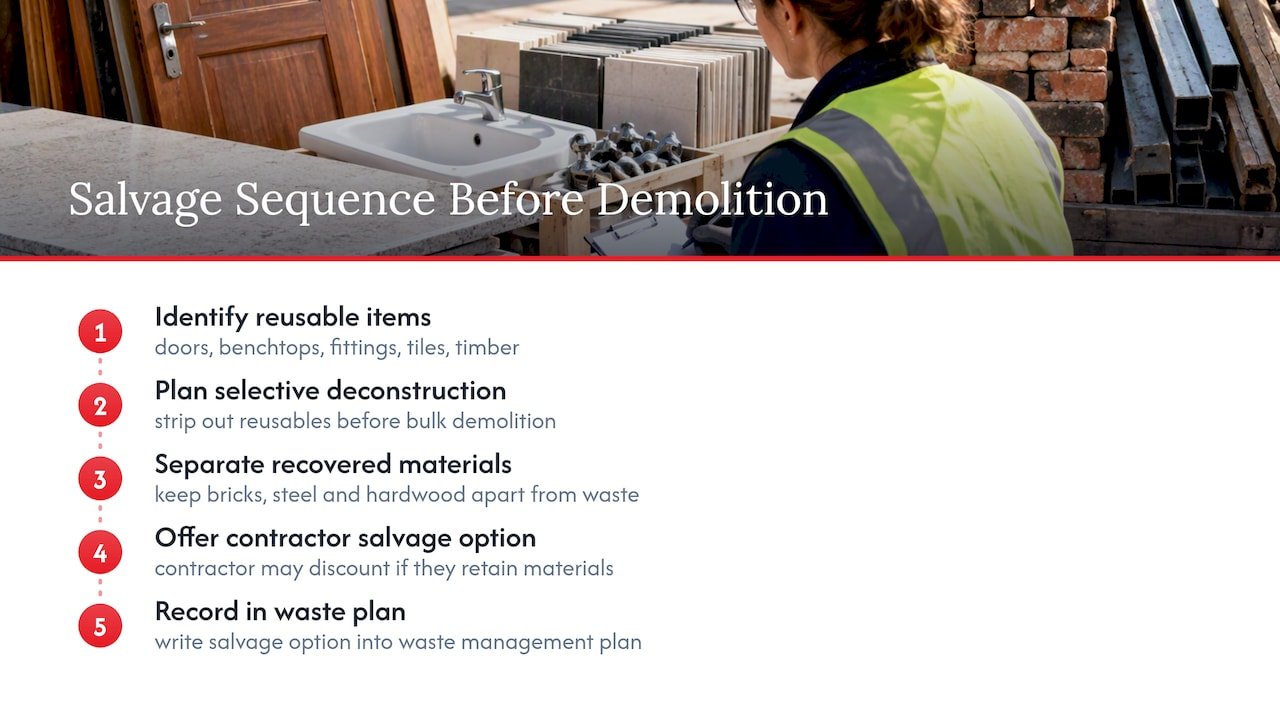
Before the main demolition begins, it is worth walking through the property and identifying anything worth keeping. Kitchen benchtops, doors, light fittings, roof tiles and structural timber are commonly salvaged by homeowners, builders or specialist reclaimers rather than sent to landfill.
Selective deconstruction, stripping out reusable materials before the bulk demolition, takes more time on site but can reduce both landfill costs and the overall environmental footprint of the project. Bricks, structural steel and hardwood framing are among the most commonly recovered materials, and some contractors will offer a discount on their quote if they can retain and on-sell recovered material themselves. Raise this option early and have it written into your waste management plan, since retrofitting a salvage plan once demolition is underway rarely works as well as planning for it from the start.
Post-demolition site cleanup and restoration processes
Once the structure is down, the site still needs work before it is genuinely ready for the next stage, whether that is a rebuild or a sale. Final cleanup includes removing all debris, levelling the site, and filling any excavated areas such as old footings or a removed pool shell.
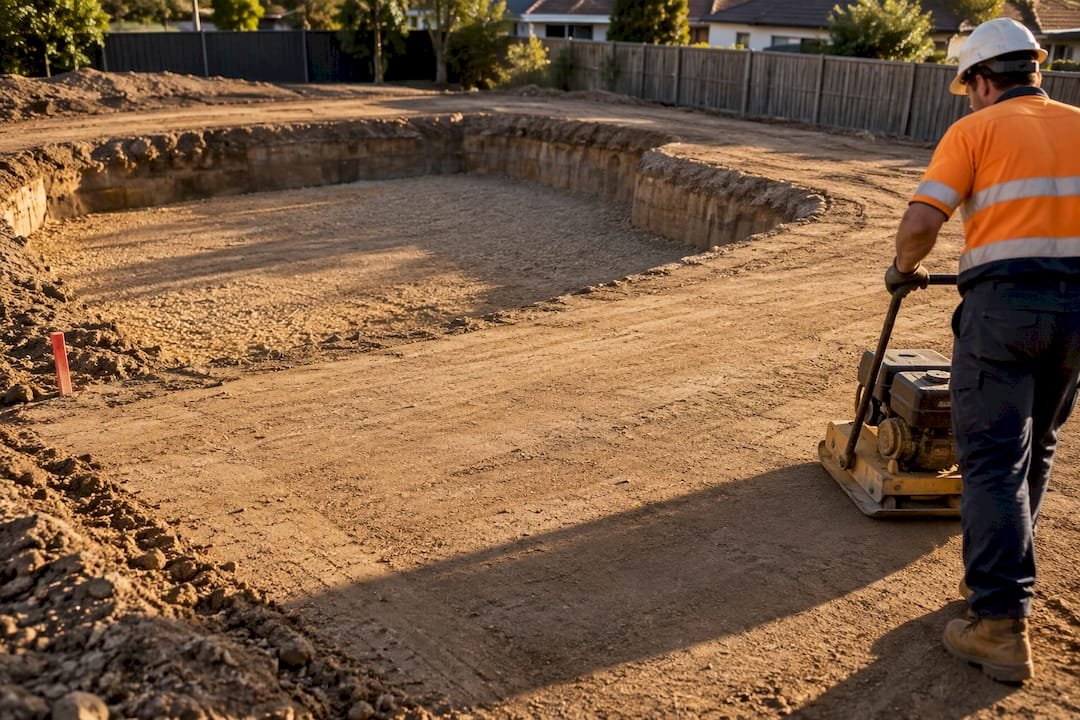
Your contractor should provide waste disposal receipts covering every load taken off site, and if asbestos was present, the independent clearance certificate should be issued before the site is considered safe to reoccupy or hand over to a builder. Restoration can also include reinstating footpaths, kerbs or nature strips damaged during the works, particularly where a council bond was held against that damage. Our guide to post-demolition land preparation covers what a build-ready site should look like if you are moving straight into construction.
Insurance considerations for demolition damage or liability
Demolition carries genuine risk to neighbouring properties, underground services and passers-by, so insurance is not an optional extra. Your contractor should carry public liability cover and workers compensation insurance as a baseline, and you should ask to see current certificates rather than taking their word for it.
Plant and equipment used on site, excavators, skid steers and demolition attachments, are usually covered under separate plant hire insurance arrangements, and it is reasonable to ask your contractor whether their hired or owned equipment is covered for damage and liability. As the homeowner, check your own home and contents policy too: some policies exclude damage that occurs during construction or demolition work, which can leave a gap unless you arrange separate cover for the works period.
Common mistakes and the one habit that prevents most problems
Most problems trace back to skipped licensed removal, unbudgeted disposal costs or a vague quote accepted too quickly. Insist on paperwork, clearance certificates and disposal receipts, and keep it.
— Tarek
How Mission Demolition can help with your demolition project
Some companies handle residential demolition, licensed asbestos removal, waste management and approvals assistance for homeowners across Sydney and Australia. 
If you are weighing up quotes, ask any contractor you are considering the same questions we have set out here: licence numbers, SWMS, asbestos register and proof of lawful disposal. Professional demolition contractors work to strict safety compliance and environmentally responsible disposal standards, and carry the licensing and insurance needed for asbestos removal work. If you would like a site inspection or a written quote for your project, visit the residential demolition page to get started.
Sources
- Demolition notifications | SafeWork NSW
- Asbestos removal procedure / guidance (BMCC)
- Demolition (Planning Portal NSW) — knockdown/rebuild phase
- Contaminated mulch management plan (EPA NSW)
- Model Code of Practice: Demolition work (Safe Work Australia)
FAQ
How do I prepare a house for demolition?
Start by booking a site survey and asbestos inspection, then confirm whether your property needs a Development Application, a Complying Development Certificate or qualifies as exempt development. Once approvals are sorted, engage a licensed contractor who can provide a SWMS, arrange utility disconnections and organise lawful waste disposal.
How much does it cost to demolish a house in Australia?
Mission Demolition does not publish set demolition prices, since cost depends on site access, asbestos findings and council conditions. You can request a tailored quote through the residential demolition page once a site inspection has assessed your specific property.
How long does it take to demolish a house?
Preparation, including approvals and any required asbestos testing and removal, commonly takes 6 to 16 weeks, while the physical demolition of a standard single-storey house is often completed within a few days. Complex sites with heritage overlays or significant asbestos can extend both stages.
What machinery is used to demolish a house?
Excavators fitted with demolition attachments, such as hydraulic breakers or shears, are the most common machinery for residential demolition, alongside skid steers for site clearance. The right equipment depends on the structure’s size, materials and site access, which is why a proper site inspection should happen before any machinery is booked.
