If your demolition in NSW goes through a complying development certificate (CDC), you must give written notice to neighbours within 20 metres before work starts. The notice period is at least 7 days in metropolitan areas and 2 days in rural, regional or residential release areas. Your certifier also has a separate notice to give before the CDC is issued. If the demolition goes through a development application (DA), your council’s conditions of consent set what happens instead.
This guide explains which notice applies to your pathway, what it should contain, how to count the days, and how to handle the neighbours’ real concerns: asbestos, dust, noise and vibration.
TL;DR
- Under a CDC, the person with the benefit of the certificate must notify each neighbour in writing before demolition starts. That is 7 days in metropolitan areas and 2 days elsewhere, for lots within 20 metres.
- In metropolitan areas the certifier also notifies neighbours 14 days before issuing the CDC. The CDC cannot be issued until that period ends.
- Neighbours can ask to see the plans, but you are not obliged to change the proposal because of their comments.
- Asbestos must be handled by a licensed contractor, and demolition hours under a CDC are 7 am to 5 pm Monday to Saturday.
- A short, friendly conversation before the formal notice usually prevents most complaints.
Table of Contents
- Which approval pathway you are on decides which notice applies
- The two notices under a CDC
- What the notice should contain
- Delivery and counting the days
- What the notice does and does not do
- Conditions that protect neighbours during a CDC demolition
- What a good notice letter covers
- If you are the neighbour
- Checking the requirements for your own site
- How Mission Demolition can help
- FAQ
- Sources
Which approval pathway you are on decides which notice applies
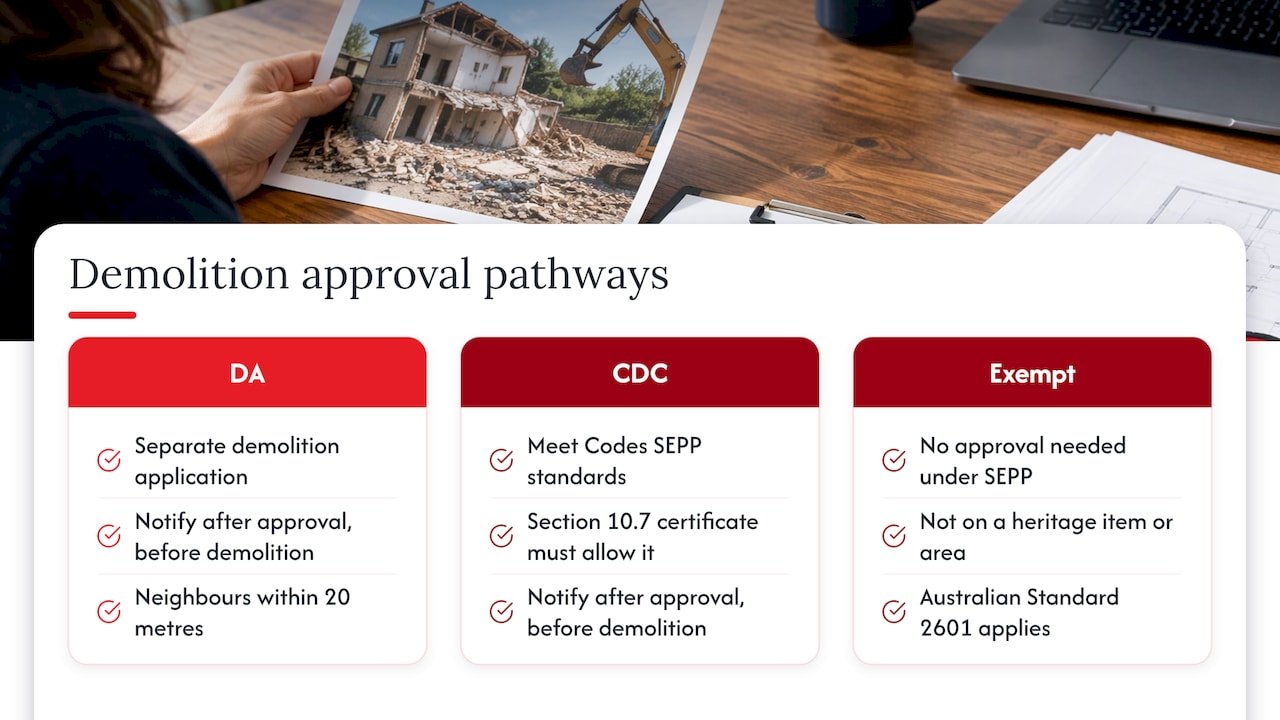
In NSW, a house or other building can generally be demolished in one of two ways. Your contractor can submit a separate development application for the demolition. Or you can demolish under a CDC if the work meets the standards in the Codes SEPP and your Section 10.7 certificate allows it. The NSW Planning Portal’s MyHome Planner describes both routes. It says that after a DA or CDC is approved, you must notify neighbours within 20 metres of the lot boundary in writing before demolition starts.
The Demolition Code lets a dwelling, an industrial building and development such as garages and swimming pools be demolished as complying development, provided they meet the Codes SEPP standards. The person with the benefit of the CDC must notify neighbours before beginning demolition work.
Some small jobs need no approval at all. A council such as Shoalhaven City Council explains that exempt development under the SEPP needs no approval, but not on or in a heritage item or heritage conservation area. Councils also note that all demolition must follow Australian Standard 2601, The Demolition of Structures.
Heritage is the usual trap. City of Ryde’s demolition information sheet states that properties with a listed heritage item, or subject to an interim heritage order, cannot use complying development. If that is you, read our guide to heritage demolition approval in NSW before you plan anything else.
For a broader view of the approvals, see our guides to demolition permits in Sydney and CDC demolition in NSW.
The two notices under a CDC
People often talk about “the neighbour notification” as if it were one letter. Under a CDC there are two distinct steps, and they are done by different people.
Notice 1: before the certificate is issued (pre-approval)
According to the Department’s page What to tell your neighbours, in metropolitan areas a certifier or council informs neighbours within a 20 metre radius that a CDC application has been lodged. This happens 14 days before the CDC can be approved. You do not write this one. Your certifier does.
The Department’s fact sheet on advice and notification to neighbours is specific. Certifiers must notify occupants of neighbouring houses within 20 metres at least 14 days before issuing a CDC for demolition. The CDC cannot be issued until after that 14-day period has finished.
This matters for your timeline. If you book a demolition crew for the week after you lodge, the notice period alone makes that impossible in metropolitan areas. Our NSW demolition approval timeline guide shows how the waiting periods stack up.
Notice 2: before work starts (pre-construction)
Once the CDC is issued, the applicant must notify neighbours within 20 metres of the boundary before any work commences. The same Department page sets the minimum at 7 days in metropolitan areas and 2 days in rural, regional or residential release areas.
The legislation says the same in its own words. Clause 148 of the Environmental Planning and Assessment Regulation 2021 requires the person benefiting from the certificate to give each neighbour written notice at least 7 days before work starts for development on relevant land, or at least 2 days otherwise. It applies where the development lot is within 20 metres of a lot with a dwelling on it.
| Notice 1 (pre-approval) | Notice 2 (pre-construction) | |
|---|---|---|
| Who gives it | Certifier or council | The person with the benefit of the CDC |
| When | 14 days before the CDC can be issued (metropolitan areas) | Before work starts: 7 days (metropolitan) or 2 days (rural, regional, release areas) |
| Who receives it | Occupants within 20 metres | Neighbours within 20 metres of the boundary |
| Form | Written | Written |
What the notice should contain
The Department’s fact sheet lists what the pre-approval notice must include:
- The address of the proposed development.
- A description of the work.
- The name and contact details of the certifier.
- Confirmation that the application was lodged under the Environmental Planning and Assessment Act 1979.
- The applicant’s name and contact details.
- The date the application was received.
- A statement that approved plans will be available to view at the local council.
For your own pre-construction notice, use the same list as a template. Then add what neighbours actually want to know: the start date, the expected duration, the working hours, who to call on site, and whether asbestos is being removed. A neighbour who has a phone number for the site supervisor is far less likely to call the council.
Delivery and counting the days
The notice must be in writing. The same fact sheet says it can be given in person, by letterbox drop or by post. The counting rules catch people out. If a notice is delivered in person on a Monday, the next day counts as day one, so the earliest a CDC could be issued after a 14-day notice is the Tuesday two weeks later. A posted notice is taken to be received on the next business day.
A worked example for the pre-construction notice in a metropolitan area:
- You letterbox drop on a Wednesday.
- Thursday is day one, so the 7th day is the following Wednesday.
- Safest practice is to plan work to start no earlier than the day after that, and to keep a dated copy of the notice and a list of the addresses you delivered to.
If you post the notices, add a business day first. Keep proof of posting. Your certifier can tell you how they count the days for their own notice.
What the notice does and does not do
A neighbour can ask to see the plans for a complying development, but the Department’s page says the applicant has no obligation to provide them. The fact sheet also says applicants are not required to change a proposal in response to neighbours’ comments. The certifier checks the proposal against the policy’s development standards.
So notification is a courtesy with a legal floor, not a veto. That is also why it pays to be generous. The Department itself encourages talking to neighbours early, even where formal notification is not required, so the project does not come as a surprise.
Conditions that protect neighbours during a CDC demolition
Most neighbour worries are about what happens on site. The conditions for a CDC demolition, set out in the Department’s fact sheet on demolition rules for exempt and complying development, answer many of them:
- Hours: demolition between 7 am and 5 pm Monday to Saturday, with no work on Sundays or public holidays.
- Waste: a waste management plan goes to the principal certifier at least 2 days before work begins.
- Run-off and erosion: controls must be in place before work begins and kept up during demolition.
- Adjoining walls: a dilapidation report is needed where a wall is within 900 mm of a boundary and an adjoining wall is also within 900 mm.
- Standard: work must comply with AS 2601-2001.
- Asbestos: must be safely handled and removed by a licensed contractor.
If you want the detail on hours and what can trigger a stop-work notice, see our guides to NSW demolition working hours and demolition noise rules in NSW.
Asbestos: the question every neighbour asks
If the building was built before the mid-1980s, neighbours will assume asbestos. SafeWork NSW’s Code of Practice for demolition work requires all asbestos likely to be disturbed to be identified and, so far as reasonably practicable, removed before demolition starts. Demolition that disturbs asbestos is high risk construction work needing a safe work method statement before it begins, and removal must be done by a licensed asbestos removalist.

Saying this plainly in your notice is reassuring. A line such as “asbestos was identified by an inspection and will be removed by a licensed removalist before demolition begins” answers the worry before it becomes a phone call. Our guide to removing asbestos before demolition walks through that sequence.
Vibration, structure and water
The same Code of Practice says no part of demolition should adversely affect the structural integrity of another building. Neighbouring buildings must not be affected by vibration or concussion, and special precautions may be needed near hospitals or buildings holding shock-sensitive equipment. Demolition must also not cause flooding or water penetration into an adjoining building. For semi-detached and terrace sites, our guide to planning safe demolition near neighbouring houses covers the methods that keep that risk low.
What a good notice letter covers
Beyond the legal minimum, a one-page letter usually settles most concerns. Include:
- The address, the start date and the expected duration.
- The working hours, matching the 7 am to 5 pm Monday to Saturday limit.
- A named contact and phone number, answered during site hours.
- How dust will be controlled and where trucks will park and load.
- Whether asbestos is present and who is removing it.
- When services will be disconnected, if it could affect the street. Our guide on proving service disconnection before demolition explains the paperwork.
- Where the site signage and the approval details can be seen. See our brief on NSW demolition site signage.
Deliver it by hand where you can, and knock. A two-minute chat with the neighbours on each side does more than any letter.
Our view: notify early, and over-deliver
We treat the legal notice as the minimum. On the jobs we plan, we want the neighbours to hear about the demolition from the owner or from us well before the 7 days run out, with a real start date, a named site contact and a straight answer on asbestos.
The complaints that stall projects rarely start with the demolition itself. They start with surprise: a machine arriving without warning, dust no one explained, a truck blocking a driveway. A clear letter and a phone number remove most of that.
We also think approvals, asbestos identification and notice should be run as one programme, not three separate tasks. Our service covers approvals, utility disconnections, hazardous waste handling and final site cleaning, so the notice describes a plan that is already in place.
Tarek
If you are the neighbour
If you have received a notice, you have a few practical options.
- Ask questions. Contact the applicant or the certifier named on the notice. You may request the plans, though the applicant does not have to provide them.
- Raise specific risks. If your wall is close to the boundary, ask whether a dilapidation report is being prepared, and ask about the asbestos plan.
- Know the hours. Under a CDC, demolition is permitted 7 am to 5 pm Monday to Saturday only.
- Try talking first on noise. The NSW EPA’s guidance on neighbourhood noise suggests a friendly conversation first. If that fails, you can complain to your local council, the police, or the Community Justice Centre for free mediation. Councils can serve prevention notices or noise control notices under the Protection of the Environment Operations Act 1997.
- Know the formal options. Campbelltown City Council notes that a person affected by offensive noise can apply to the Local Court for a noise abatement order under section 268 of that Act. Where there is a breach of the planning Act, Hawkesbury City Council explains that any person, including a neighbour, can seek orders in the Land and Environment Court under section 9.45.
If there is an immediate safety risk, such as a damaged structure after a storm or fire, the process differs. Our page on emergency demolition safety in NSW explains who to call first.
Checking the requirements for your own site
Rules differ by site, so confirm yours before you write a single notice:
- Your Section 10.7 certificate from the council shows whether the land is affected by heritage or other controls that rule out a CDC.
- Your council’s demolition page. Councils such as City of Newcastle explain which demolition is exempt development and which is complying development, and note that a CDC can be lodged with either the council or an accredited certifier.
- Your certifier or council approval documents. They list the conditions you must follow.
- The NSW Planning Portal. The MyHome Planner page lists the documents needed before approval, including the Section 10.7 certificate, site and survey plan and waste management plan. For buildings over 6 metres, it also lists the demolition contractor’s licence and insurance details.
An approval under a DA carries its own conditions of consent. Read them, because they may set notice or hours conditions that differ from a CDC.
How Mission Demolition can help
We plan and carry out demolition and asbestos removal for homeowners, builders and developers in Sydney and across Australia. That includes residential demolition, licensed asbestos work, and full project management covering approvals, utility disconnections, hazardous waste handling and final site cleaning. We can help you put the paperwork and the neighbour notice in the right order.
If asbestos is a concern on your site, start with asbestos inspection and testing, so your notice can say exactly what has been found and how it will be removed. To talk through a project, contact Mission Demolition.
FAQ
Do I have to notify neighbours before demolition in NSW?
Under a CDC, yes. You must give written notice to neighbours within 20 metres before work starts, at least 7 days ahead in metropolitan areas and 2 days in rural, regional or residential release areas. If you use a DA, check your conditions of consent for any notification requirement.
Who sends the neighbour notice, me or the certifier?
Both have a part under a CDC. The certifier sends the pre-approval notice at least 14 days before issuing the CDC in metropolitan areas. You, as the person with the benefit of the certificate, send the pre-construction notice before work begins.
Can a neighbour stop my demolition?
Not by objecting to the notice. You are not required to change a proposal in response to comments, and the certifier checks compliance with the development standards. A neighbour can still complain about noise or hours, or take action over a breach in the Land and Environment Court.
Does the notice have to be in writing?
Yes. The Department’s fact sheet says it can be handed over in person, delivered by letterbox drop or sent by post. Keep a dated copy and a record of the addresses.
What hours can demolition run under a CDC?
Demolition is permitted from 7 am to 5 pm Monday to Saturday, with no demolition on Sundays or public holidays. Your approval may set further conditions, so read it before you book machines.
Sources
- Environmental Planning and Assessment Regulation 2021, clause 148
- Demolish, MyHome Planner, NSW Planning Portal
- What to tell your neighbours, NSW Planning Portal
- Demolition, NSW Planning Portal
- Advice and notification to neighbours, NSW Department of Planning
- Demolition of buildings: rules for exempt and complying development
- Code of Practice: Demolition work, SafeWork NSW
- Demolition, Shoalhaven City Council
- Demolition information sheet, City of Ryde
- Demolition, City of Newcastle
- Dealing with neighbourhood noise, NSW EPA
- Neighbourhood noise, Campbelltown City Council
- Civil enforcement, Hawkesbury City Council