
Site access for demolition means controlling who and what can enter and leave the work area, from the first day of preparation until the site is handed back. In Australia the person who controls the workplace must secure it against unauthorised entry, plan safe entry and exit routes, and meet state notification rules before work begins. Get this right and the job runs faster, with fewer stop-work risks and neighbour complaints.
TL;DR
- The person controlling the workplace must secure the site so far as is reasonably practicable. Only workers involved in the demolition and authorised people go in.
- Plan clearly marked, lit entry and exit points. Where practicable, keep two ways out of the work area.
- Fencing, signs, locked gates and supervision are the everyday tools of access control, and they stay in place when the site is empty.
- Notifiable demolition (for example, load-bearing structures 6 metres or more in height) needs written notice to the regulator. In NSW that is 5 calendar days before work starts.
- Asbestos removal tightens access further: barriers, signs and no re-entry by unlicensed people until clearance.
Table of Contents
- What site access means on a demolition job
- Who is allowed on site
- Planning entry and exit routes
- Fencing, signs and locking up
- Notifications and approvals that affect access
- How asbestos changes access
- Preparing your property: a checklist
- Our perspective
- Get a site access plan from Mission Demolition
- FAQ
- Sources
What site access means on a demolition job
Site access is the set of controlled entry and exit points to the workplace. Under the Model Code of Practice: Demolition work, the person conducting a business or undertaking (PCBU) who controls the workplace, often the principal contractor or the demolition contractor, must ensure the workplace is secured against unauthorised access so far as is reasonably practicable.
In practice that means:
- Only workers directly involved in the demolition and other authorised people enter the work area.
- Exclusion zones keep everyone else out of particular areas, such as the drop zone near a collapsing wall or a machine’s swing radius.
- Everyone entering the site reports to the site office, and the access openings in hoarding or fencing have doors or gates that lock after hours.
WorkSafe Victoria’s Demolition Code of Practice says the same thing in different words: secure the demolition area, control access and egress points at all times, secure them when unattended, and monitor the arrangements to confirm they keep working. That last point matters. A fence that was fine on Monday can have a gap by Thursday after a truck movement or a storm.
Who is allowed on site
For an owner, the simplest rule is that you are not automatically authorised. Once machinery starts, a homeowner standing on the slab to watch is a risk to themselves and to the crew. Arrange inspections before work starts, or at an agreed time when machines are stopped and the contractor can escort you.
Typical categories of authorised people are:
- Licensed demolition workers and operators who have completed the site induction.
- The supervisor, who must ensure nobody unauthorised enters an exclusion zone.
- Certifiers, inspectors and utility providers, escorted and inducted.
- Truck drivers and delivery staff, restricted to marked loading zones.
The Model Code expects workers to receive the information, instructions, training and supervision they need. Visitors are covered by the same logic: no induction, no unsupervised entry.
Planning entry and exit routes
The best access plan is drawn before the first machine arrives. The Model Code says all access to and egress from the site, its amenities and work areas should be clearly marked and lit, and protected from falling objects or material. Where practicable, keep at least two accesses to the work area so an emergency that cuts off one route does not trap anyone. The emergency plan must cover evacuation and notifying emergency services at the earliest opportunity.
Choosing the gate location
Large infrastructure projects give a good model. The Sydney Metro Construction Traffic Management Framework lists what to weigh when locating site accesses: safety of the travelling public, safe entry and exit consistent with the relevant Australian Standard, Austroads or road authority guidelines, impact on the local community in terms of safety, noise and road damage, and site security to reduce vandalism. A single house in a suburban street faces the same questions at smaller scale.
Practical checks for a residential block:
- Can a truck reach the gate without reversing across a busy road, a bus stop or a cyclist route?
- Is there a clear turning area, or will trucks need a spotter?
- Are overhead power lines, trees or narrow driveways limiting machine size?
- Where will the skip bins and the excavator sit so they do not block the emergency exit?
- Will neighbours’ driveways stay usable?
Tell your contractor about easements, shared driveways, steep access or a battle-axe block early. These change the machine choice and often the program.
Protecting the public edge
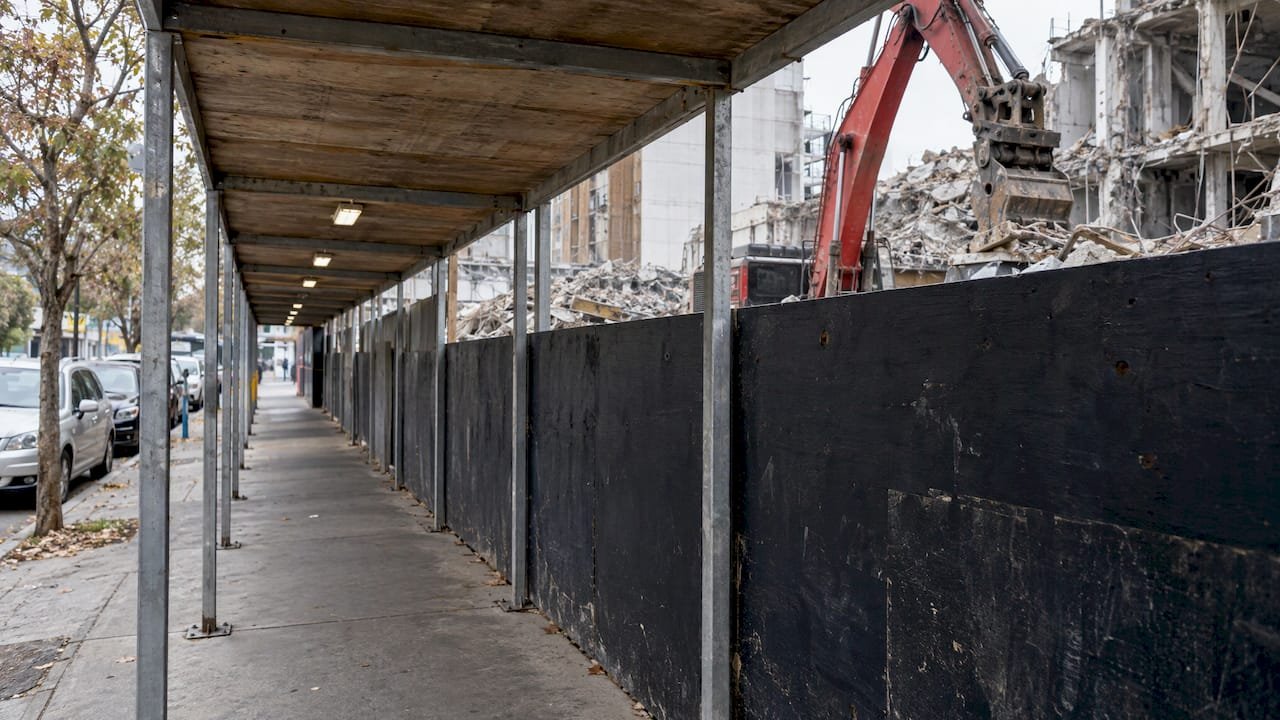
Where the work is next to a public place and there is a risk of falling debris or hazardous noise, the Model Code says protection should be selected and erected before demolition starts, kept in place throughout and regularly inspected. In Victoria, employers should consult the VBA and the local council about public protection, and overhead protective structures for public walkways, used with perimeter hoarding, should be designed by a suitably qualified person.
Fencing, signs and locking up
The Model Code gives concrete benchmarks, using the ACT’s version as its example:
| Element | What the code says |
|---|---|
| Hoarding | At least 2.4 metres high, closely timbered, covered or sheathed |
| Perimeter fencing | Chain mesh or mesh panels, minimum wire diameter 2 mm, at least 2 metres high, secured to stay upright and withstand reasonable impacts |
| Signs | To AS 1319, weatherproof, with the words ‘DANGER Demolition Work in Progress’ and ‘All persons entering site must report to the site office’ |
| Barricades | Secure and impassable, with adequate signage and lock out procedures for pedestrian and vehicle access |
When the site is unattended, the ACT demolition code says all access should be locked, cranes, earthmoving machinery and plant locked with keys removed, and cutting gear and power tools stored in a ventilated, locked room or container. Overnight and weekend security is where many sites slip, so build it into the routine rather than relying on memory.
For local requirements and a fuller look at fence types, see our guide to demolition site fencing requirements.
Notifications and approvals that affect access
Access control sits inside a wider legal frame. Planning approval (a DA, CDC or building permit) and workplace safety notification are separate obligations, and both can apply to one project.
Notifying the regulator
In NSW, SafeWork NSW requires notice 5 calendar days before licensed demolition work that involves a load-bearing structure (or one related to its physical integrity) at least 6 metres high, load-shifting machinery on a suspended floor, or explosives. Interstate contractors working in NSW must notify too, and inspectors can issue on-the-spot fines for appointing an unlicensed contractor to do licensed work, or for failing to notify or starting inside the 5-day period. Our page on SafeWork demolition notification in NSW explains who lodges it and when.
The 6-metre trigger is measured from the lowest ground level next to the base of the structure to its highest point, according to HSE Direct, which notes this catches many ordinary commercial and residential jobs people assume are exempt.
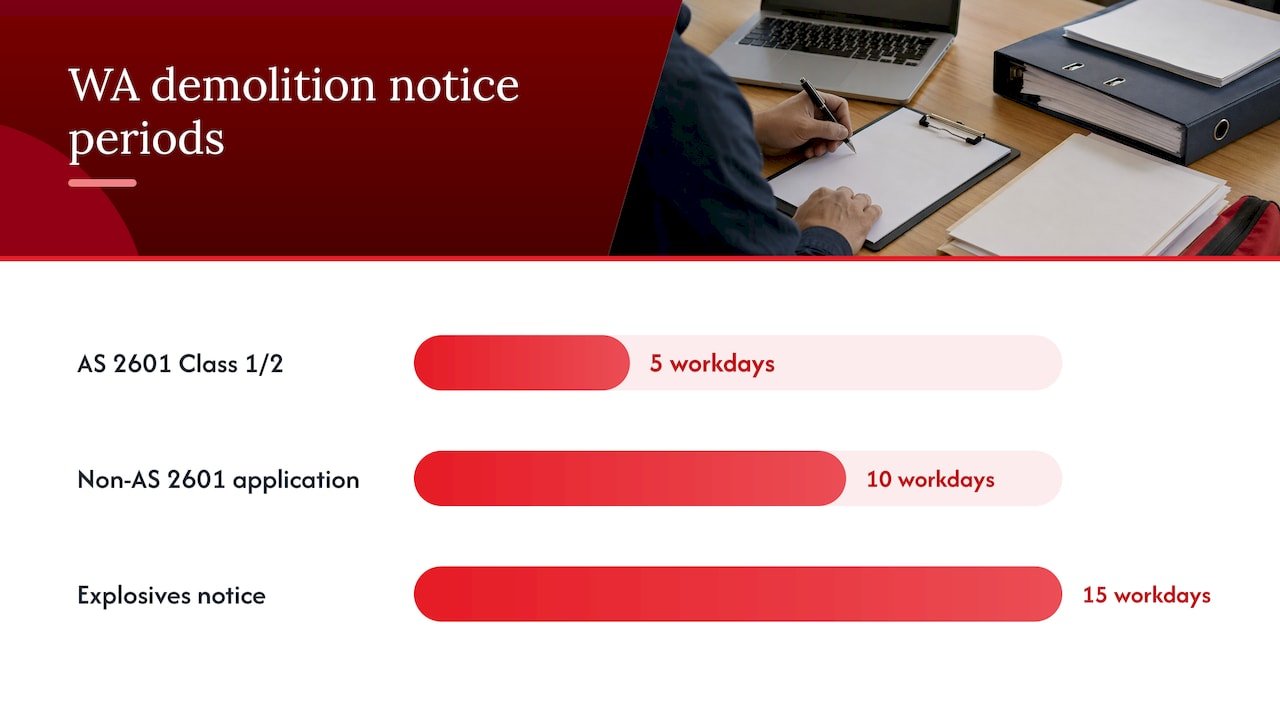
Elsewhere the numbers differ. WorkSafe WA requires 5 working days’ notice for Class 1 or 2 work done in accordance with AS 2601, approval applied for at least 10 working days ahead where work is not in accordance with AS 2601, and 15 working days for explosives. Victoria runs notification through the building permit and surveyor inspection stages. The ACT requires a demolition builder’s licence and development and building approval, with an extra trigger for structures that contain or have contained loose-fill asbestos insulation. Always check the current rule with your state regulator.
Neighbours, utilities and councils
In NSW, once a DA or CDC is approved, the homeowner must notify neighbours within 20 m of the lot boundary before demolition starts, with at least seven days’ notice in metropolitan areas and two days in rural, regional or release areas, per the NSW Planning Portal. The same page notes you may need a security deposit or bond for potential damage to council property. Our neighbour notification guide covers the steps.
Utilities come off first. The Shire of Toodyay states that electricity, water, gas and telecommunications must be disconnected and providers notified before demolition, and that the contractor lodges a Notice of Completion within seven days of finishing. Disconnection also decides where crews can safely walk and park machines.
For approval sequencing, see demolition permits in Sydney and the NSW demolition approval timeline. Work hours also shape access; the working hours checklist for NSW is worth reading before you book trucks.
How asbestos changes access
Safe Work Australia says you must check for asbestos before demolition starts, and demolition may be high risk construction work needing a safe work method statement.
If asbestos is found, access becomes tighter:
- Signs and barriers go up to warn that asbestos removal is in progress and to keep unauthorised people out, and surrounding properties are notified, as set out in the City of Vincent’s asbestos removal declaration.
- Everyone on site wears suitable PPE such as coveralls, gloves, eye protection and a P2 disposable respirator, per the same declaration.
- Licensed removal work needs written notice to the regulator; in Queensland the GPC safety standard cites 5 days’ notice and an asbestos removal control plan.
- After removal, an independent hygienist issues a clearance certificate before non-licensed workers can re-enter, according to Gladison Constructions, and isolated areas stay closed to occupants until then.
That is why asbestos should be sorted before the demolition crew arrives. Our asbestos before demolition process and pre-demolition checklist set out the order of work.
Preparing your property: a checklist
- Confirm approvals and notifications are lodged and who lodges them.
- Arrange an asbestos inspection, and remove any asbestos first.
- Book utility disconnections and keep a record.
- Notify neighbours in writing within the required window.
- Clear the driveway, move vehicles and cut back overhanging branches where agreed.
- Agree gate position, bin locations and truck routes with your contractor.
- Agree how and when you can visit the site.
- Confirm the after-hours lock-up plan.
Our perspective
Most access problems we see are planning problems. A gate in the wrong place, a neighbour who was never told, or an unchecked ceiling sheet can stall a job for days. We treat access as part of the demolition method, not an add-on.
Our approach is to walk the site early, agree the entry and exit routes, and tie them to the approvals, utility disconnections and waste plan. Where asbestos is present, we build the exclusion zones and clearance steps into the program from the start, so the crew and the neighbours know what to expect.
If you give a contractor the full picture of the site, the access plan can be simple, safe and quick. That is the outcome we work towards on every residential, commercial and industrial job.
Tarek
Get a site access plan from Mission Demolition
Mission Demolition handles residential, commercial and industrial demolition, licensed asbestos removal, strip-outs and site clearance, with project management that covers approvals, utility disconnections, hazardous waste handling and final site cleaning. We can plan access with you from the start.
For a house or garage, see our residential demolition service. For larger sites, see industrial demolition and site clearance, or contact us to discuss your project.
FAQ
Who is responsible for securing a demolition site?
The PCBU who controls the workplace, usually the principal contractor or demolition contractor, must secure it against unauthorised access so far as is reasonably practicable. Owners should confirm in writing who holds that role.
Can I enter my own property during demolition?
Not freely. Only authorised people involved in the work should be in the work area, and everyone reports to the site office. Ask your contractor to arrange a supervised visit when machinery is stopped.
How many entry points should a demolition site have?
The Model Code says that where practicable at least two accesses should be maintained to the work area, so there is an alternative escape route if the main one is cut off. Gate locations should also suit truck movements and the street.
Do I need to tell neighbours before demolition?
In NSW, yes. After approval, you must notify neighbours within 20 m of the lot boundary, with at least seven days’ notice in metropolitan areas. Other states have their own rules, so check with your council.
When can people re-enter an area where asbestos was removed?
Non-licensed workers and occupants should not return until an independent hygienist has issued a clearance certificate following air monitoring.
Sources
- Model Code of Practice: Demolition work, Safe Work Australia
- Demolition Code of Practice, WorkSafe Victoria
- Construction Traffic Management Framework, Sydney Metro
- Demolition code of practice, ACT
- Demolition notifications, SafeWork NSW
- Demolition Notification in Australia, HSE Direct
- Demolition work, WorkSafe WA
- Demolish, NSW Planning Portal
- Demolition, Shire of Toodyay
- Demolition, Safe Work Australia
- Asbestos Removal Declaration, City of Vincent
- Contractors and Port Users Safety Standard, GPC
- Commercial Strip-Out: Process, Cost & Timing, Gladison