A hazardous materials survey before demolition is an invasive inspection that finds asbestos, and often lead, PCBs and synthetic mineral fibres, in every part of a building that the demolition will disturb. Do it before you tender, not after the excavator arrives. The survey tells you what must be removed by a licensed removalist, what it will cost to deal with, and what the demolition plan has to allow for. We handle asbestos inspection and testing, licensed asbestos removal and demolition, so the survey result goes straight into a plan we can carry out.
This guide is for homeowners clearing a block for a new build, business owners, project managers, builders and developers. It explains what the survey is, what the law expects, who is qualified to do it and what happens next.
TL;DR
- A demolition survey is intrusive: the surveyor opens up walls, ceilings, floors and voids to find asbestos that a normal register or visual inspection cannot see.
- Asbestos likely to be disturbed must be identified and, so far as reasonably practicable, removed before demolition starts.
- Samples must be analysed by a NATA-accredited laboratory, and the surveyor must be a competent person.
- The report tells you whether you need a Class A or Class B licensed removalist, and it goes to everyone pricing the job.
- Finding asbestos mid-demolition stops work and blows out budgets. A survey up front is the cheaper path.
Table of Contents
- What a hazardous materials survey before demolition is
- Do you need one? Houses, commercial buildings and registers
- How the survey is carried out
- What the report must tell you
- What happens when the survey finds asbestos
- What if asbestos turns up after work starts?
- Rules that have changed recently
- Planning the job around the survey
- How we handle it
- Our view
- FAQ
- Sources
What a hazardous materials survey before demolition is
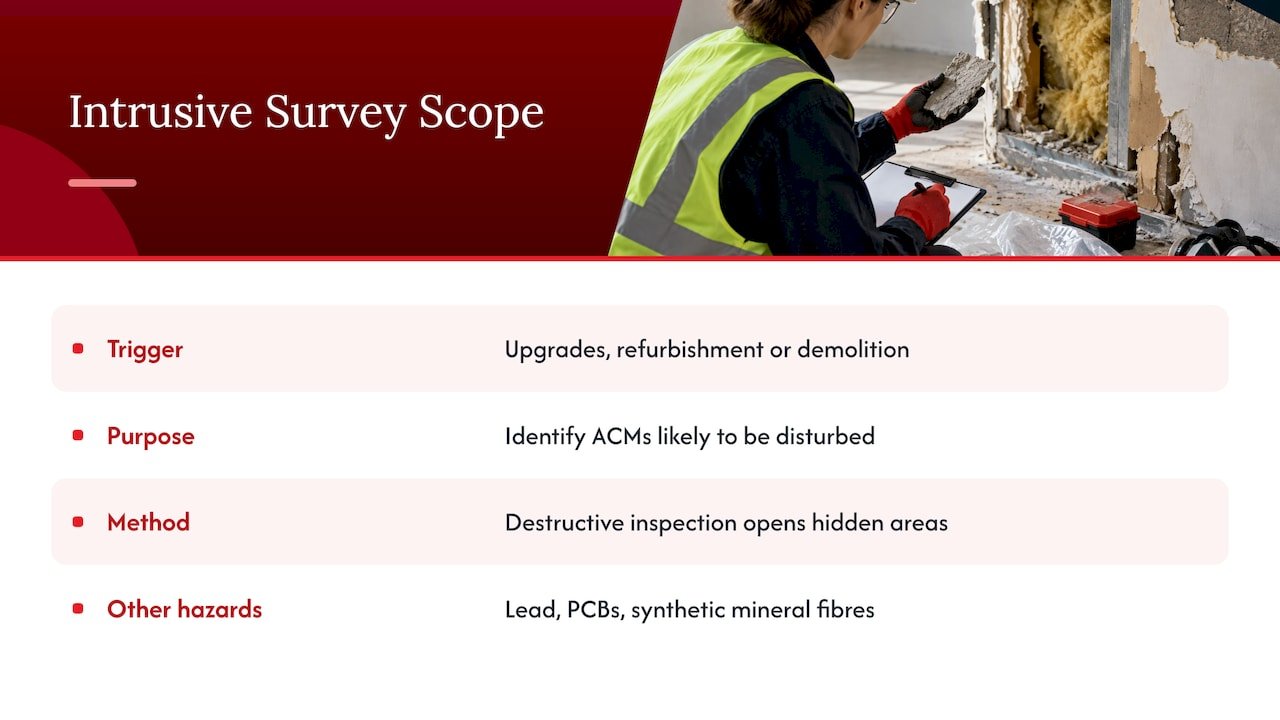
The National Guide for Asbestos Surveys calls it a demolition or refurbishment (intrusive) survey. It is required when premises, structures or plant are to be upgraded, refurbished or demolished. Its job is to identify every asbestos-containing material (ACM) likely to be disturbed, so it can be removed before work begins.
The word “intrusive” matters. A surveyor doing this work uses destructive inspection: lifting tiles, removing bricks, and opening walls, ceilings and floors to get into areas that are normally closed. That is very different from the visual check done for a routine asbestos register.
The survey is usually called an asbestos survey, but the scope is wider. South Australia’s guidance says a demolition survey can also pick up other hazardous chemicals such as lead, polychlorinated biphenyls (PCBs) and synthetic mineral fibres. Lead paint and old insulation are common in older buildings, so the whole list is worth asking for.
Why you need it before you demolish
Three reasons stand out:
- Safety. Workers, neighbours and passers-by are not exposed to asbestos fibres released by breaking up the structure.
- Compliance. The model Code of Practice for demolition work requires asbestos likely to be disturbed to be identified and, so far as reasonably practicable, removed before demolition starts. A Safe Work Method Statement (SWMS) must also be prepared before demolition begins.
- Cost certainty. Safe Work Australia’s asbestos code notes that a demolition survey reduces cost variations by minimising unexpected asbestos discoveries. It can also save money where materials assumed to be asbestos test negative.
For a homeowner, the last point is the one that bites. A fibro shed, an eaves lining or a layer of old flooring adhesive can add a licensed removal line to a quote that looked fixed. Knowing before you sign a demolition contract is far better than finding out halfway through.
Do you need one? Houses, commercial buildings and registers
The rules differ a little by state and by building type, so check with your local regulator. Here is the general pattern from the official guidance.
Houses. In South Australia, a dwelling becomes a workplace when demolition work starts. No asbestos register is required for a residential dwelling, but a competent person must inspect for asbestos. If that person cannot say on reasonable grounds that asbestos is absent, or part of the building likely to be disturbed is inaccessible, asbestos must be assumed present. SafeWork NSW gives the same direction for NSW: check the register, and have a competent person inspect if there is none.
Commercial and industrial buildings. Under the model WHS Regulations, the person with management or control of the workplace must review the asbestos register before demolition or refurbishment. If it is inadequate for the work, it must be revised. A copy goes to the business doing the work, and asbestos likely to be disturbed must be identified and removed so far as reasonably practicable.
A standard register is often not enough. It is usually a visual record built for day-to-day management of a building in use. A demolition survey has to reach voids, risers, ceiling spaces and wall cavities. Large construction clients make this explicit: one national set of minimum standards says registers are often inadequate for demolition unless they include destructive sampling of all in-scope locations. If you manage a property and are not sure where your register stands, our quick audit for asbestos register requirements is a good place to start.
The emergency exception
There is one carve-out. The identify-and-remove requirement does not apply where a structure is structurally unsound or collapse is imminent, or where the purpose of the demolition is to reach the asbestos itself. Safe Work Australia’s current asbestos code sets this out. After a fire, storm or collapse, the dangerous-structure work still needs careful planning. Our emergency demolition services cover that situation.
How the survey is carried out
A good survey follows a predictable sequence.
- Scope and access. The surveyor confirms which parts of the building will be demolished or stripped. The National Guide says intrusive surveys are done in unoccupied areas, with controls to prevent debris spreading. Plan for the building to be empty of people during the work.
- Destructive inspection. Tiles, bricks, wall linings, ceilings and floors are opened up to reach hidden materials: pipe lagging, cement sheet behind linings, floor adhesives, roof sheeting, flues and cavity insulation.
- Sampling. Samples must be representative and must avoid cross-contamination. The Guide gives examples: take the full depth of a material, and for flooring take several samples covering tile, adhesive and paper backing.
- Laboratory analysis. All samples go to a NATA-accredited laboratory, and the surveyor should check that the lab’s scope covers the sample type. South Australia’s regulator accepts only official NATA negative results.
- Second survey after strip-out. The Guide notes a second survey may follow once a soft-strip is done, because new areas become visible when fit-out is removed.
- Report. More on this below.
A word on shortcuts. Queensland’s asbestos register guidance warns that near-infrared handheld analysers are not an appropriate test method for identifying ACM. A quote based on a device reading rather than a laboratory result should not be relied on. We explain how the lab methods differ in asbestos testing methods explained.
Who is qualified to do it
The survey must be done by a competent person: someone with the knowledge and skills from training, qualification or experience. The National Guide gives a benchmark: the BOHS IP402 course plus at least six months’ supervised experience identifying, sampling and assessing ACMs, with extra experience for demolition and refurbishment surveys. Accreditation of the surveyor’s organisation to NATA ISO/IEC 17020 gives further confirmation.
Queensland’s guidance lists who may qualify: occupational hygienists with asbestos experience, licensed asbestos assessors, asbestos removal supervisors, holders of a VET statement of attainment for asbestos assessors, and staff of ISO 17020-accredited organisations. Ask for the name, qualification and organisation accreditation up front, and expect to see them on the report. Our asbestos inspection and testing service covers the inspection side of this.
What the report must tell you
The report is the document that everything else depends on. According to the National Guide, a good intrusive survey report:
- is given to designers and contractors bidding for the work, so asbestos risks can be priced in the tender;
- assesses the condition and friability of each ACM, which decides whether a Class A or Class B licensed removalist is needed;
- records the dates the bulk analysis was carried out and reported, and the names and signatures of the analyst and approving signatory;
- marks clearly, on plans and in text, any areas where access was not possible, so work in those areas can proceed safely.
That last item is the one people skim past. An area marked “no access” is not a clean area. Treat it as asbestos until shown otherwise.
Here is a simple worked example. A homeowner buys a 1960s fibro cottage with a detached garage to clear for a new home. The survey finds bonded cement sheet on the walls and eaves, vinyl floor tiles with black adhesive, and a roof of corrugated sheeting in the garage. The report lists each material, its location, an estimated area and its condition, and marks the roof void as accessed only in part. With that in hand, every demolition quote is based on the same facts: licensed removal first, then a standard demolition of what is left.
What the survey does not replace
The survey does not replace the removal control plan, the clearance inspection or the demolition SWMS. It feeds into all three. For the SWMS, our demolition method statement template shows what regulators look for.
What happens when the survey finds asbestos
The legal starting point is simple. Under the WHS Regulation sections cited by WorkSafe Queensland, asbestos must be removed before demolition commences, so far as reasonably practicable. If the duty holder does not remove it first, they must provide evidence of why removal was not reasonably practicable. It is a burden of proof, not a free choice.
Western Australia’s technical guideline for intrusive hazardous materials surveys, effective 29 April 2026, takes the same line. Hazardous materials should be removed before demolition as far as reasonably practicable. Where removal is not practicable or creates a greater risk, alternative management needs a documented risk assessment and controls.
Class A or Class B
The licence class follows the type of asbestos:
| Situation | Licence needed |
|---|---|
| Any friable asbestos (crumbles easily, such as sprayed insulation or lagging) | Class A |
| More than 10 m² of non-friable (bonded) asbestos | Class A or Class B |
| Less than 10 m² of non-friable asbestos | No licence required in SA, though safety standards still apply |
These thresholds come from WorkSafe Queensland and South Australia’s guidance. Check your own state’s rules, because they are set by each jurisdiction. The licensed removalist must prepare an asbestos removal control plan before licensed removal starts. For Class A work, an independent licensed assessor must air-monitor during removal and at clearance. Our Class A vs Class B explainer covers the ARCP and clearance in more detail.
Waste, soil and clearance
Asbestos waste must be contained, labelled and taken to a site authorised to accept it. If the structure contained asbestos, Queensland requires the demolition zone’s top soil to be scraped to roughly 30 to 50 mm, wetted, double-wrapped in 200 micrometre polythene and disposed of as asbestos waste. Dumping it with general fill is the mistake that causes the largest penalties. Our checklist to stop asbestos and illegal dumping before demolition walks through the paperwork.
The clearance certificate from an independent licensed assessor is what confirms all the asbestos has been removed and the space is safe to re-occupy. Once you hold it, the demolition can proceed.
What if asbestos turns up after work starts?
Stop work, keep people out and call a licensed removalist. This is the scenario a proper survey is meant to prevent, but it still happens in areas marked “no access” or in hidden layers. One set of national construction standards treats every unexpected discovery as a high-risk near miss that must be reported, with licensed contractors engaged and a removal plan lodged with the regulator.
The delay is the real cost: crews stood down, machines idle, neighbours complaining. The report’s “no access” notes tell you where to look first.
Rules that have changed recently
Three updates are worth knowing about:
- Model WHS laws. Safe Work Australia’s amendments page shows the model Regulations compiled as at 5 December 2025, and lists an Amendment (Workplace Exposure Limits) 2026 due to take effect on 1 December 2026. Amendments apply only once each state or territory enacts them, so check yours.
- Demolition licence training in NSW. From 1 March 2025 a person can be prosecuted for letting a worker do licensed demolition work without the approved course CPCCDE3030, as set out on the SafeWork NSW demolition page. Check the contractor’s workers hold it.
- National direction. Ministers welcomed the Asbestos National Strategic Plan 2024 to 2030, which focuses on safe removal of ACM from the built environment.
In NSW you also need to understand who lodges the demolition notification and when. Our guide to SafeWork NSW demolition notification covers it.
Planning the job around the survey
Once you hold the report, the sequence for a typical job is:
- Give the report to everyone quoting, so quotes are comparable.
- Appoint a licensed removalist for the ACM, with an asbestos removal control plan.
- Arrange air monitoring and clearance by an independent licensed assessor.
- Prepare the SWMS and lodge any required notifications.
- Disconnect utilities and complete approvals.
- Demolish, strip out or cut concrete as the scope requires.
- Clean the site and dispose of waste at authorised facilities.
After a strip-out or demolition on a project that continues into fit-out, a post-construction builders’ clean is the last step before the space is handed over. For a bigger picture of how demolition projects run, see building demolition in Australia and why asbestos inspection before demolition matters.
How we handle it
We provide demolition and asbestos removal for residential, commercial and industrial clients across Sydney and Australia. That includes asbestos inspection and testing, licensed asbestos remediation, asbestos disposal, house and commercial demolition, building strip-outs, site clearance and concrete cutting. Our project management covers approvals, utility disconnections, hazardous waste handling and final site cleaning, so one team carries the survey findings through to a clean site.
If you are clearing a house, start with residential demolition. For a fit-out or tenancy, look at interior strip out services. For larger sites, see industrial demolition and site clearance. To book an inspection, go to asbestos inspection and testing, or contact us through our main page.
Our view
Most demolition problems we hear about start the same way: someone priced the job before they knew what was in the building. The survey is the cheapest document in the whole project, and it decides the price of everything after it.
Our view is that the survey, the licensed removal and the demolition belong in one plan. When the people who inspect, remove and demolish work from one set of findings, there is less to hand over and less to go wrong. That is why we offer asbestos inspection and testing, licensed removal, disposal and demolition together, with the approvals, utility disconnections and final clean included in the project management.
We would rather you know what is in the walls before the machines arrive. Safety, compliance and responsible waste disposal are how we work.
Tarek
FAQ
Is a hazardous materials survey the same as an asbestos register?
No. A register records known or presumed asbestos in a building in use, often from visual inspection. A demolition survey is intrusive and opens up hidden areas. A register can be a starting point, but it is often not enough for demolition unless it includes destructive sampling.
Do I need a survey to demolish a house?
Yes, in practice. A dwelling becomes a workplace once demolition starts, and a competent person must inspect for asbestos. If asbestos cannot be ruled out, it must be assumed present. State rules differ, so check with your regulator.
Who receives the survey report?
The report should go to designers and contractors bidding for the work, so that asbestos risks are priced into the tender. The person with management or control of the premises also gives a copy to the business carrying out the work.
Can demolition proceed if some areas could not be accessed?
Only with care. The report must mark inaccessible areas, and asbestos is assumed present in them. Work there should follow the removal plan and SWMS, and any discovery must stop work until a licensed removalist deals with it.
Sources
- National Guide for Asbestos Surveys
- Asbestos.sa.gov.au: demolition and refurbishment
- Safe Work Australia: Model Code of Practice, Demolition work
- Safe Work Australia: How to manage and control asbestos in the workplace (2020)
- Safe Work Australia: How to manage and control asbestos in the workplace (November 2026)
- SafeWork NSW: Demolition
- WorkSafe Queensland: Asbestos and demolition
- Queensland asbestos registers for workplaces
- WA DHW Technical Guideline TG020
- Safe Work Australia: Amendments to the model WHS laws
- WHS ministers meeting communique, 10 May 2024
- SHAPE Minimum Standards