Last Updated: November 12, 2026
Quick Summary
Asbestos disposal documentation in Sydney is a chain of records covering identification, licensed removal, sealed and labelled packaging, transport, facility acceptance and a final disposal receipt. Keep each record with the job file so every load can be traced from site to landfill.
- Keep the surveyor’s report or lab certificate as proof the material was identified before work began.
- Record the removalist’s licence number, class and expiry date in the job file before work starts.
- Photograph sealed, labelled packages before the load leaves site as cheap evidence of presentation.
- Confirm with the facility that it accepts the specific waste type before delivery to prevent refused loads.
- Obtain a disposal receipt naming the facility, quantity, waste type, transporter and date.
Table of Contents
- Which Asbestos Waste Needs Documentation in NSW
- Step-by-Step Documentation Workflow From Removal to Landfill
- Asbestos Waste Transport Documentation and Load Requirements
- Understanding the Asbestos Disposal Receipt
- Asbestos Removal Clearance Certificate and Site Records
- Disposing of Small Amounts of Asbestos in Sydney
- Booking Your Asbestos Removal With Mission Demolition
- Frequently Asked Questions
Getting asbestos waste to the right place in Sydney is only half the job. Proper asbestos disposal documentation behind every load is what protects you if a council, a regulator or a future buyer asks where the material went. This guide walks through which asbestos waste needs documentation under NSW rules, what records to keep at each stage, and how to check that the material was disposed of properly.
Asbestos waste is any material that contains asbestos, from a single cracked sheet to a full house strip-out. Under NSW rules, what you must record depends on how the material is bonded, how much you are moving and who is carrying it. SafeWork NSW asbestos guidance sets the baseline for licensed work, and the EPA covers waste tracking. Get the category wrong and the paperwork is wrong too. NSW hazardous waste disposal steps explain when free CleanOuts apply, how IWTS tracking works and when a licensed contractor is required.
Which Asbestos Waste Needs Documentation in NSW
Not every load needs the same records. The starting question is what the material is and how much of it there is.
Bonded, friable and small-quantity loads
Bonded asbestos is the common type. The fibres are held in a binding material, such as fibro cement sheeting. Friable asbestos crumbles easily and releases fibres far more readily, so it carries stricter controls (Managing asbestos in or on soil).
- Bonded asbestos in larger amounts usually needs full waste tracking.
- Friable asbestos needs full documentation at any quantity.
- Small quantities of bonded material can sometimes be handled through a simpler route, but you still need a record of where it went.
Step-by-Step Documentation Workflow From Removal to Landfill
Treat the paperwork as a chain of custody. Each handoff should generate a record before the material moves to the next stage, and each record should name the material, the quantity, the date and the responsible party, forming complete asbestos disposal documentation for the job. The workflow below maps the records a NSW job typically produces, distinguishing what is legally required from what is simply good evidence if a council, insurer or future buyer asks questions.
- Confirm the material and keep the identification record. A professional asbestos survey, a laboratory analysis certificate or a hazardous materials register establishes what is being removed. Retain the surveyor’s report or lab certificate with the job file. This is the document that proves the material was identified before work began, and it is the first thing a regulator or purchaser will ask for.
- Verify the removalist’s licence before work starts. Asbestos removal work generally must be carried out by a licensed removalist, and the licence class should match the work (friable versus bonded) (Asbestos). Confirm the current requirements with SafeWork NSW. Record the licence number, the licence class and the expiry date in the job file. A copy of the licence is recommended evidence even where not strictly mandated.
- Record the removal itself. The removalist should provide a removal control plan or equivalent site document, plus a record of the date, the area treated, the quantity removed and the method used. For licensed work, the removalist is required to keep records of the removal, and the PCBU (person conducting a business or undertaking) should hold a copy.
- Package and label before the load leaves site. Waste must be sealed in heavy-duty plastic, labelled as asbestos, and where practical double-wrapped. Record the number of packages, the approximate weight or volume, and the date of packaging. Photographs of labelled, sealed packages are cheap evidence and resolve most disputes about how the load was presented.
- Generate the transport record. Where waste tracking applies, the transporter should carry the relevant waste tracking documentation. Even where tracking is not triggered, a transport record showing the date, the transporter, the vehicle, the origin, the destination and the quantity is recommended. Keep a copy on site and a copy with the driver.
- Confirm facility acceptance before delivery. Ring the licensed landfill or transfer station and confirm it accepts the specific waste type, the packaging standard it requires, whether a booking is needed and what evidence it will issue. Record the name of the person who confirmed acceptance and the date. This single step prevents most rejected loads.
- Obtain and file the disposal receipt. The facility should issue a receipt or docket showing the date, the facility, the quantity received, the waste type and the transporter. File it with the transport record and the removal records. If the receipt is not issued on the day, request a copy in writing before the job is closed out.
- Close the file with a clearance certificate where applicable. For licensed removal work, a clearance certificate or clearance inspection record confirms the area is safe to reoccupy. Keep it with the survey, the removal records, the transport records and the disposal receipts so the whole chain can be produced on request.
Watch out: the most common failure point is step 5 to step 6, a load arrives at a facility with paperwork that does not match the load, or with no prior confirmation that the facility accepts that waste type, and the load is refused. A refused load still has to be transported and stored lawfully, so the cost and delay sit with whoever arranged disposal.
A complete file lets you show exactly where every load went, which is the point of the exercise. Where a requirement is uncertain, verify the current position with SafeWork NSW and the NSW Environment Protection Authority before the load moves, because thresholds and tracking rules are updated from time to time.
The workflow runs from identification through to a closed file, with each stage producing its own record.
| Step | What to do | Timing or evidence |
|---|---|---|
| 1. Identify material | Keep survey report or lab certificate | Before work begins |
| 2. Verify licence | Record licence number, class and expiry | Before work starts |
| 3. Record removal | Keep removal control plan and quantities | During removal |
| 4. Package and label | Seal, label and photograph packages | Before load leaves site |
| 5. Transport record | Carry tracking documentation with driver | Each load |
| 6. Confirm acceptance | Confirm facility accepts the waste type | Before delivery |
| 7. File receipt | Obtain and file disposal receipt | Same day if possible |
| 8. Close file | Add clearance certificate where applicable | At job close-out |
Asbestos Waste Transport Documentation and Load Requirements
Moving asbestos waste is where most problems start. Loads must be sealed, labelled and tracked from pick-up to delivery.
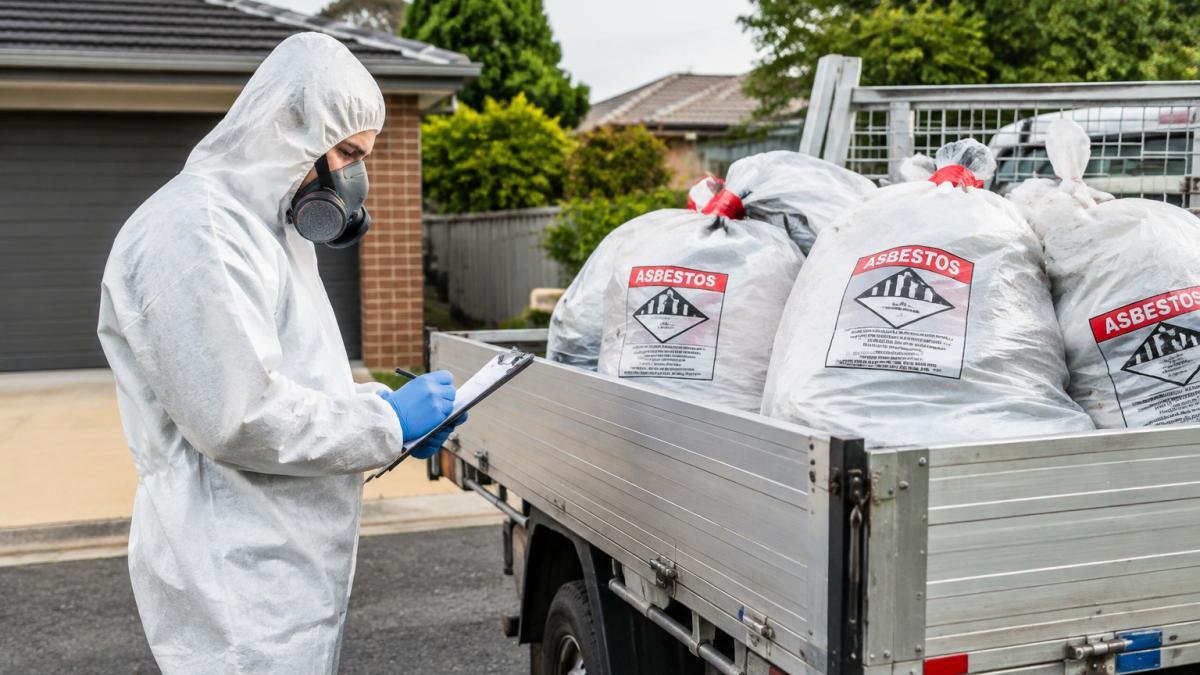
- Keep each load sealed so fibres cannot escape during transport.
- Record the load details before the vehicle leaves the site.
- Use only transport methods and vehicles suited to the material.
- Carry copies of the transport paperwork in the vehicle.
Watch out: a load that arrives at the tip without matching paperwork can be refused, and you may then have to take it back.
Understanding the Asbestos Disposal Receipt
The disposal receipt is your proof that the waste reached a licensed facility and was accepted there. It is also the document that closes the chain of custody, so it needs to be specific enough to match the load to the job.
A well-formed receipt or docket typically shows:
- The facility name, address and environment protection licence number.
- The date and time the load was received.
- The quantity received, expressed in tonnes or cubic metres, and the waste type (for example, bonded asbestos or friable asbestos).
- The transporter’s name and vehicle details.
- The origin of the load, where the facility records it.
- Any waste tracking reference number, where tracking applies.
- The name of the facility officer who accepted the load.
Where the facility issues a weighbridge docket, keep it with the receipt. The weighbridge ticket is often the only independent record of quantity, and it is the document that resolves disputes about how much material was actually disposed of.
Record retention. There is no single retention period that applies to every record in every scenario, so the safe approach is to keep the full job file for at least the period during which a regulator, insurer or purchaser could reasonably ask for it. Keep asbestos disposal records for as long as a regulator, insurer or purchaser could reasonably ask for them.
Rejected loads and disputes. If a load is refused, the receipt will not exist, so the evidence you rely on shifts to the transport record, the facility’s rejection note and any correspondence confirming why the load was refused. Keep all three. If a contractor claims a load was disposed of but cannot produce a receipt, treat the claim as unverified until the facility confirms it in writing.
Audits and compliance checks. During an audit, the regulator will typically ask for the survey, the removalist’s licence details, the transport records and the disposal receipts as a set. A file where the receipts match the transport records and the removal quantities is straightforward to audit.
Watch out: a receipt issued to the transporter rather than to you is still useful evidence, but request a copy in your own records before the job is closed, because the transporter may not retain it for as long as you need it.
Asbestos Removal Clearance Certificate and Site Records
After removal, a clearance certificate confirms the area is safe to reoccupy. Keep it alongside your site records: the survey, the removal details, the transport records and the disposal receipts. Together they show the whole job was done correctly, and they are the first thing a buyer or insurer will ask to see.
Disposing of Small Amounts of Asbestos in Sydney
Small jobs, such as a few broken fibro sheets from a garden shed, still need records. Many people assume a small load can go in a general bin. It cannot. Seal the material, label it, and deliver it to an authorised facility, keeping the receipt. Ask the facility about its small-load rules and any fees before you go, because disposal fees vary by facility and quantity. Pricing depends on the load, the dates and the facility, so check current rates with the facility directly.
Booking Your Asbestos Removal With Mission Demolition
Mission Demolition is a licensed and insured demolition company that handles asbestos removal, strip-outs and site clearance in Sydney. Find out when and how SafeWork NSW demolition notification must be lodged before your job is booked. Pricing depends on the size and complexity of the job. Request a free quote for asbestos removal and demolition to get current pricing for your project.
Frequently Asked Questions
What documents are required when disposing of asbestos waste?
Asbestos waste in NSW generally needs a waste tracking record for loads that meet the regulatory thresholds, a transport record showing the load’s origin, quantity and destination, and a disposal receipt from the licensed facility that accepted it. Keep these together with your site records. For projects involving licensed removal, confirm with your removalist that you receive copies of the waste tracking documentation. Check with the facility beforehand, since acceptance rules and paperwork requirements can vary.
Do I need a waste transport certificate for asbestos?
Transport documentation is required for asbestos waste moved in NSW, and the level of detail depends on the quantity and how the waste is carried. Waste tracking requirements under the NSW regulations apply to larger loads and licensed removal work, so the transporter should be able to show the paperwork that matches the job. Ask your removalist for their transport documentation before the load leaves the site, and confirm the destination facility is licensed to accept asbestos waste.
How can I verify that asbestos waste was disposed of legally?
Ask for the disposal receipt from the licensed facility, which should show the date, quantity, the facility name and licence details, and reference the transport record. Compare the quantity on the receipt with the quantity recorded at removal. A receipt from a facility that is not licensed to take asbestos is a warning sign. Keep these records for your own files so you can show proper disposal later if questions arise.