
There is no single national rule for asbestos fences. Safe Work Australia sets the model laws, but each state and territory applies its own, so what you may do with an old fibro fence depends on where you live. As a general pattern, bonded (non-friable) asbestos under 10 square metres can be removed without a licence in most places, anything larger or any friable material needs a licensed removalist, and the waste can only go to a facility licensed to take it. The ACT is stricter: a licence is required for any amount. Here is how that plays out for a fence, from identifying it to disposing of it.
TL;DR
- Fences built before 1990 from cement-like sheeting are highly likely to contain asbestos, and only a NATA-accredited laboratory test can confirm it.
- In most states, removing less than 10 m² of bonded asbestos does not need a licence, but regulators still recommend a licensed professional. In the ACT any amount needs a licence.
- More than 10 m² of bonded asbestos, or any friable asbestos, must be removed by a licensed removalist, who must notify the regulator before starting.
- Asbestos waste must be wrapped, labelled and taken to a licensed facility. In NSW, householders must also report the load to the EPA.
- Undamaged fences can be left alone. Damaged or crumbling ones need advice from a competent person.
Table of Contents
- Why old fences are an asbestos issue
- How to tell if your fence contains asbestos
- The 10 square metre rule and who can remove what
- Safe work rules if you remove a small section
- Notification when a licensed removalist does the job
- Transport and disposal of asbestos fence waste
- Damaged fences and shared boundaries
- Penalties and why the rules are worth following
- Need a fence tested or removed?
- A simple checklist before you touch the fence
- FAQ
- Sources
Why old fences are an asbestos issue
Asbestos was banned across Australia from 31 December 2003, but products made before then are still standing in backyards. Asbestos cement sheeting, including super-six, was used in fences before 1990 is the common advice from the national agency, and the same sheeting is what most people call a fibro fence. These panels are bonded: the fibres are locked into cement. In good condition they are low risk. The danger starts when they are cut, drilled, broken, sanded or blasted with a high-pressure cleaner, because that releases fibres into the air.
That is why regulation focuses on three moments: when you test, when you disturb the fence, and when you get rid of the waste.
How to tell if your fence contains asbestos
You cannot be sure by looking. Western Australia’s Department of Health guidance says fences built before 1990 from cement-like material are highly likely to contain asbestos. Clues that point towards asbestos include seven ridges on a corrugated panel, a hessian-like surface pattern and asbestos cement capping. Five-ridge panels or metal capping are more typical of asbestos-free material.
Treat those as hints only. The same guidance is clear that certainty comes from laboratory testing by a NATA-accredited facility. WorkSafe WA also advises leaving suspect material undisturbed, having it assessed by a competent person and tested. If asbestos is confirmed, mark the area and apply warning labels.
If you want to know how testing works before you book, our guide to asbestos testing methods explains sampling and lab analysis, and our asbestos inspection and testing service covers the on-site side.
The 10 square metre rule and who can remove what
The dividing line in most jurisdictions is bonded versus friable, and then quantity.
| Situation | What the rules say |
|---|---|
| Less than 10 m² of bonded asbestos (WA, NSW) | No licence needed, but a licensed professional is recommended |
| More than 10 m² of bonded asbestos | Licensed non-friable (Class B) removalist required |
| Any amount of friable asbestos | Licensed friable (Class A) removalist required |
| ACT | Licence required for any amount |
The WA position is set out by WorkSafe: a homeowner can remove less than 10 square metres of non-friable asbestos, though licensed removal is strongly recommended. SafeWork NSW says the same threshold applies, and it also recommends a licensed professional for any amount of non-friable asbestos. On the ACT, Safe Work Australia notes that licensing rules vary by state, and a licence is mandatory for any amount there.
Two practical points catch people out.
A fence adds up quickly. A standard sheet fence has two faces and a height of around 1.8 metres. Count the total sheet area, not the length of the boundary. A run of about 5.5 metres of 1.8 metre fence already reaches roughly 10 m² on one face, so many whole-boundary fences go well over the threshold. If you are close to the line, treat it as licensed work.
Tradies are held to a stricter standard. A fencing contractor, builder or handyman working on your property is a worker under WHS law. WorkSafe WA notes that trades and construction workers must comply with WHS laws, which limit how much asbestos they can remove without a licence. Hiring an unlicensed fencer to knock down a large fibro boundary is not a loophole.
Victoria is different again. A Geelong-based explainer notes that the 10 m² limit sits in the state’s OHS Regulations, which apply to workplaces, and that Victoria’s wording differs from NSW. Check WorkSafe Victoria, WorkSafe Queensland or your own state regulator for the current text before you plan a job. Our guide to NSW asbestos removal regulations covers the NSW detail, and our explainer on Class A vs Class B asbestos shows what each licence permits.
Safe work rules if you remove a small section
If your state allows you to remove a small amount and you choose to, the WA guidance on asbestos cement fences sets out the precautions. In summary:
- Wet the fence progressively so dust stays down.
- Wear a respirator, gloves and overalls.
- Keep uninvolved people, children and pets away from the area.
- Take the fence apart with minimal damage, and do not use power tools.
- Wrap the pieces in two layers of heavy-duty plastic labelled with an asbestos warning.
Those steps come from the WA Department of Health fence guidance. WorkSafe WA adds that strict safety precautions and protective equipment apply to removal, disposal and decontamination.
Licensed work goes further. In Queensland, for example, licensed removal needs decontamination facilities and a clearance inspection before the area is handed back. That is part of what you pay for when you hire a licensed team.
Notification when a licensed removalist does the job
When the work is licensed, the removalist carries the paperwork. The Safe Work Australia model code says licensed removal work must generally be notified to the state or territory regulator at least five days before it starts, with exceptions for emergencies. The notification includes the site address, the type of asbestos, the supervisor’s name and the estimated quantity.
For homeowners, this has two effects. First, allow lead time: a licensed fence removal cannot start the day you call. Second, ask any removalist whether they lodge the notification for you. In NSW, our summary of the five-day SafeWork notification explains what is lodged and when.
Transport and disposal of asbestos fence waste
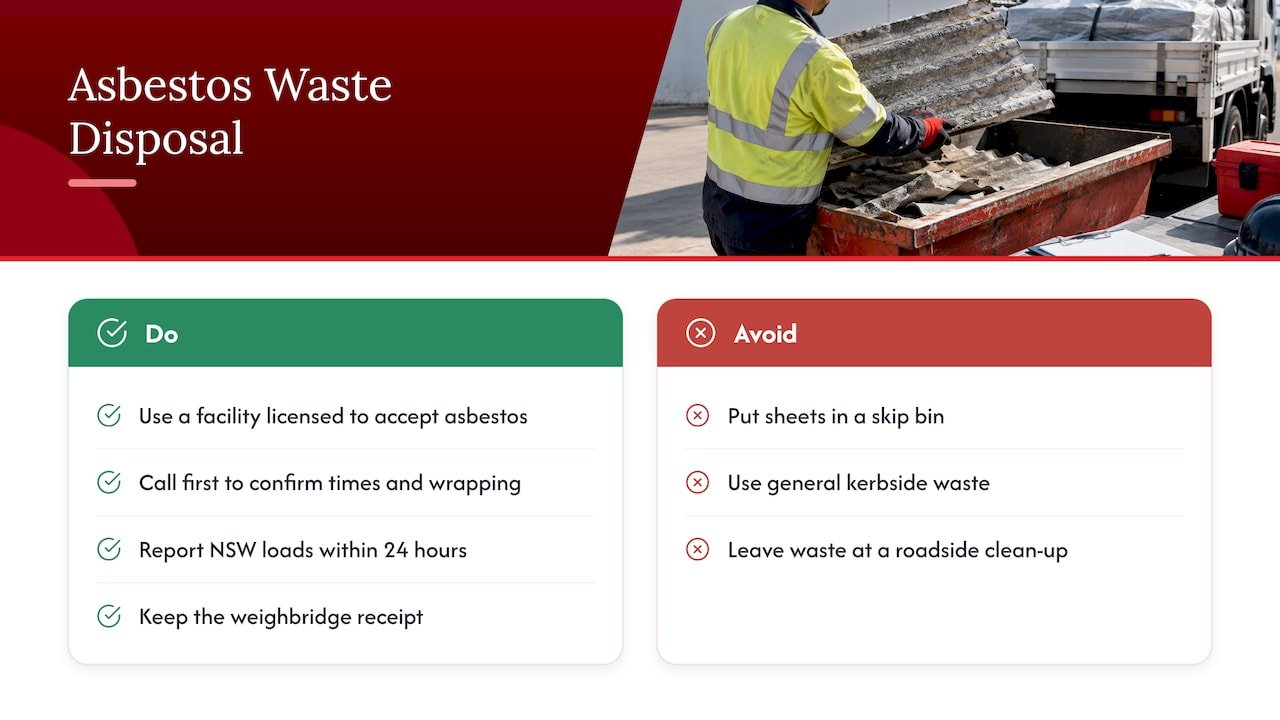
Disposal is where well-meaning DIY jobs go wrong. The national asbestos safety agency states that asbestos waste can only be disposed of at a facility licensed to accept it. Call the facility first to confirm opening times and wrapping requirements. Do not put fence sheets in a skip bin, general kerbside waste or a roadside clean-up.
NSW adds a reporting step. Under the EPA’s guidelines, householders transporting asbestos waste generated at their property must report the load to the EPA within 24 hours of completion. Trade operators face tracking rules too, covered in our guide to asbestos waste tracking in NSW. For the national picture, see how to dispose of asbestos waste legally in Australia.
Keep the weighbridge receipt. It is your proof the waste went where it should.
Damaged fences and shared boundaries
A fence that is intact and painted is usually safer left alone than pulled down. Problems start when sheets are cracked, weathered to the point that fibres are exposed, or broken by a fallen branch.
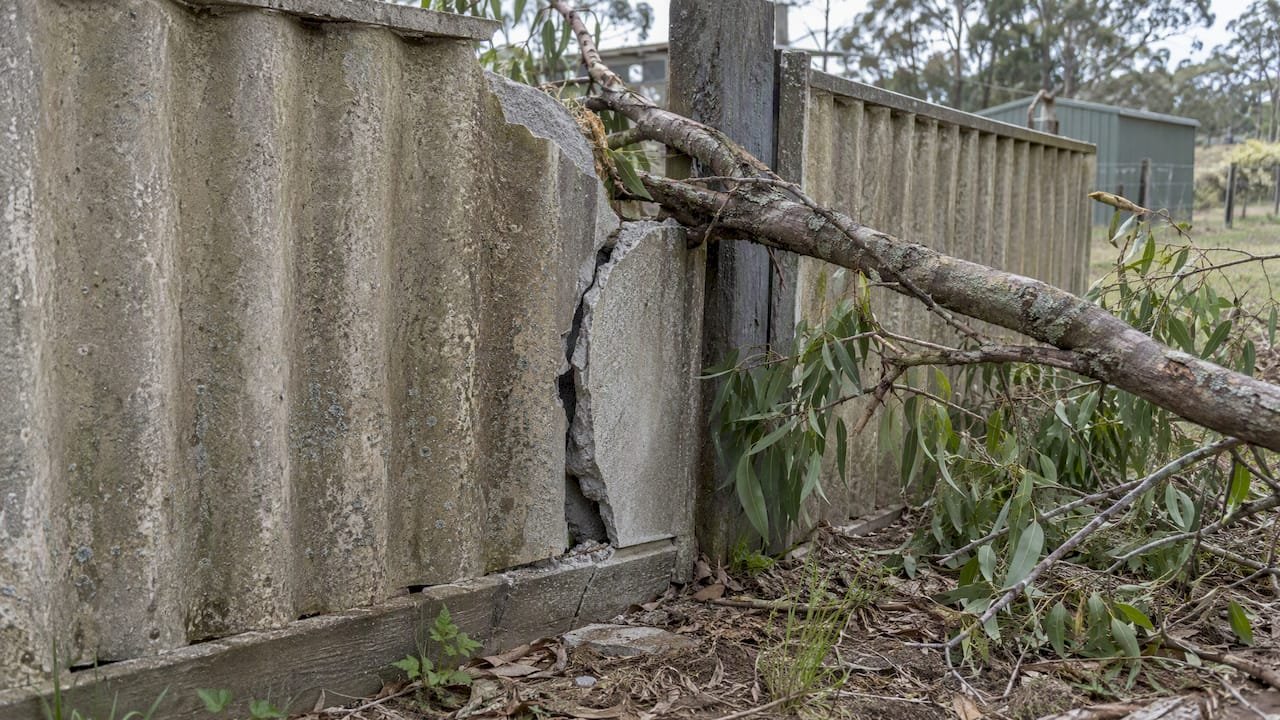
If you are unsure about the condition, the WA guidance recommends seeking advice from an asbestos-containing material competent person or an occupational hygienist, and your local government may help. Very poor fences may need temporary warning signs or barriers while they wait for removal.
Boundary fences add a neighbour. If two owners disagree about removing a potentially hazardous asbestos fence, the same guidance says local government health officers may step in, or the matter can go to a Magistrate’s Court under dividing fence legislation. Having a written test result and a licensed quote on the table usually settles the conversation faster than an argument over cost.
If you may have inhaled dust during a break or demolition, stop work, keep others away and speak to your GP. Do not sweep or vacuum the debris.
Penalties and why the rules are worth following
Fines vary by state and by whether you are a householder or a business. In NSW, for instance, we cover typical penalty exposure in our guide to asbestos fines in NSW. The bigger cost is practical: a contaminated yard, a neighbour complaint, a council notice, and a clean-up that costs far more than doing it properly the first time.
Our perspective
Most fence enquiries we hear about start the same way: someone has already started pulling sheets out, or a fencer has cut one with an angle grinder, and now there are broken pieces across the lawn. The 10 m² rule makes small jobs sound trivial. In practice, we think a fence is one of the easier places to underestimate asbestos, because it is long, it is weathered and it is often shared.
Our approach is to test first, because the result decides everything else: whether you need a licence, how the waste is handled and what you tell a neighbour or a buyer. If the answer is yes, we treat the fence as a proper removal job, with the right protective equipment, controlled wetting, wrapped and labelled waste, and disposal at a licensed facility.
We also look at the fence in context. If it sits beside a garage, a roof or a house that is heading for demolition, we plan the asbestos removal first so the site is clear before machines arrive. That is the sequence the rules expect, and it avoids costly stoppages later.
Tarek
Need a fence tested or removed?
If your fence tests positive, or you would rather not guess, we handle licensed asbestos removal, disposal and site clean-up for homeowners, builders and property managers across Sydney and Australia. You can start with asbestos removal in Sydney, or see our asbestos disposal and roof removal services for the wider range of work.
If the fence is part of a bigger project, our residential demolition team can coordinate asbestos removal before the house or garage comes down, and our guide to removing asbestos before demolition explains the order of works. For a quote, get in touch through our site.
A simple checklist before you touch the fence
- Note the age of the fence. Pre-1990 sheeting is a red flag.
- Look at ridge count, surface pattern and capping, then confirm by laboratory test.
- Measure the total sheet area you would remove.
- Check your state regulator’s rules for that quantity, and whether a licence is required.
- Decide who removes it: licensed professional for anything above the threshold, and wise for anything below it.
- Confirm the licensed disposal facility and its requirements before moving any waste.
- In NSW, plan the EPA report if you transport the waste yourself.
- Tell your neighbour and, if it is a shared boundary, agree the plan in writing.
For larger sites with several structures, our site clearance checklist is a useful template for sequencing the work.
FAQ
Can I remove an asbestos fence myself in Australia?
In most states you may remove less than 10 m² of bonded asbestos without a licence, but regulators recommend using a licensed professional. In the ACT a licence is needed for any amount. Above 10 m², or for any friable material, a licensed removalist is required.
How do I know if my fence is asbestos?
Fibro-style fences built before 1990 are highly likely to contain asbestos. Seven ridges, a hessian-like pattern and asbestos cement capping are common signs. Only testing by a NATA-accredited laboratory confirms it.
Where can I dispose of asbestos fence sheets?
Only at a facility licensed to accept asbestos waste. Call ahead to confirm hours and wrapping rules, and wrap sheets in two layers of labelled heavy-duty plastic. In NSW, householders must report a self-transported load to the EPA within 24 hours.
Do I need to notify anyone before a licensed removal?
The licensed removalist generally notifies the state or territory WHS regulator at least five days before work starts. Emergencies are an exception. Confirm with your removalist that they will lodge it.
What if my neighbour objects to removing a shared asbestos fence?
Local government health officers may become involved, or the dispute may go to a Magistrate’s Court under dividing fence legislation, according to WA guidance. Check your own state’s dividing fences law for the process that applies to you.
Sources
- Asbestos cement fences guidance note, WA Department of Health
- What does asbestos look like? WorkSafe WA
- Removing asbestos, WorkSafe WA
- Asbestos, SafeWork NSW
- Asbestos WHS duties, Safe Work Australia
- How to safely remove asbestos, model code of practice
- Asbestos and demolition, WorkSafe Queensland
- Asbestos identification, removal and disposal, Asbestos Safety and Eradication Agency
- Asbestos and Waste Tyres Guidelines, NSW EPA
- Victorian 10 sqm rule explained