If your bathroom was built or last renovated before 1990, treat every tile, board, and pipe lagging as a possible asbestos risk until a licensed assessor says otherwise. Don’t drill, scrape, or sand anything. Restrict access to the room, and arrange sampling by a licensed professional, with the material analysed by a NATA-accredited lab before any renovation work continues.
TL;DR:
- Testing by a licensed assessor using a NATA-accredited lab is essential before any renovation work on pre-1990 bathrooms.
- Suspected asbestos-containing materials include vinyl tiles, grout sealants, fibro backing boards, textured ceilings, pipe lagging, and cement sheeting, often co-occurring.
- Immediate actions when asbestos is suspected include stopping work, isolating the area, avoiding dust disturbance, and calling licensed professionals for assessment.
- Non-friable, intact asbestos can often be left undisturbed or encapsulated, but damaged or friable materials require licensed removal with proper clearance procedures.
- Early testing saves time and money, preventing costly delays during renovations caused by discovering asbestos mid-job.
Table of Contents
- Where asbestos in bathrooms tends to hide
- How to tell if it’s asbestos, and how testing actually works
- What to do the moment you suspect asbestos
- Leave it, cap it, or remove it: choosing the right response
- Picking a licensed assessor and removalist
- Timelines, costs, and keeping your renovation on track
- Why Mission Demolition treats bathroom asbestos differently
- Why the “just leave it” advice misses the point
- Where to check the rules yourself
- Get your bathroom tested and sorted properly
- Sources
Where asbestos in bathrooms tends to hide
Bathrooms pack more asbestos-containing material into a small footprint than almost any other room in an older Australian house. That’s partly moisture control (fibro sheeting resists water) and partly cost. Builders through the 1960s to 1980s used it because it was cheap, fireproof, and easy to work with.
The usual suspects, according to NSW asbestos guidance, include:
- Vinyl floor tiles and the black mastic adhesive underneath them
- Grout and sealants around the bath, shower recess, or vanity
- Fibre cement backing boards behind wall tiles
- Textured or “popcorn” ceiling finishes
- Pipe lagging on hot water pipes running through the wall cavity
- Cement sheeting used as a wet-area substrate
A bathroom renovated in stages over several decades can carry two or three of these materials at once, each with a different risk profile depending on its condition. The simplest screening question is still the age of the house. If it was built before 1990, assume asbestos is present somewhere until testing proves otherwise.
How to tell if it’s asbestos, and how testing actually works
You genuinely cannot identify asbestos by looking at it. Fibro sheeting, vinyl backing, and modern cement board can look identical to the naked eye, and colour, texture, and age are unreliable clues. The only way to know for certain is laboratory analysis by a NATA-accredited facility, and the sample itself should be collected by a licensed asbestos assessor rather than a homeowner with a Stanley knife.
Here’s what the process generally looks like:
- A licensed assessor inspects the material and identifies likely sample points, often more than one if materials differ across the room.
- They collect a small sample using wet methods and sealed containment, minimising fibre release during extraction.
- The sample goes to a NATA-accredited lab for polarised light microscopy (PLM), the standard Australian testing method for identifying asbestos fibres.
- You receive a written lab report identifying the material as positive, negative, or containing a specific asbestos type (chrysotile, amosite, or crocidolite).
Pro Tip: Ask your assessor for the lab’s NATA accreditation number on the report itself. A report without it isn’t worth the paper it’s printed on for insurance or resale purposes.
DIY sampling isn’t just discouraged, it’s actively risky. Cutting into a suspect material without wet suppression or containment can release fibres into the air of a room you’re standing in, and state safework guidance is blunt about the trade-off: a five-minute shortcut can turn a contained, manageable job into a full decontamination.
What to do the moment you suspect asbestos
Trades find suspect material mid-job more often than anyone likes to admit, usually when a tile cracks or a wall sheet gets an unexpected hole in it. What you do in the next ten minutes matters more than almost any other decision in the renovation.
- Stop work immediately. Down tools, don’t finish “just this one cut.”
- Isolate the bathroom. Close the door, and if there’s an extraction fan, turn it off rather than on.
- Keep family, pets, and anyone not involved in assessment well away from the area.
- Avoid dry sweeping or vacuuming. Both aerosolise fibres far more efficiently than leaving debris undisturbed.
- Bag any clothing or footwear that may have contacted the material, and seal tools rather than carrying them through the rest of the house.
- Call a licensed assessor or removalist and follow their containment instructions exactly, including any advice about sealing doorways or vents before they arrive.
Pro Tip: If you’ve got portable fans or heaters running in the bathroom, switch them off too. Airflow is the enemy once fibres are potentially loose.
Leave it, cap it, or remove it: choosing the right response
Not every positive test means ripping out the whole bathroom. What you do next depends on the material’s condition and how invasive your renovation plans are.
- Leave it in place: bonded, undamaged asbestos-cement sheeting or intact vinyl tiles pose minimal risk if left undisturbed. Periodic visual checks are enough, and this is often the most sensible option if you’re not renovating.
- Encapsulate or cap: tiling directly over stable vinyl tiles, or overlaying a fibro backing board with a new sheet, avoids disturbing the original material. This works well when the underlying ACM is in good condition, but it’s not a fix for damaged or crumbling material, and it needs proper preparation to hold up long term.
- Licensed removal: required when material is friable (crumbly), already damaged, or when your renovation plan involves cutting, drilling, or demolishing it. This route needs a licensed removalist, clearance air monitoring once the job’s done, and disposal at a facility licensed to accept asbestos waste.
Cost and disruption climb sharply as you move down that list, which is exactly why a pre-renovation asbestos survey pays for itself. Knowing what you’re dealing with before you book trades means you’re not paying for a stalled job halfway through.
Picking a licensed assessor and removalist
Not every contractor advertising “asbestos removal” is licensed for the scope of your job, and the gap between a competent operator and a corner-cutter usually shows up in the paperwork, not the sales pitch.
- Check their licence against your state’s WorkSafe or equivalent regulator registry before booking anything.
- Confirm they use a NATA-accredited lab for sample analysis and can show you a chain-of-custody process for how samples are handled.
- Ask for a written scope of works, a timeline, and confirmation they’ll provide a waste manifest tracking disposal.
- Insist on an independent clearance inspection and air monitoring report once work is finished, not just a verbal “all clear.”
Red flags are usually easy to spot once you know what to listen for: vague answers about which lab they use, pressure to skip testing “because it’s probably fine,” or no mention of a clearance certificate at all. A properly licensed operator won’t blink at any of these questions.
Timelines, costs, and keeping your renovation on track
Budget more time than you’d expect, especially factoring in construction cleaning cost Australia which can impact your renovation budget. Sample collection and lab turnaround typically run a few business days, though rush options exist for time-pressed renovations. A straightforward bonded material removal in a domestic bathroom, including setup, extraction, decontamination, and clearance air monitoring, commonly takes one to three days depending on scope.
- Assessment and testing: a modest upfront cost compared with the alternative
- Small bonded removals: mid-range, scaling with area and accessibility
- Larger or friable removals: higher, driven by containment complexity and disposal volume
Reporting from the Canberra Times found that a positive asbestos result discovered mid-renovation commonly causes real delays and blown budgets across Canberra’s older housing stock. Testing before your trades arrive, not after the tiler’s already pulled up a floor, is the cheapest insurance you’ll buy on the whole project.
Why Mission Demolition treats bathroom asbestos differently
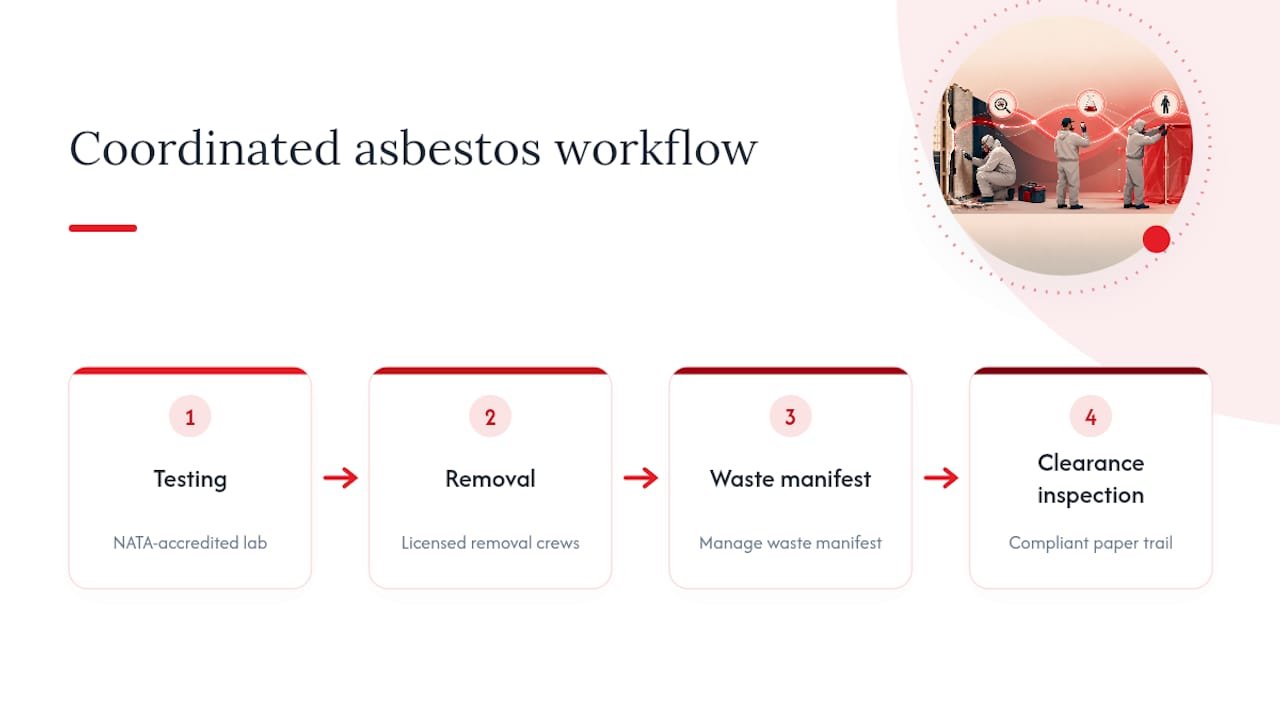
Most homeowners don’t need a lecture on fibre types, they need someone to coordinate the testing, the removal, and the paperwork without six phone calls to six different providers. That’s the gap Missiondemolition fills: licensed removal crews who work directly with NATA-accredited labs, manage the waste manifest, and organise the clearance inspection so you’ve got a compliant paper trail for resale or insurance down the track.
Before you call, have your survey report, your home’s build date, and a few photos of the affected area ready. It speeds up the quote and means the crew arrives knowing exactly what they’re dealing with.
Why the “just leave it” advice misses the point
A lot of general renovation advice treats asbestos as a binary: rip it all out or ignore it completely. Neither is right for most bathrooms.
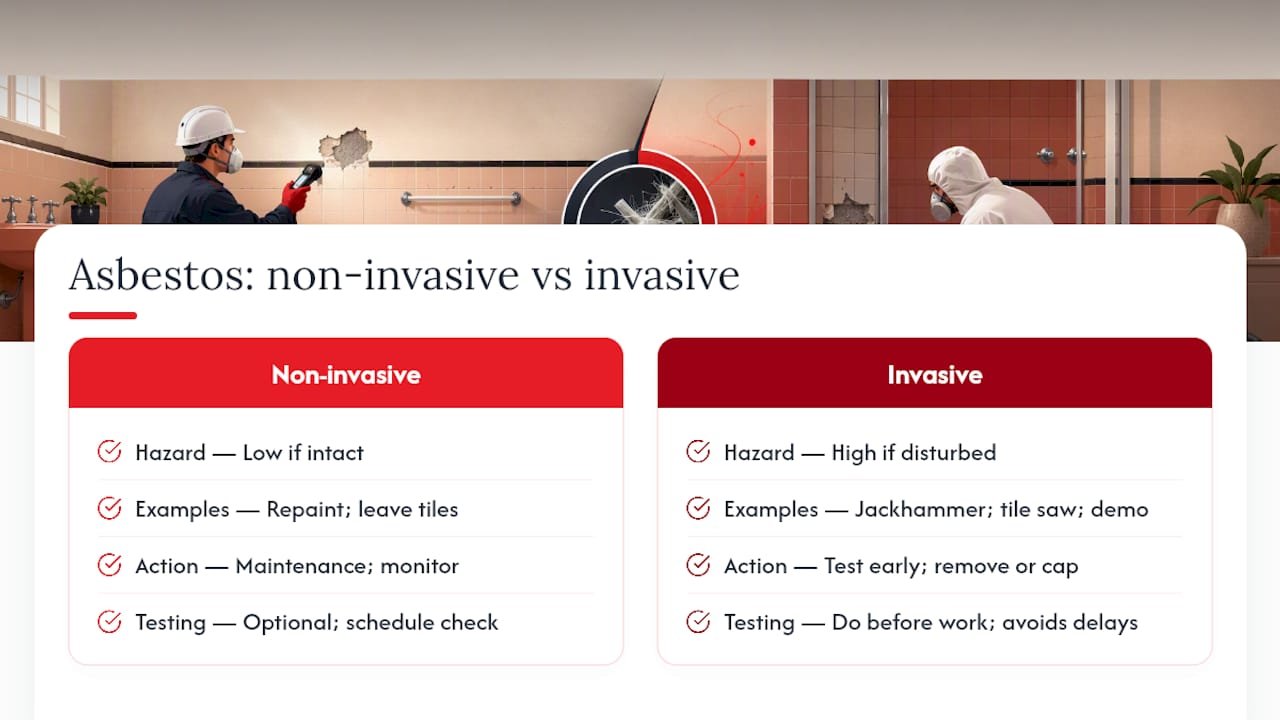
The more useful framing is asking what your renovation plan actually requires. If you’re repainting and leaving tiles alone, an intact fibro backing board sitting quietly behind them isn’t an emergency, it’s a maintenance item. But the moment your plans involve a jackhammer, a tile saw, or a demolition crew, that same board becomes a genuine hazard, and the calculus flips entirely.
Where I think homeowners get caught out isn’t ignorance of the risk, it’s underestimating how cheap it is to check before committing to a renovation timeline. A lab result costs a fraction of what a stalled job costs once a tiler’s already found something they don’t like the look of. Get the testing done early, and every other decision, capping, removal, or leaving it alone, becomes straightforward.
— Tarek
Where to check the rules yourself
For current guidance, see Asbestos Safety and Eradication Agency, your state’s asbestos or WorkSafe website, and NATA’s accredited lab directory. Keep your survey and clearance reports on file for future renovations or sale disclosure.
Get your bathroom tested and sorted properly
Missiondemolition is the alternative to juggling separate testers, removalists, and waste contractors for a bathroom job. One licensed team handles the assessment coordination, the removal, and the clearance certificate, so you’re not chasing three different businesses to get one room signed off.
That matters most when your tiler is booked for next Tuesday and you’ve just found something suspicious behind the vanity. Missiondemolition’s asbestos removal services cover Sydney homeowners needing fast, licensed removal without the renovation stalling for weeks. If your bathroom’s pre-1990 and you’re planning any demolition or strip-out work, get in touch for a quote before your trades start pulling up tiles. It’s a lot cheaper than finding out the hard way.
This article is general information, not a substitute for advice from a qualified doctor. Consult a qualified healthcare professional about your own circumstances before acting on anything here.
Sources
- Find and identify asbestos tool | Asbestos
- Bathroom | Asbestos
- The home
- A DIY guide to asbestos safety for home renovators
- The hidden asbestos risk inside thousands of Canberra bathrooms | The Canberra Times
