If your home’s eaves went up before 1990, treat them as asbestos until a NATA-accredited lab proves otherwise. Intact panels are generally safest left alone. Damaged or disturbed eaves are a different story: stop work immediately and arrange testing or a licensed removal, because a clearance certificate is the only real proof the area is safe.
TL;DR:
- Visual assessments cannot confirm asbestos presence; laboratory testing by a NATA-accredited lab is essential for certainty.
- Damaged eaves with cracks or crumbling panels pose high health risks and require immediate, careful intervention by licensed professionals.
- Small, intact bonded asbestos panels may be monitored safely without removal until damage or renovation prompts action.
- Licensed removal jobs follow strict three-phase procedures, including pre-work assessments, containment during removal, and post-removal clearance.
- Costs vary based on material condition, area size, and building height, with full licensed removal necessary for any friable or significantly damaged asbestos eaves.
Table of Contents
- Where asbestos in eaves is commonly found and how to spot it
- How to confirm whether your eaves contain asbestos
- What to do immediately if you find damaged or suspect eaves
- When licensed removal is legally required
- What a compliant eaves removal job actually looks like
- Estimated costs and timeframes for testing and eaves removal
- How to choose a licensed asbestos removal contractor
- How Missiondemolition approaches every eaves job
- Why “she’ll be right” is the most expensive mistake in eaves management
- Get your eaves tested and cleared by a licensed crew
- Sources
Where asbestos in eaves is commonly found and how to spot it
Eaves, soffits, carport linings and verandah ceilings were prime spots for bonded asbestos cement sheeting right through to the mid‑1980s, and many Australian homes built before 1990 often carry it. If your place was built or last re‑clad before that cutoff, the eaves deserve a proper look before you touch them.
A few visual patterns show up again and again on older homes:
- Flat, rigid fibre‑cement sheets fixed with visible nail heads, often in a grid pattern
- Drilled circular or slotted vents set into the panel for roof ventilation
- Timber battens covering sheet joins
- Paint that’s cracking, flaking or bubbling in a way that suggests age rather than fresh weathering
- Sagging, chipped edges or small punched holes where fixtures were once attached
Here’s the catch: modern fibre‑cement replacement products can look almost identical to the old asbestos cement sheets, and well‑maintained original panels can look deceptively sound. Eyeballing a soffit from the ground tells you the building’s age matters, not what’s actually in the sheet. That distinction only gets settled in a lab.
How to confirm whether your eaves contain asbestos
Visual assessment narrows down risk. It never confirms it. The only way to know for certain is laboratory analysis. Only a NATA-accredited facility can confirm asbestos content and distinguish bonded from friable material (https://www.asbestos.nsw.gov.au/who-to-contact/getting-an-asbestos-sample-tested).
- Engage a licensed assessor or asbestos removalist to collect the sample. Don’t cut, drill or break a suspect panel yourself.
- The assessor wets the material, takes a small sample using controlled methods, and seals it for transport, keeping fibre release to a minimum.
- The sample goes to a NATA-accredited lab, which typically turns results around within a few business days.
- Once results come back, the assessor can advise whether the eaves need removal now, can be monitored, or are simply a different, non-asbestos material.
For a straightforward single-storey home, a site visit plus one or two samples is often enough to plan next steps. Larger or multi-material properties may need a broader survey before anyone touches a panel.
What to do immediately if you find damaged or suspect eaves
The biggest risk with asbestos in eaves isn’t the material sitting there quietly. It’s what happens when someone disturbs it without realising. If a panel is cracked, broken or crumbling, act fast but carefully:
- Stop any renovation, gutter, or roofing work near the eaves straight away
- Keep kids, pets and tradespeople away from the area until it’s assessed
- Never drill, sand, scrape, pressure‑wash, sweep or vacuum the material with a household vacuum
- Avoid touching or moving broken pieces; cordon off the space instead
- Photograph the damage from a safe distance for the assessor’s reference
- Note the building’s approximate age and the exact location of the panels
Short exposure to disturbed asbestos doesn’t typically cause immediate symptoms, but the health risk from asbestos is cumulative and long-term, so any suspected disturbance is worth documenting and managing properly rather than shrugging off.
Pro Tip: Keep a dated photo log of any damage you find before it’s assessed. Removalists and insurers both find this useful, and it saves you re-explaining the timeline later.
When licensed removal is legally required
Not all asbestos in eaves carries the same risk. Bonded (non‑friable) asbestos cement has the fibres locked into a solid matrix and is relatively stable when intact. Friable asbestos crumbles by hand and releases fibres far more readily, and damaged or weathered bonded sheeting can behave like friable material once it starts breaking apart.
- Some states allow homeowners to remove small quantities of bonded asbestos themselves, under strict conditions
- Eaves work almost always exceeds those “small work” thresholds once you account for total panel area
- Working at height on a roofline adds a fall risk on top of the asbestos risk, which is exactly why licensed contractors carry both safety equipment and the right licence class
- Safe Work Australia’s model code of practice sets the baseline controls that state regulators build their specific licensing rules on
Check your own state’s asbestos authority for the exact square‑metre thresholds. In practice, eaves removal is a Class A or Class B licensed job for almost every Australian home.
What a compliant eaves removal job actually looks like
A proper job runs in three distinct phases, and skipping any one of them is how corners get cut on other jobs.
- Pre‑work: a survey and sampling confirm what you’re dealing with, followed by a scoping visit, an access plan for the roofline, and a written safe work method statement.
- On site: the crew sets up containment around the work area, wets the material to suppress dust, wears full PPE, removes sheets whole wherever possible rather than breaking them, lowers them carefully to ground level, and runs a full decontamination process before packing up.
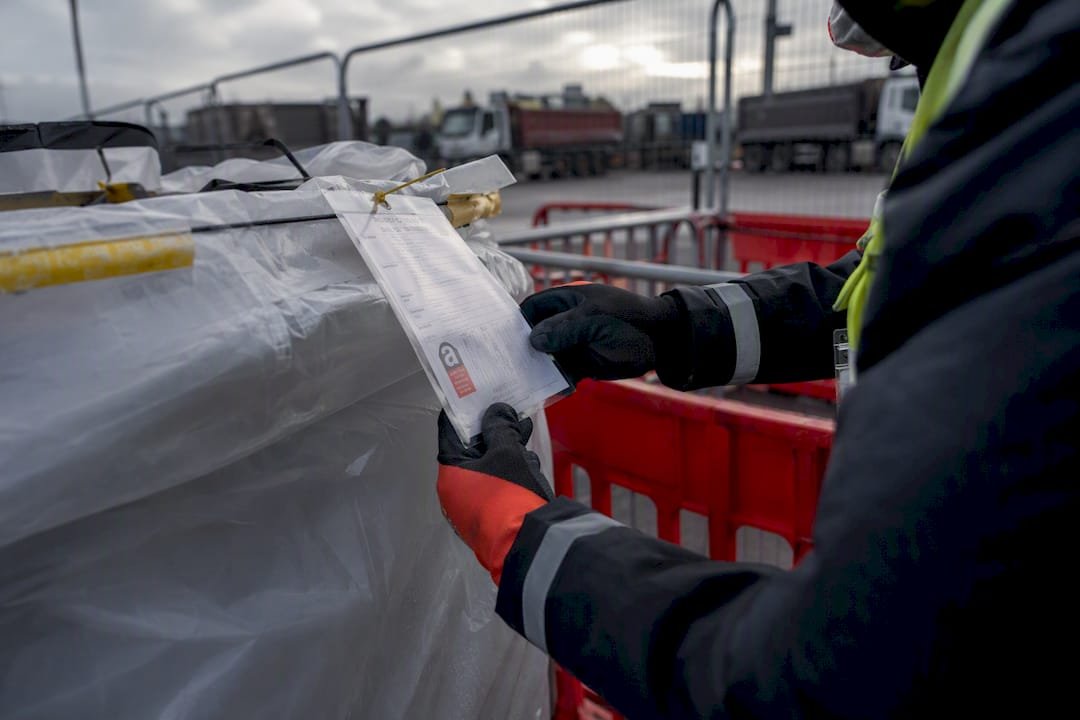
- Post‑work: waste is double‑wrapped, labelled and transported by a licensed carrier to an approved disposal site, with a waste manifest tracking the load. A clearance inspection, and air monitoring where the job warrants it, precedes the clearance certificate that says the area is safe to re‑occupy.
Heavily painted panels deserve extra care during removal. Repeated coats of paint over the years can make old asbestos cement brittle, and it’s more prone to snapping unexpectedly than a bare or lightly painted sheet.
A quote that skips air monitoring, clearance inspection, or licensed disposal isn’t a bargain. It’s an incomplete job wearing a cheaper price tag.
Estimated costs and timeframes for testing and eaves removal
Price depends heavily on whether the material is bonded or friable, the total area in square metres, how hard the eaves are to access, and whether you’re replacing the removed panels with new lining.
-
Sampling and lab testing: a modest fixed fee, with results generally back within days
-
Small patch removal (a single damaged section): the cheapest tier of removal work
-
Full perimeter eaves removal on a standard single‑storey home: a mid‑range job, priced per square metre
-
Removal plus new fascia and soffit lining: costs more but avoids a second trade visit later
-
Bonded removal costs considerably less than friable removal, which needs full containment and air monitoring on top of the base removal work
Two‑storey homes and properties needing scaffolding cost more and take longer, largely because of the access work rather than the asbestos removal itself. Always ask for an itemised quote that separates testing, removal, disposal and clearance, so you can see exactly what you’re paying for.
How to choose a licensed asbestos removal contractor
A good contractor won’t hesitate when you ask the right questions, and a hesitant answer is often the clearest red flag going.
- Ask for their licence class (A or B) and confirm it covers the scope of your job.
- Request a written safe work method statement and proof of current insurance.
- Confirm how they’ll run the clearance process, and who issues the clearance certificate.
- Get an itemised written quote covering sampling, removal, licensed waste transport and clearance inspection as separate line items.
- Walk away from vague scopes, unusually low prices, refusal to share a licence number, or no clear plan for safe access at height.
Once the job’s done, keep the lab report and clearance certificate with your property records. They matter if you sell, renovate further, or need proof of compliance down the track.
Pro Tip: A missing waste manifest is one of the easiest ways to spot non-compliant disposal. Ask to see it before you pay the final invoice, not after.
How Missiondemolition approaches every eaves job
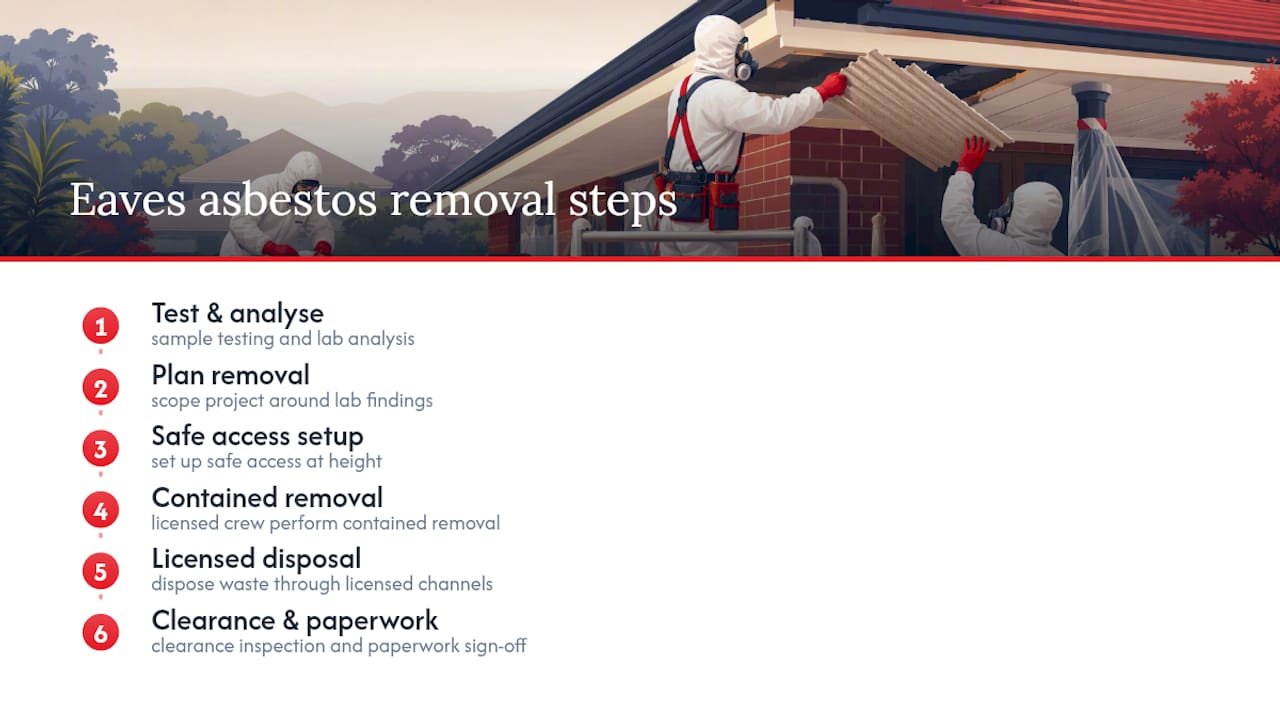
Every eaves job Missiondemolition runs starts the same way: test first, then plan the removal around what the lab actually finds. Our licensed crews handle full project scoping, safe access at height, contained removal and licensed disposal, closing out with the clearance paperwork that protects you at resale or during future renovations. Tarek, who covers asbestos compliance and demolition practice for Missiondemolition, brings that end‑to‑end sequence to every article on this topic.
Why “she’ll be right” is the most expensive mistake in eaves management
Most homeowners either panic about asbestos or ignore it completely, and both reactions cost money. The panic response tears out intact, low‑risk bonded sheeting that could have stayed put for another decade, paying full removal and disposal fees for zero added safety. The ignore response is worse: it lets a slowly deteriorating panel sit through a few more storm seasons until it’s cracking, and now what should have been a routine bonded removal is a friable job with containment and air monitoring stacked on top.
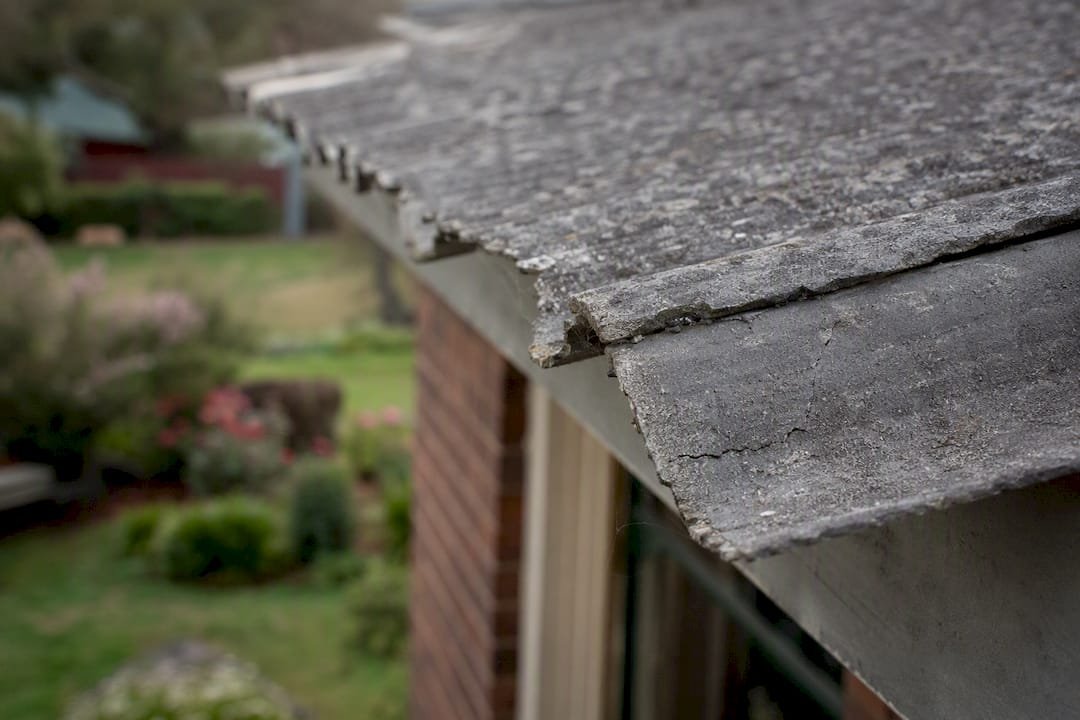
The gap in most advice online is that it treats “asbestos in eaves” as a single risk category. It isn’t. Intact bonded sheeting on a dry, undisturbed soffit is a low‑urgency item to note and monitor. The same material with a hairline crack from a ladder mishap, or thirty years of paint building up brittle layers, is a different job entirely. What actually protects you isn’t fear of the material. It’s knowing which category your eaves sit in, and that only comes from a test, not a guess from the ground.
If there’s one thing worth pushing back on in the standard advice, it’s the blanket call to “get it removed” the moment someone mentions the word asbestos. Removal is the right answer once material is damaged, once you’re renovating the roofline anyway, or once a test confirms friable content. Before that point, a documented, monitored, intact panel is a legitimate long‑term option, not a problem you’re failing to solve.
— Tarek
Get your eaves tested and cleared by a licensed crew
Missiondemolition is the alternative to guessing your way through an eaves problem: our licensed team handles the sampling, the removal, the disposal and the clearance certificate as one coordinated job, not four separate headaches you have to chase down yourself. That matters most on eaves work specifically, where roof access, containment and disposal logistics trip up a lot of one‑off contractors.
A typical enquiry starts with a site visit and sampling, moves to a written quote itemising testing, removal, licensed transport and clearance, then a scheduled removal date once you’ve signed off. We’ll also flag if your job qualifies for a smaller bonded removal versus a full licensed strip, so you’re not paying for more scope than the material actually needs.
If your eaves are cracked, ageing, or due for replacement alongside gutter or fascia work, get in touch with our licensed asbestos removal team for an inspection and a proper written quote.
Sources
For state‑specific rules, check your local asbestos authority, the Safe Work Australia model code, and NATA’s accredited laboratory register before booking any test or removal.
This article is general information, not a substitute for advice from a qualified doctor. Consult a qualified healthcare professional about your own circumstances before acting on anything here.
- Getting an asbestos sample tested
- Asbestos cement soffit panelling (Eaves) — Asbestos Product Guide
- Model Code of Practice: How to safely remove asbestos — Safe Work Australia
