
If you suspect asbestos in your garage, treat the material as asbestos until it is tested, and do not disturb it. Avoid walking on, cutting, drilling, pressure-washing or sweeping the sheets, and arrange a professional inspection. If testing confirms asbestos and removal is needed, hire a licensed removalist rather than tackling it yourself.
TL;DR:
- Grey, fibrous, chalky corrugated sheets and dust in gutters can signal asbestos, especially in buildings predating 1990, but only accredited laboratory testing confirms it.
- Intact bonded cement sheets usually release few fibres, but cutting, drilling, sanding, breaking, or pressure washing can release fibres; keep people and pets away.
- Arrange inspection and sampling before renovations, demolition, or work near damaged sheets, gutters, or nearby soil; a written laboratory report identifies material and condition.
- Most garage roofs exceed small job exemptions once quantity and condition are considered; hire a licensed removalist for higher risk or larger work.
- Asbestos waste must be double wrapped, labelled, and taken to an authorised facility; request itemised quotes because access, scaffolding, licensing, and disposal fees affect costs.
Table of Contents
- How to spot likely asbestos in garages and sheds
- Why asbestos in a garage can be hazardous
- Getting a formal inspection and laboratory testing
- Immediate do’s and don’ts if you suspect asbestos
- When to hire a licensed asbestos removalist
- Disposal requirements and cost factors
- Why a licensed full-service contractor reduces risk
- Our take: don’t let “it looks fine” delay testing
- How we can help with inspection, removal and disposal
- FAQ
- Sources
How to spot likely asbestos in garages and sheds
Garages, sheds and outhouses built before the late 20th century are common places to find asbestos, particularly in the roof and wall sheeting. According to Asbestos Victoria, these structures rank among the most likely spots for asbestos in a typical property, alongside soffits, gutters and eaves.
A few visual clues raise suspicion, though none of them confirm anything on their own:
- Grey corrugated cement sheets with a fibrous, slightly chalky surface
- A building age that predates 1990, when asbestos cement sheeting was still common
- Weathering, cracking or a brittle texture on roof or wall panels
- Dust build-up in gutters beneath corrugated roofing
That last point matters more than most homeowners realise. Corrugated asbestos roofs flex and rub with temperature changes, and the resulting dust often collects in gutters, on nearby surfaces and even in the soil below. Asbestos Victoria is clear that visual inspection cannot confirm whether a material contains asbestos. Colour, corrugation pattern and age are only prompts to get it checked, not a diagnosis.
Why asbestos in a garage can be hazardous
Asbestos fibres are linked to mesothelioma, asbestosis and lung cancer, and mesothelioma can take 10 to 60 years to develop after exposure, according to Healthdirect. That long latency is part of why the material is treated so cautiously even when a garage roof looks fine from the ground.
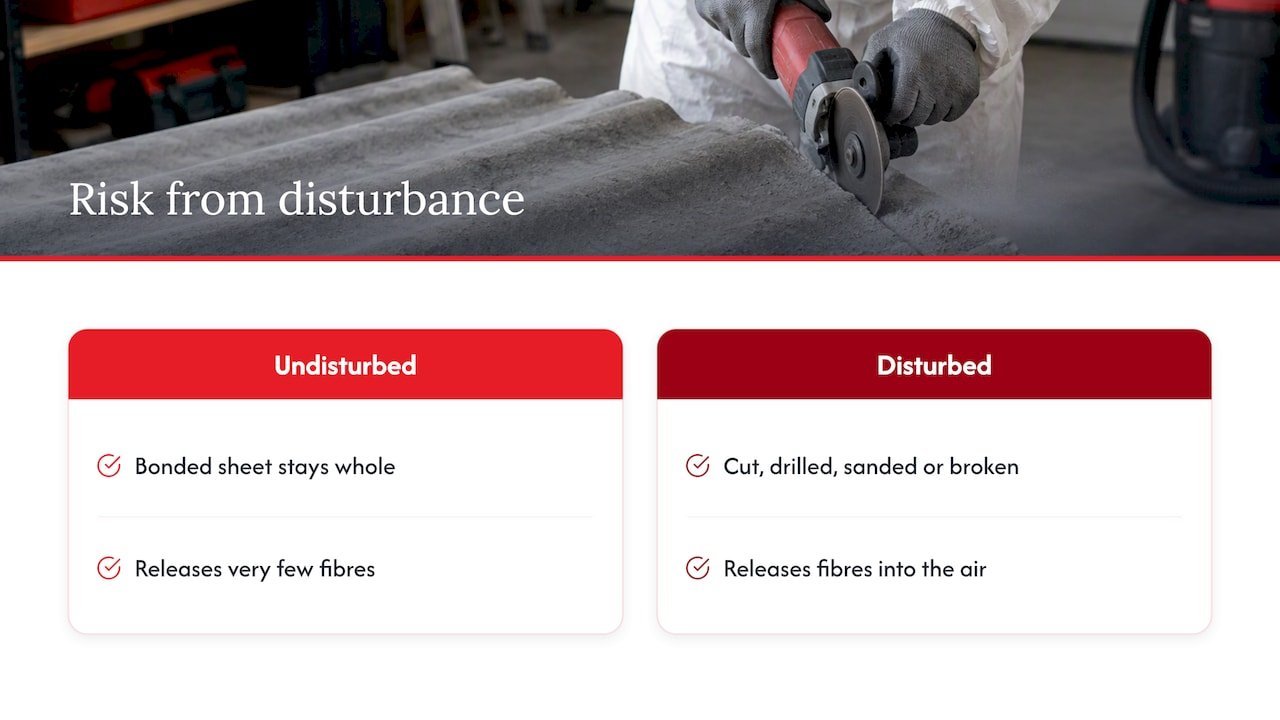
The risk comes from disturbance, not mere presence. Intact bonded cement sheeting generally releases very few fibres while it stays whole and undisturbed. The danger rises sharply once sheets are cut, drilled, sanded, broken or pressure-washed, because those actions release fibres into the air where they can be inhaled.
If you think you have been exposed to asbestos dust, mention it to your doctor rather than waiting to see if symptoms appear. Given the decades-long latency involved, a documented exposure history is worth having on record early.
Getting a formal inspection and laboratory testing
Arrange testing if you notice damaged or weathered sheeting, you are planning a renovation or demolition, or you suspect gutters or soil near the garage are contaminated. A competent assessment generally follows a consistent process:
- A trained assessor conducts a site walk to identify suspect materials and sampling points.
- Samples are collected under chain-of-custody procedures so results can be traced back to the exact location.
- The samples go to a NATA-accredited laboratory for analysis, since only accredited lab testing can confirm whether a material contains asbestos.
- You receive a written report identifying the material and, where relevant, its condition.
Asbestos testing methods for garages and similar structures rely on this lab-confirmed process rather than a tradesperson’s opinion on-site. Skipping it and assuming based on looks alone is the most common mistake homeowners make, and it is also the one with the most serious consequences if they are wrong.
Immediate do’s and don’ts if you suspect asbestos
Until you get a result back, a few simple precautions limit your exposure and stop the problem from spreading.
- Keep people and pets away from the garage and close doors and windows to limit airflow
- Avoid touching, moving or leaning anything against suspect sheeting
- If dust is visible and you must reduce it urgently, a light water mist can help suppress fibres, applied without force
- Cover gutters or exposed soil nearby to limit contamination spreading further
- Tell neighbours in advance if any work near the garage might generate dust
Just as important is what to avoid. Do not drill, cut, sand, pressure-wash or dry-sweep suspect material, and do not use a household vacuum cleaner on any asbestos dust or debris, since standard vacuums spread fine fibres rather than containing them, as Asbestos Victoria notes. Corrugated asbestos roofs are also fragile underfoot, so stay off the roof entirely.
Pro Tip: If you need to contain loose fragments temporarily, use heavy plastic sheeting weighed down at the edges rather than taping directly onto the material.
When to hire a licensed asbestos removalist
Licensing in Australia distinguishes between non-licensed work on small amounts of non-friable material and the Class A and Class B licensed removal required for larger or more hazardous jobs, as outlined by SafeWork NSW. Most garage roofs and wall sheeting fall outside the small DIY exemptions once you factor in quantity and condition, which is why licensed removal is the safer default.
A proper removal job usually follows this sequence, often coordinated alongside specialist retaining wall removal and earthmoving services:
- A risk assessment of the site, access and material condition.
- Where required, an asbestos removal control plan setting out methods and controls.
- Wet removal techniques to suppress dust, using hand tools rather than power tools on bonded sheeting.
- Containment of the work area, double-wrapping of removed material and on-site decontamination.
- Lawful transport of waste to an authorised disposal facility.
When comparing licensed removal quotes, ask each contractor for evidence of their licence, the disposal site they use, proof of insurance, whether clearance testing is included, and exactly what the quoted price covers.
Disposal requirements and cost factors
Asbestos waste must be double-wrapped in heavy-duty plastic, labelled and transported to an authorised asbestos landfill facility, since not every tip is licensed to accept it. Our guide to legal asbestos disposal covers the packaging and transport rules in more detail.
Costs vary with the area and volume of material, how accessible the roof or wall is, whether the job needs a Class A or Class B licence, whether scaffolding is required, and local disposal fees. Clearance testing after removal adds a further cost but confirms the site is safe to re-occupy.
When comparing quotes, ask for an itemised breakdown covering testing, removal, transport and disposal separately, since a single lump figure makes it hard to tell whether two quotes are actually comparable.
Why a licensed full-service contractor reduces risk
Coordinating testing, removal, transport and disposal across separate providers increases the chance that something falls through the gaps, including cross-contamination between stages. Working with one licensed contractor for the whole job centralises that risk, produces the compliance paperwork you will need later, and handles neighbour and site notifications as part of the process rather than leaving them to you.
Our take: don’t let “it looks fine” delay testing
The biggest gap we see between homeowner instinct and good practice is patience with uncertainty. People want a quick visual answer: is it asbestos or isn’t it. That answer does not exist without a lab result, and chasing it by scraping, drilling or pressure-washing a suspect sheet to “check” is how a low-risk situation turns into an airborne one.
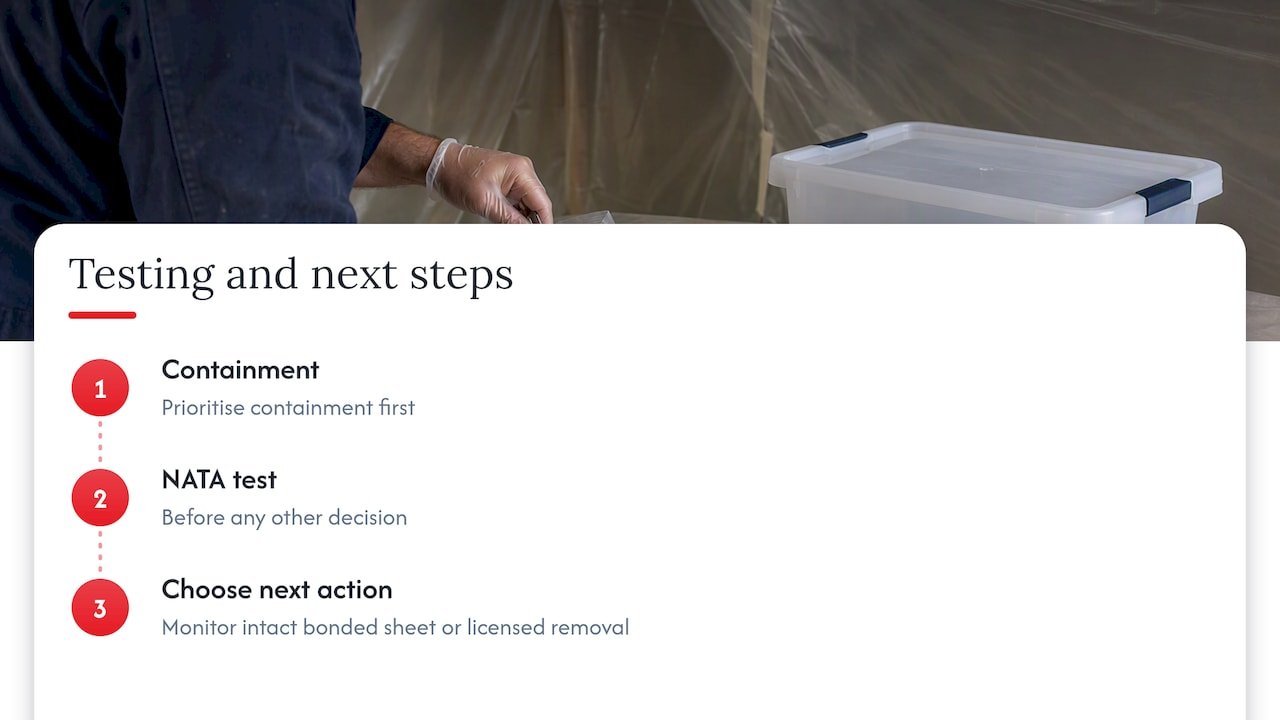
The conventional advice to “get it tested eventually” undersells the urgency. If a garage roof or wall is weathered, cracked, or due for any renovation work, testing should happen before any other decision, not after plans are already made. Prioritise containment first, a NATA-accredited test result second, and only then decide between monitoring an intact bonded sheet or arranging licensed removal.
What gets overrated is the idea that age or appearance settles the question. What gets underrated is how much a documented, lab-confirmed result simplifies everything that follows, from insurance conversations to future property sales.
— Tarek
How we can help with inspection, removal and disposal
We handle asbestos garage removal from the first site visit through to lawful disposal, so you are not left coordinating testing, removal and transport across separate contractors. Our team manages:
- Site visits and a written quote before any work starts
- Licensed removal using containment, wet methods and decontamination
- Lawful transport and disposal at an authorised facility
- Compliance paperwork and clearance documentation for your records

If you suspect asbestos in a garage, shed or outbuilding, get in touch for an inspection or quote and we will talk you through what the job involves before anything is scheduled.
This article is general information, not a substitute for advice from a qualified doctor. Consult a qualified healthcare professional about your own circumstances before acting on anything here.
FAQ
How much would it cost to replace an asbestos roof?
Replacement cost depends on roof size, access, whether the job is Class A or B licensed work, scaffolding needs and local disposal fees, so prices vary considerably between properties. Request an itemised quote covering testing, removal, transport and disposal so you can compare contractors on the same basis.
What are the three forms of asbestos?
Asbestos exposure is linked to serious diseases including mesothelioma, asbestosis and lung cancer, with mesothelioma sometimes developing 10 to 60 years after exposure, according to Healthdirect. Rather than focusing on fibre types, homeowners are better served by treating any suspect material the same way: assume it is asbestos until a lab confirms otherwise.
What does corrugated asbestos look like?
Corrugated asbestos cement sheeting typically appears grey, fibrous and slightly chalky, often on roofs or walls built before 1990. Appearance alone cannot confirm asbestos content, so a visual match should prompt testing rather than a final conclusion, as Asbestos Victoria notes.
What are the rules on asbestos?
Rules vary by state and territory, but they generally require licensed removal for larger or higher-risk jobs, proper containment and wet removal methods, and disposal only at authorised facilities, as set out by SafeWork NSW. Before any demolition or major renovation, an asbestos survey is generally expected as part of standard compliance.
Sources
- Asbestos Victoria — asbestos and where it may be found
- Healthdirect — asbestosis (and related asbestos disease guidance)
- SafeWork NSW — working as a licensed asbestos removalist (licensing overview)
