A standard residential asbestos inspection in Australia typically runs from around $300 to $900, depending on property size and how many samples get tested. NATA-accredited lab analysis of each sample costs between $40 and $140, on top of the inspector’s callout fee. A full survey with a written asbestos register sits at the higher end; a quick presumptive check sits at the lower end.
TL;DR:
- Most residential asbestos inspections in Australia cost between $300 and $900, heavily influenced by sample quantity and property scope.
- The biggest cost driver is the number of samples needed, which depends on property age, structure complexity, and renovation history.
- Lab analysis from a NATA-accredited facility costs $40 to $140 per sample, and proper documentation is essential for results to hold up officially.
- DIY sampling is discouraged due to health risks and the likelihood of invalid results, making professional inspection the safest choice.
- Clear scope, fixed sample count, and a named lab in the quote prevent scope creep and unexpected charges during inspection and removal.
Table of Contents
- Asbestos inspection cost ranges: what a quote should look like
- What actually drives the price up or down
- The main types of asbestos inspections explained
- Why NATA lab accreditation matters more than the price tag
- Should you collect the sample yourself?
- Comparing quotes without getting stung
- What your report should contain, and what happens if asbestos turns up
- A straight answer from someone who’s seen the quotes go both ways
- Get a scoped quote from Mission Demolition
- Where to check the official guidance yourself
- Sources
Asbestos inspection cost ranges: what a quote should look like
A presumptive visual inspection, where an assessor walks the property and flags suspect materials without lab testing, generally costs a few hundred dollars. It’s the cheapest option but gives you the least certainty.
A proper sampling visit with lab analysis is where most homeowners land, and pricing tends to follow property size:
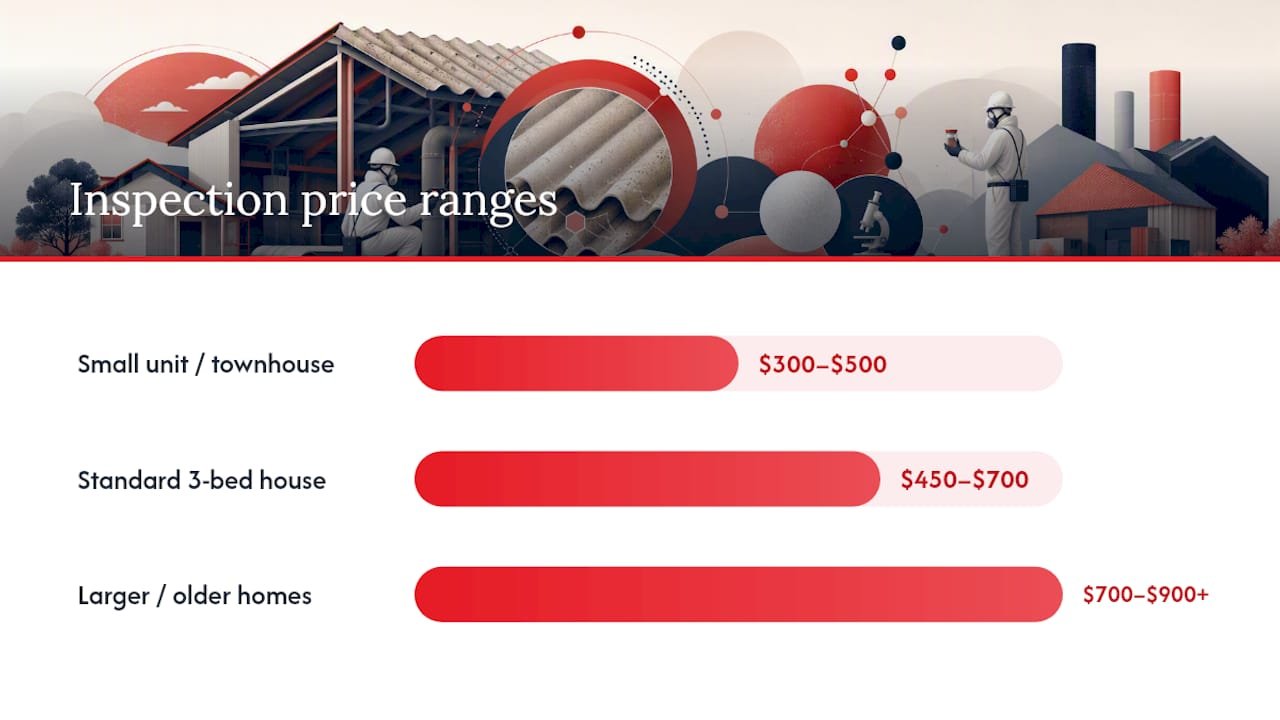
- Small unit or townhouse: $300 to $500, covering a handful of samples
- Standard three-bedroom house: $450 to $700, often 5 to 10 samples
- Larger homes or pre-1990 properties with more building materials: $700 to $900+, sometimes with 15 or more samples
A full survey with a formal asbestos register for a larger or older property can be more expensive, particularly when the roof space, subfloor, and outbuildings all need separate sampling. Some Sydney providers advertise inspections starting from a few hundred dollars for straightforward jobs, with full surveys climbing well beyond that once scope and sample count increase.
Most reputable quotes include GST and a stated travel radius. If a quote looks unusually cheap, check whether GST and travel are added separately afterwards. That gap is where a “budget” quote quietly becomes an expensive one.
What actually drives the price up or down
Two houses of identical size can attract wildly different quotes, and it almost always comes down to scope, not the inspector’s hourly rate.
Sample count is the biggest lever. Assessors group similar materials into “homogeneous areas” (all the fibro sheeting on one wall, for example) and take one sample per area. A house with mixed renovations, multiple flooring types, and several outbuildings needs more samples than a single-era brick veneer, and each sample adds a lab fee on top of the callout.
Other factors that move the number:
- Property age and construction type — pre-1990 homes with fibro cladding, vinyl tiles, or old eaves linings usually need more samples than newer builds
- Access difficulty — tight subfloors, high roof spaces, or asbestos hidden behind wall linings add time and sometimes require specialist access equipment
- Turnaround time — faster lab results carry a premium, often 24 to 48 hour rush fees
- Remoteness — regional and rural properties often pay a travel surcharge
- Inspector accreditation level — a licensed assessor doing a basic sample collection charges less than a certified asbestos management planner writing a full register
Pro Tip: Ask upfront how many homogeneous areas the inspector expects to sample before they arrive. A vague answer here is usually where scope creep starts.
The main types of asbestos inspections explained
Not every property needs the same service, and knowing which one to ask for stops you paying for more than you need.
-
Visual or presumptive inspection. An assessor inspects accessible areas and identifies materials likely to contain asbestos based on appearance, age, and known building patterns. No lab testing is involved, so it’s fast and cheap but carries genuine uncertainty. Fine for early due diligence, not fine for renovation planning.
-
Sampling visit with lab analysis. The assessor physically collects small samples from suspect materials, bags and labels each one with a chain-of-custody record, and sends them to a NATA-accredited lab. Most residential jobs land here, with anywhere from three to fifteen-plus samples depending on the property.
-
Full asbestos survey and register. A comprehensive inspection covering every accessible area, producing a formal asbestos register with photographs, sample locations, and material condition ratings. Commonly requested before major renovations, demolitions, or by property managers for ongoing compliance.
-
Clearance testing. Conducted after removal work to confirm the site is safe for reoccupation. This is charged as a separate engagement, priced by air monitoring and site size rather than sample count.
Why NATA lab accreditation matters more than the price tag
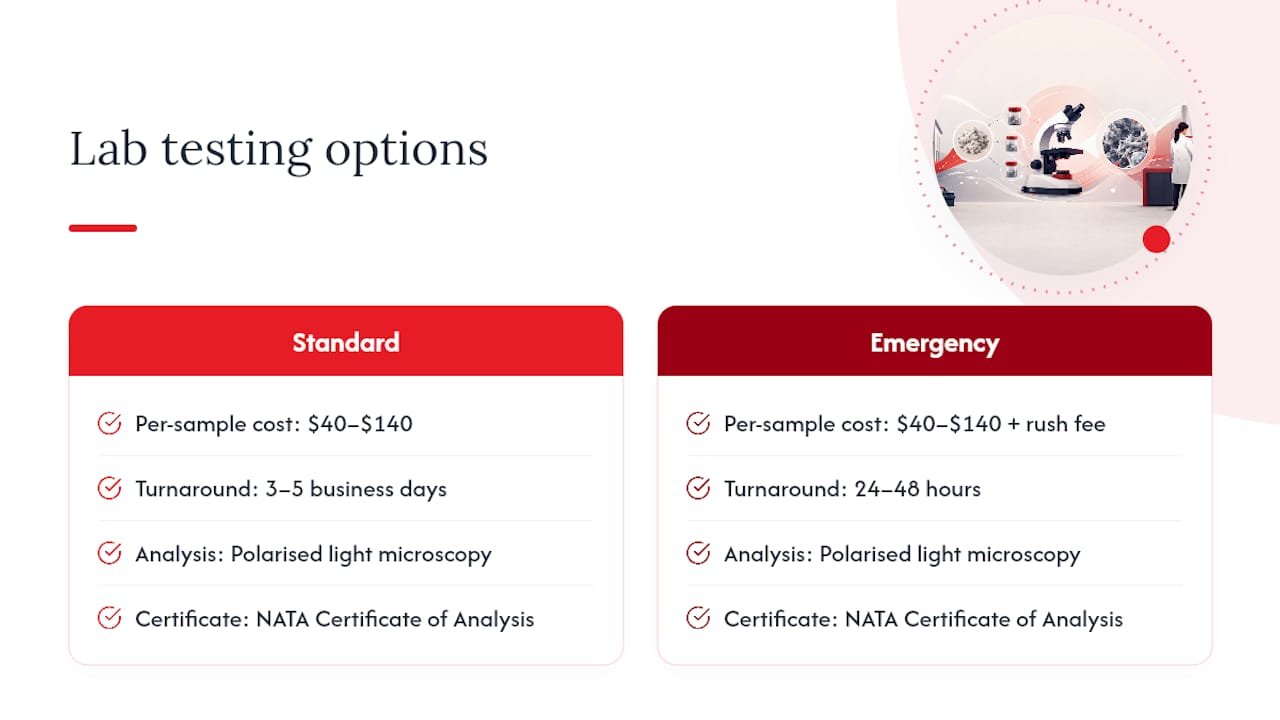
Every legitimate quote should name the NATA-accredited laboratory doing the analysis, because per-sample lab costs typically fall between $40 and $140 and that figure covers polarised light microscopy analysis and a formal Certificate of Analysis.
That certificate isn’t paperwork for its own sake. NATA accreditation and a proper Certificate of Analysis are treated as the standard for any result that needs to hold up with lenders, insurers, or regulators. A result from an unaccredited lab, or one missing a chain-of-custody record, can be worthless the moment you need it for a property transaction or a compliance audit. Standard turnaround runs three to five business days; emergency testing within 24 to 48 hours usually adds a rush fee on top of the base per-sample rate.
Should you collect the sample yourself?
You can buy a DIY asbestos test kit online, but that doesn’t mean it’s a good idea. Government guidance is blunt on this: asbestos cannot be reliably identified by sight, and professional sampling with NATA lab analysis is the recommended path before any renovation or demolition work begins.
The real risks of DIY sampling include:
- Disturbing friable material and releasing airborne fibres into your own home
- Cross-contaminating samples, which can invalidate the lab result entirely
- Missing hidden materials that a trained assessor knows to check
- Some labs refusing to accept self-collected samples without a documented chain of custody
If you do collect a sample yourself, most labs will only accept it with strict packaging and documentation requirements, and many simply won’t process it at all. The few dollars saved rarely justifies the exposure risk or the chance of an unusable result.
Comparing quotes without getting stung
Two quotes for the same house can differ by hundreds of dollars, and the sample-count rules and inspector scope are usually why. Before you sign anything, run through this checklist:
- Confirmed sample count, not a vague “as required” line
- Named NATA-accredited laboratory, with accreditation number visible on the report
- Chain-of-custody documentation for every sample collected
- Clear deliverables — will you get a written report, photos, and a register, or just a phone call?
- Contractor’s insurance and licences, especially if removal work might follow
Red flags worth walking away from: no fixed sample count, a lab that won’t be named until after you’ve paid, or a “report” that turns out to be a one-page email. A scoped fixed-fee quote that itemises everything upfront protects you from scope creep far better than a cheap per-sample rate with no ceiling.
Pro Tip: If a quote seems too good to be true, ask exactly how many samples are included in that price. Vague answers usually mean extra invoices later.
It’s also worth budgeting for what happens after the inspection. If asbestos turns up, removal costs can factor in several variables that are worth understanding before you commit to a renovation timeline.
What your report should contain, and what happens if asbestos turns up
A proper report names the exact location of every sample, includes the lab’s Certificate of Analysis, states the material category (bonded or friable), and gives clear recommendations, whether that’s leave it alone, encapsulate it, or remove it.
If results come back positive, here’s what typically follows:
- Management plan — for bonded, undamaged material that can stay in place safely, often a separate document from the inspection report
- Removal quote — for material that needs to go before renovation or demolition proceeds
- Clearance testing — booked once removal is finished, confirming the site is safe to reoccupy
Removal costs vary enormously depending on material type and quantity, from a few hundred dollars for a small bonded item to several thousand for extensive friable asbestos. Mission Demolition can provide a scoped removal quote once your inspection report identifies exactly what needs handling.
A straight answer from someone who’s seen the quotes go both ways
Most homeowners fixate on the per-sample fee and miss the bigger cost driver, which is scope creep from an inspection that wasn’t properly defined from the start. A $300 quote that balloons to $700 because “more samples were needed on site” is far more common than an inspector deliberately overcharging.
The fix isn’t finding the cheapest number on a page. It’s asking for a fixed sample count and a named NATA lab before you book, then holding the inspector to that scope. Government guidance from SafeWork NSW on licensing exists precisely because unlicensed or under-scoped work causes real harm, not paperwork delays. Mission Demolition has coordinated inspections and licensed removals across thousands of Sydney properties, and the pattern holds every time: the clients who ask hard questions upfront pay less overall, not more.
— Tarek
Get a scoped quote from Mission Demolition
Mission Demolition is the straightforward alternative to chasing quotes from three different inspectors and a separate removal contractor. We coordinate NATA-accredited testing, interpret the results in plain English, and hold a licensed asbestos removal permit under SafeWork NSW rules, so the same team that tells you what’s there can also handle it if removal is needed.
Before you call for a quote, have your property’s approximate age, the areas you’re planning to renovate, and any known building materials (fibro sheeting, old vinyl flooring, roof type) ready. It cuts down the back and forth, and gets you a more accurate scope on the first call. If you’re planning renovation work and want the inspection and any follow-up removal handled by one accountable team, get in touch through our asbestos removal Sydney page and we’ll walk you through what your property likely needs before you commit to anything.
Where to check the official guidance yourself
- Getting an asbestos sample tested — Asbestos NSW’s testing and per-sample cost guidance
- SafeWork NSW asbestos and demolition licence holders — licensing requirements for removal contractors
- Asbestos and your home — national consumer guidance from the Asbestos Safety and Eradication Agency
- Mission Demolition — for a scoped inspection or removal quote in Sydney
Sources
- Getting an asbestos sample tested | Asbestos NSW
- SafeWork NSW asbestos and demolition licence holders
- Asbestos and your home | Asbestos Safety and Eradication Agency
