
If your workplace was built or had materials installed before the jurisdictional cutoff dates, or there’s any reason to suspect asbestos is present, the person with management or control must prepare and keep an asbestos register. If no asbestos is identified after checking, that finding still has to be recorded in writing. Check your building’s construction date first, then book a competent person to survey the site if you’re not certain either way.
TL;DR:
- The asbestos register must include the date of identification, precise location, material type, and condition rating for each asbestos-containing material.
- Any suspected asbestos areas inaccessible during surveys are logged as presumed asbestos until tested and confirmed otherwise.
- The register remains current with regular reviews triggered by material disturbance, work planning, or safety requests, ideally every five years but sooner if needed.
- Responsible parties, such as property owners or managers, must engage a competent person for surveys and ensure all contractors access the register before starting work.
- In cases of asbestos removal or damage, a licensed asbestos removalist must handle the task, and clearance certificates should be documented and added to the register.
Table of Contents
- Asbestos register requirements: what the law actually demands
- Who has to prepare it: PCBUs, managers, and the competent person
- What a compliant asbestos register must record
- Reviewing and labelling: keeping the register alive, not archived
- Sharing the register and connecting it to your asbestos management plan
- A working checklist and when to call in the professionals
- Where to check the exact rules for your state
- Sources
- FAQ
Asbestos register requirements: what the law actually demands
An asbestos register is a written safety document listing every identified or assumed asbestos‑containing material (ACM) at a workplace, along with its location and condition. It exists so that nobody drills, cuts, or demolishes into asbestos without knowing it’s there.
The model Work Health and Safety Regulations, adopted in every jurisdiction except Victoria, set the legal baseline. In practice, most guidance points to buildings constructed or with materials installed before the 2000s as the trigger for needing a register, though the exact cutoff varies by state and material type. Victoria runs its own asbestos framework outside the model WHS system, so checking the local regulator matters more than relying on a national rule of thumb.
A quick way to test whether the requirement for asbestos surveys and a register applies to you:
- The building or plant was constructed, or had materials installed, before the relevant jurisdictional cutoff.
- You have reasonable grounds to suspect asbestos is present, regardless of build date.
- Renovation, demolition, or refurbishment work is planned that could disturb old materials.
If none of that applies and there’s no reasonable basis to suspect asbestos, you’re exempt from keeping a full register. You still need a documented statement confirming that no asbestos or ACM has been identified. Skipping that step is one of the most common compliance gaps property managers get caught on.
Who has to prepare it: PCBUs, managers, and the competent person
The legal duty sits with the “person conducting a business or undertaking” (PCBU) or whoever holds management or control of the workplace. That’s usually the property owner, but it can shift to a tenant, facilities manager, or head contractor depending on the lease or contract. Whoever holds that control is responsible for making sure a register exists, gets reviewed, and stays accurate.
You don’t have to identify asbestos yourself. Safe Work Australia’s guidance recommends engaging a competent person, someone with the training, experience, and equipment to identify suspect materials, take samples safely, and interpret NATA‑accredited laboratory results.
Commissioning a survey typically follows this sequence:
- Contact a qualified asbestos assessor or a licensed asbestos survey provider and describe the building’s age and use.
- The assessor inspects visually, samples suspect materials, and sends them to a NATA‑accredited lab.
- You receive a report with labelled photos, sample results, and a condition rating for each material found.
- Any area the surveyor couldn’t safely access gets logged as inaccessible and treated as presumed asbestos until proven otherwise.
Pro Tip: Ask your surveyor for digital, geo‑tagged photos of every sample point. It saves enormous time on the next review and gives contractors an instant visual reference before they start cutting into a wall.
What a compliant asbestos register must record
A compliant register needs four mandatory fields for every entry: the date asbestos was identified or assumed, a precise location description (not just “roof” but “eastern roof sheeting, bay 3”), the type of asbestos or ACM, and a condition assessment (good, fair, or poor).
Beyond the mandatory fields, a stronger register usually includes:
- Labelled photographs showing exactly where each sample was taken.
- A site plan overlay marking asbestos locations against the building layout.
- Laboratory results confirming material type.
- A record of any areas that were inaccessible during the survey.
- History of any removal work and the clearance certificates that followed.
Practical survey deliverables like a simple condition rating scale and a version history showing who updated which entry and when make the difference between a register that gets ignored and one contractors actually trust.
Storage format is your choice. Some businesses still keep a paper folder in the site office; others use a shared drive or an online database with QR codes linking straight from a wall label to the digital record. Whichever format you pick, keep one master version and a clear audit trail of edits. A register with three conflicting copies floating around different email inboxes defeats the entire purpose.
Reviewing and labelling: keeping the register alive, not archived
An asbestos register has to be reviewed regularly, but several events force an earlier update:
- Asbestos is removed, disturbed, or sealed.
- Refurbishment or demolition work is planned for an area containing ACM.
- A health and safety representative or the PCBU requests a review.
- New areas become accessible that were previously unchecked.
WorkSafe Victoria treats the five‑year mark as a maximum, not a target, precisely because conditions can change well before then. Updating an entry doesn’t always mean a full re‑survey, sometimes a visual inspection and updated photos are enough, but any material disturbance or new suspect area warrants bringing a competent person back in.
Labelling matters just as much as the paperwork. Where it’s reasonably practicable, physically label known ACM on-site with signage, and back it up with a QR code or online link to the full register entry.
Pro Tip: Put labels at eye level near access points, not just on the material itself. A tradesperson opening a roof hatch needs to see the warning before they’re standing next to the asbestos, not after.
Sharing the register and connecting it to your asbestos management plan
The register has to reach anyone whose work could disturb asbestos, and it has to reach them before work starts, not after the first cut is made. That includes:
- Contractors and tradespeople engaged for renovation, maintenance, or demolition.
- Licensed asbestos removalists brought in for remediation work.
- Any other PCBU carrying out work at the site, including subcontractors.
Once asbestos is identified, the register becomes the foundation for a written asbestos management plan, which sets out control measures, emergency procedures, and who’s responsible for what. WorkSafe WA’s guidance treats the register and the AMP as a pair, one identifies the hazard, the other controls it.
If the property changes hands or management shifts to a new PCBU, the register transfers with the workplace. It stays put, gaps in a handover are exactly how contractors end up disturbing asbestos nobody warned them about.
A working checklist and when to call in the professionals
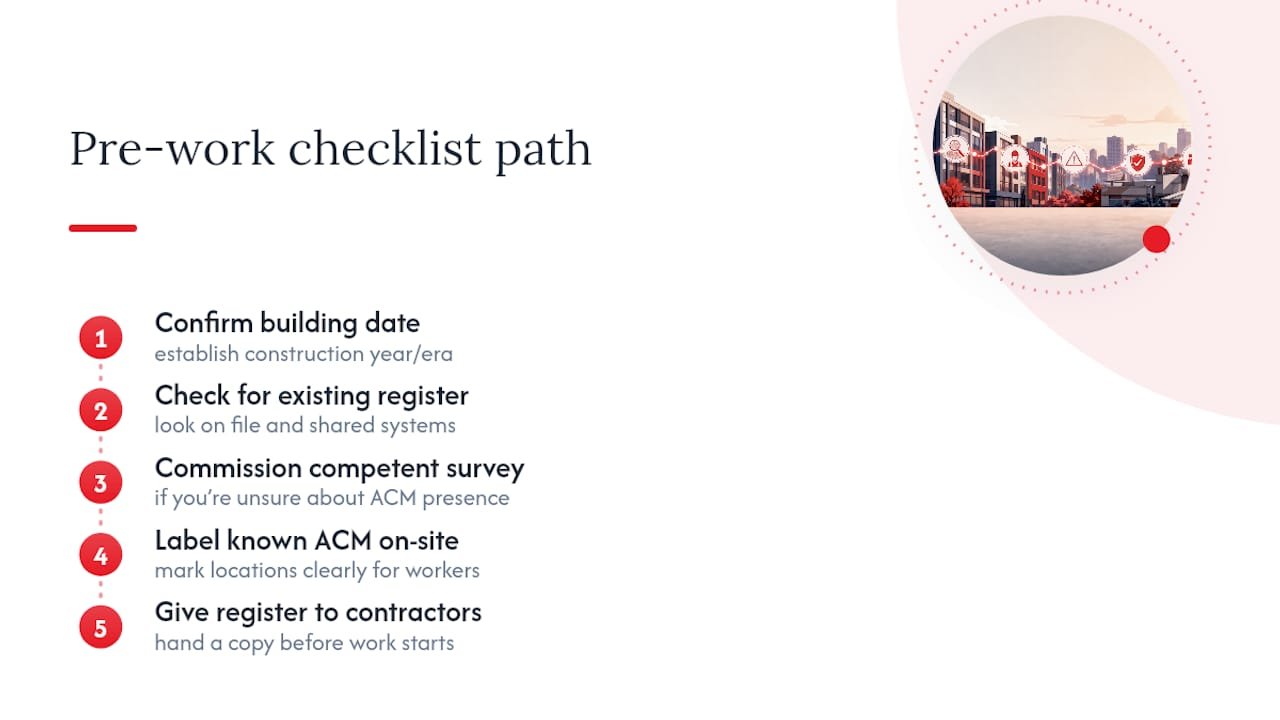
Run through this before anything else: confirm the building’s construction date, check whether a register already exists on file, commission a competent person’s survey if you’re unsure, label any known ACM on-site, and hand a copy of the register to every contractor before they start work.
Companies experienced in demolition and asbestos jobs report that sites with an up-to-date, accessible register move faster and safer than sites where the paperwork gets found halfway through a job. A live, shared register beats a static PDF sitting in a drawer, every time.
If your survey turns up friable asbestos, damaged ACM, or material in an area you’re about to demolish or renovate, that’s the point to bring in a licensed asbestos removalist rather than handling it yourself. A compliant job ends with a clearance certificate confirming the area is safe, and that certificate becomes part of your register’s history. Missiondemolition’s asbestos removal services cover exactly this handoff, from initial survey through to a documented, compliant clearance.
— Tarek
Where to check the exact rules for your state
Start with Safe Work Australia’s asbestos registers guide and the model Code of Practice for templates and legal wording. Then check your own regulator, SafeWork NSW, WorkSafe WA, or WorkSafe Victoria, since Victoria’s rules sit outside the model WHS framework.
Sources
- Asbestos registers guide — Safe Work Australia (August 2023)
- Asbestos register and asbestos management plan — WorkSafe WA (24 Nov 2024)
- Asbestos registers and management plans — SafeWork NSW
- Use asbestos registers to help keep workplaces safe — WorkSafe Victoria
FAQ
What should be in an asbestos register?
Every entry needs the date asbestos was identified or assumed, a precise location, the material type, and a condition rating. Photos, lab results, and a record of inaccessible areas strengthen the register but aren’t strictly mandatory.
What are the asbestos register requirements in Western Australia?
WA follows the model WHS framework: if asbestos is present, assumed, or likely to appear at the workplace, you must prepare a register and, once asbestos is confirmed, an asbestos management plan as well.
What are the requirements for an asbestos report or survey?
A competent person should inspect the site, sample suspect materials, and send them to a NATA‑accredited laboratory for testing. Any area they can’t safely access should be logged as inaccessible and treated as presumed asbestos until confirmed otherwise.
How often does an asbestos register need reviewing?
At least every five years, and sooner if asbestos is removed, disturbed, sealed, or if refurbishment or demolition work is planned for an area containing ACM.
Who has to receive a copy of the asbestos register?
Any contractor, tradesperson, or PCBU carrying out work that could disturb asbestos must be given the register before work starts, not after.

One Response