
Most small residential asbestos removals involve 1–5 days of active work on site, but the full process from inspection to official clearance commonly runs 2–4 weeks for a typical Australian home. That gap catches a lot of homeowners off guard. The contractor who quotes “one day” is usually talking about the hours they spend physically removing material, not the inspection, lab results, regulatory notifications, clearance air monitoring, and disposal paperwork that bookend the job.
Three things move the needle most:
- Material type: friable asbestos (loose, crumbly, airborne-capable) requires a Class A licence and more stages than bonded non-friable work
- Quantity and location: a single sheet of fibro on a fence is a different project from pipe lagging inside a wall cavity
- Lab and clearance delays: NATA-accredited lab turnaround and independent air monitoring results are outside anyone’s direct control
Safe Work Australia’s Model WHS Regulations set the national framework that state regulators like SafeWork NSW build their licensing and notification rules on. Missiondemolition operates under those rules on every job.
Pro Tip: Book your follow-on trades (tilers, painters, plasterers) at least two weeks after your planned removal date, not the day after. Lab results and clearance certificates take time, and a failed clearance adds another 2–5 days before anyone else can re-enter the work zone.
Key takeaways
Most residential asbestos removal projects in Australia run 2–4 weeks from inspection to clearance certificate, even when active removal takes only 1–5 days.
| Point | Details |
|---|---|
| Full timeline vs active removal | Active removal takes 1–5 days; the full inspection-to-clearance process typically runs 2–4 weeks. |
| Notification buffer | NSW requires up to 5 business days’ notice before licensed removal starts; factor this into your schedule before booking trades. |
| Lab turnaround impact | PLM/PCM results take 24–72 hours; TEM can take 1–5 business days; each failed clearance adds 2–5 days. |
| Clearance before reoccupation | No one should re-enter a work zone until an independent clearance certificate is issued in writing. |
| Missiondemolition | Handles licensed removal, ARCP, independent monitoring, and disposal under one contract, with confirmed timelines from the first inspection. |
Table of Contents
- What does the asbestos removal timeline look like, stage by stage?
- Day-by-day example timelines for small, medium, and complex jobs
- What factors make the asbestos removal timeline longer or shorter?
- How does testing, lab analysis, and clearance work in Australia?
- How to schedule your renovation around asbestos removal
- How does the timeline affect what you pay?
- Are there alternatives to removal, and how do they affect timing?
- Missiondemolition: Australian timelines, compliance, and real project examples
- What actually causes schedule surprises on asbestos jobs
- Missiondemolition makes the booking process straightforward
- Sources
What does the asbestos removal timeline look like, stage by stage?
Each stage has its own time window, and they stack sequentially. You cannot skip ahead.
Inspection and sampling
An accredited asbestos assessor visits the site, collects bulk samples from suspect materials, and sends them to a NATA-accredited laboratory. On-site time is typically 1–3 hours for a standard home. Lab turnaround depends on the method: PLM (polarised light microscopy) and PCM (phase contrast microscopy) results usually come back within 24–72 hours; TEM (transmission electron microscopy), used for low-level clearance work and some friable jobs, can take 1–5 business days unless you pay for a rush service.
Asbestos removal control plan and regulatory notifications
Once lab results confirm asbestos is present, the licensed contractor prepares an Asbestos Removal Control Plan (ARCP). This document covers containment methods, PPE requirements, decontamination procedures, and disposal routes. Preparing and reviewing an ARCP adds days to the pre-removal schedule, particularly on complex jobs. Under the Model WHS Regulations, licensed removalists must notify the relevant state regulator before starting certain classes of work. In NSW, SafeWork NSW requires five business days’ notice for licensed asbestos removal work. That notification window alone can add a week to your schedule if you have not planned for it.
Containment and site setup
Contractors seal off the work area with polyethylene sheeting, establish decontamination units (showers, change areas), and set up negative-pressure HEPA filtration where required. For a single room, setup takes half a day to a full day. A multi-room or whole-house job can take 1–2 days just to establish containment properly.
Active removal
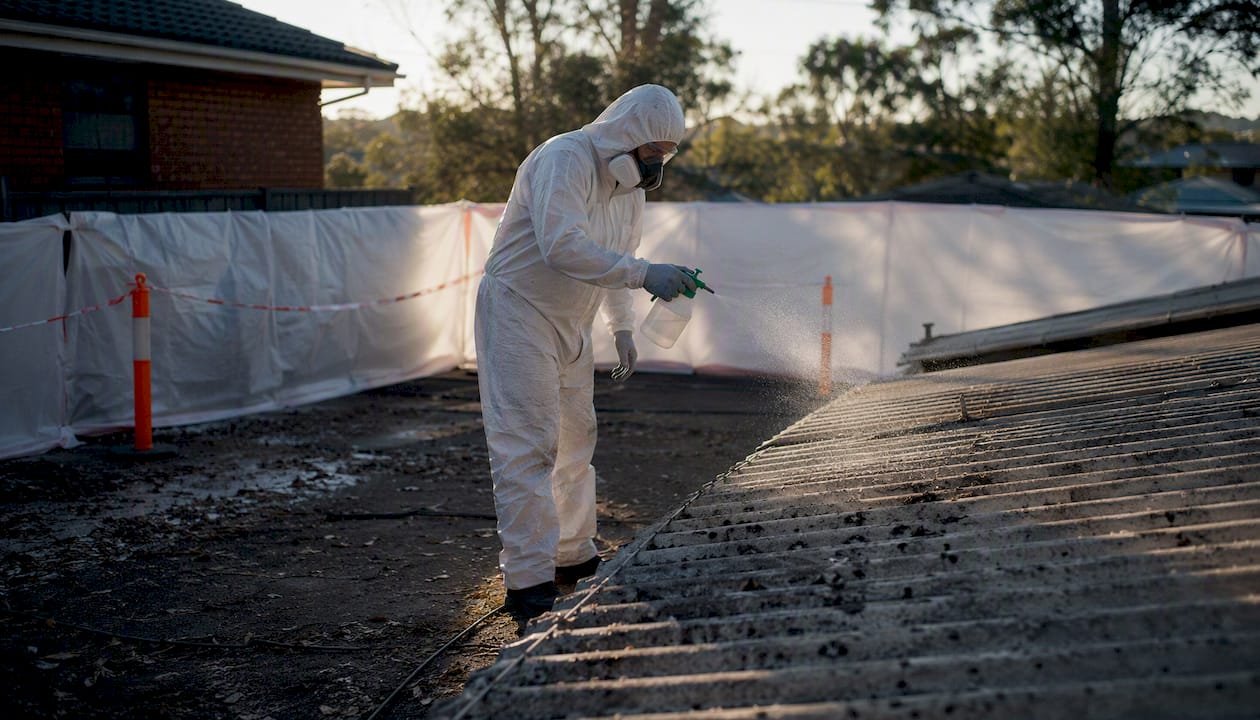
Non-friable materials (bonded fibro sheeting, floor tiles, roof sheeting) are wet-cut or carefully removed intact to minimise fibre release. A single-room job typically takes 4–8 hours of active removal. Multi-room or whole-house non-friable work runs 2–4 days. Friable removal (pipe lagging, sprayed insulation, loose-fill) is slower, more controlled, and almost always requires more stages. Friable removals can require multiple days and repeated clearance testing, with a Class A licensed contractor on site throughout.
Final cleanup, visual inspection, and clearance air monitoring
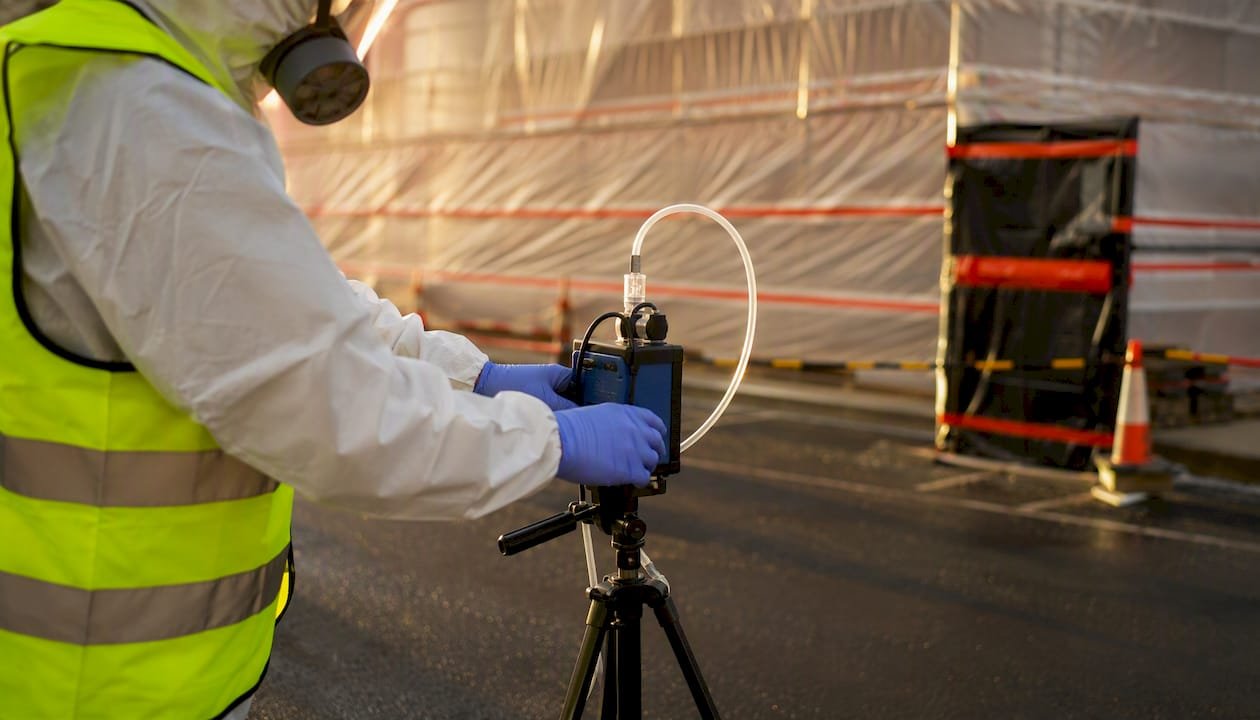
After removal, the contractor does a detailed visual inspection of the contained area, then an independent hygienist or occupational hygienist conducts clearance air monitoring. Samples are sent to a NATA-accredited lab. If results pass, a clearance certificate is issued. If they fail, the contractor re-cleans, and the whole monitoring cycle repeats. Each failed clearance cycle typically adds 2–5 days.
Disposal and manifest paperwork
Asbestos waste must be transported to a licensed disposal facility in sealed, labelled packaging. A waste transport certificate (manifest) tracks the chain of custody from site to tip. Completing and filing this paperwork usually takes a few hours, but transport logistics can add half a day depending on the facility’s location and operating hours.
| Stage | Typical duration |
|---|---|
| Inspection and sampling | 1–3 hours on site; 24–72 hrs (PLM/PCM) or 1–5 days (TEM) for lab results |
| ARCP preparation and regulatory notification | 1–3 days (ARCP); up to 5 business days (notification window) |
| Containment and site setup | Half day to 2 days depending on scope |
| Active removal | 4–8 hours (single room) to 4+ days (whole house or friable) |
| Clearance air monitoring and lab results | 1–3 days per cycle; add 2–5 days per failed clearance |
| Disposal and manifest paperwork | Half day to 1 day |
Pro Tip: Ask your contractor to submit the regulatory notification on the day lab results come back positive, not when they are ready to start work. That five-business-day clock starts ticking from the notification date, so every day you wait is a day added to your schedule.
Day-by-day example timelines for small, medium, and complex jobs
Small job: single room floor tiles or a ceiling patch
- Day 1: Accredited assessor visits, collects samples, submits to lab
- Days 2–3: Lab results returned (PLM, 24–72 hours); contractor notified; ARCP prepared; regulatory notification submitted
- Days 4–8: Notification window clears (5 business days)
- Day 9: Contractor sets up containment (half day), completes removal (half day to full day)
- Day 10: Visual inspection; independent hygienist collects clearance air samples
- Day 11–12: Lab returns clearance results; certificate issued if passed
- Total end-to-end: approximately 10–14 days
You likely do not need to vacate the whole house for a contained single-room job, but you should keep children and pets out of the area and adjacent rooms during active removal and monitoring.
Medium job: multiple rooms, popcorn ceilings, attic insulation
- Days 1–3: Inspection, sampling, lab results
- Days 4–8: ARCP, notification window
- Days 9–10: Containment setup across multiple zones
- Days 11–13: Active removal in stages; each zone cleared before moving to the next
- Day 14: First clearance air monitoring round
- Days 15–16: Lab results; if one zone fails, re-clean and re-test adds 2–3 days
- Days 17–18: Final clearance certificate issued; disposal manifest completed
- Total end-to-end: approximately 2–3 weeks
Whole-home temporary relocation is worth considering here, especially if the attic or ceiling space is involved. Fibre migration through ceiling penetrations is a real risk during active work.
Complex job: whole-house friable removal or multi-trade site
Whole-house asbestos abatement typically runs 2–4 weeks end-to-end. Add friable materials and you are looking at the upper end of that range or beyond. A multi-trade construction site with concurrent works can push the schedule further because clearance certificates must be issued before other trades re-enter the asbestos work zones.
Expect:
- Multi-day containment setup across the entire structure
- Staged removal with zone-by-zone clearance cycles
- Possible multiple rounds of re-testing if any zone fails
- Separate disposal runs for different material classifications
- A final whole-site clearance before reoccupation
Pro Tip: On complex jobs, ask for a zone-by-zone clearance schedule in writing before work starts. This lets your builder and other trades plan re-entry dates for each area rather than waiting for the entire site to clear at once.
What factors make the asbestos removal timeline longer or shorter?
The condition and type of asbestos, its location, and the need for third-party clearance monitoring are the primary drivers of how long a removal takes. Beyond those, several practical factors can add days you did not budget for.
- Friable vs non-friable: Friable materials require a Class A licensed contractor, more containment, slower wet-method removal, and typically more clearance cycles. Non-friable bonded materials are faster to remove and carry lower regulatory overhead.
- Quantity and hidden material: A small identified patch is straightforward. Discovering additional asbestos during removal (inside wall cavities, under floor coverings, around pipe penetrations) triggers a scope change, a revised ARCP, and potentially a new notification window.
- Location on site: Roof sheeting, subfloor insulation, and pipe lagging inside wall cavities all present access challenges. Tight spaces slow removal rates and complicate containment setup.
- Weather: External removal work (roofing, eaves, fencing) can be delayed by wind, rain, or extreme heat. Wind speeds above a site-specific threshold typically halt outdoor asbestos work entirely.
- Lab turnaround and monitoring availability: NATA-accredited labs and independent hygienists are in demand. Rush testing costs more; standard turnaround adds days. If your hygienist is booked out, clearance monitoring cannot happen until they are available.
- Regulatory notification windows: The five-business-day notification requirement in NSW is a fixed delay. Other states have their own windows. Check with your state regulator before assuming you can start quickly.
Pro Tip: Always ask your contractor whether the quoted scope includes a contingency for hidden material. A fixed-price quote with no contingency clause means any surprise discovery becomes a variation, and variations add both cost and time.
How does testing, lab analysis, and clearance work in Australia?
Asbestos abatement in Australia follows a four-phase process: pre-work survey and notification, containment, wet-method removal with HEPA filtration, and post-abatement clearance testing. The testing and clearance phases are where most schedule uncertainty lives.
Sampling strategy
Accredited assessors use a homogeneous area sampling approach. For a given material type in a given area, the standard practice involves collecting multiple samples (commonly three to seven per homogeneous area, depending on the area’s size and variability) to confirm identification and inform the removal scope. More samples mean more lab submissions and potentially longer wait times before the ARCP can be finalised.
Lab methods and turnaround
PLM identifies asbestos type and is the standard method for bulk material identification. PCM counts airborne fibres and is used for clearance air monitoring. Both typically return results within 24–72 hours from a NATA-accredited lab. TEM provides higher sensitivity and is used for low-level clearance testing after friable removal or in situations where PCM results are borderline. TEM turnaround runs 1–5 business days under standard conditions; rush TEM can return results in 24 hours but at a significant cost premium.
Lab turnaround is the single most common cause of a project running longer than the quoted removal days. A standard PLM result takes 24–72 hours; a TEM result under standard conditions takes up to 5 business days. If your clearance sample requires TEM and the lab is at capacity, that alone can push your reoccupation date back by nearly a week.
Clearance air monitoring and pass criteria
An independent hygienist (not the removal contractor) conducts clearance air monitoring after the visual inspection passes. In Australia, the clearance criterion for non-friable removal is typically below 0.01 fibres per millilitre of air, assessed by PCM. Friable removal clearance uses more stringent criteria and often requires TEM. If the sample fails, the contractor re-cleans the contained area and the hygienist returns for another round. Each failed cycle adds 2–5 days. You can read more about what the asbestos clearance inspection process involves and what a pass or fail looks like.
Regulatory requirements
Under the Model WHS Regulations, licensed removal is mandatory for friable asbestos of any quantity and for non-friable asbestos above 10 square metres. Independent clearance by a licensed asbestos assessor is required before the area can be reoccupied. State regulators enforce these requirements; SafeWork NSW publishes the specific licence classes and verification steps for NSW projects.
How to schedule your renovation around asbestos removal
Getting the sequencing right saves you from paying idle tradespeople and from reoccupying a space before it is safe.
Before you book anything:
- Commission an accredited asbestos inspection and wait for confirmed lab results before booking a removal contractor
- Confirm the contractor holds the correct licence class (Class B for non-friable; Class A for friable work)
- Check whether your state requires a notification period and factor that into your start date
- Notify tenants or neighbours of planned works as required under your tenancy agreement or local council rules
Booking buffers to build in:
- Allow at least 3–5 business days between inspection sampling and receiving lab results before scheduling removal
- Add the regulatory notification window (up to 5 business days in NSW) on top of that
- Schedule follow-on trades no earlier than 3 days after the planned removal completion date, and only after you hold a clearance certificate in hand
Household logistics:
- For contained single-room jobs, occupants can usually remain in the home but should stay out of adjacent areas during active work and monitoring
- For multi-room or whole-house jobs, plan temporary accommodation for the duration of active removal plus at least one clearance cycle
- Pets, particularly birds, are more sensitive to airborne fibres; arrange off-site care during active removal regardless of job size
- Seal or remove soft furnishings from adjacent rooms before containment is established
Coordinating with builders and other trades:
- No trade should re-enter a work zone until the clearance certificate is issued and in writing
- Share the zone-by-zone clearance schedule with your builder so they can sequence other works
- Build a minimum two-week buffer between your planned removal completion and any fixed-date commitments (settlement, lease start, council inspection)
Contractor vetting checklist:
- Verify the licence class and number through your state regulator’s online register
- Confirm the contractor uses an independent hygienist for clearance monitoring (not their own staff)
- Ask for a sample ARCP and waste manifest from a previous job to check documentation quality
- Confirm the lab they use is NATA-accredited
Pro Tip: Request the clearance certificate as a PDF the same day it is issued. Do not rely on the contractor to forward it later. You need that document before any other trade re-enters the zone, and delays in receiving it can hold up your entire renovation schedule.
How does the timeline affect what you pay?
Time and cost are directly linked in asbestos removal, and understanding where the billing structure sits helps you read a quote critically.
- Mobilisation vs daily labour: Most contractors charge a fixed mobilisation fee covering equipment, PPE, and travel, plus a daily or half-day labour rate for active removal. Extended containment periods (waiting for lab results, notification windows) may attract a site-holding fee if the contractor has equipment on site.
- Friable premium: Friable removal attracts higher rates because it requires Class A licensed staff, more containment infrastructure, slower removal methods, and typically more clearance cycles. The disposal cost for friable material is also higher because it must go to a facility licensed to accept it.
- Failed clearance costs: Each failed clearance cycle means re-cleaning labour, another hygienist visit, and another lab submission. These costs are usually not included in a standard quote. Ask specifically whether the quote covers one or two clearance attempts.
- Disposal and manifest fees: Disposal is charged by weight or volume at the licensed facility, plus transport. Manifest preparation is usually a fixed administrative fee.
- Practical advice: Ask for a time-staged quote that separates mobilisation, daily removal labour, monitoring, and disposal into line items. Include a contingency line for hidden material discovery. Schedule your follow-on trades with a buffer so you are not paying idle labour while waiting for clearance results.
Are there alternatives to removal, and how do they affect timing?
Removal is not always the only option under Australian practice. Encapsulation and management-in-place are accepted in specific circumstances.
Encapsulation involves applying a sealant to bonded, non-friable asbestos materials that are in good condition and not likely to be disturbed. It is faster than removal, typically completed in a day or two, and does not require the same containment infrastructure. There is no active removal, so the clearance requirements are less intensive. The trade-off is that the material remains in place and must be managed, inspected regularly, and disclosed to future owners or tenants.
Management in place means leaving identified asbestos materials undisturbed, documenting their location in an asbestos register, and monitoring their condition over time. This is appropriate for materials in good condition that will not be disturbed by planned works. It adds no time to a renovation schedule because no physical work is done, but it creates an ongoing management obligation.
Neither option is appropriate for:
- Friable or damaged materials
- Materials in areas that will be disturbed by renovation work
- Situations where the material’s condition is deteriorating
Pro Tip: If you are planning a renovation that will disturb the area where asbestos is present, encapsulation is not a long-term solution. You will need removal before the renovation proceeds, so the time saving from encapsulation now becomes a double-handling cost later.
Missiondemolition: Australian timelines, compliance, and real project examples
Missiondemolition holds the licences required for both Class A (friable) and Class B (non-friable) asbestos removal across residential, commercial, and industrial sites throughout Australia. Every project includes an ARCP prepared before work starts, independent air monitoring arranged through NATA-accredited hygienists, and waste manifests completed and filed at the point of disposal.
A typical Missiondemolition residential job runs like this: A homeowner in Sydney’s inner west contacts us after discovering fibro sheeting under their bathroom tiles. We arrange an accredited inspection within 48 hours, submit samples to a NATA-accredited lab, and have confirmed results back within 72 hours. The ARCP is prepared and the SafeWork NSW notification submitted the same day results arrive. Active removal takes one day. Independent clearance air monitoring is conducted the following morning, with PCM results returned within 24 hours. The clearance certificate is issued and emailed to the homeowner by Day 10 from first contact. Their tiler starts Day 12.
Compliance checklist for Australian asbestos removal projects:
- Accredited inspection and NATA-lab confirmed identification before any removal
- ARCP prepared and reviewed by the licensed contractor
- Regulatory notification submitted to the state regulator within the required window
- Class A or Class B licence verified through the state regulator’s online register
- Independent hygienist (not the removal contractor) conducting clearance air monitoring
- Clearance certificate issued before any reoccupation or follow-on trade entry
- Waste transport manifest completed and retained for the required period
- Asbestos register updated (for commercial and strata properties)
For a detailed walkthrough of the asbestos clearance certificate process, including what the certificate must contain and how long it takes to issue, Missiondemolition’s guide covers each step.
Pro Tip: Keep a copy of every document: the lab report, the ARCP, the notification confirmation, the clearance certificate, and the waste manifest. If you sell the property or a future renovation disturbs adjacent areas, this paper trail protects you legally and speeds up any future assessment.
What actually causes schedule surprises on asbestos jobs
The jobs that run over schedule almost always share the same handful of problems. Hidden material is the biggest one. A homeowner books a single-room tile removal, and the assessor finds fibro backing board under the tiles, asbestos rope around the bath waste pipe, and a patch of textured ceiling coating that was not visible in the original inspection. Each discovery triggers a scope change, a revised ARCP, and potentially a new notification window. What looked like a 10-day project becomes three weeks.
Poor site preparation is the second most common cause. Contractors arrive to find the work area not cleared, access blocked, or adjacent rooms full of furniture that needs to be moved before containment can be established. Every hour of delay on Day 1 of setup pushes the clearance date back.
Lab delays are the third. Standard turnaround is 24–72 hours for PLM/PCM, but labs run at capacity during busy periods. A sample submitted on a Thursday afternoon may not return results until Tuesday. If that sample is a clearance result and it fails, the re-test cycle does not start until Wednesday at the earliest.
Missiondemolition manages these risks by submitting samples early in the day, maintaining relationships with multiple NATA-accredited labs to route around capacity constraints, and building contingency days into every project schedule from the outset. When a re-test is needed, the hygienist is already booked for the following morning rather than scheduled from scratch.
Missiondemolition makes the booking process straightforward
Asbestos removal in Sydney and across Australia does not have to mean weeks of uncertainty. Missiondemolition’s process is built around giving you a confirmed timeline from the first call.
Here is how it works: you contact Missiondemolition for a site inspection, an accredited assessor visits within 48 hours, samples go to a NATA-accredited lab, and you receive a scoped quote with a staged timeline once results are confirmed. Licensed removal, independent air monitoring, disposal, and clearance documentation are all handled under one contract. No chasing separate hygienists or labs.
What Missiondemolition handles on your behalf:
- Licensed Class A and Class B removal for residential, commercial, and industrial sites
- ARCP preparation and regulatory notification to SafeWork NSW and other state regulators
- Independent NATA-accredited air monitoring and clearance certificate coordination
- Asbestos waste transport and licensed disposal with full manifest documentation
- Zone-by-zone clearance scheduling to keep your builder and trades moving
Ready to get a confirmed timeline for your project? Request a quote for asbestos removal in Sydney or visit the professional asbestos removal services page to see the full scope of what is covered.
Sources
These are the primary sources that govern asbestos removal timelines, licensing, and clearance requirements in Australia.
- Model WHS Regulations (1 January 2021) – Safe Work Australia
- SafeWork NSW – Class A asbestos removal licence
- How Long Does Asbestos Abatement Take? Real Timelines
- How long does asbestos removal take? | Removal duration

One Response