A CDC (Complying Development Certificate) is a fast-track approval that lets you demolish a house, garage or similar structure in NSW without a full development application, as long as the job meets the fixed standards of the state’s Demolition Code. If your building is not eligible, you need a development application (DA) through your council instead. Below we explain which path fits, what the code demands, what to lodge, how long it takes, and where asbestos and licensing can stop a job.
TL;DR
- A demolition CDC is available for many dwellings, garages, industrial buildings and pools that meet the Demolition Code. Heritage areas and non-compliant sites go through a DA.
- Apply online through the NSW Planning Portal. CDCs can be issued in as little as 20 days, though fees apply.
- If the building was built before 1987, a CDC is only approved if asbestos can be safely handled and removed.
- Demolition work on load-bearing or structural elements needs a licensed demolisher and a safe work method statement (SWMS).
- You generally cannot demolish a house you intend to replace until the approval for the new home is in place.
Table of Contents
- What CDC means for demolition in NSW
- When your demolition qualifies for a CDC
- Rules a demolition CDC puts on the work
- How to apply for a demolition CDC
- Timing and cost
- Knockdown rebuild: sequence matters
- Licences and asbestos: where jobs get delayed
- Our perspective: treat the CDC as a project plan
- Getting the job done with Mission Demolition
- FAQ
- Sources
What CDC means for demolition in NSW
CDC stands for Complying Development Certificate. It is a combined planning and construction approval for straightforward development that meets every mandatory standard, issued by a council or a private certifier. The NSW Government describes it as a fast-tracked pathway for straightforward developments that do not need a complex development application.
For demolition, the standards sit in the State Environmental Planning Policy (Exempt and Complying Development Codes) 2008. The Demolition Code allows a dwelling, an industrial building, garages and swimming pools to be demolished as complying development if they meet its standards.
CDC, DA and construction certificate: the differences
These three terms get mixed up constantly, and the demolition contractor you speak to may use them loosely.
| Approval | What it is | Typical use in demolition |
|---|---|---|
| CDC | A fast-track approval for work that meets the fixed codes | Demolition of an eligible house, garage or pool |
| DA | A merit-assessed development application lodged with council | Demolition that does not meet the code, such as some heritage situations |
| Construction certificate | Confirms plans comply with the Building Code of Australia and the development consent | The build that follows, unless a CDC covers it |
The Planning Portal notes that a demolition contractor will typically submit a separate DA, while demolition can also be done under a CDC if it complies with the codes and the Section 10.7 certificate for the land. A construction certificate is not required for work approved under a CDC.
In practice: if your site is ordinary, the building is not heritage-listed and the work fits the code, a CDC is usually the quicker route. If anything about the site is unusual, expect the DA route.
When your demolition qualifies for a CDC
The code covers full or partial demolition of a dwelling house or ancillary development associated with it. Two limits matter most to owners.
Heritage. In heritage or draft heritage conservation areas, only specified development may be demolished as complying development. Check your Section 10.7 planning certificate and your council’s heritage listings before you commit to a timeline.
Age of the building. For buildings constructed before 1987, a CDC can only be approved if asbestos can be safely handled and removed. In Sydney, most older fibro homes, garages and sheds fall into this group, so asbestos planning belongs at the start of the project, not after approval.
If your site is flagged, a certifier will tell you at the first check. Ask them before paying for plans.
Rules a demolition CDC puts on the work
A CDC is not just paperwork. It attaches conditions, and the contractor has to build the job around them. According to the NSW rules for demolition as exempt and complying development:
- Demolition must follow Australian Standard AS 2601–2001.
- All essential services must be properly disconnected.
- Erosion and sediment controls must prevent pollution leaving the site.
- Specific rules apply to wall support and dilapidation reports if work occurs within 900 mm of a common boundary.
- Conditions include a waste management plan and set hours of operation: 7 am to 5 pm, Monday to Saturday.
Hours are one of the most common reasons for neighbour complaints and stop-work notices. Noise limits can add further triggers, and we cover them in our guide to demolition noise rules in NSW and a checklist for avoiding a stop-work order.
Safety documents on site
Under the SafeWork NSW code of practice, a SWMS must be prepared before high-risk construction work involving demolition of a load-bearing element or an element related to the structure’s physical integrity. The code also says asbestos exposure is a demolition hazard to be identified in the risk-management process. If you want to understand how a SWMS differs from a job safety analysis, this explainer on SWMS and JSA requirements for Australian sites sets out the difference clearly.
How to apply for a demolition CDC
Applications are lodged online through the NSW Planning Portal, usually by your certifier or builder on your behalf. The portal says you need to submit a certificate of title, site plan, design plans, structural plans, building specifications and any other documents the council or certifier requires.
A practical order of work:
- Get your Section 10.7 planning certificate from council to see heritage, bushfire, flood and other flags.
- Commission an asbestos inspection if the building predates 1987. Results shape the demolition method and the approval. See our asbestos inspection service.
- Engage your demolition contractor early. They should confirm licensing, insurance and the waste and erosion plans the certifier will ask for.
- Prepare the plans and site documents your certifier lists, including the demolition-specific checklist items such as contractor insurance evidence.
- Lodge via the Planning Portal and pay the certifier’s and portal fees.
- Book utility disconnections with licensed professionals. The Planning Portal states that utilities must be disconnected by licensed professionals before demolition.
- Notify neighbours and SafeWork NSW where required, then demolish.
Timing and cost
The Planning Portal says CDC approvals can be issued in as little as 20 days, and that fees may apply; the portal lists its service fees on its own site. Certifier fees are set by the certifier, so get quotes. We do not publish fixed prices for demolition or asbestos work because they depend on site access, materials, building size and waste volumes, and we quote each job after assessing it.
Two other costs catch owners off guard. Councils may require a security deposit or bond to cover damage to council property such as footpaths and kerbs. And if asbestos is found, removal and disposal by a licensed contractor is a separate line item from the demolition itself.
Allow more time than 20 days overall. Pre-lodgement checks, asbestos testing, disconnections and contractor booking all sit either side of the approval clock.
Knockdown rebuild: sequence matters
If you are demolishing to build, the approvals interact. The Planning Portal advises that you cannot demolish your existing house until approval for your new home has been granted, and that the demolition application is separate. Many owners lodge both together and line up the contractor so the site is cleared promptly once approvals land.
After clearing, secure the site before construction starts. A clean, graded and fenced block with services capped makes the builder’s start much smoother. Our team handles residential demolition including disconnections coordination, waste handling and final site clean.
Licences and asbestos: where jobs get delayed
Demolition licence
In NSW you must hold a current demolition licence to carry out demolition work that involves load-bearing or structurally related elements. SafeWork NSW explains that this means an unrestricted (DE1) or restricted (DE2) licence, and the licence holder must notify SafeWork NSW at least 5 calendar days before starting such work. The code of practice adds that those controlling the workplace should confirm with the regulator whether a specific licence is required. Ask any contractor for their licence number and insurance certificate and check them, before the certifier does.
Asbestos removal and notification
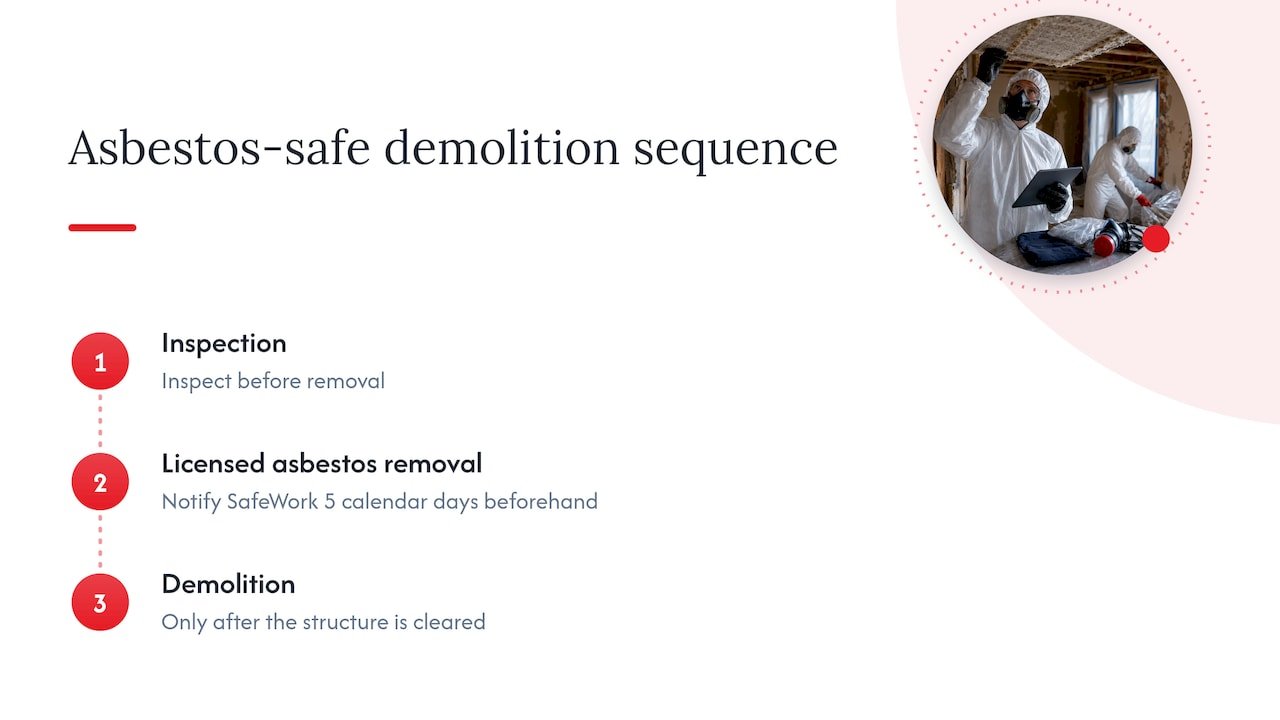
SafeWork NSW must be notified at least 5 calendar days before licensed asbestos removal work. Notification applies to removal of more than 10 m² of non-friable asbestos or any friable asbestos. We explain the process in our page on SafeWork asbestos notification and the wider rules in our NSW asbestos removal regulations guide.
The practical consequence: build asbestos time into your programme. Inspection first, then removal by a licensed contractor, then demolition of the cleared structure. Doing it in any other order risks contaminating the site and the waste stream.
Our perspective: treat the CDC as a project plan
Most demolition delays we see are not caused by the approval itself. They come from things discovered late: a fibro garage nobody tested, a service connection still live, a boundary wall that needed support, a neighbour surprised by a start at the wrong hour. A CDC rewards owners who have done that homework, because the certifier can tick the conditions off quickly.
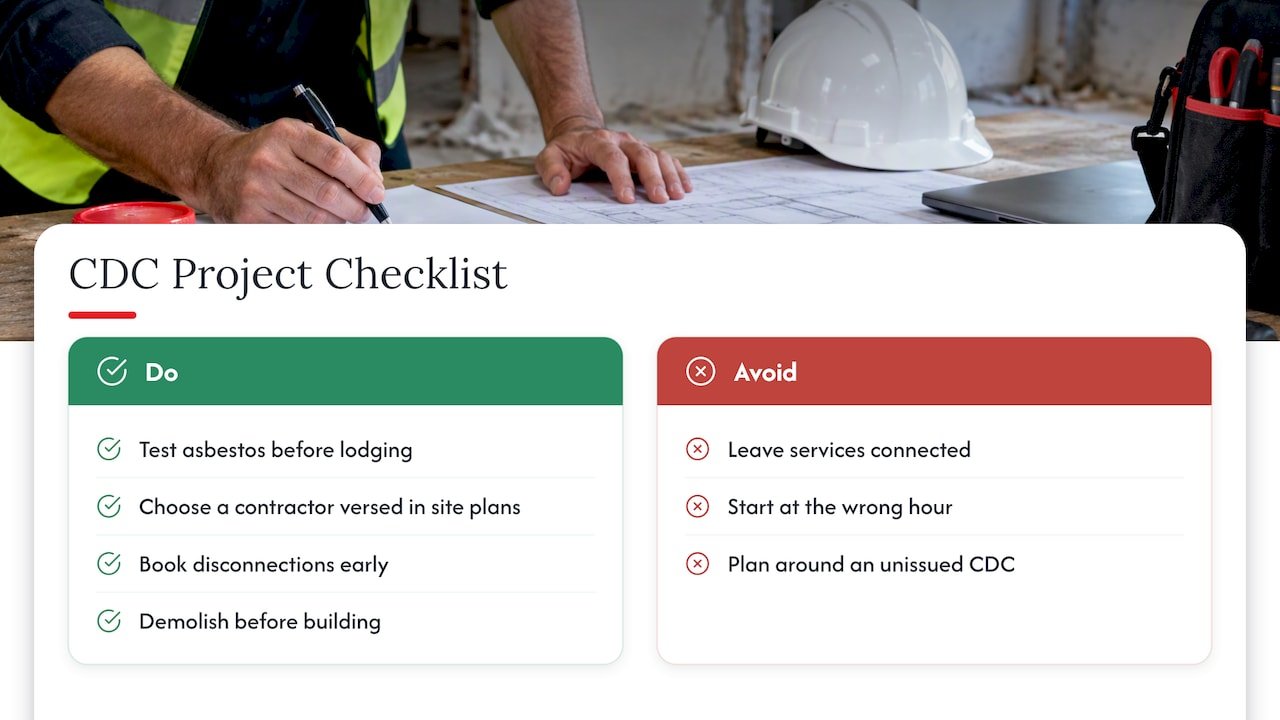
Our advice is to treat the approval documents as a checklist for the whole job. Test for asbestos before lodging when the building is older than 1987. Choose a contractor who can speak to the waste management plan, the erosion controls and the hours of work without looking them up. Book disconnections early, since they are often the slowest trade to arrive. And keep demolition and the new build in the right order, so you are never paying for an empty block that cannot yet be built on.
We combine modern plant and experienced crews with strict safety compliance and responsible waste disposal, and we would rather tell you early that your site needs a DA than let you plan around a CDC that will not be issued.
— Tarek
Getting the job done with Mission Demolition
We manage demolition end to end across Sydney and Australia: approvals support, utility disconnections, licensed asbestos removal, hazardous waste handling and the final site clean. That covers houses, garages, sheds, strip-outs, concrete cutting, and commercial and industrial sites.
If you have a building in mind, tell us the address, the approximate age and whether you plan to rebuild. We will outline the approval path, the asbestos steps and the sequence. Start at our demolition services page or go straight to asbestos removal in Sydney.
FAQ
What does CDC stand for in NSW?
CDC stands for Complying Development Certificate. It is a fast-track approval for development that meets set standards in the state planning codes, issued by a council or private certifier. For demolition, the relevant standards are in the Demolition Code.
Do I need council approval to demolish a house in NSW?
Yes, in most cases some approval is needed, either a CDC where the work meets the Demolition Code or a DA lodged with council. Heritage areas and non-compliant sites usually need a DA. Check your Section 10.7 planning certificate and ask your certifier before you book a contractor.
Can I demolish my house before my new home is approved?
No. The Planning Portal advises that demolition cannot happen until approval for the new home has been granted, and that the demolition application is separate. Plan your timeline so both approvals line up.
How long does a demolition CDC take?
Approvals can be issued in as little as 20 days once a complete application is lodged. Allow extra time for asbestos testing, utility disconnections and contractor scheduling before work starts.
Does asbestos affect a demolition CDC?
Yes. For buildings constructed before 1987, a CDC can only be approved if asbestos can be safely handled and removed. Licensed removal also triggers a SafeWork NSW notification at least 5 calendar days beforehand where the thresholds apply.
Sources
- Complying Development, NSW Planning Portal
- Demolition, NSW Planning Portal
- Demolish, MyHome Planner, NSW Planning Portal
- Approvals needed for your building project, NSW Government
- Demolition of buildings: rules for exempt and complying development, NSW Department of Planning
- Code of Practice: Demolition work, SafeWork NSW
- Working as a demolition licence holder, SafeWork NSW
- Asbestos notifications, SafeWork NSW
- Knockdown rebuild considerations for project homes, NSW Planning Portal
- SWMS vs JSA: what Australian sites legally need