
You must notify SafeWork NSW at least five calendar days before starting any notifiable licensed asbestos removal work, meaning any friable asbestos or more than 10 m² of non-friable asbestos. Emergencies are different: phone SafeWork NSW on 13 10 50 straight away, then lodge an electronic notification within 24 hours. Everything else in this guide builds on that one rule.
TL;DR:
- A nonfriable job under 10 m² usually falls outside notification rules, but inspectors judge the area actually removed, not the estimate on the quote.
- Use SWONS when available, save its acknowledgment PDF as proof of filing, and submit an updated notification if the site, dates, or scope materially change.
- During Class A work, readings above 0.02 fibers per milliliter require crews to stop work immediately and notify SafeWork NSW without delay.
- A complete filing needs license and business details, worker and assessor contacts, the exact site and scope, plus required plans, monitoring reports, and clearance certificates.
- The SWONS acknowledgment confirms receipt, not approval; SafeWork NSW issues no separate sign off, and no further regulatory clearance is needed after the waiting period.
Table of Contents
- Which asbestos removal work you must notify
- How to notify SafeWork NSW
- Emergency asbestos removals: the 24 hour rule
- Air monitoring exceedances above 0.02 fibres/ml
- Information and documents your notification needs
- After you notify: acknowledgements, not approvals
- Compliance, enforcement and common pitfalls
- How licensed removalists meet notification obligations in practice
- Practical checklist and final priorities for NSW projects
- FAQ
- Sources
Which asbestos removal work you must notify
Not every job needs a notification, but the threshold is lower than many project owners expect. SafeWork NSW ties the requirement to the asbestos class and the quantity involved, not to the size of the overall project.
- Any quantity of Class A (friable) asbestos removal work is notifiable, regardless of how small the area seems.
- Class B (non-friable) asbestos removal work becomes notifiable once the area exceeds 10 m².
- Interstate licence holders performing removal work in NSW must still notify SafeWork NSW, even if they already notified their home state regulator.
A small non-friable job under 10 m², such as replacing a single damaged sheet, usually falls outside the notification requirement, but it still needs a licensed or competent person depending on the material and quantity. When a job sits close to the 10 m² line, treat it as notifiable rather than risk a misclassification, since inspectors assess the actual area removed, not the estimate on a quote.
How to notify SafeWork NSW
SafeWork NSW built the SafeWork Online Notification System, known as SWONS, as the preferred way to lodge a notification, and it is faster and better documented than the manual alternatives.
- Log in to the SWONS portal using your licence credentials and select the asbestos removal notification type.
- Enter the site address, licence details, scope of work and planned start date, allowing for the five-day window.
- Submit the form and wait for the system to generate an acknowledgement.
- Download the acknowledgement PDF and save it to your project file immediately.
When SWONS is unavailable, you can lodge the Notification of asbestos removal work application (form NA-01) by email, with adu@safework.nsw.gov.au as the preferred inbox for most asbestos notification forms. Keep a printed or scanned copy of whatever you send, along with the date and time of lodgement. For enquiries or urgent matters, SafeWork NSW’s general line is 13 10 50.
Pro Tip: Create a project folder the day you decide a job is notifiable, and drop the SWONS PDF, emails and site photos into it as you go, rather than reconstructing the trail later.
Emergency asbestos removals: the 24 hour rule
An emergency notification applies when a sudden, unexpected event creates an immediate risk of asbestos exposure or threatens an essential service, not simply when a project is running behind schedule.
- Phone SafeWork NSW on 13 10 50 as soon as the emergency is identified, before any removal work begins.
- Lodge an electronic notification, through SWONS or the manual form, within 24 hours of that call.
- A phone call alone does not satisfy the notification obligation. Written lodgement within the 24 hour window is still required.
Treat the phone call as the first step, not the whole process, and diarise the 24 hour deadline the moment you hang up.
Air monitoring exceedances above 0.02 fibres/ml
During Class A removal work, air monitoring tracks respirable asbestos fibre levels in real time. Air monitoring results above 0.02 fibres per millilitre trigger an immediate stop-work and notification obligation, a limit set specifically for licensed Class A work rather than general site conditions.
- Stop work immediately across the affected area once a reading exceeds the threshold.
- Notify SafeWork NSW by phone on 13 10 50 or by email without delay.
- Submit the air monitoring report together with the respirable fibres notification form, addressed to adu@safework.nsw.gov.au, as part of the formal submission.
Some crews treat this as a side note to the main removal notification, but it is a distinct, specialised filing with its own declaration and attachment requirements.
Information and documents your notification needs
A complete notification moves through SWONS without follow-up queries. An incomplete one stalls the five-day clock while SafeWork NSW or your own team chases missing details, so it pays to assemble everything before you open the form.
- Licence number, ABN and business details for the entity carrying out the removal.
- Names and contact details for the supervisor on site and the operatives involved.
- Clearance inspector details and, where relevant, the asbestos assessor’s licence number.
- Site owner or controller details, the precise site address and the scope of work, including area and asbestos type.
- Supporting documents: clearance certificates, air monitoring reports, and the safe work method statement or asbestos control plan.
Our asbestos inspection and testing process is built around collecting these details early, since assessor and clearance information is usually the hardest to chase down once a job is already underway.
After you notify: acknowledgements, not approvals
Submitting through SWONS generates an acknowledgement email and a downloadable PDF confirming SafeWork NSW received your notification. That acknowledgement is not the same as regulatory approval, because SafeWork NSW does not issue an approval letter for asbestos removal notifications.
- Save the acknowledgement PDF the moment it arrives, since it is your primary evidence of timely lodgement.
- Work may lawfully commence once the five calendar days have elapsed from a correctly lodged notification, with no further sign-off needed.
- If site details, dates or scope change materially after lodging, submit an updated notification reflecting the new information rather than relying on the original.
The system functions as a registry, not a gate, but the five-day wait still has to run its course before tools go on site.
Compliance, enforcement and common pitfalls
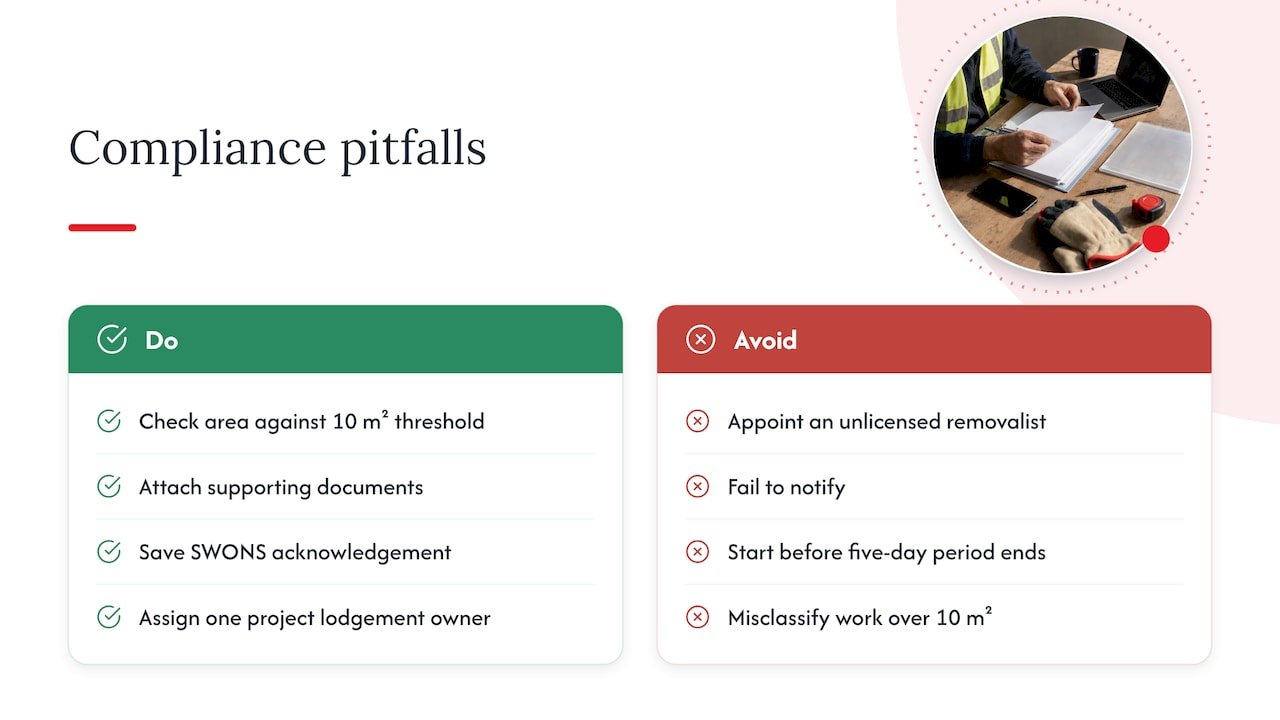
SafeWork NSW inspectors can issue on-the-spot fines for appointing an unlicensed asbestos removalist, for failing to notify at all, or for starting work before the five-day period ends. The most common pitfalls we see are misclassifying a job as non-notifiable when the area creeps past 10 m², submitting a notification without the supporting documents attached, and failing to save the SWONS acknowledgement for later reference.
Nominate one person on each project, usually the site supervisor or licence holder, to own lodgement and evidence retention from start to finish. For a fuller breakdown of penalty amounts and a compliance checklist, see our guide on avoiding asbestos fines in NSW.
How licensed removalists meet notification obligations in practice
On a typical project, the documentation pack comes together before the notification is lodged, not after. Licence and ABN details, the safe work method statement, clearance inspector contact and assessor licence number all get drafted into the SWONS fields early, so the five-day window can start running as soon as the scope is confirmed.
We save every SWONS acknowledgement, air monitoring result and clearance certificate into the project file as it is issued, which keeps the audit trail intact if SafeWork NSW ever asks for it. When a job turns into an emergency removal, the same team that handles the phone call to 13 10 50 also lodges the 24 hour electronic notification, so nothing falls through the gap between the call and the paperwork. Our asbestos removal team can manage this documentation on your behalf where a project owner would rather hand it off entirely. Post-removal site cleaning is a separate but related cost worth budgeting for, and construction cleaning costs in Australia vary depending on scope.
Practical checklist and final priorities for NSW projects
The biggest risk on most projects is not the paperwork itself but the sequencing. Confirm the classification first, because a wrong call there undoes everything that follows. Lodge through SWONS, save the acknowledgement the moment it lands, and respect the five-day wait even when a client wants work to start sooner.
If you discover notifiable asbestos mid-project, stop, confirm the area and class, and lodge the notification before touching the material again. For anything urgent, 13 10 50 is the number to call first.
— Tarek
FAQ
Is asbestos a notifiable incident?
Asbestos itself is not automatically a notifiable incident, but certain events involving asbestos are. A sudden exposure risk or an air monitoring reading above 0.02 fibres/ml during Class A work must be reported to SafeWork NSW as a specific notification.
How do I submit an asbestos notification?
The preferred method is SafeWork NSW’s online system, SWONS, which returns an acknowledgement email and PDF once lodged. When SWONS is unavailable, you can lodge the NA-01 application form by email instead.
Is asbestos notifiable?
Licensed removal of any friable asbestos is always notifiable, and non-friable removal becomes notifiable once the area exceeds 10 m². Interstate licence holders working in NSW must also notify, even if they already notified in their home jurisdiction.
When to notify SafeWork NSW in NSW?
For standard licensed removal work, notify at least five calendar days before work begins. For emergencies, phone SafeWork NSW on 13 10 50 immediately and lodge an electronic notification within 24 hours of that call.
What happens if I fail to notify before starting work?
SafeWork NSW inspectors can issue on-the-spot fines for starting notifiable work before the five-day period has elapsed or for failing to notify at all. Keeping a saved acknowledgement and project documentation is the clearest way to demonstrate compliance if asked.
