Most residential demolitions in NSW proceed under a complying development certificate (CDC), not a full development application, provided the building meets AS 2601 and Demolition Code standards. But that pathway only holds if asbestos has already been dealt with. If your property was built before 1987, a licensed removalist must identify and clear any asbestos, and you need a clearance certificate in hand before structural demolition starts. Skip that step and your CDC approval stalls regardless of how straightforward the rest of the site looks.
Before you contact a certifier or council, get three things sorted:
- An asbestos inspection report (assume it’s present in any pre-1987 structure until proven otherwise)
- A waste management plan ready to lodge with your certifying authority
- Proof of contractor licensing, insurance, and a confirmed disposal route for hazardous waste
Quick fact: Complying development pathways for demolition can only proceed on pre-1987 buildings once asbestos has been safely removed by a licensed contractor under WHS Regulation.
Key Takeaways
Council approval for demolition in NSW almost always hinges on one gating item: asbestos clearance, which must happen before structural work, regardless of which approval pathway applies.
| Point | Details |
|---|---|
| Pathway depends on structure | Exempt development suits minor structures, CDC suits most standard dwellings, and heritage or complex sites need a full DA. |
| Asbestos clearance gates everything | Pre-1987 buildings need licensed inspection, removal, and an independent clearance certificate before demolition proceeds. |
| Notification has hard deadlines | Structures over six metres require five days written notice to SafeWork NSW before work starts. |
| Documentation prevents desk rejections | Waste management plans, disconnection proof, and dilapidation reports need to be ready before lodging. |
| Missiondemolition manages it end to end | Missiondemolition coordinates licensed removal, waste plans, disconnections, and clearance certificates under one contract. |
Table of Contents
- Which approval pathway applies to your site?
- What are the asbestos licence rules before demolition begins?
- What documents does council need for site clearing?
- How long do approvals and asbestos clearance actually take?
- How Missiondemolition manages approvals and clearance for you
- Do you need environmental or heritage checks before clearing?
- What erosion and sediment controls does your council expect?
- Are there hazards beyond asbestos you need to check for?
- Who’s liable, the contractor or the property owner?
- What happens if you don’t get council approval?
- Why treating approvals as project milestones changes the outcome
- Get your site cleared and approved without the coordination headaches
- FAQ: council approvals and site clearing in NSW
- Sources
Which approval pathway applies to your site?
Three routes exist for demolition in NSW, and picking the wrong one wastes weeks. The choice depends on the structure’s age, size, heritage status, and how close it sits to a boundary.
Exempt development covers minor structures, think garden sheds, small outbuildings, carports under a certain footprint, that can come down without formal council or certifier sign-off. Even here, AS 2601-2001 still governs how the work is carried out. Exempt doesn’t mean unregulated; it means the approval step is skipped, not the safety standard.
Complying development certificates are the pathway most homeowners and builders end up using for standard dwellings and freestanding structures. CDCs process faster than a DA, but they come loaded with Schedule 9 conditions: a waste management plan, evidence that gas, water, and power have been disconnected, and confirmation the building meets Demolition Code benchmarks. Miss any one of those and the certifier bounces the application back.
Development applications become mandatory when the site carries heritage listing, sits in a conservation area, involves complex adjoining structures, or simply falls outside what a CDC allows. DAs take longer and invite public notification, but they’re the only legal route for anything a certifier can’t sign off independently.
Conditions that show up repeatedly across all three pathways include:
- Waste management and recycling plans
- Erosion and sediment controls during works
- Restricted working hours (typically weekdays, with weekend limits)
- Dilapidation reports where demolition sits close to a neighbouring wall
Get the pathway wrong at the outset and you’re not just delayed, you’re often starting the paperwork from scratch.
What are the asbestos licence rules before demolition begins?
The person conducting a business or undertaking (the PCBU, usually the demolition contractor or the property owner directly engaging labour) has a legal duty to identify asbestos before any structural work touches the site. That means reviewing an existing asbestos register if one exists, or arranging a competent inspection if it doesn’t. For anything built before 1987, the safe assumption is that asbestos is present until an inspection proves otherwise.
Licence classes matter because they determine who can legally touch the material:
- Class A licence covers any friable asbestos (material that crumbles or can be reduced to powder by hand) and any quantity of non-friable asbestos when combined with an associated combined demolition (ACD) approach.
- Class B licence covers non-friable asbestos removal in any quantity, the more common scenario in residential fibro sheeting and eaves.
- Unlicensed removal is legally permitted only for under 10 square metres of non-friable material, though SafeWork NSW recommends licensed removal regardless of quantity, because misidentification risk and disposal compliance both increase when unlicensed operators handle the job.
Notification timing catches people out more than the licensing itself. Where demolition work meets specific criteria, structures six metres or higher, for instance, the SafeWork NSW Code of Practice requires the PCBU to give written notice to the regulator at least five days before work starts. That five-day window is a hard floor, not a suggestion, and it applies on top of whatever your council or certifier separately requires.
From 1 March 2025, SafeWork NSW also requires demolition licence holders to confirm their crews have completed CPCCDE3030 training for identifying site hazards, so ask any contractor for evidence of current crew accreditation, not just a company licence number.
Once licensed removal is complete, an independent asbestos assessor must issue a clearance certificate before the site can be reoccupied or structural demolition can proceed. No clearance certificate means no legal progression, full stop.
Pro Tip: Order your asbestos inspection the same week you engage a certifier, not after. Inspection results routinely take longer than property owners expect, and every day spent waiting on a report is a day your CDC clock isn’t ticking.
What documents does council need for site clearing?
Desk rejections almost always trace back to a missing document rather than a bad decision. Before you lodge anything, assemble this set:
- Current site plan and title documents confirming ownership and boundaries
- A waste management plan, submitted to your principal certifying authority at least two days before works begin
- Demolition contractor’s licence number and current public liability insurance certificate
- Asbestos register or inspection report covering the structure
- Written confirmation of your licensed disposal route for hazardous waste
Beyond the mandatory five, most sites also need:
- A dilapidation report on adjoining walls if demolition falls within 900 millimetres of a neighbouring structure
- Erosion and sediment run off control measures documented for the certifier
- Service disconnection certificates from your gas, water, and electricity providers
- A security bond where works risk damaging public infrastructure like footpaths or kerbs
Upload everything to your council’s online portal in one pass rather than trickling documents through over several weeks. Certifiers process complete applications faster, and a single coherent submission signals you’ve managed the project properly rather than assembling it reactively. Confirm with your specific certifier which of the secondary documents they’ll actually require, since some councils are stricter than others on dilapidation reports and bonds.
How long do approvals and asbestos clearance actually take?
The realistic sequence runs: asbestos inspection, then licensed removal if required, then clearance certificate, then CDC or DA determination. Each stage has its own minimum lead time, and they don’t run in parallel if asbestos turns up unexpectedly.
The pitfalls that blow out timelines are predictable:
- Starting demolition before the clearance certificate arrives (this is the single most common and most expensive mistake)
- Forgetting neighbour notification where a DA or specific council condition requires it
- Arranging waste disposal only after works begin, rather than confirming the licensed route beforehand
- Assuming early morning or weekend work is allowed without checking your specific approval conditions
Pro Tip: Order asbestos inspections and utility disconnections in the same week you engage your certifier. Practitioners consistently point to this delay, inspections and disconnections left too late, as the cause of most restart fines and stalled sites.
How Missiondemolition manages approvals and clearance for you
Coordinating a certifier, a licensed asbestos assessor, a waste contractor, and your utility providers as separate parties is where most delays creep in. Missiondemolition runs all of it under one contract.
That includes:
- Licensed asbestos removal (Class A and Class B) with accredited, CPCCDE3030 trained crews
- Preparation of waste management plans ready for certifier submission
- Coordination of gas, water, and electricity disconnections
- Licensed disposal arrangements and the paperwork to prove it
- Booking independent clearance inspections once removal is complete
A single contractor managing removal, disconnections, and disposal together gives councils coherent evidence of site control, rather than a patchwork of documents from separate parties with no single point of accountability.
Situations where a single experienced contractor earns its cost back quickly: asbestos discovered mid-project after a DA is already lodged, a dilapidation dispute with a neighbour over a shared wall, or a council bond requirement that needs resolving before works can even start. Each of these stalls a self-managed project for weeks; a contractor who already holds the relevant licences and certifier relationships can often resolve them in days.
Pro Tip: Before requesting a quote, have your site address, approximate building age, and any existing asbestos report on hand. It shortens the scoping conversation considerably.
For residential jobs, start with residential demolition services; for hazardous material handling specifically, the asbestos removal team handles licensing and clearance end to end.
Do you need environmental or heritage checks before clearing?
Demolition approvals don’t exist in isolation from environmental and heritage law. Before a certifier or council signs off, they’ll check whether the site sits within a heritage conservation area, adjoins a listed item, or contains vegetation covered by a local tree preservation order.
If the property or its surrounds are heritage listed, even partial demolition typically forces the project onto the DA pathway rather than CDC, because a certifier can’t independently assess heritage impact. Councils commonly require a heritage impact statement identifying which elements of a structure (facades, chimneys, original brickwork) must be retained or documented before removal.
Flora and fauna considerations matter most on larger residential or industrial sites with established trees or vegetation close to the demolition footprint. Many councils require a tree preservation permit before any removal that affects a protected species, and some development conditions specify protective fencing around root zones during works to prevent incidental damage from machinery access.
None of this replaces the asbestos and structural requirements already covered, it sits alongside them. A site can clear every asbestos and waste condition and still stall at the certifier stage if a heritage or vegetation check hasn’t been addressed. Raise the question with your council or certifier early, ideally at the same time you’re arranging your asbestos inspection, so a heritage referral doesn’t surface as a surprise halfway through your CDC assessment.
What erosion and sediment controls does your council expect?
Sediment and run off control isn’t optional paperwork, it’s an enforceable condition on almost every demolition approval, exempt, CDC, or DA. Councils impose these controls because demolition sites disturb soil and generate debris that can wash into stormwater systems during rain, carrying contaminants with it.
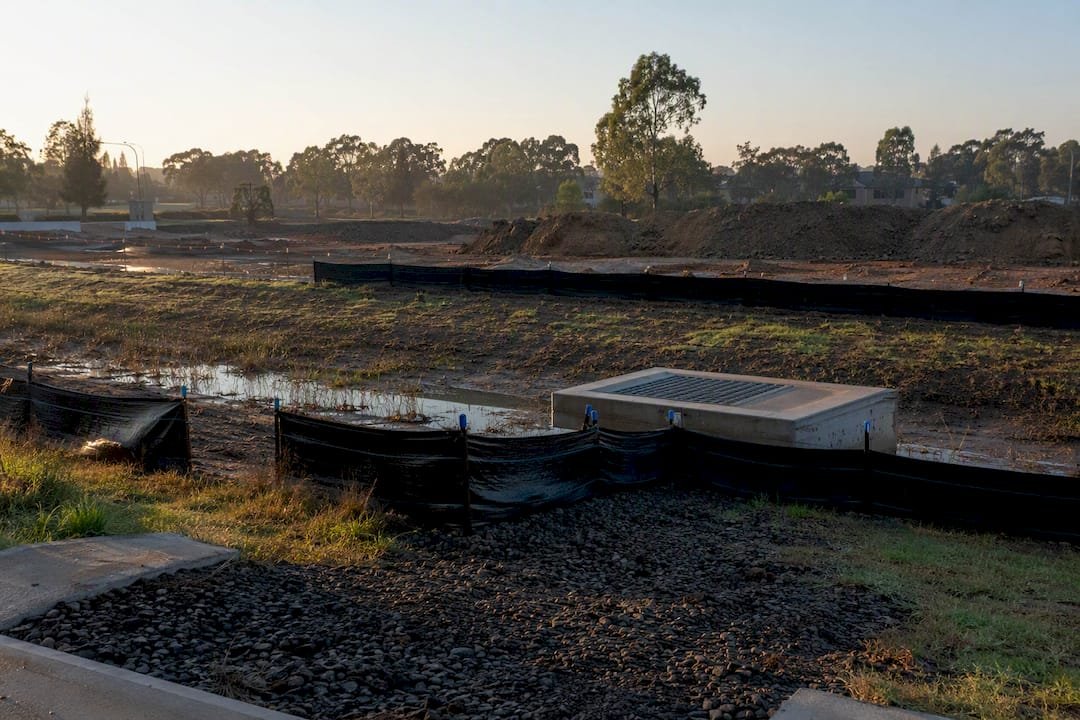
Standard measures councils expect documented in your submission include silt fencing around the site perimeter, sediment traps positioned at stormwater inlets, and stabilised entry and exit points to stop soil tracking onto the street on vehicle tyres. Larger sites, particularly those over a certain area or adjoining waterways, may need a more detailed erosion and sediment control plan showing drainage paths and control placement on a site diagram rather than a simple checklist.
Certifiers routinely inspect these controls during works, not just at approval stage. A council officer finding silt fencing collapsed or a sediment trap blocked can issue an on the spot order to halt works until it’s fixed, which stops your demolition schedule cold regardless of how well the asbestos and structural side of the project is running.
Local councils sometimes layer their own requirements on top of the state baseline, particularly in catchment areas feeding directly into waterways or drinking water supply zones. It’s worth checking your specific council’s development control plan for any additional sediment control specifications before you finalise your waste management plan, since retrofitting controls after approval means a second round of certifier sign off.
Are there hazards beyond asbestos you need to check for?
Asbestos gets the regulatory attention, but it isn’t the only hazardous material sitting in an older structure. Pre 1970s properties commonly carry lead based paint on window frames, skirting, and external cladding, and disturbing it during demolition creates a dust hazard that falls under separate WHS handling requirements from asbestos.
Older industrial or commercial sites bring a wider hazard profile: underground fuel tanks, residual chemical storage, treated timber containing arsenic based preservatives, and in some cases contaminated soil from decades of prior use. A competent person should assess these risks alongside the asbestos inspection, not as an afterthought once demolition is already underway.
The practical protocol mirrors the asbestos process: identify before you disturb, engage a suitably licensed contractor for removal, and dispose of hazardous material through an appropriately licensed facility rather than general waste. For lead paint specifically, wet removal methods and contained disposal reduce airborne dust risk during strip out work.
Skipping this step doesn’t just risk a health hazard, it risks a stalled certifier assessment if a hazard surfaces mid demolition that wasn’t flagged in your original application. Building this check into your initial site inspection, alongside asbestos, costs little extra and avoids a second, unplanned assessment later.
Who’s liable, the contractor or the property owner?
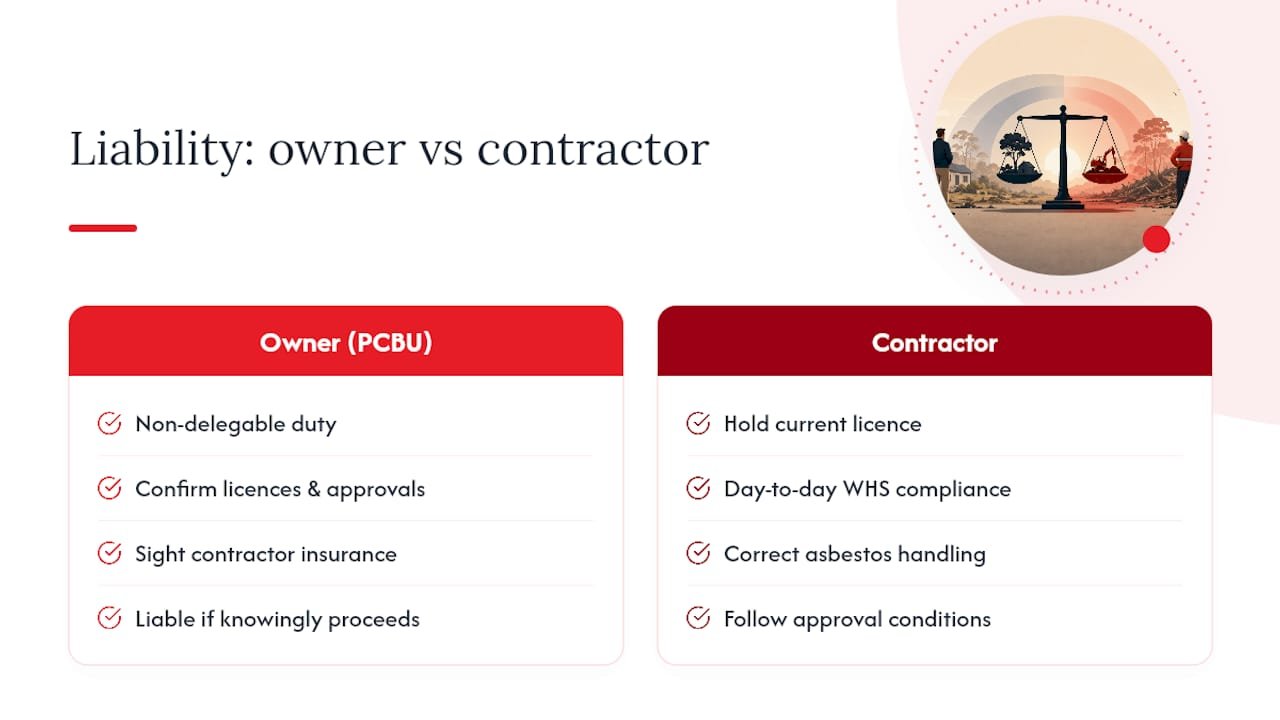
Liability during site clearing splits along a fairly clear line, but plenty of property owners misunderstand where their responsibility actually starts and stops. As the PCBU (or the party engaging a PCBU), the property owner carries a non-delegable duty to ensure the work is planned and approved correctly, this includes confirming the contractor holds current licences and that approvals are in place before works commence.
Once a licensed demolition contractor is engaged, day-to-day WHS compliance, correct asbestos handling, and adherence to approval conditions on site become the contractor’s direct responsibility under their own licence obligations. But that doesn’t erase the owner’s exposure. If a contractor operates without the correct licence, or an owner knowingly proceeds without required clearance certificates, both parties can face regulatory consequences, not just the contractor.
Insurance is where this distinction becomes practical rather than theoretical. A property owner should always sight a contractor’s current public liability insurance and licence documentation before works begin, not take it on trust. If damage occurs to a neighbouring property or a worker is injured on an unlicensed or improperly approved site, the owner’s own liability exposure increases sharply if they can’t demonstrate they checked these things beforehand.
Contracts that clearly assign responsibility, who handles approvals, who arranges asbestos clearance, who’s accountable for waste disposal, protect both sides. Ambiguity is where disputes and delayed insurance claims tend to start.
What happens if you don’t get council approval?
Non compliance with council approval requirements during site clearing isn’t a paperwork technicality, it carries real financial and legal exposure. Undertaking demolition without the correct approval, whether that’s proceeding under an exempt development claim that doesn’t actually apply or simply skipping the CDC or DA process entirely, exposes the property owner and contractor to council enforcement action, which can include stop work orders and fines.
Asbestos related breaches carry the heaviest consequences. Removing asbestos without the correct licence, disposing of it outside a licensed facility, or proceeding with demolition before a clearance certificate has been issued are all matters SafeWork NSW can prosecute, separate from any council penalty. These aren’t hypothetical risks reserved for large commercial sites, residential demolitions face the same enforcement standards.
Beyond direct penalties, non compliant works can trigger a rectification order, forcing remedial work at the owner’s cost, or invalidate insurance cover if a claim arises from unlicensed or unapproved work. Council can also require a site to be made safe or reinstated if works proceeded without proper approval, which can cost significantly more than the original approval process would have.
The practical takeaway is straightforward: the cost of getting approvals and asbestos clearance right up front is consistently lower than the cost of remediation after a compliance breach.
Why treating approvals as project milestones changes the outcome
Most guidance on this topic treats council approval and asbestos clearance as separate boxes to tick. That framing is backwards. Asbestos clearance isn’t a compliance formality sitting alongside your CDC or DA, it’s the gating milestone that determines whether every other approval condition can actually be satisfied.
The conventional advice, “get your approval, then arrange your contractor”, has the sequence wrong for older buildings. If your inspection turns up friable asbestos after a CDC has already been lodged, you’re not just delayed, you may need to restart parts of the application because the removal method changes what the certifier needs to see.
What the evidence in this piece actually supports is a project management approach: order the inspection first, treat the clearance certificate as the critical path item, and only then finalise your waste management plan and disconnection paperwork around it. Property owners who manage this themselves across multiple contractors consistently lose time at the handoff points, when the inspector finishes but the removalist hasn’t started, or removal finishes but clearance inspection is booked out for another fortnight. That’s not a licensing problem. It’s a coordination problem, and it’s the one part of this process most owners underestimate.
Get your site cleared and approved without the coordination headaches
Missiondemolition is the alternative to juggling a certifier, an asbestos assessor, a waste contractor, and your utility providers as four separate relationships. For NSW property owners and developers navigating council approval requirements for site clearing, the practical advantage is having one licensed operator who prepares your waste management plan, removes asbestos under current Class A and Class B licensing, coordinates service disconnections, and books your clearance certificate, all under a single contract with clear accountability.
That matters most when something goes wrong mid project: asbestos turns up later than expected, a neighbour disputes a dilapidation report, or a council bond condition needs resolving fast. Owners managing these separately often lose weeks at exactly these handoff points. Missiondemolition’s crews hold current demolition licences and CPCCDE3030 hazard identification training, so the paperwork a certifier needs is already being generated as the work happens, not assembled afterwards.
If you’re preparing a site for redevelopment, start with a quote for residential demolition or, where asbestos is the primary concern, licensed asbestos removal. Have your site address and building age ready, and you’ll get a realistic timeline back the same week.
FAQ: council approvals and site clearing in NSW
Do I need council approval to demolish a shed or small structure?
Minor structures often qualify as exempt development, meaning no formal approval is needed, but the work must still meet AS 2601 demolition standards.
Can I remove asbestos myself before demolition?
Unlicensed removal is legally limited to small amounts of non-friable material, though SafeWork NSW recommends licensed removal for any quantity due to disposal and identification risks.
How long does an asbestos clearance certificate take to get?
Timing depends on inspector and assessor availability, but ordering the initial inspection as early as possible, ideally before lodging your CDC, avoids it becoming the critical path delay.
What happens if I start demolition without a clearance certificate?
You risk a stop work order, potential SafeWork NSW prosecution, and invalidated insurance cover if an incident occurs, on top of having to halt and restart the project.
Does a CDC work for a heritage listed property?
No. Heritage listed sites or those in conservation areas generally require a full development application because a certifier can’t independently assess heritage impact.
Sources
- Asbestos | SafeWork NSW
