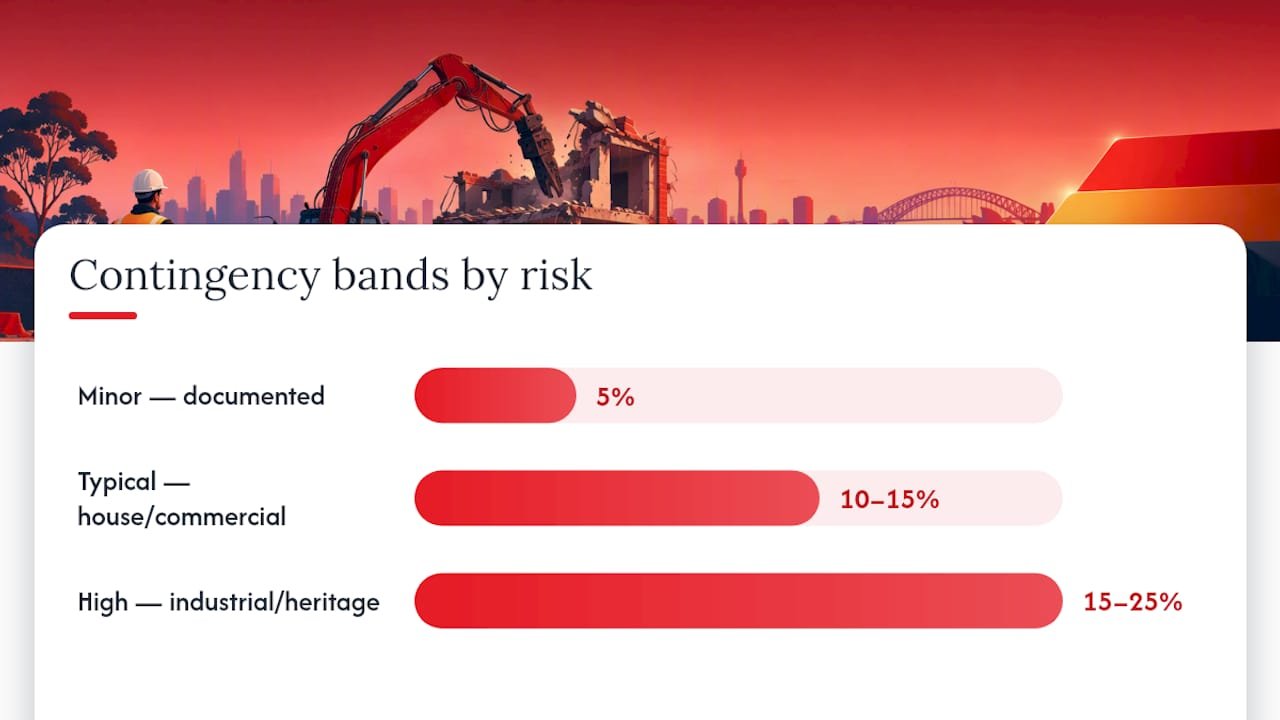
Set your demolition contingency as a risk-adjusted allowance, not a flat guess: roughly 5% for straightforward, well-surveyed jobs, 10 to 15% for typical demolitions, and 15 to 25% or more where hazardous materials, buried structures or access constraints are unknown. Commission a hazardous materials survey before you price the job. It is the single biggest lever for shrinking that range. The sections below walk through the method, the main cost drivers and how to manage the fund once work starts.
TL;DR:
- A hazardous materials survey is essential before pricing demolition, as it can significantly reduce the contingency range for unknown risks.
- Using a risk register with expected monetary values provides a clearer and more defendable basis for contingency than applying flat percentage allowances.
- The typical contingency percentage is 10 to 15% for standard demolitions with some known conditions, but it can rise to 25% or more for sites with significant unknowns or hazards.
- Proper site investigation, testing, and early risk assessment can prevent common cost overruns caused by hazardous materials, buried structures, and utility delays.
- Managing contingency proactively involves contractual clarity, regular reporting, and thorough documentation to prevent it from becoming untracked or misused.
Table of Contents
- What percentage should I budget, and why
- Risk-based contingency methodology: turning risks into dollar allowances
- Primary cost drivers that consume contingency in demolition projects
- How to document, track and approve contingency use during the project
- How to present and defend your contingency to stakeholders
- Publisher expertise: practical ways Mission Demolition reduces contingency use
- Practical pitfalls and a short checklist from a project manager
- How Mission Demolition can help with contingency risk reduction
- Sources
- FAQ
What percentage should I budget, and why
The percentage you choose should reflect what you actually know about the site, not habit. A 5% allowance suits minor, well-documented works: a single detached garage with a clean title search and a completed hazardous materials survey, for instance. A typical house or light commercial demolition, where some unknowns remain around slab thickness, buried services or partial asbestos content, usually sits in the 10 to 15% band. Sites with genuine uncertainty, old industrial buildings, properties with no as-built drawings, or sites near heritage overlays, warrant 15 to 25% or higher.
Flat percentages have a weakness: they treat a well-surveyed job and a blind one the same way. A better practice, used across the wider construction sector, is to price provisional sums or PC sums for specific uncertain items rather than folding everything into one number. If you do not know the extent of subsurface contamination, price a provisional quantity for testing and remediation rather than guessing at a percentage and hoping it covers the item.
A few short examples show how this plays out:
- A single-storey house demolition with a completed asbestos survey and known services: 8 to 10% covers minor surprises like an unrecorded stormwater connection.
- A 1970s commercial building with partial documentation: 15% plus a specific provisional sum for suspected bonded asbestos in wall sheeting.
- An industrial site with unknown underground tanks and no geotechnical history: 20% or higher, with a separate provisional sum for tank decommissioning if one is found.
Industry advisory guidance backs this shift away from static numbers: contingency is better managed through active risk assessment than a fixed percentage, because a documented risk basis is easier to defend to a client or a board than “we always use 15%,” according to RLB Rider Digest guidance. The percentage is a starting point, not the method itself.
Risk-based contingency methodology: turning risks into dollar allowances
A percentage is a shortcut. A risk register is the actual calculation, and it holds up far better under scrutiny. The process has three steps.
- Itemise the risks. List every plausible unknown specific to the site: suspected hazardous materials, buried tanks or footings, service disconnection delays, access restrictions, and third-party approval timing.
- Estimate likelihood and impact. For each risk, assign a rough probability and a dollar impact if it occurs, then multiply them to get an expected monetary value (EMV). A risk with a 30% chance of costing $40,000 carries an EMV of $12,000.
- Sum the EMVs and set governance thresholds. Add the EMVs together to build your contingency figure, then define who can approve a drawdown against it: a site supervisor for small amounts, a project manager for mid-range figures, and the client or director for anything above an agreed ceiling.
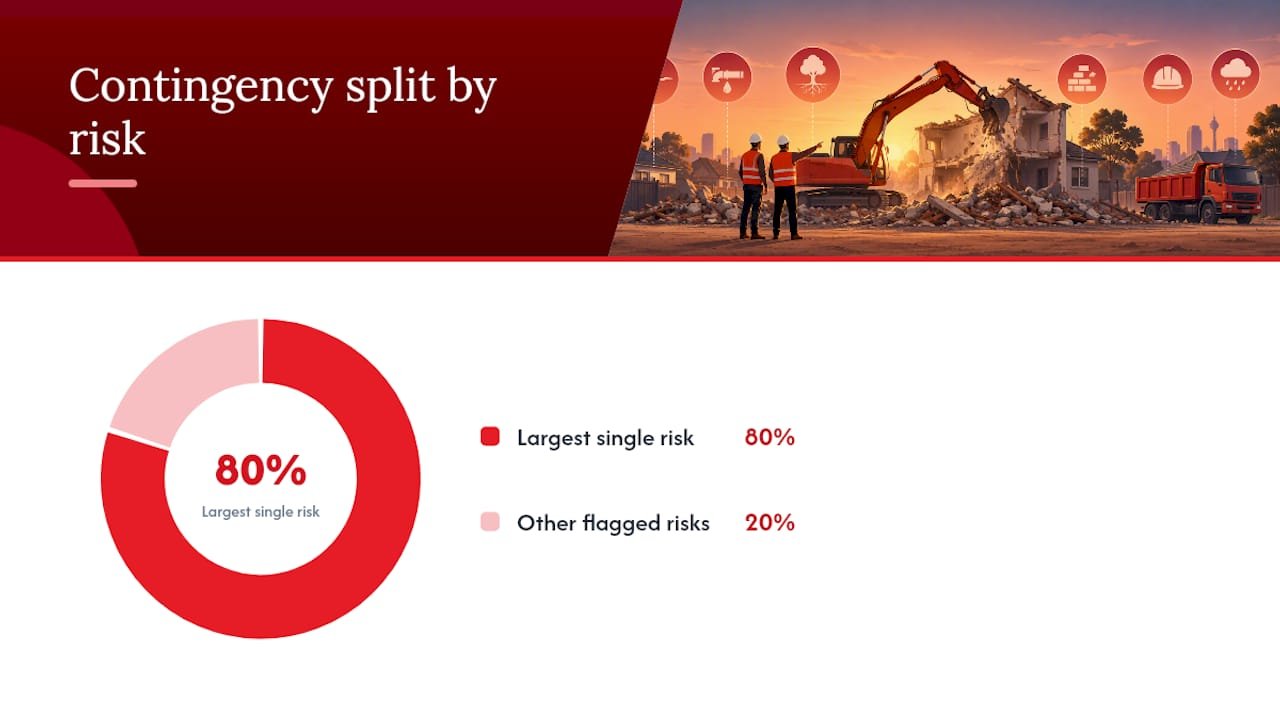
A short worked example: say a demolition has three flagged risks. Summed, those three risks alone justify a $15,000 contingency allowance before any general percentage buffer is added.
Pro Tip: Keep the risk register alive after award, not just at tender. Update probabilities as surveys and site cuts confirm or rule out each item, and release the associated EMV back to the project once a risk is closed.
This approach lines up with what pre-demolition hazardous materials assessments show in practice: survey findings can swing project costs by an order of magnitude, so the biggest single risk on most sites deserves the most rigorous EMV, not a rough guess folded into an overall percentage.
Primary cost drivers that consume contingency in demolition projects
Most contingency blowouts trace back to a small number of repeat offenders, and nearly all of them are things a proper site investigation would have flagged.
- Hazardous materials. Asbestos surveys, licensed removal, air monitoring and clearance certificates are the single largest source of demolition cost variation, and the reason a pre-tender survey matters more than almost any other line item.
- Waste classification and disposal. Landfill levies and gate fees vary by waste classification and jurisdiction, and getting the classification wrong after the fact is expensive; early sampling turns the largest cost variable into a known figure rather than a guess, as industry guidance on demolition waste points out.
- Unknown buried structures. Old fuel tanks, disused pits, redundant footings and the backfill and compaction work that follows their removal routinely appear on sites with no as-built records.
- Utility disconnections and third-party timing. Waiting on a utility provider to disconnect power, gas or water can stall a program by weeks, and temporary works or traffic management plans often need revising once real site conditions are confirmed.
The pattern across all four is the same: uncertainty at tender becomes cost during construction. A site that has been sampled, tested and mapped before pricing needs far less contingency than one priced from drawings alone, which is why understanding demolition scope and site investigation requirements before tender close is worth the time it takes.
How to document, track and approve contingency use during the project
Contingency only works as a risk tool if it is managed with the same discipline as the rest of the budget.
- Decide where contingency sits contractually. Owner-held contingency gives the client control over release and keeps unused funds with them; contractor-held contingency gives the contractor flexibility but less client visibility. Clarify this in the contract before work starts.
- Set a reporting cadence. Weekly or fortnightly reporting against the risk register works for most demolition programs, with each drawdown supported by evidence: invoices, weighbridge dockets for waste classification, or asbestos clearance certificates for remediation work.
- Use a simple approval matrix. A site supervisor might approve drawdowns under $2,000, a project manager up to $15,000, and anything above that needs client sign-off. Keep the thresholds in the contract, not just in someone’s head.
- Reconcile at completion. Unused contingency should revert to the party that funded it, and the final reconciliation should show every drawdown against its original risk line, closing the loop the register opened at tender.
This mirrors general guidance on contingency allowance management, where clear contractual rules and periodic reviews are recommended specifically to stop contingency turning into an open cheque book. For time-critical projects like warehouse strip-outs, aligning this reporting cadence with your clearance and SWMS documentation timeline keeps approvals from becoming the bottleneck.
How to present and defend your contingency to stakeholders
A contingency figure without a story behind it invites pushback. Frame it as a de-risking allowance built from named, probability-weighted risks, not as padding on top of the estimate.
- Open with a one-page summary showing the top five risks, their EMVs and the total contingency they justify.
- Include a simple bar chart comparing EMV by risk category and a run chart tracking drawdown against the register over time.
- Address the most common objection, “why so high,” by pointing directly at the specific unknowns driving the figure rather than defending the percentage in the abstract.
- Back the case with external references where useful: a completed hazardous materials survey, a demolition work plan prepared under relevant Victorian guidance, or comparable project data.
Asbestos removal projects can run into significant cost territory when surveys are skipped or delayed, and documented case studies of asbestos removal projects show that early registers and management plans consistently avoid the worst overruns. That single data point does more to justify a contingency line than any amount of percentage debate.
Publisher expertise: practical ways Mission Demolition reduces contingency use
A best practice approach centres on removing unknowns before they become cost blowouts. Licensed asbestos surveys and in-house project management help ensure hazardous materials, service locations and waste volumes are identified before work starts rather than discovered mid-demolition.
Established waste classification practices and recycling and recovery pathways keep disposal costs predictable, since materials are sorted and directed to the right destination from the outset rather than reclassified on site. Combined with appropriate licensing and insurance across asbestos removal and demolition work, this operational discipline helps narrow the gap between the contingency you budget and the contingency you actually need.
Practical pitfalls and a short checklist from a project manager
The three traps that eat contingency fastest: pricing off drawings without a site walk, skipping the hazardous materials survey to save time at tender, and treating contingency as a slush fund instead of a tracked register. At tender, insist on a survey and a risk register. At award, lock in your approval matrix before the first drawdown request lands. The one habit worth building: review the register weekly, not just when something goes wrong.
— Tarek
How Mission Demolition can help with contingency risk reduction
Reducing contingency starts before demolition, with a proper site read. Mission Demolition’s asbestos inspection and testing identifies hazardous materials ahead of tender, and full project management, covering approvals, utility disconnections and site clearance, closes off many of the unknowns that otherwise inflate a contingency figure.
If you are pricing a demolition and want a tailored risk assessment rather than a flat percentage guess, get in touch through Mission Demolition with your site address, any existing drawings or title searches, and details of the building’s age and prior use. Whatever contractor you engage, ask for their asbestos licence, clearance certificates and waste disposal receipts before work starts, and check what credentials and evidence a demolition contractor should provide.
Sources
Readers wanting to check the detail behind this guidance can look to the WorkSafe Victoria demolition compliance code for principal contractor duties and demolition work plan requirements, and the Asbestos Safety and Eradication Agency’s case studies for real project outcomes tied to early surveys. For a deeper look at why surveys matter commercially, see why asbestos inspection before demolition matters.
FAQ
How much should you budget for contingency?
The right figure comes from summing expected costs across a specific risk register, not from picking a single default percentage.
How do you estimate the cost of demolition?
Demolition costs are estimated by combining known scope items, structure size, materials and access, with dollar allowances for identified risks such as hazardous materials, unknown buried items and waste disposal by classification. A pre-tender hazardous materials survey is one of the most effective ways to convert a rough estimate into a defensible one, since survey findings can shift project costs by an order of magnitude.
What does a 10% contingency mean?
It suits demolitions with reasonable documentation and a completed hazardous materials survey, sitting toward the lower end of the typical range for demolition work.
How many percent should be the contingency fund?
There is no single fixed figure: guidance from sources like AIA’s contingency management resource notes that owners, contractors and designers may hold different contingencies depending on delivery method and project risk.
