Demolition site recycling means separating a building’s materials as they come down, so concrete, brick, metal and timber go to processors instead of landfill, and hazardous material such as asbestos is handled by licensed people before anything else. Done well, it cuts disposal costs, keeps the job compliant and gives you paperwork you can stand behind. This guide covers what can be recovered, how to sort it, what happens next, and where asbestos changes the plan.
TL;DR
- Concrete, brick, metal and clean timber are the main recoverable streams on most demolition sites. Crushed masonry becomes road base, aggregate and drainage material.
- Separate materials at the source. Clean, single-material loads are worth more and cost less to process than mixed skips.
- Identify asbestos before demolition starts. Friable asbestos, or more than 10 square metres of bonded asbestos, needs a licensed removalist.
- Ask for verified disposal pathways. Receipts and tracking records show where waste actually went.
- Plan the waste stream before the excavator arrives, not after the first skip is full.
Table of Contents
- Why demolition waste is worth planning properly
- What comes out of a demolition, and what can be recovered
- How to sort materials on a demolition site
- Asbestos: the stream that must never be mixed in
- What happens to materials after they leave the site
- Recovery rates: what the numbers say and what they hide
- Rules differ by state and council
- A planning checklist before demolition
- Our perspective
- Demolition and waste handling with Mission Demolition
- FAQ
- Sources
Why demolition waste is worth planning properly
Construction and demolition (C&D) waste is the largest waste stream in the country. A NSW planning document puts it at around 39% of Australia’s total national waste output. The National Waste Report 2022 recorded 29.0 million tonnes coming from the C&D stream in a single year.
For a property owner or builder, that scale matters for three practical reasons:
- Cost. Every tonne sent to landfill carries a gate fee and, in most states, a waste levy. A tonne of clean concrete sent to a recycler usually costs far less.
- Compliance. Principal contractors carry the legal and financial risk if waste ends up somewhere unlawful. A documented plan is described by one Australian safety consultancy as a core necessity for managing regulatory, legal and financial risk.
- Reputation and approvals. Councils and consent authorities increasingly ask for a waste management plan before approving a demolition or development application.
What comes out of a demolition, and what can be recovered
A typical house or small commercial building breaks down into a handful of streams. Some are very easy to recover. Others need care.
| Material | Typical recovery route | Notes |
|---|---|---|
| Concrete (slabs, footings, driveways) | Crushed to recycled aggregate, road base, drainage fill | Highest-volume stream. Keep free of rebar, timber and soil where possible. |
| Brick and masonry | Crushed for fill and base, or cleaned for reuse | Whole bricks with sound mortar removal can be resold. |
| Steel and other metals | Scrap metal recyclers | Sort ferrous from non-ferrous as it comes down. |
| Timber | Reuse, mulch, or biomass, depending on treatment | Painted or treated timber needs separate handling. |
| Glass, windows, fixtures | Reuse where intact, otherwise glass recycling | Salvage before demolition, not after. |
| Roof tiles | Crushed with masonry or reused | Terracotta tiles are often reusable. |
| Plasterboard | Specialist plasterboard recyclers where available | Keep dry and away from other waste. |
| Soil | Reuse or classified disposal | Needs classification if contamination is possible. |
| Asbestos-containing material | Licensed removal and disposal at an approved facility | Never part of a recycling stream. |
Concrete and brick do most of the heavy lifting. Once crushed they become the base layers under roads, car parks and new slabs, which is why a demolition with a lot of masonry can reach a very high recovery rate. Recycling processors describe this as a full lifecycle approach: debris becomes construction material, which extends the life of natural resource quarries.
How to sort materials on a demolition site
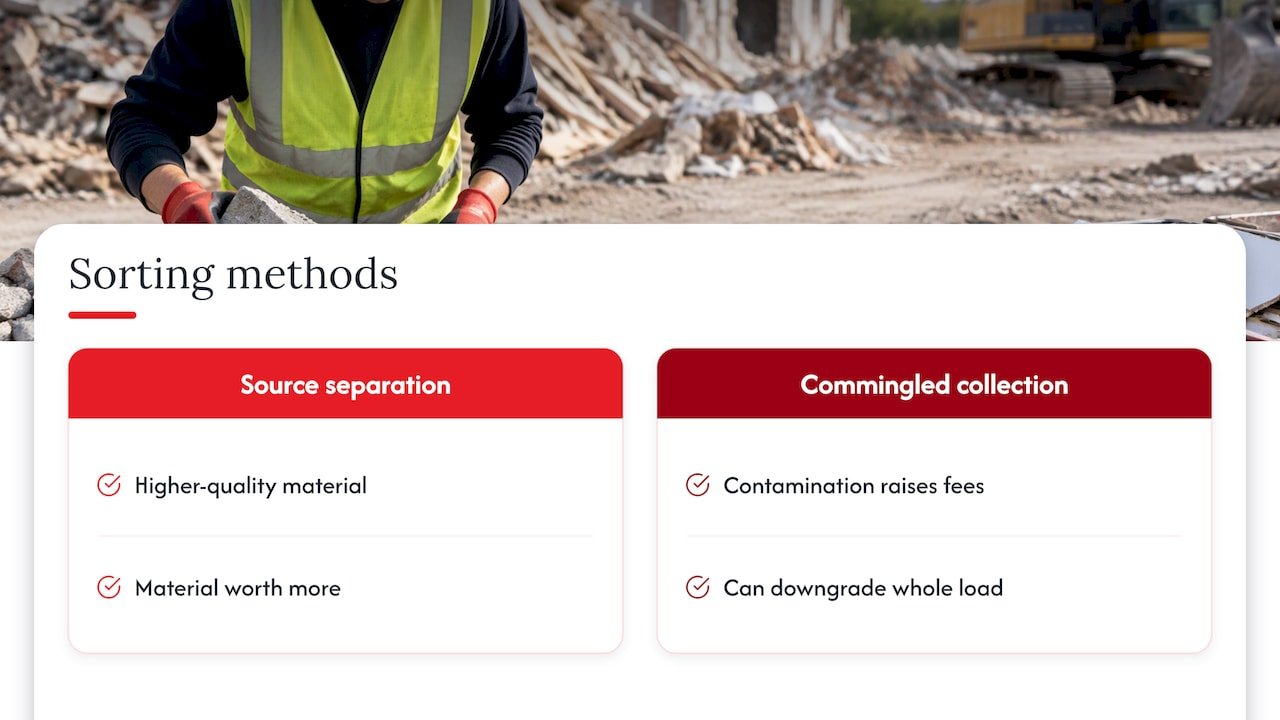
The single most useful habit in demolition recycling is source separation: putting materials into separate containers or stockpiles at the point where they are removed. A professional guide to recycling C&D waste explains that separating materials at the source produces higher-quality material worth more than commingled collection. The same guide’s logic explains why: contamination raises processing fees and can downgrade a whole load.
A practical sorting sequence
- Walk the building first. List what is salvageable (doors, fittings, hardwood, roof tiles, fixtures) and what is hazardous. Anything salvageable comes out before the machines start.
- Remove hazardous material. Asbestos, lead paint, fluorescent tubes, refrigerants and fuel or chemical residues go first, under the right licences.
- Strip out the interior. Plasterboard, carpet, insulation, cabling and fittings come out by hand and are sorted into their own bins.
- Take down the structure in streams. Timber framing, roofing metal and brickwork are separated as the structure comes apart, not scooped up together.
- Break up slabs last. Concrete is processed on site or loaded out for crushing once the rest is gone, with reinforcing steel pulled and sent to scrap.
- Keep records. Weigh dockets and receipts from each facility are your evidence of where each stream went.
Setting up the site
Space is usually the limit, especially on tight Sydney residential blocks. A few things help:
- Label every bin clearly with the material and what is not allowed in it.
- Place bins where trucks can reach them without crossing stockpiles.
- Keep concrete and brick stockpiles away from drains and boundaries, and manage dust and runoff.
- Brief every subcontractor on the bin system on day one. Most contamination comes from a trade who did not know the rules.
On larger jobs, digital site records help. A guide to construction site waste reduction shows how photo logs and shared records keep sorting rules visible to everyone on the job.
Asbestos: the stream that must never be mixed in
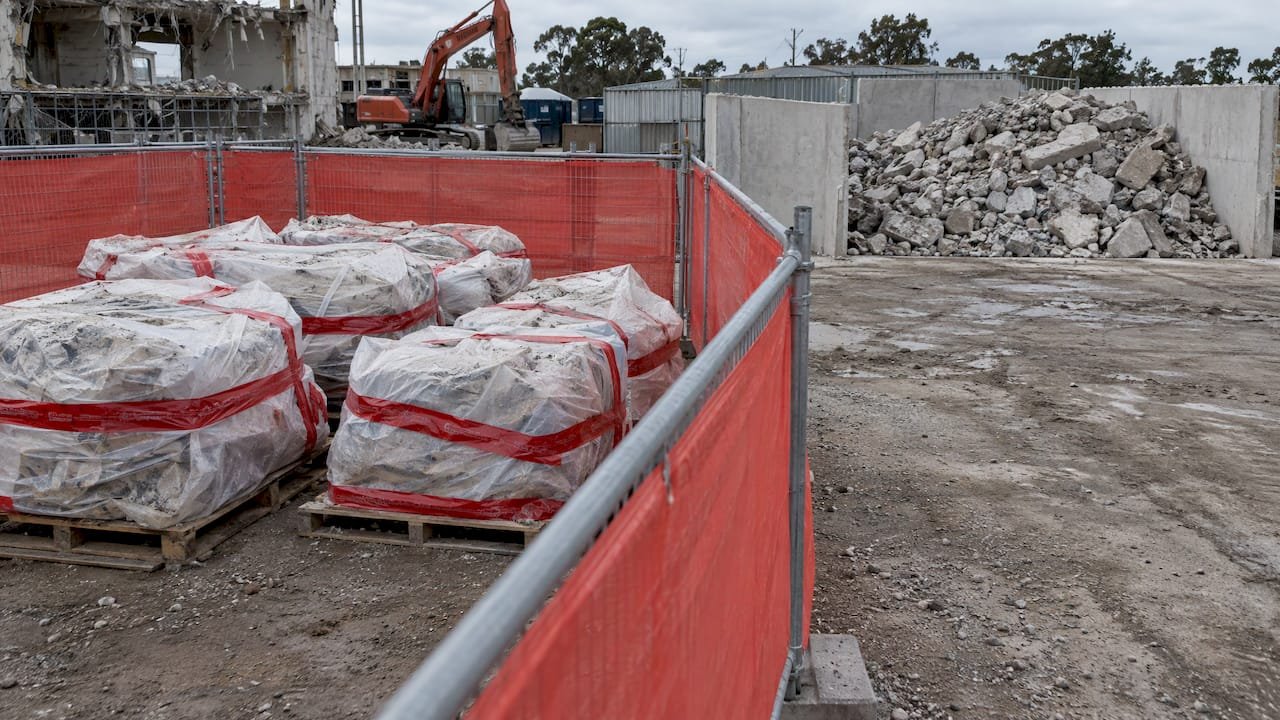
In buildings built before the late 1980s, asbestos can sit in roofing, eaves, wall sheeting, flooring, vinyl backing, fences and old garages. It turns a recycling job into a regulated one, because a single contaminated load can make an entire pile of crushed concrete or timber unrecyclable.
The national model code of practice sets out the baseline. Under Safe Work Australia’s guidance on managing asbestos in the workplace:
- the asbestos register must be checked before demolition begins;
- friable asbestos, or bonded asbestos covering more than 10 square metres, must be removed by a licensed asbestos removalist;
- waste must be sealed in heavy-duty plastic or suitable containers and taken to a facility licensed to receive it.
In NSW, the EPA’s construction and demolition waste management toolkit adds that asbestos waste should be classified on site under the EPA Waste Classification Guidelines. It also notes that SafeWork NSW may require written notification of removal work, and that a clearance certificate may be needed before a space is reoccupied. Keep the classification report, sampling results, site checks and the notification copy in your project file.
If you want detail on the NSW process, our guides on five days’ notice for NSW removalists, the NSW asbestos removal regulations and the asbestos removal compliance checklist walk through each step. For the order of work, see how to remove asbestos before demolition.
What happens to materials after they leave the site
Recyclable loads go to a processing facility, where they are weighed, inspected, sorted further and processed.
- Concrete and brick are crushed and screened into graded products for road base, drainage layers, backfill and bedding.
- Metals are shredded or baled and sold to smelters.
- Timber is chipped for mulch, landscaping or energy recovery, or reused as structural or feature timber if sound.
- Mixed loads go to sorting lines, which recover some material but at higher cost and lower quality.
- Residual waste goes to landfill, with the levy and gate fee that applies in your state.
The quality of what you send in decides the price you pay. Clean, single-material loads are accepted at lower rates. Contaminated loads can be rejected, or charged at general waste rates.
Recovery rates: what the numbers say and what they hide
Recovery performance varies enormously. Green Industries SA reported a 97.4% metropolitan C&D recovery rate in South Australia for 2022-23, underpinned by state strategies aiming for zero avoidable waste to landfill by 2030. That shows what is achievable where infrastructure, policy and pricing line up.
At the other end, an Australian safety consultancy notes that actual material recovery in the construction sector can be as low as 14%, despite industry claims of 90% diversion. The gap comes down to how recovery is counted and whether disposal pathways are verified.
For your project, three things drive the real rate:
- Source separation. The more material is sorted at the job site, the less contamination and the lower the processing fees.
- Access to processors. Distance to a recycling facility changes cost. A long haul can erase the saving.
- Verification. If you cannot show weigh dockets from a licensed facility, you cannot claim a recovery rate.
Rules differ by state and council
Waste law in Australia is made at state and territory level, and councils add their own requirements through development consent conditions. In NSW, the EPA toolkit referenced above covers classification, tracking and the responsibilities of principal contractors. Councils such as Inner West publish their own demolition and construction waste requirements, which usually mean submitting a waste management plan and keeping dockets.
Before you start:
- Read your development consent or complying development certificate conditions for waste.
- Check your council’s waste requirements for demolition.
- Confirm the state levy and classification rules that apply to each stream.
- Ask your demolition contractor how each stream will be tracked and documented.
For a broader view of the approach, see our guide to sustainable demolition practices on Australian sites and our overview of building demolition in Australia.
A planning checklist before demolition
Use this list when briefing a contractor or preparing a waste management plan:
- Hazardous materials survey and asbestos register reviewed.
- Salvage list prepared (fixtures, timber, tiles, bricks).
- Waste streams identified with a destination for each.
- Bin and stockpile layout agreed, with truck access.
- Licensed removalist engaged for any asbestos covered by the licensing thresholds.
- Weigh dockets and receipts collected for each load.
- Final site clean and clearance documents filed.
Our perspective
Most of the waste problems we see are decided before demolition begins. A site that is surveyed properly, with the asbestos identified, the salvage listed and the streams planned, ends up cheaper and cleaner than one that arrives with a skip and hopes for the best.
We run demolition as a full-service project: approvals, utility disconnections, hazardous waste handling and final site cleaning. That matters for recycling because the order of work is what protects your recyclables. Asbestos comes out first by licensed hands, then the strip-out, then the structure, then the slab. Each step keeps the next stream clean.
Our approach combines modern technology with hands-on experience, and we put strict safety compliance and environmentally responsible waste disposal at the centre of every residential, commercial and industrial job. If you want to know where your materials are going, we think you should be able to see it in the paperwork, and we plan our jobs that way.
Tarek
Demolition and waste handling with Mission Demolition
We handle residential, commercial and industrial demolition, building strip-outs, concrete cutting, site clearance and licensed asbestos removal across Sydney and Australia. That includes the asbestos inspection, the removal, the disposal and the final clean, so your waste plan sits under one project.
If you are preparing a house, commercial or industrial job, talk to us about your demolition project and we will walk you through the sequence for your site.
For specific work, our pages on residential demolition, interior strip-outs, industrial site clearance and asbestos inspection and testing explain how each is run. For the practical side of removal and cartage, read about demolition waste removal in Sydney.
FAQ
What can be recycled on a demolition site?
Concrete, brick, metals, clean timber, glass and many fittings can be recovered. Concrete and brick are the largest streams and are crushed into road base, aggregate and drainage material. Plasterboard and some timber need separate handling. Asbestos is never recycled and must be disposed of through licensed channels.
Do I need a licensed contractor to remove asbestos before demolition?
Yes, in many cases. Under the national model code, friable asbestos or bonded asbestos over 10 square metres must be removed by a licensed asbestos removalist. Check your state regulator for the exact licensing and notification rules, and check the asbestos register before work begins.
Does sorting on site really save money?
It usually does. Source-separated materials are higher quality and worth more, and sorting at the job site reduces contamination and processing fees. Mixed skips are typically charged at higher rates and recover less material.
How do I know my waste was actually recycled?
Ask for weigh dockets and receipts from each licensed facility, and keep them with your waste management plan. Verified pathways are what separate a real recovery rate from a claimed one.
Do waste rules differ between councils?
Yes. State law sets the baseline, and councils add conditions through development consent and their own waste requirements. Read your consent conditions and your council’s demolition waste page before work starts.
Sources
- Warehouse development planning document, NSW Planning Portal
- National Waste Report 2022, DCCEEW
- Construction Waste Management in Australia, HSE Direct
- ResourceCo Wingfield C&D waste recycling
- Recycling Construction and Demolition Wastes: a guide for architects and contractors
- BRCKS: reducing construction material waste
- How to manage and control asbestos in the workplace, Safe Work Australia
- Construction and demolition waste management toolkit, NSW EPA
- Resource Recovery Report 2022-23, Green Industries SA